SUBSCRIBE TO OUR FREE NEWSLETTER
Daily news & progressive opinion—funded by the people, not the corporations—delivered straight to your inbox.
5
#000000
#FFFFFF
To donate by check, phone, or other method, see our More Ways to Give page.
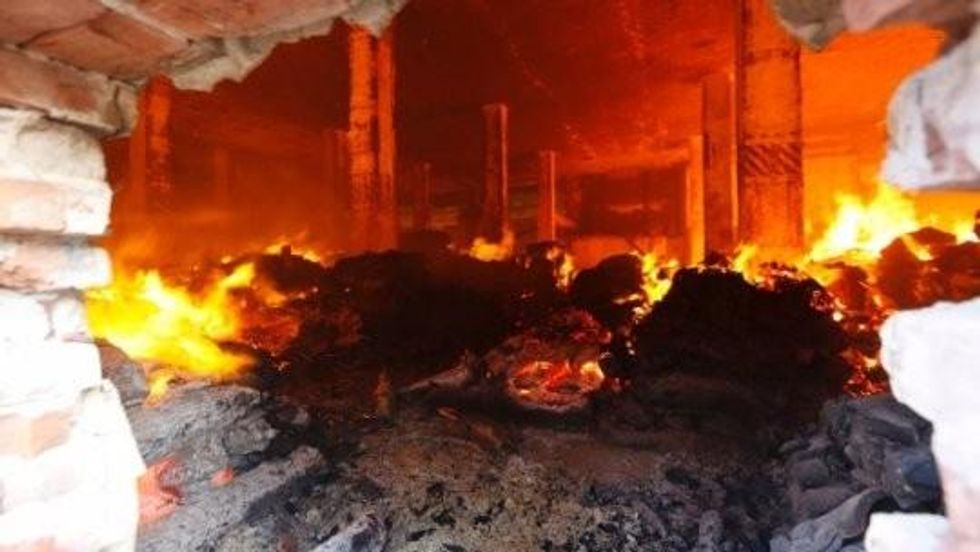
Firefighters were still battling flames on Friday after the 10-story building in the industrial district of Gazipur was set ablaze around midnight on Thursday.
Fifteen trucks carrying garments were also reportedly set ablaze.
"We were the biggest supplier of Gap in Bangladesh," Nur-e-Alam, a senior manager of factory owner Standard Group, told Reuters. "Our cargoes were ready for shipment and all that was burnt up."
News agencies are reporting no injuries at this time.
Local fire official Abu Jafar said the workers had a dispute with the company, the Associated Press reports, while Mosharraf Hossain, a senior officer in the industrial police force, told Agence France-Presse, "We think it's an act of arson committed by workers from both inside the factory complex and outside."
According to Reuters:
Police and witnesses said tempers flared following a mosque loudspeaker announcement of a worker's death after police fired in the air to break up a road blockade by workers who had earlier vandalized the factory and set two buildings on fire.
Police had to fire shots in the air to scatter the workers and let in fire fighters, Mushfiqur Rahman, another manager at Standard Group, told reporters.
The nation's $20-billion industry has come under increasing scrutiny since the Rana Plaza disaster that killed over 1,100 people who toiled for poverty wages. Workers have mobilized on the streets, calling for better wages and working conditions, and an end to the corporate indifference that allows the exploitation of human capital.
Mohammad Atiqul Islam, president of industry body the Bangladesh Garment Manufacturers and Exporters Association, warned that this week's fire meant all 18,000 workers at the factory were at risk of losing their jobs.
But Bangladeshi labor activist Kalpona Akter recently told author and radio host Sonali Kolhatkar, "We need these [factory] jobs. But we want these jobs with dignity... with safe working conditions, decent wages, and a voice in the workplace, and a unionized work place."
_________________
Firefighters were still battling flames on Friday after the 10-story building in the industrial district of Gazipur was set ablaze around midnight on Thursday.
Fifteen trucks carrying garments were also reportedly set ablaze.
"We were the biggest supplier of Gap in Bangladesh," Nur-e-Alam, a senior manager of factory owner Standard Group, told Reuters. "Our cargoes were ready for shipment and all that was burnt up."
News agencies are reporting no injuries at this time.
Local fire official Abu Jafar said the workers had a dispute with the company, the Associated Press reports, while Mosharraf Hossain, a senior officer in the industrial police force, told Agence France-Presse, "We think it's an act of arson committed by workers from both inside the factory complex and outside."
According to Reuters:
Police and witnesses said tempers flared following a mosque loudspeaker announcement of a worker's death after police fired in the air to break up a road blockade by workers who had earlier vandalized the factory and set two buildings on fire.
Police had to fire shots in the air to scatter the workers and let in fire fighters, Mushfiqur Rahman, another manager at Standard Group, told reporters.
The nation's $20-billion industry has come under increasing scrutiny since the Rana Plaza disaster that killed over 1,100 people who toiled for poverty wages. Workers have mobilized on the streets, calling for better wages and working conditions, and an end to the corporate indifference that allows the exploitation of human capital.
Mohammad Atiqul Islam, president of industry body the Bangladesh Garment Manufacturers and Exporters Association, warned that this week's fire meant all 18,000 workers at the factory were at risk of losing their jobs.
But Bangladeshi labor activist Kalpona Akter recently told author and radio host Sonali Kolhatkar, "We need these [factory] jobs. But we want these jobs with dignity... with safe working conditions, decent wages, and a voice in the workplace, and a unionized work place."
_________________
Firefighters were still battling flames on Friday after the 10-story building in the industrial district of Gazipur was set ablaze around midnight on Thursday.
Fifteen trucks carrying garments were also reportedly set ablaze.
"We were the biggest supplier of Gap in Bangladesh," Nur-e-Alam, a senior manager of factory owner Standard Group, told Reuters. "Our cargoes were ready for shipment and all that was burnt up."
News agencies are reporting no injuries at this time.
Local fire official Abu Jafar said the workers had a dispute with the company, the Associated Press reports, while Mosharraf Hossain, a senior officer in the industrial police force, told Agence France-Presse, "We think it's an act of arson committed by workers from both inside the factory complex and outside."
According to Reuters:
Police and witnesses said tempers flared following a mosque loudspeaker announcement of a worker's death after police fired in the air to break up a road blockade by workers who had earlier vandalized the factory and set two buildings on fire.
Police had to fire shots in the air to scatter the workers and let in fire fighters, Mushfiqur Rahman, another manager at Standard Group, told reporters.
The nation's $20-billion industry has come under increasing scrutiny since the Rana Plaza disaster that killed over 1,100 people who toiled for poverty wages. Workers have mobilized on the streets, calling for better wages and working conditions, and an end to the corporate indifference that allows the exploitation of human capital.
Mohammad Atiqul Islam, president of industry body the Bangladesh Garment Manufacturers and Exporters Association, warned that this week's fire meant all 18,000 workers at the factory were at risk of losing their jobs.
But Bangladeshi labor activist Kalpona Akter recently told author and radio host Sonali Kolhatkar, "We need these [factory] jobs. But we want these jobs with dignity... with safe working conditions, decent wages, and a voice in the workplace, and a unionized work place."
_________________