

SUBSCRIBE TO OUR FREE NEWSLETTER
Daily news & progressive opinion—funded by the people, not the corporations—delivered straight to your inbox.
5
#000000
#FFFFFF
To donate by check, phone, or other method, see our More Ways to Give page.
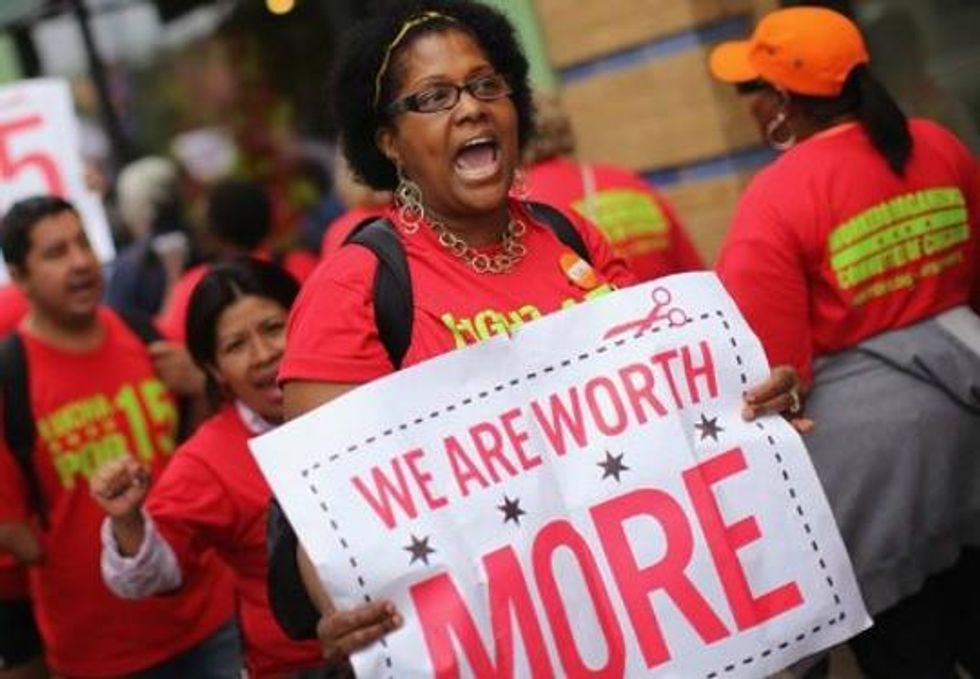
To do so, the group which began the drive, D.C. Working Families, must collect 23,000 signatures in order for the proposal to be included as a referendum on the D.C. ballot next November.
The referendum would also raise the hourly rate for tipped workers to $8.75 and would require the minimum wage to increase as the cost of living rises, in a city known as the epicenter of American wage disparity.
"A widening income and wealth gap has come to be one of the hallmarks of life in the nation's capital," as Naureen Khan at Al Jazeera notes, "driven by both the professionals with college degrees who call the city home, and the low-wage workers who have struggled to find work at all and whose unemployment rate remains disproportionately high."
A recent analysis by the D.C. Fiscal Policy Institute showed that the top fifth of D.C income-earners have an average salary of $253,000 and the lowest fifth with an average of $9,100 per year.
Organizers for Working Families, who have been backed by "a coalition of labor groups, economic justice organizations and faith leaders," as Al Jazeera reports, said they were "extremely disappointed" when Mayor Vincent Gray vetoed a living wage bill earlier this year that would have mandated large-scale retailers in the city to pay workers at least $12.50 an hour.
Walmart had threatened to pull its plans to build five new stores in D.C. if the law, which had been passed by the city council, wasn't vetoed by the Mayor.
"We can't wait no more. We're taking things into our own hands," said Delvone Michael, the new executive director of Working Families at a launch rally in front of the offices of the mayor and the City Council on Tuesday. "So while they're in there figuring, we're going to be out here organizing."
Meanwhile, the D.C. Council could vote as early as December on a bill that would alternatively raise the city's minimum wage to $11.50 an hour over the course of three years, which organizers say is not quite enough to get by in the expensive city.
"The folks that have been elected aren't listening," said John Boardman, executive secretary-treasurer of Unite Here Local 25 at the rally. "They need a clearer message. They need something that tells them exactly what the people want...you can't live at the rates being proposed in this building."
"We are the nation's capital but we are becoming the capital of inequality. We have become a city of the haves and the have-nots," said Rev. George Gilbert Jr., the pastor of Holy Trinity United Baptist Church and the leader of the group D.C. Jobs or Else. "We have become a city that boasts about the amount of new residents who come into the city each month, while the folks who have been here are being thrown away."
Organizers say they are optimistic about the petition drive, citing a new poll by Public Policy Polling (PPP), commissioned by Working Families, that showed 74% of DC voters were in favor of a $12.50 per hour minimum wage.
Similar minimum wage changes did well on the ballot this November. In New Jersey, voters overwhelmingly approved a constitutional amendment to raise the minimum wage to $8.25 an hour and add automatic cost-of-living increases each year.
In the Seattle suburb of SeaTac, Washington voters have likely passed a living wage measure that will boost the minimum wage of over 6,000 workers to $15 an hour--although the final results are still being counted.
As for the national minimum wage, a recent Gallup poll showed 76% of Americans are in favor of an increase from $7.25 to $9 an hour.
_______________________
To do so, the group which began the drive, D.C. Working Families, must collect 23,000 signatures in order for the proposal to be included as a referendum on the D.C. ballot next November.
The referendum would also raise the hourly rate for tipped workers to $8.75 and would require the minimum wage to increase as the cost of living rises, in a city known as the epicenter of American wage disparity.
"A widening income and wealth gap has come to be one of the hallmarks of life in the nation's capital," as Naureen Khan at Al Jazeera notes, "driven by both the professionals with college degrees who call the city home, and the low-wage workers who have struggled to find work at all and whose unemployment rate remains disproportionately high."
A recent analysis by the D.C. Fiscal Policy Institute showed that the top fifth of D.C income-earners have an average salary of $253,000 and the lowest fifth with an average of $9,100 per year.
Organizers for Working Families, who have been backed by "a coalition of labor groups, economic justice organizations and faith leaders," as Al Jazeera reports, said they were "extremely disappointed" when Mayor Vincent Gray vetoed a living wage bill earlier this year that would have mandated large-scale retailers in the city to pay workers at least $12.50 an hour.
Walmart had threatened to pull its plans to build five new stores in D.C. if the law, which had been passed by the city council, wasn't vetoed by the Mayor.
"We can't wait no more. We're taking things into our own hands," said Delvone Michael, the new executive director of Working Families at a launch rally in front of the offices of the mayor and the City Council on Tuesday. "So while they're in there figuring, we're going to be out here organizing."
Meanwhile, the D.C. Council could vote as early as December on a bill that would alternatively raise the city's minimum wage to $11.50 an hour over the course of three years, which organizers say is not quite enough to get by in the expensive city.
"The folks that have been elected aren't listening," said John Boardman, executive secretary-treasurer of Unite Here Local 25 at the rally. "They need a clearer message. They need something that tells them exactly what the people want...you can't live at the rates being proposed in this building."
"We are the nation's capital but we are becoming the capital of inequality. We have become a city of the haves and the have-nots," said Rev. George Gilbert Jr., the pastor of Holy Trinity United Baptist Church and the leader of the group D.C. Jobs or Else. "We have become a city that boasts about the amount of new residents who come into the city each month, while the folks who have been here are being thrown away."
Organizers say they are optimistic about the petition drive, citing a new poll by Public Policy Polling (PPP), commissioned by Working Families, that showed 74% of DC voters were in favor of a $12.50 per hour minimum wage.
Similar minimum wage changes did well on the ballot this November. In New Jersey, voters overwhelmingly approved a constitutional amendment to raise the minimum wage to $8.25 an hour and add automatic cost-of-living increases each year.
In the Seattle suburb of SeaTac, Washington voters have likely passed a living wage measure that will boost the minimum wage of over 6,000 workers to $15 an hour--although the final results are still being counted.
As for the national minimum wage, a recent Gallup poll showed 76% of Americans are in favor of an increase from $7.25 to $9 an hour.
_______________________
To do so, the group which began the drive, D.C. Working Families, must collect 23,000 signatures in order for the proposal to be included as a referendum on the D.C. ballot next November.
The referendum would also raise the hourly rate for tipped workers to $8.75 and would require the minimum wage to increase as the cost of living rises, in a city known as the epicenter of American wage disparity.
"A widening income and wealth gap has come to be one of the hallmarks of life in the nation's capital," as Naureen Khan at Al Jazeera notes, "driven by both the professionals with college degrees who call the city home, and the low-wage workers who have struggled to find work at all and whose unemployment rate remains disproportionately high."
A recent analysis by the D.C. Fiscal Policy Institute showed that the top fifth of D.C income-earners have an average salary of $253,000 and the lowest fifth with an average of $9,100 per year.
Organizers for Working Families, who have been backed by "a coalition of labor groups, economic justice organizations and faith leaders," as Al Jazeera reports, said they were "extremely disappointed" when Mayor Vincent Gray vetoed a living wage bill earlier this year that would have mandated large-scale retailers in the city to pay workers at least $12.50 an hour.
Walmart had threatened to pull its plans to build five new stores in D.C. if the law, which had been passed by the city council, wasn't vetoed by the Mayor.
"We can't wait no more. We're taking things into our own hands," said Delvone Michael, the new executive director of Working Families at a launch rally in front of the offices of the mayor and the City Council on Tuesday. "So while they're in there figuring, we're going to be out here organizing."
Meanwhile, the D.C. Council could vote as early as December on a bill that would alternatively raise the city's minimum wage to $11.50 an hour over the course of three years, which organizers say is not quite enough to get by in the expensive city.
"The folks that have been elected aren't listening," said John Boardman, executive secretary-treasurer of Unite Here Local 25 at the rally. "They need a clearer message. They need something that tells them exactly what the people want...you can't live at the rates being proposed in this building."
"We are the nation's capital but we are becoming the capital of inequality. We have become a city of the haves and the have-nots," said Rev. George Gilbert Jr., the pastor of Holy Trinity United Baptist Church and the leader of the group D.C. Jobs or Else. "We have become a city that boasts about the amount of new residents who come into the city each month, while the folks who have been here are being thrown away."
Organizers say they are optimistic about the petition drive, citing a new poll by Public Policy Polling (PPP), commissioned by Working Families, that showed 74% of DC voters were in favor of a $12.50 per hour minimum wage.
Similar minimum wage changes did well on the ballot this November. In New Jersey, voters overwhelmingly approved a constitutional amendment to raise the minimum wage to $8.25 an hour and add automatic cost-of-living increases each year.
In the Seattle suburb of SeaTac, Washington voters have likely passed a living wage measure that will boost the minimum wage of over 6,000 workers to $15 an hour--although the final results are still being counted.
As for the national minimum wage, a recent Gallup poll showed 76% of Americans are in favor of an increase from $7.25 to $9 an hour.
_______________________

