

SUBSCRIBE TO OUR FREE NEWSLETTER
Daily news & progressive opinion—funded by the people, not the corporations—delivered straight to your inbox.
5
#000000
#FFFFFF
To donate by check, phone, or other method, see our More Ways to Give page.
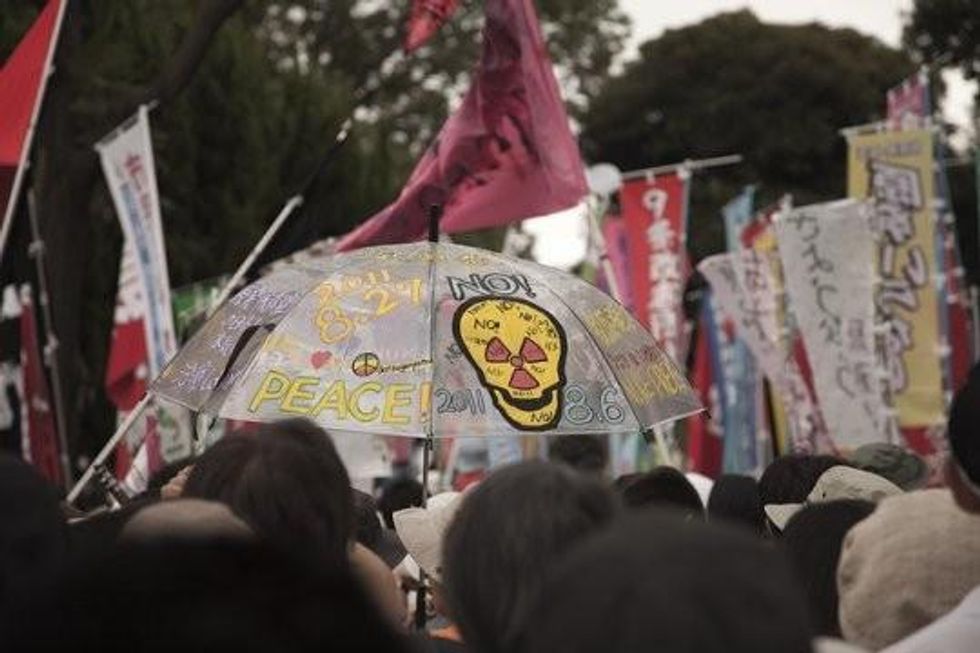
At the demonstration, which was organized by three anti-nuclear power groups, protesters marched past government offices as well as the head office of Fukushima plant operator TEPCO.
"We need to win back a world where our future children can live," said Nobel Prize-winning author Kenzaburo Oe at the rally.
Takanori Teraoka, a Tokyo worker and father, said, "Something that could leave future generations with irreparable damage must not be done."
On September 15, Japan switched off its last nuclear reactor, but many in the country are fearful that--despite the ongoing crisis at Fukushima--some of the nuclear reactors are on track to restart. The Asahi Shimbun reports that
five electric power companies, including TEPCO, have applied to the Nuclear Regulation Authority for safety examinations required for restarting 14 of the 50 nuclear reactors. The administration of Prime Minister Shinzo Abe says it will approve restarts of the reactors that are deemed safe by the NRA.
TEPCO's application is to restart the world's largest nuclear plant.
"If an opportunity to restart the nuclear reactors is given at some point in six months or a year, it will be impossible to push back the momentum to the restarting of the nuclear plants," Oe warned.
A TEPCO official said on Monday that the country has no plans of abandoning nuclear power.
"The Japanese government still considers nuclear as an option for the energy mix. It must not be excluded from the overall energy mix," said TEPCO Vice President Zengo Aizawa while speaking at the World Energy Congress being held in Daegu, South Korea.
"The government has rethought the idea of abandoning nuclear energy," said Aizawa.
* * *
Twitter users documented the action:
_________________
At the demonstration, which was organized by three anti-nuclear power groups, protesters marched past government offices as well as the head office of Fukushima plant operator TEPCO.
"We need to win back a world where our future children can live," said Nobel Prize-winning author Kenzaburo Oe at the rally.
Takanori Teraoka, a Tokyo worker and father, said, "Something that could leave future generations with irreparable damage must not be done."
On September 15, Japan switched off its last nuclear reactor, but many in the country are fearful that--despite the ongoing crisis at Fukushima--some of the nuclear reactors are on track to restart. The Asahi Shimbun reports that
five electric power companies, including TEPCO, have applied to the Nuclear Regulation Authority for safety examinations required for restarting 14 of the 50 nuclear reactors. The administration of Prime Minister Shinzo Abe says it will approve restarts of the reactors that are deemed safe by the NRA.
TEPCO's application is to restart the world's largest nuclear plant.
"If an opportunity to restart the nuclear reactors is given at some point in six months or a year, it will be impossible to push back the momentum to the restarting of the nuclear plants," Oe warned.
A TEPCO official said on Monday that the country has no plans of abandoning nuclear power.
"The Japanese government still considers nuclear as an option for the energy mix. It must not be excluded from the overall energy mix," said TEPCO Vice President Zengo Aizawa while speaking at the World Energy Congress being held in Daegu, South Korea.
"The government has rethought the idea of abandoning nuclear energy," said Aizawa.
* * *
Twitter users documented the action:
_________________
At the demonstration, which was organized by three anti-nuclear power groups, protesters marched past government offices as well as the head office of Fukushima plant operator TEPCO.
"We need to win back a world where our future children can live," said Nobel Prize-winning author Kenzaburo Oe at the rally.
Takanori Teraoka, a Tokyo worker and father, said, "Something that could leave future generations with irreparable damage must not be done."
On September 15, Japan switched off its last nuclear reactor, but many in the country are fearful that--despite the ongoing crisis at Fukushima--some of the nuclear reactors are on track to restart. The Asahi Shimbun reports that
five electric power companies, including TEPCO, have applied to the Nuclear Regulation Authority for safety examinations required for restarting 14 of the 50 nuclear reactors. The administration of Prime Minister Shinzo Abe says it will approve restarts of the reactors that are deemed safe by the NRA.
TEPCO's application is to restart the world's largest nuclear plant.
"If an opportunity to restart the nuclear reactors is given at some point in six months or a year, it will be impossible to push back the momentum to the restarting of the nuclear plants," Oe warned.
A TEPCO official said on Monday that the country has no plans of abandoning nuclear power.
"The Japanese government still considers nuclear as an option for the energy mix. It must not be excluded from the overall energy mix," said TEPCO Vice President Zengo Aizawa while speaking at the World Energy Congress being held in Daegu, South Korea.
"The government has rethought the idea of abandoning nuclear energy," said Aizawa.
* * *
Twitter users documented the action:
_________________

