SUBSCRIBE TO OUR FREE NEWSLETTER
Daily news & progressive opinion—funded by the people, not the corporations—delivered straight to your inbox.
5
#000000
#FFFFFF
To donate by check, phone, or other method, see our More Ways to Give page.
U.S. and Israeli officials are in initial negotiations over a new 10-year military aid package.
As Defense News reports Thursday, the package, which would extend through 2027, is focusing on a "full spectrum of Israeli concerns, including military modernization needs, new threats from regional instability and the erosion of Israel's so-called qualitative military edge (QME) due to U.S. arms sales in the Mideast."
Under the existing $30 billion aid agreement, signed in 2007, the need for Israel to maintain an "edge" over their regional adversaries was not directly accounted for. The updated, more "holistic" approach--according to Michael Oren, Israel's ambassador to the U.S.--will ensure the relative superiority of Israel's arsenal will become codified in the agreement.
Reporting on what they describe as "Washington's decades-long, de facto commitment to Israel's QME," Defense News continues:
Oren mentioned "very large [US] contracts to the Middle East" that "raise the question of armies having capabilities similar to our own and how we make sure we can maintain our QME." Nevertheless, the Israeli envoy said Israel is not raising objections to such sales.
Latest available data by the US Congressional Research Service lists $91.9 billion in new US arms agreements to the Near East from 2008 through 2011.
"We understand that if America doesn't sell these weapons, others will," Oren said. "We also understand the fact that each of these sales contributes to hundreds or thousands of American jobs. And we have an interest in a strong and vital American economy."
Israel is also asking that the new accord account for defensive measures such as the nearly $2 billion spent fortifying its borders with Egypt, Lebanon and Syria.
This news comes as the U.S.'s extensive military aid to neighboring Egypt has come under fire following the Egyptian military's ongoing massacre of supporters of ousted President Mohammed Morsi.
The U.S. provides roughly 1.6 billion dollars, including 1.3 billion dollars in sophisticated weaponry, in annual aid to Egypt.
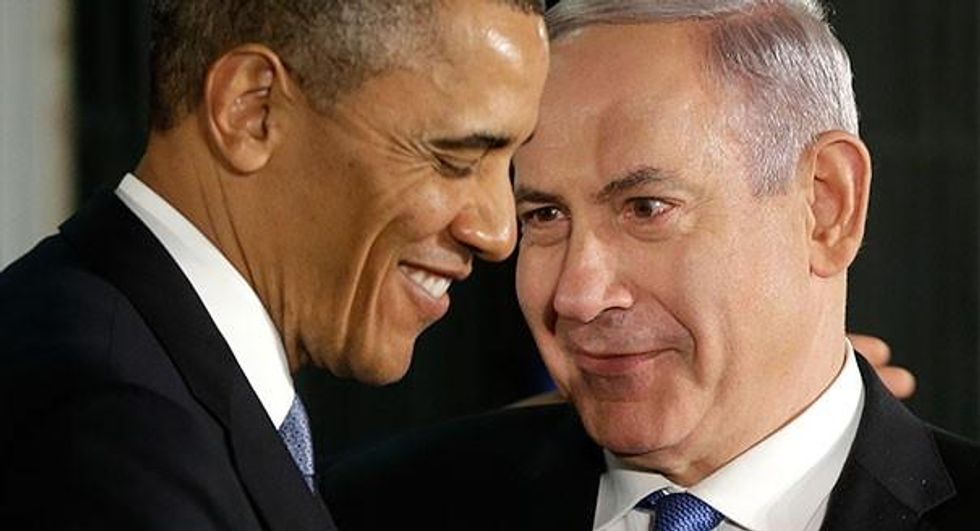
Plans to begin discussions for the new aid package were initially announced during U.S. President Barack Obama's recent trip to Israel. "We've directed our teams to start working on extending it for the years beyond," Obama said in a news conference with Israeli Prime Minister Benjamin Netanyahu.
_____________________
U.S. and Israeli officials are in initial negotiations over a new 10-year military aid package.
As Defense News reports Thursday, the package, which would extend through 2027, is focusing on a "full spectrum of Israeli concerns, including military modernization needs, new threats from regional instability and the erosion of Israel's so-called qualitative military edge (QME) due to U.S. arms sales in the Mideast."
Under the existing $30 billion aid agreement, signed in 2007, the need for Israel to maintain an "edge" over their regional adversaries was not directly accounted for. The updated, more "holistic" approach--according to Michael Oren, Israel's ambassador to the U.S.--will ensure the relative superiority of Israel's arsenal will become codified in the agreement.
Reporting on what they describe as "Washington's decades-long, de facto commitment to Israel's QME," Defense News continues:
Oren mentioned "very large [US] contracts to the Middle East" that "raise the question of armies having capabilities similar to our own and how we make sure we can maintain our QME." Nevertheless, the Israeli envoy said Israel is not raising objections to such sales.
Latest available data by the US Congressional Research Service lists $91.9 billion in new US arms agreements to the Near East from 2008 through 2011.
"We understand that if America doesn't sell these weapons, others will," Oren said. "We also understand the fact that each of these sales contributes to hundreds or thousands of American jobs. And we have an interest in a strong and vital American economy."
Israel is also asking that the new accord account for defensive measures such as the nearly $2 billion spent fortifying its borders with Egypt, Lebanon and Syria.
This news comes as the U.S.'s extensive military aid to neighboring Egypt has come under fire following the Egyptian military's ongoing massacre of supporters of ousted President Mohammed Morsi.
The U.S. provides roughly 1.6 billion dollars, including 1.3 billion dollars in sophisticated weaponry, in annual aid to Egypt.
Plans to begin discussions for the new aid package were initially announced during U.S. President Barack Obama's recent trip to Israel. "We've directed our teams to start working on extending it for the years beyond," Obama said in a news conference with Israeli Prime Minister Benjamin Netanyahu.
_____________________
U.S. and Israeli officials are in initial negotiations over a new 10-year military aid package.
As Defense News reports Thursday, the package, which would extend through 2027, is focusing on a "full spectrum of Israeli concerns, including military modernization needs, new threats from regional instability and the erosion of Israel's so-called qualitative military edge (QME) due to U.S. arms sales in the Mideast."
Under the existing $30 billion aid agreement, signed in 2007, the need for Israel to maintain an "edge" over their regional adversaries was not directly accounted for. The updated, more "holistic" approach--according to Michael Oren, Israel's ambassador to the U.S.--will ensure the relative superiority of Israel's arsenal will become codified in the agreement.
Reporting on what they describe as "Washington's decades-long, de facto commitment to Israel's QME," Defense News continues:
Oren mentioned "very large [US] contracts to the Middle East" that "raise the question of armies having capabilities similar to our own and how we make sure we can maintain our QME." Nevertheless, the Israeli envoy said Israel is not raising objections to such sales.
Latest available data by the US Congressional Research Service lists $91.9 billion in new US arms agreements to the Near East from 2008 through 2011.
"We understand that if America doesn't sell these weapons, others will," Oren said. "We also understand the fact that each of these sales contributes to hundreds or thousands of American jobs. And we have an interest in a strong and vital American economy."
Israel is also asking that the new accord account for defensive measures such as the nearly $2 billion spent fortifying its borders with Egypt, Lebanon and Syria.
This news comes as the U.S.'s extensive military aid to neighboring Egypt has come under fire following the Egyptian military's ongoing massacre of supporters of ousted President Mohammed Morsi.
The U.S. provides roughly 1.6 billion dollars, including 1.3 billion dollars in sophisticated weaponry, in annual aid to Egypt.
Plans to begin discussions for the new aid package were initially announced during U.S. President Barack Obama's recent trip to Israel. "We've directed our teams to start working on extending it for the years beyond," Obama said in a news conference with Israeli Prime Minister Benjamin Netanyahu.
_____________________