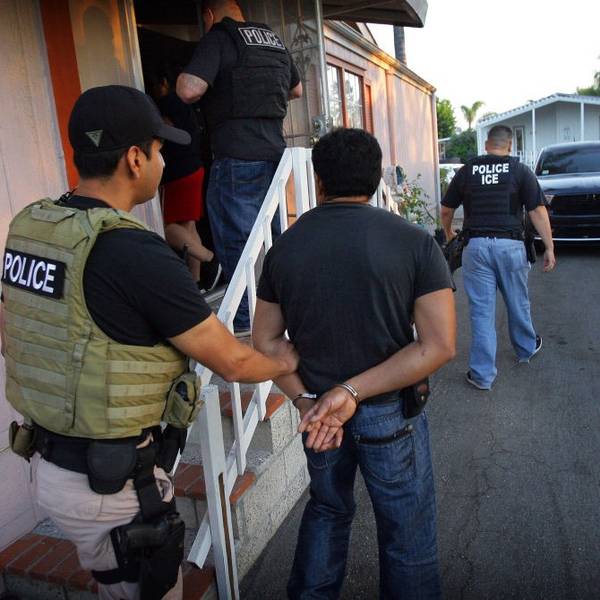

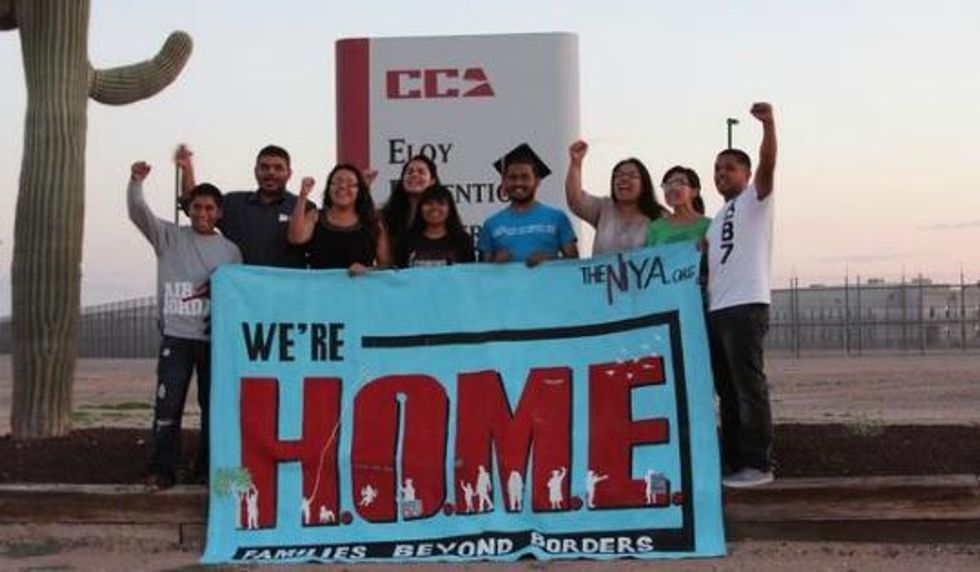
Let out on parole, the demonstrators are being allowed to return to their US homes pending an immigration judge's decision on their asylum claim--a ruling that may take years.
Following their release, the demonstrators were met with a "hero's welcome" when they emerged from a Greyhound bus in Tuscon, Arizona.
Though celebrating their release, many others were prompted to ask what is to become of the millions of others who remain in immigration custody.
"I am good, very excited. It's a big surprise," Maria Peniche, one of the 9 activists, told the Associated Press. "This opens a path for other Dreamers in Mexico."
While in detention, the Dream 9 hoped to draw some of the media's attention to the cruel and often "humiliating" condition of the hundreds of other immigrants being held in US detention centers. Shortly after arriving, six of the protesters were placed in solitary confinement for organizing a hunger strike among the other detainees.
The group was detained after attempting to cross into the United States from Mexico in a demonstration meant to spur immigration reform within a reticent Congress to allow for a path to citizenship and draw attention to the 1.7 million other youths who, because of forcible removal or self-deportation, have been unable to return to their families in the US.
"The Dream 9 have become a rallying point for many youth in the movement who have felt shut out of the cautious political dialogues in Washington," writes human rights columnist Michelle Chen. "By framing immigrant justice as a human rights issue, they challenge mainstream reform groups that selectively tout the merits of the 'good' immigrants who have proven to be 'deserving' through their educational achievement or patriotism. They aim to push the debate beyond the usual Beltway rhetoric of 'earned citizenship' and 'aspiring Americans.'"
Their release followed the Tuesday ruling in which immigration asylum officers found that all 9 had "credible fear of persecution or torture in their birth country" and could therefore not be sent back, said Margo Cowan, the group's attorney.
The 9 protesters--who had been brought to the US illegally as children and theoretically would qualify for a path to citizenship--had been held for over two weeks after staging a defiant protest at the US-Mexico border.
Objecting to "the exclusion of their parents from citizenship," and the "deportation of hundreds of thousands of undocumented people during Barack Obama's administration," the group assembled in Mexico--some having arrived previously, others flew in for the demonstration--and notified authorities about their attempted re-entry at the Nogales border point.
All 9 were arrested, some symbolically donning university gowns and mortar boards.
The actions of the Dream 9 "have upset the delicate politics of the immigration debate," continues Chen.
"But with their iconic graduation caps, standing defiantly at the U.S.-Mexico border crossing, the Dream 9 have also become a new touchstone for the migrant rights movement, especially for the more radical strands of the movement who are less willing to seek legislative "compromise" in the halls of Congress and more focused on advocating for justice."
"I know you're going to think that I'm crazy for doing this," said Dream 9'er Lizabeth Mateo, "but to be honest, I think it's even crazier that I had to wait fifteen years to see my family."
Tweets about "#bringthemhome OR #Dream9"
_____________________
Let out on parole, the demonstrators are being allowed to return to their US homes pending an immigration judge's decision on their asylum claim--a ruling that may take years.
Following their release, the demonstrators were met with a "hero's welcome" when they emerged from a Greyhound bus in Tuscon, Arizona.
Though celebrating their release, many others were prompted to ask what is to become of the millions of others who remain in immigration custody.
"I am good, very excited. It's a big surprise," Maria Peniche, one of the 9 activists, told the Associated Press. "This opens a path for other Dreamers in Mexico."
While in detention, the Dream 9 hoped to draw some of the media's attention to the cruel and often "humiliating" condition of the hundreds of other immigrants being held in US detention centers. Shortly after arriving, six of the protesters were placed in solitary confinement for organizing a hunger strike among the other detainees.
The group was detained after attempting to cross into the United States from Mexico in a demonstration meant to spur immigration reform within a reticent Congress to allow for a path to citizenship and draw attention to the 1.7 million other youths who, because of forcible removal or self-deportation, have been unable to return to their families in the US.
"The Dream 9 have become a rallying point for many youth in the movement who have felt shut out of the cautious political dialogues in Washington," writes human rights columnist Michelle Chen. "By framing immigrant justice as a human rights issue, they challenge mainstream reform groups that selectively tout the merits of the 'good' immigrants who have proven to be 'deserving' through their educational achievement or patriotism. They aim to push the debate beyond the usual Beltway rhetoric of 'earned citizenship' and 'aspiring Americans.'"
Their release followed the Tuesday ruling in which immigration asylum officers found that all 9 had "credible fear of persecution or torture in their birth country" and could therefore not be sent back, said Margo Cowan, the group's attorney.
The 9 protesters--who had been brought to the US illegally as children and theoretically would qualify for a path to citizenship--had been held for over two weeks after staging a defiant protest at the US-Mexico border.
Objecting to "the exclusion of their parents from citizenship," and the "deportation of hundreds of thousands of undocumented people during Barack Obama's administration," the group assembled in Mexico--some having arrived previously, others flew in for the demonstration--and notified authorities about their attempted re-entry at the Nogales border point.
All 9 were arrested, some symbolically donning university gowns and mortar boards.
The actions of the Dream 9 "have upset the delicate politics of the immigration debate," continues Chen.
"But with their iconic graduation caps, standing defiantly at the U.S.-Mexico border crossing, the Dream 9 have also become a new touchstone for the migrant rights movement, especially for the more radical strands of the movement who are less willing to seek legislative "compromise" in the halls of Congress and more focused on advocating for justice."
"I know you're going to think that I'm crazy for doing this," said Dream 9'er Lizabeth Mateo, "but to be honest, I think it's even crazier that I had to wait fifteen years to see my family."
Tweets about "#bringthemhome OR #Dream9"
_____________________
Let out on parole, the demonstrators are being allowed to return to their US homes pending an immigration judge's decision on their asylum claim--a ruling that may take years.
Following their release, the demonstrators were met with a "hero's welcome" when they emerged from a Greyhound bus in Tuscon, Arizona.
Though celebrating their release, many others were prompted to ask what is to become of the millions of others who remain in immigration custody.
"I am good, very excited. It's a big surprise," Maria Peniche, one of the 9 activists, told the Associated Press. "This opens a path for other Dreamers in Mexico."
While in detention, the Dream 9 hoped to draw some of the media's attention to the cruel and often "humiliating" condition of the hundreds of other immigrants being held in US detention centers. Shortly after arriving, six of the protesters were placed in solitary confinement for organizing a hunger strike among the other detainees.
The group was detained after attempting to cross into the United States from Mexico in a demonstration meant to spur immigration reform within a reticent Congress to allow for a path to citizenship and draw attention to the 1.7 million other youths who, because of forcible removal or self-deportation, have been unable to return to their families in the US.
"The Dream 9 have become a rallying point for many youth in the movement who have felt shut out of the cautious political dialogues in Washington," writes human rights columnist Michelle Chen. "By framing immigrant justice as a human rights issue, they challenge mainstream reform groups that selectively tout the merits of the 'good' immigrants who have proven to be 'deserving' through their educational achievement or patriotism. They aim to push the debate beyond the usual Beltway rhetoric of 'earned citizenship' and 'aspiring Americans.'"
Their release followed the Tuesday ruling in which immigration asylum officers found that all 9 had "credible fear of persecution or torture in their birth country" and could therefore not be sent back, said Margo Cowan, the group's attorney.
The 9 protesters--who had been brought to the US illegally as children and theoretically would qualify for a path to citizenship--had been held for over two weeks after staging a defiant protest at the US-Mexico border.
Objecting to "the exclusion of their parents from citizenship," and the "deportation of hundreds of thousands of undocumented people during Barack Obama's administration," the group assembled in Mexico--some having arrived previously, others flew in for the demonstration--and notified authorities about their attempted re-entry at the Nogales border point.
All 9 were arrested, some symbolically donning university gowns and mortar boards.
The actions of the Dream 9 "have upset the delicate politics of the immigration debate," continues Chen.
"But with their iconic graduation caps, standing defiantly at the U.S.-Mexico border crossing, the Dream 9 have also become a new touchstone for the migrant rights movement, especially for the more radical strands of the movement who are less willing to seek legislative "compromise" in the halls of Congress and more focused on advocating for justice."
"I know you're going to think that I'm crazy for doing this," said Dream 9'er Lizabeth Mateo, "but to be honest, I think it's even crazier that I had to wait fifteen years to see my family."
Tweets about "#bringthemhome OR #Dream9"
_____________________