

SUBSCRIBE TO OUR FREE NEWSLETTER
Daily news & progressive opinion—funded by the people, not the corporations—delivered straight to your inbox.
5
#000000
#FFFFFF
To donate by check, phone, or other method, see our More Ways to Give page.
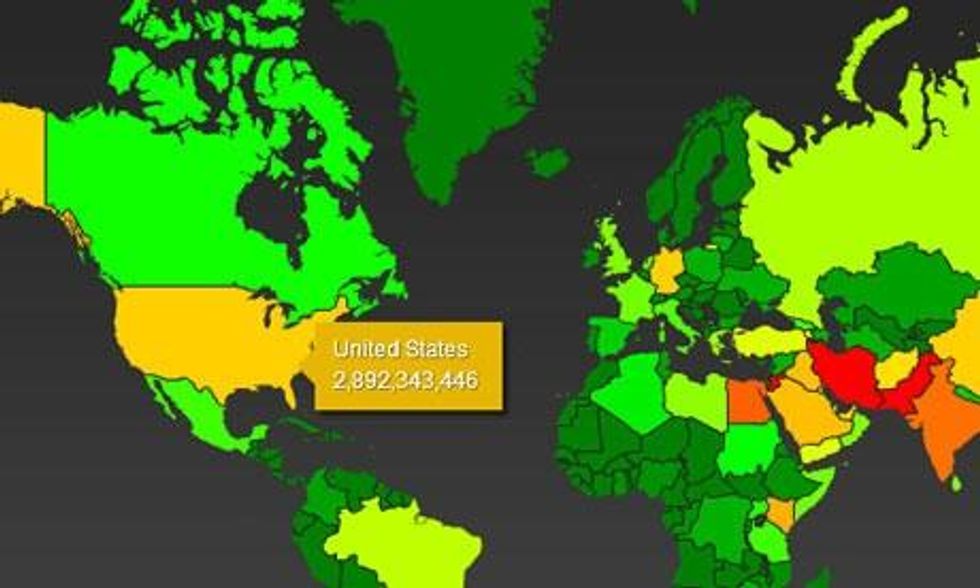
According to documents viewed by the news outlet, the program called Boundless Informant uses an individual computer's IP Address to categorize by location government surveillance intercepts and filed reports of 'metadata,' which includes the identities of the sender and recipient, and the time, date, duration and location of a communication.
With 14 billion reports, Iran was the country where the largest amount of intelligence was gathered followed by 13.5 billion from Pakistan. One of America's closest Arab allies, Jordan, came third with 12.7 billion. Egypt was fourth with 7.6 billion and India fifth with 6.3 billion.
As journalist Glenn Greenwald, who is one of the reporters behind the disclosure, said Thursday on CNN's Piers Morgan, "the entire world is impacted."
According to the Guardian report:
An NSA factsheet about the program, acquired by the Guardian, says: "The tool allows users to select a country on a map and view the metadata volume and select details about the collections against that country."
Under the heading "Sample use cases", the factsheet also states the tool shows information including: "How many records (and what type) are collected against a particular country."
A snapshot of the Boundless Informant data, contained in a top secret NSA "global heat map" seen by the Guardian, shows that in March 2013 the agency collected 97bn pieces of intelligence from computer networks worldwide.
The disclosed map--in addition to other documents seen by the Guardian--contradicts earlier government assertions made to Congress that the NSA was unable to provide statistics on the amount of data being collected on American citizens, as the authors assert that "the NSA does in fact break down its surveillance intercepts which could allow the agency to determine how many of them are from the US."
Despite this, NSA spokeswoman Judith Emmel told the Guardian in a response to the latest disclosures: "NSA has consistently reported - including to Congress - that we do not have the ability to determine with certainty the identity or location of all communicants within a given communication. That remains the case."
_____________________
According to documents viewed by the news outlet, the program called Boundless Informant uses an individual computer's IP Address to categorize by location government surveillance intercepts and filed reports of 'metadata,' which includes the identities of the sender and recipient, and the time, date, duration and location of a communication.
With 14 billion reports, Iran was the country where the largest amount of intelligence was gathered followed by 13.5 billion from Pakistan. One of America's closest Arab allies, Jordan, came third with 12.7 billion. Egypt was fourth with 7.6 billion and India fifth with 6.3 billion.
As journalist Glenn Greenwald, who is one of the reporters behind the disclosure, said Thursday on CNN's Piers Morgan, "the entire world is impacted."
According to the Guardian report:
An NSA factsheet about the program, acquired by the Guardian, says: "The tool allows users to select a country on a map and view the metadata volume and select details about the collections against that country."
Under the heading "Sample use cases", the factsheet also states the tool shows information including: "How many records (and what type) are collected against a particular country."
A snapshot of the Boundless Informant data, contained in a top secret NSA "global heat map" seen by the Guardian, shows that in March 2013 the agency collected 97bn pieces of intelligence from computer networks worldwide.
The disclosed map--in addition to other documents seen by the Guardian--contradicts earlier government assertions made to Congress that the NSA was unable to provide statistics on the amount of data being collected on American citizens, as the authors assert that "the NSA does in fact break down its surveillance intercepts which could allow the agency to determine how many of them are from the US."
Despite this, NSA spokeswoman Judith Emmel told the Guardian in a response to the latest disclosures: "NSA has consistently reported - including to Congress - that we do not have the ability to determine with certainty the identity or location of all communicants within a given communication. That remains the case."
_____________________
According to documents viewed by the news outlet, the program called Boundless Informant uses an individual computer's IP Address to categorize by location government surveillance intercepts and filed reports of 'metadata,' which includes the identities of the sender and recipient, and the time, date, duration and location of a communication.
With 14 billion reports, Iran was the country where the largest amount of intelligence was gathered followed by 13.5 billion from Pakistan. One of America's closest Arab allies, Jordan, came third with 12.7 billion. Egypt was fourth with 7.6 billion and India fifth with 6.3 billion.
As journalist Glenn Greenwald, who is one of the reporters behind the disclosure, said Thursday on CNN's Piers Morgan, "the entire world is impacted."
According to the Guardian report:
An NSA factsheet about the program, acquired by the Guardian, says: "The tool allows users to select a country on a map and view the metadata volume and select details about the collections against that country."
Under the heading "Sample use cases", the factsheet also states the tool shows information including: "How many records (and what type) are collected against a particular country."
A snapshot of the Boundless Informant data, contained in a top secret NSA "global heat map" seen by the Guardian, shows that in March 2013 the agency collected 97bn pieces of intelligence from computer networks worldwide.
The disclosed map--in addition to other documents seen by the Guardian--contradicts earlier government assertions made to Congress that the NSA was unable to provide statistics on the amount of data being collected on American citizens, as the authors assert that "the NSA does in fact break down its surveillance intercepts which could allow the agency to determine how many of them are from the US."
Despite this, NSA spokeswoman Judith Emmel told the Guardian in a response to the latest disclosures: "NSA has consistently reported - including to Congress - that we do not have the ability to determine with certainty the identity or location of all communicants within a given communication. That remains the case."
_____________________

