

SUBSCRIBE TO OUR FREE NEWSLETTER
Daily news & progressive opinion—funded by the people, not the corporations—delivered straight to your inbox.
5
#000000
#FFFFFF
To donate by check, phone, or other method, see our More Ways to Give page.
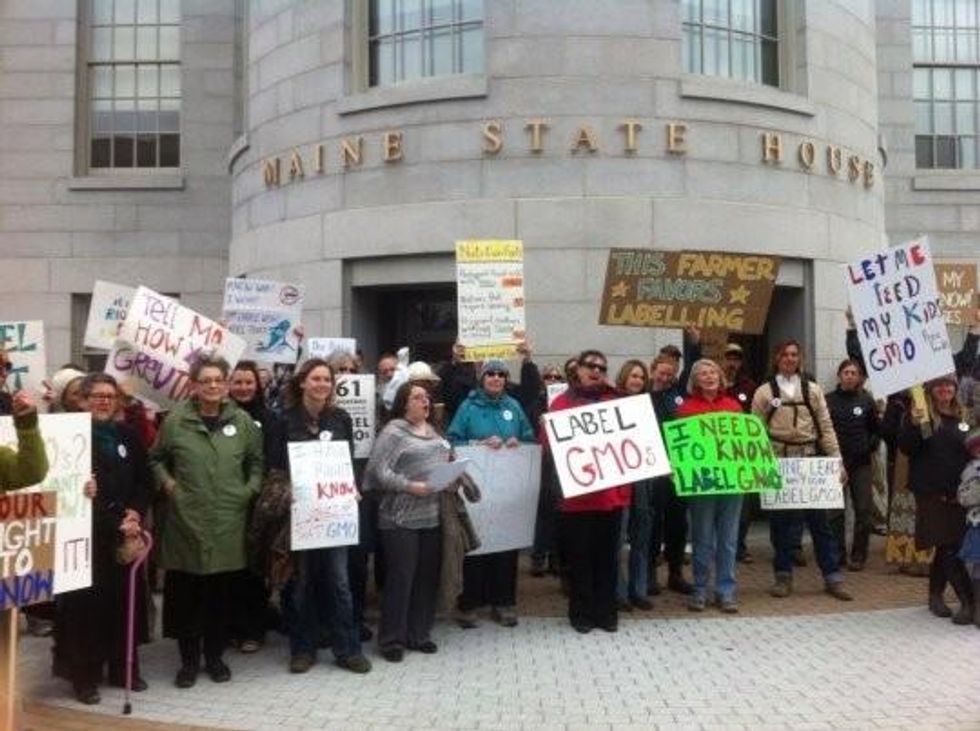
"If you're going to engage the American public, and the people of Maine, in a lab experiment, you know, it's my opinion that perhaps they ought to know they're in that lab experiment," said Rep. Lance Harvell (R-Farmington), sponsor of L.D. 718, An Act To Protect Maine Food Consumers' Right To Know about Genetically Engineered Food and Seed Stock, testifying before the Legislature's Agriculture, Conservation and Forestry Committee in Augusta.
"We're all guinea pigs and were consuming this food and many people don't know this technology is being foisted upon them," said Heather Spalding, Interim Director for the Maine Organic Farmers and Growers Association.
"The scientific uncertainty surrounding GMOs is a good reason for the state to require labeling," Harvell stated in a press release from the Maine Organic Farmers and Gardeners Association. "Consumers have a right to know what they are eating and to make informed choices about the health risks they take with products that are not subject to federal safety testing."
The proposed legislation depends on momentum for GMO labeling. It reads, in part:
Sec. 2. Contingent effective date; contingent repeal. The Commissioner of Agriculture, Conservation and Forestry shall monitor legislative activities in other states and certify to the Secretary of State and the Revisor of Statutes when legislation substantially similar to this Act has been adopted in at least 5 other states or in a state or states with a population or combined population of at least 20,000,000. Those sections of this Act that enact the Maine Revised Statutes, Title 22, chapter 565 take effect 30 days after the date of the commissioner's certification. If no certification has been made by the commissioner pursuant to this section by January 1, 2023, this Act is repealed on that date.
Familiar names are behind the campaign to fight the legislation, Steve Mistler reports for the State House Bureau:
An industry coalition opposed to the bill includes the Maine State Chamber of Commerce and the Maine Farm Bureau, with backing from agribusiness giant Monsanto and the Grocery Manufacturers Association.
Monsanto and the Grocery Manufacturers Association also poured money into California's defeated Prop. 37, which sought to label GMOs.
A recent poll showed that over 91% of Mainers are in support of labeling GMOs.
NECN has video:
___________________________
"If you're going to engage the American public, and the people of Maine, in a lab experiment, you know, it's my opinion that perhaps they ought to know they're in that lab experiment," said Rep. Lance Harvell (R-Farmington), sponsor of L.D. 718, An Act To Protect Maine Food Consumers' Right To Know about Genetically Engineered Food and Seed Stock, testifying before the Legislature's Agriculture, Conservation and Forestry Committee in Augusta.
"We're all guinea pigs and were consuming this food and many people don't know this technology is being foisted upon them," said Heather Spalding, Interim Director for the Maine Organic Farmers and Growers Association.
"The scientific uncertainty surrounding GMOs is a good reason for the state to require labeling," Harvell stated in a press release from the Maine Organic Farmers and Gardeners Association. "Consumers have a right to know what they are eating and to make informed choices about the health risks they take with products that are not subject to federal safety testing."
The proposed legislation depends on momentum for GMO labeling. It reads, in part:
Sec. 2. Contingent effective date; contingent repeal. The Commissioner of Agriculture, Conservation and Forestry shall monitor legislative activities in other states and certify to the Secretary of State and the Revisor of Statutes when legislation substantially similar to this Act has been adopted in at least 5 other states or in a state or states with a population or combined population of at least 20,000,000. Those sections of this Act that enact the Maine Revised Statutes, Title 22, chapter 565 take effect 30 days after the date of the commissioner's certification. If no certification has been made by the commissioner pursuant to this section by January 1, 2023, this Act is repealed on that date.
Familiar names are behind the campaign to fight the legislation, Steve Mistler reports for the State House Bureau:
An industry coalition opposed to the bill includes the Maine State Chamber of Commerce and the Maine Farm Bureau, with backing from agribusiness giant Monsanto and the Grocery Manufacturers Association.
Monsanto and the Grocery Manufacturers Association also poured money into California's defeated Prop. 37, which sought to label GMOs.
A recent poll showed that over 91% of Mainers are in support of labeling GMOs.
NECN has video:
___________________________
"If you're going to engage the American public, and the people of Maine, in a lab experiment, you know, it's my opinion that perhaps they ought to know they're in that lab experiment," said Rep. Lance Harvell (R-Farmington), sponsor of L.D. 718, An Act To Protect Maine Food Consumers' Right To Know about Genetically Engineered Food and Seed Stock, testifying before the Legislature's Agriculture, Conservation and Forestry Committee in Augusta.
"We're all guinea pigs and were consuming this food and many people don't know this technology is being foisted upon them," said Heather Spalding, Interim Director for the Maine Organic Farmers and Growers Association.
"The scientific uncertainty surrounding GMOs is a good reason for the state to require labeling," Harvell stated in a press release from the Maine Organic Farmers and Gardeners Association. "Consumers have a right to know what they are eating and to make informed choices about the health risks they take with products that are not subject to federal safety testing."
The proposed legislation depends on momentum for GMO labeling. It reads, in part:
Sec. 2. Contingent effective date; contingent repeal. The Commissioner of Agriculture, Conservation and Forestry shall monitor legislative activities in other states and certify to the Secretary of State and the Revisor of Statutes when legislation substantially similar to this Act has been adopted in at least 5 other states or in a state or states with a population or combined population of at least 20,000,000. Those sections of this Act that enact the Maine Revised Statutes, Title 22, chapter 565 take effect 30 days after the date of the commissioner's certification. If no certification has been made by the commissioner pursuant to this section by January 1, 2023, this Act is repealed on that date.
Familiar names are behind the campaign to fight the legislation, Steve Mistler reports for the State House Bureau:
An industry coalition opposed to the bill includes the Maine State Chamber of Commerce and the Maine Farm Bureau, with backing from agribusiness giant Monsanto and the Grocery Manufacturers Association.
Monsanto and the Grocery Manufacturers Association also poured money into California's defeated Prop. 37, which sought to label GMOs.
A recent poll showed that over 91% of Mainers are in support of labeling GMOs.
NECN has video:
___________________________

