SUBSCRIBE TO OUR FREE NEWSLETTER
Daily news & progressive opinion—funded by the people, not the corporations—delivered straight to your inbox.
5
#000000
#FFFFFF
To donate by check, phone, or other method, see our More Ways to Give page.
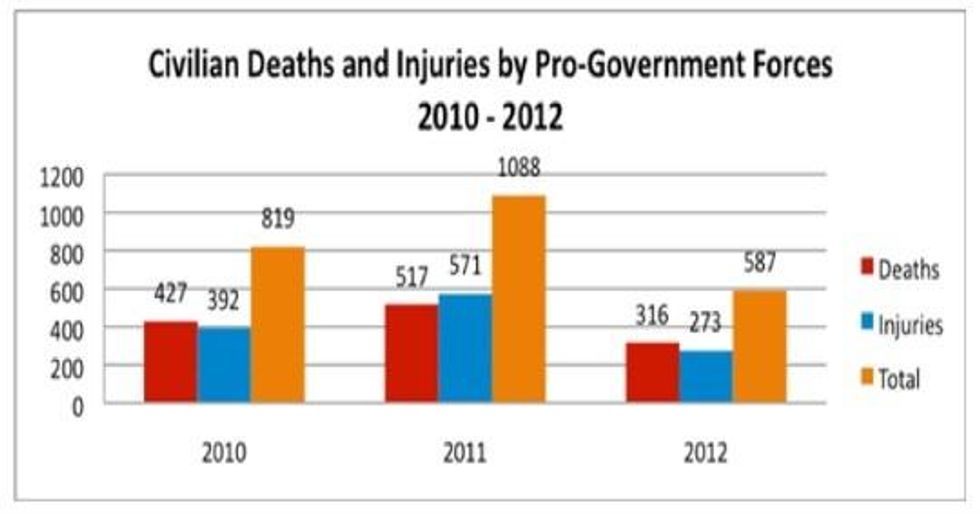
In a war that the US refuses to end in Afghanistan, the civilian population of that country continues to suffer the most with the UN reporting 2,754 civilian deaths and 4,805 civilian injuries in the country last year.
Though the report released by the United Nations Mission in Afghanistan (UNAMA) says the casualty rates were down from 2011, it was cautious to note that the level of ongoing death and injury was nothing to celebrate.
"The human cost of the conflict remains unacceptable," said Jan Kubis, the Special Representative of the UN Secretary-General for Afghanistan and the head of UNAMA.
"It is the tragic reality that most Afghan women and girls were killed or injured while engaging in their everyday activities," said Georgette Gagnon, Director of Human Rights section of UNAMA.
The UN report notes that targeting of Afghan government workers was up a shocking 700 percent in 2012. It also notes the largest number of victims of violence come from roadside bombs and other attacks by anti-government and anti-US/NATO forces, like the Taliban.
The report is a rather cold accounting of attributable deaths and injuries in the country, but offers little in the way of context for a war that has now dragged on for more than eleven years with no real end in sight. Despite talk of "drawdowns" in Washington and some accepted notion in the US media that the "war will be over by 2014," the violence in the country is "unacceptable" precisely because so few seem to understand why the war is still being fought at all..
Peace talks are non-existent and the use of unmanned drones in the country is on the rise.
Specifically on the use of US drones, the report says:
The number of weapons released by drones jumped from 294 in 2011 to 506 in 2012, a 72 percent increase in Afghanistan.
In 2012, UNAMA documented five incidents of drone strikes which resulted in 16 civilian deaths and three injuries, an increase from 2011 when UNAMA documented one incident.
Most of the civilian casualties from drone strikes in 2012 appear to be the result of weapons aimed directly at insurgents. However, information available to UNAMA indicates some instances may be due to targeting errors. For example, UNAMA documented one incident that occurred on 20 October when a drone struck in Baraki Barak district, Logar province, killing four children, aged between 11 and 13 years. Three boys died immediately while the fourth boy died during the transport to a Kabul hospital. The drone strike reportedly followed a clash between Anti-Government Elements and pro-Government Forces which occurred a few kilometers from the incident area.
And Jones notes that the violence, from both sides, is ultimately the result of the war and occupation itself, which the US has no real plan to end. She writes:
For more than a decade, U.S. forces have fought many types of wars in Afghanistan, from a low-footprint invasion, to multiple surges, to a flirtation with Vietnam-style counterinsurgency, to a ramped-up, gloves-off air war. And yet, despite all the experiments in styles of war-making, the American military and its coalition partners have ended up in the same place: stalemate, which in a battle with guerrillas means defeat. For years, a modest-sized, generally unpopular, ragtag set of insurgents has fought the planet's most heavily armed, technologically advanced military to a standstill, leaving the country shaken and its citizens anxiously imagining the outcome of unpalatable scenarios.
______________________
In a war that the US refuses to end in Afghanistan, the civilian population of that country continues to suffer the most with the UN reporting 2,754 civilian deaths and 4,805 civilian injuries in the country last year.
Though the report released by the United Nations Mission in Afghanistan (UNAMA) says the casualty rates were down from 2011, it was cautious to note that the level of ongoing death and injury was nothing to celebrate.
"The human cost of the conflict remains unacceptable," said Jan Kubis, the Special Representative of the UN Secretary-General for Afghanistan and the head of UNAMA.
"It is the tragic reality that most Afghan women and girls were killed or injured while engaging in their everyday activities," said Georgette Gagnon, Director of Human Rights section of UNAMA.
The UN report notes that targeting of Afghan government workers was up a shocking 700 percent in 2012. It also notes the largest number of victims of violence come from roadside bombs and other attacks by anti-government and anti-US/NATO forces, like the Taliban.
The report is a rather cold accounting of attributable deaths and injuries in the country, but offers little in the way of context for a war that has now dragged on for more than eleven years with no real end in sight. Despite talk of "drawdowns" in Washington and some accepted notion in the US media that the "war will be over by 2014," the violence in the country is "unacceptable" precisely because so few seem to understand why the war is still being fought at all..
Peace talks are non-existent and the use of unmanned drones in the country is on the rise.
Specifically on the use of US drones, the report says:
The number of weapons released by drones jumped from 294 in 2011 to 506 in 2012, a 72 percent increase in Afghanistan.
In 2012, UNAMA documented five incidents of drone strikes which resulted in 16 civilian deaths and three injuries, an increase from 2011 when UNAMA documented one incident.
Most of the civilian casualties from drone strikes in 2012 appear to be the result of weapons aimed directly at insurgents. However, information available to UNAMA indicates some instances may be due to targeting errors. For example, UNAMA documented one incident that occurred on 20 October when a drone struck in Baraki Barak district, Logar province, killing four children, aged between 11 and 13 years. Three boys died immediately while the fourth boy died during the transport to a Kabul hospital. The drone strike reportedly followed a clash between Anti-Government Elements and pro-Government Forces which occurred a few kilometers from the incident area.
And Jones notes that the violence, from both sides, is ultimately the result of the war and occupation itself, which the US has no real plan to end. She writes:
For more than a decade, U.S. forces have fought many types of wars in Afghanistan, from a low-footprint invasion, to multiple surges, to a flirtation with Vietnam-style counterinsurgency, to a ramped-up, gloves-off air war. And yet, despite all the experiments in styles of war-making, the American military and its coalition partners have ended up in the same place: stalemate, which in a battle with guerrillas means defeat. For years, a modest-sized, generally unpopular, ragtag set of insurgents has fought the planet's most heavily armed, technologically advanced military to a standstill, leaving the country shaken and its citizens anxiously imagining the outcome of unpalatable scenarios.
______________________
In a war that the US refuses to end in Afghanistan, the civilian population of that country continues to suffer the most with the UN reporting 2,754 civilian deaths and 4,805 civilian injuries in the country last year.
Though the report released by the United Nations Mission in Afghanistan (UNAMA) says the casualty rates were down from 2011, it was cautious to note that the level of ongoing death and injury was nothing to celebrate.
"The human cost of the conflict remains unacceptable," said Jan Kubis, the Special Representative of the UN Secretary-General for Afghanistan and the head of UNAMA.
"It is the tragic reality that most Afghan women and girls were killed or injured while engaging in their everyday activities," said Georgette Gagnon, Director of Human Rights section of UNAMA.
The UN report notes that targeting of Afghan government workers was up a shocking 700 percent in 2012. It also notes the largest number of victims of violence come from roadside bombs and other attacks by anti-government and anti-US/NATO forces, like the Taliban.
The report is a rather cold accounting of attributable deaths and injuries in the country, but offers little in the way of context for a war that has now dragged on for more than eleven years with no real end in sight. Despite talk of "drawdowns" in Washington and some accepted notion in the US media that the "war will be over by 2014," the violence in the country is "unacceptable" precisely because so few seem to understand why the war is still being fought at all..
Peace talks are non-existent and the use of unmanned drones in the country is on the rise.
Specifically on the use of US drones, the report says:
The number of weapons released by drones jumped from 294 in 2011 to 506 in 2012, a 72 percent increase in Afghanistan.
In 2012, UNAMA documented five incidents of drone strikes which resulted in 16 civilian deaths and three injuries, an increase from 2011 when UNAMA documented one incident.
Most of the civilian casualties from drone strikes in 2012 appear to be the result of weapons aimed directly at insurgents. However, information available to UNAMA indicates some instances may be due to targeting errors. For example, UNAMA documented one incident that occurred on 20 October when a drone struck in Baraki Barak district, Logar province, killing four children, aged between 11 and 13 years. Three boys died immediately while the fourth boy died during the transport to a Kabul hospital. The drone strike reportedly followed a clash between Anti-Government Elements and pro-Government Forces which occurred a few kilometers from the incident area.
And Jones notes that the violence, from both sides, is ultimately the result of the war and occupation itself, which the US has no real plan to end. She writes:
For more than a decade, U.S. forces have fought many types of wars in Afghanistan, from a low-footprint invasion, to multiple surges, to a flirtation with Vietnam-style counterinsurgency, to a ramped-up, gloves-off air war. And yet, despite all the experiments in styles of war-making, the American military and its coalition partners have ended up in the same place: stalemate, which in a battle with guerrillas means defeat. For years, a modest-sized, generally unpopular, ragtag set of insurgents has fought the planet's most heavily armed, technologically advanced military to a standstill, leaving the country shaken and its citizens anxiously imagining the outcome of unpalatable scenarios.
______________________