

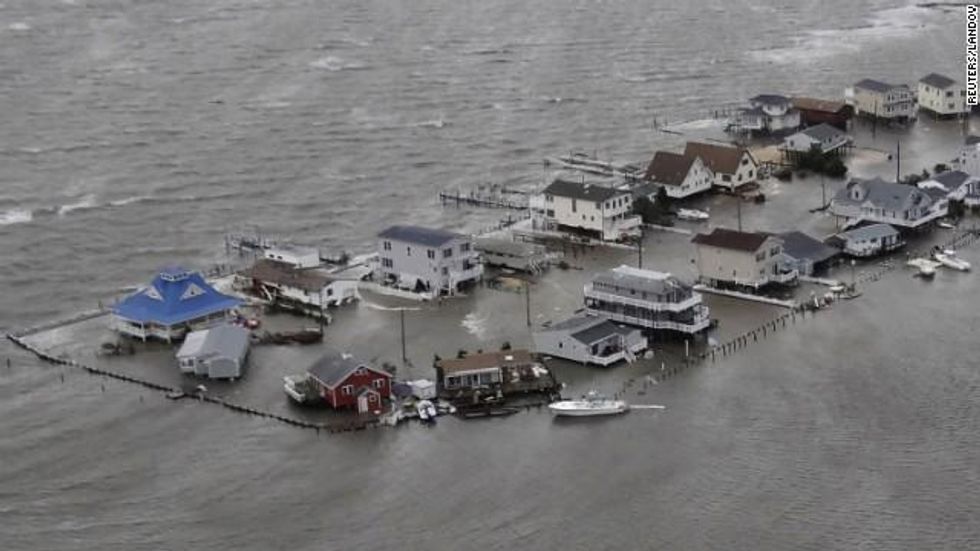
As people mourn the loss of life and governments assess the damage and begin the cleanup work, climate experts and scientists have the unenviable task of voicing two realities: Sandy is yet another example of the extreme weather associated with climate change we've been warning about and--if we don't change course--there's much more of this in our future.
A CNN report asks, Is Sandy Just Taste of Things to Come?:
The Intergovernmental Panel on Climate Change predicted in 2007 that the global average sea level would rise between seven and 23 inches by the end of this century. More recent projections suggest that the melting of sea ice could mean a rise in excess of 30 inches. The New York State Sea Level Rise Task Force translated that into a local projection of 2 to 5 inches by the 2020s, and with rapid Arctic ice melt the rise could be as much as 5 to 10 inches over the next fifteen years. Combine that with a trend toward more intense storms and New York is "highly vulnerable," professor Michael Oppenheimer of Princeton University told CNN.
"(Superstorm) Sandy is a foretaste of things to come," he predicted, "from the combination of bigger storms and higher sea levels, both of which contribute equally to the growing threat." [...]
In a paper published by Nature in February, he and three colleagues concluded that the "storm of the century" would become the storm of "every twenty years or less."
New York Governor Andrew Cuomo appears to agree.
"After what happened, what has been happening in the last few years, I don't think anyone can sit back anymore and say 'Well, I'm shocked at that weather pattern,'" he said Tuesday.
The conclusion of Oppenheimer and his colleagues is that storms will become larger and more powerful.
"Climate change will probably increase storm intensity and size simultaneously, resulting in a significant intensification of storm surges," they wrote. Sandy had a diameter of some 900 miles, much larger than most storms.
Euractiv adds:
Last month, EU Climate Action Commissioner Connie Hedegaard wrote that "formerly one-off extreme weather episodes seem to be becoming the new normal".
She noted that:
- The last summer was the hottest on record in the United States;
- Central and Eastern Europe also suffered record high temperatures;
- The United Kingdom experienced it wettest-ever summer;
- Northern India endured its heaviest rainfalls;
- The US and East Africa were hit by their worst-ever droughts.
Arctic summer sea ice also shrank to its smallest recorded level in September.
Hedegaard's office declined to comment on any potential link between Hurricane Sandy and climate change. But Kristalina Georgieva, the EU's humanitarian aid and crisis response commissioner, said in a statement: "Hurricane Sandy is yet another example of the increasing intensity and frequency of natural disasters."
Writing on the relentless assault on climate science and the industry-backed campaign to deny the existence of human-caused global warming and climate change, environmental researcher and journalist Sunita Narain laments how those sustained and well-funded efforts have dumbed down the American people on the issue and "pushed scientists underground" to the detriment of the public.
"Now we are the losers," she writes. "We don't get to know more or engage in the learning of the changes. We don't get to understand what is beginning to happen the world that we live in and the world our children will inherit. This is when we know that change is afoot. We know that the frequency and intensity of natural disasters is up and is devastating our world."
And concludes: "The only one good that can come from tropical storm Sandy is if we stop allowing the science of climate change to be discredited or dismissed. It is time we heard the news with the subtext intact."
# # #
As people mourn the loss of life and governments assess the damage and begin the cleanup work, climate experts and scientists have the unenviable task of voicing two realities: Sandy is yet another example of the extreme weather associated with climate change we've been warning about and--if we don't change course--there's much more of this in our future.
A CNN report asks, Is Sandy Just Taste of Things to Come?:
The Intergovernmental Panel on Climate Change predicted in 2007 that the global average sea level would rise between seven and 23 inches by the end of this century. More recent projections suggest that the melting of sea ice could mean a rise in excess of 30 inches. The New York State Sea Level Rise Task Force translated that into a local projection of 2 to 5 inches by the 2020s, and with rapid Arctic ice melt the rise could be as much as 5 to 10 inches over the next fifteen years. Combine that with a trend toward more intense storms and New York is "highly vulnerable," professor Michael Oppenheimer of Princeton University told CNN.
"(Superstorm) Sandy is a foretaste of things to come," he predicted, "from the combination of bigger storms and higher sea levels, both of which contribute equally to the growing threat." [...]
In a paper published by Nature in February, he and three colleagues concluded that the "storm of the century" would become the storm of "every twenty years or less."
New York Governor Andrew Cuomo appears to agree.
"After what happened, what has been happening in the last few years, I don't think anyone can sit back anymore and say 'Well, I'm shocked at that weather pattern,'" he said Tuesday.
The conclusion of Oppenheimer and his colleagues is that storms will become larger and more powerful.
"Climate change will probably increase storm intensity and size simultaneously, resulting in a significant intensification of storm surges," they wrote. Sandy had a diameter of some 900 miles, much larger than most storms.
Euractiv adds:
Last month, EU Climate Action Commissioner Connie Hedegaard wrote that "formerly one-off extreme weather episodes seem to be becoming the new normal".
She noted that:
- The last summer was the hottest on record in the United States;
- Central and Eastern Europe also suffered record high temperatures;
- The United Kingdom experienced it wettest-ever summer;
- Northern India endured its heaviest rainfalls;
- The US and East Africa were hit by their worst-ever droughts.
Arctic summer sea ice also shrank to its smallest recorded level in September.
Hedegaard's office declined to comment on any potential link between Hurricane Sandy and climate change. But Kristalina Georgieva, the EU's humanitarian aid and crisis response commissioner, said in a statement: "Hurricane Sandy is yet another example of the increasing intensity and frequency of natural disasters."
Writing on the relentless assault on climate science and the industry-backed campaign to deny the existence of human-caused global warming and climate change, environmental researcher and journalist Sunita Narain laments how those sustained and well-funded efforts have dumbed down the American people on the issue and "pushed scientists underground" to the detriment of the public.
"Now we are the losers," she writes. "We don't get to know more or engage in the learning of the changes. We don't get to understand what is beginning to happen the world that we live in and the world our children will inherit. This is when we know that change is afoot. We know that the frequency and intensity of natural disasters is up and is devastating our world."
And concludes: "The only one good that can come from tropical storm Sandy is if we stop allowing the science of climate change to be discredited or dismissed. It is time we heard the news with the subtext intact."
# # #
As people mourn the loss of life and governments assess the damage and begin the cleanup work, climate experts and scientists have the unenviable task of voicing two realities: Sandy is yet another example of the extreme weather associated with climate change we've been warning about and--if we don't change course--there's much more of this in our future.
A CNN report asks, Is Sandy Just Taste of Things to Come?:
The Intergovernmental Panel on Climate Change predicted in 2007 that the global average sea level would rise between seven and 23 inches by the end of this century. More recent projections suggest that the melting of sea ice could mean a rise in excess of 30 inches. The New York State Sea Level Rise Task Force translated that into a local projection of 2 to 5 inches by the 2020s, and with rapid Arctic ice melt the rise could be as much as 5 to 10 inches over the next fifteen years. Combine that with a trend toward more intense storms and New York is "highly vulnerable," professor Michael Oppenheimer of Princeton University told CNN.
"(Superstorm) Sandy is a foretaste of things to come," he predicted, "from the combination of bigger storms and higher sea levels, both of which contribute equally to the growing threat." [...]
In a paper published by Nature in February, he and three colleagues concluded that the "storm of the century" would become the storm of "every twenty years or less."
New York Governor Andrew Cuomo appears to agree.
"After what happened, what has been happening in the last few years, I don't think anyone can sit back anymore and say 'Well, I'm shocked at that weather pattern,'" he said Tuesday.
The conclusion of Oppenheimer and his colleagues is that storms will become larger and more powerful.
"Climate change will probably increase storm intensity and size simultaneously, resulting in a significant intensification of storm surges," they wrote. Sandy had a diameter of some 900 miles, much larger than most storms.
Euractiv adds:
Last month, EU Climate Action Commissioner Connie Hedegaard wrote that "formerly one-off extreme weather episodes seem to be becoming the new normal".
She noted that:
- The last summer was the hottest on record in the United States;
- Central and Eastern Europe also suffered record high temperatures;
- The United Kingdom experienced it wettest-ever summer;
- Northern India endured its heaviest rainfalls;
- The US and East Africa were hit by their worst-ever droughts.
Arctic summer sea ice also shrank to its smallest recorded level in September.
Hedegaard's office declined to comment on any potential link between Hurricane Sandy and climate change. But Kristalina Georgieva, the EU's humanitarian aid and crisis response commissioner, said in a statement: "Hurricane Sandy is yet another example of the increasing intensity and frequency of natural disasters."
Writing on the relentless assault on climate science and the industry-backed campaign to deny the existence of human-caused global warming and climate change, environmental researcher and journalist Sunita Narain laments how those sustained and well-funded efforts have dumbed down the American people on the issue and "pushed scientists underground" to the detriment of the public.
"Now we are the losers," she writes. "We don't get to know more or engage in the learning of the changes. We don't get to understand what is beginning to happen the world that we live in and the world our children will inherit. This is when we know that change is afoot. We know that the frequency and intensity of natural disasters is up and is devastating our world."
And concludes: "The only one good that can come from tropical storm Sandy is if we stop allowing the science of climate change to be discredited or dismissed. It is time we heard the news with the subtext intact."
# # #