SUBSCRIBE TO OUR FREE NEWSLETTER
Daily news & progressive opinion—funded by the people, not the corporations—delivered straight to your inbox.
5
#000000
#FFFFFF
To donate by check, phone, or other method, see our More Ways to Give page.

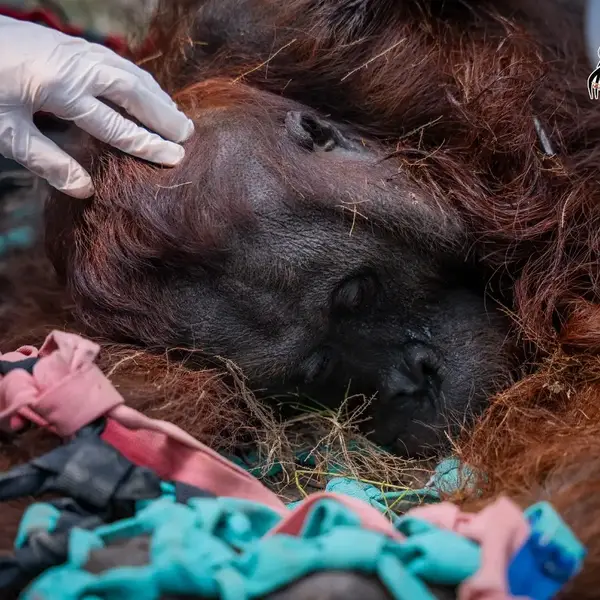
The Tripa peat swamp forest on the coast of Aceh province, reports The Digital Journal's Elizabeth Blatt, is home to one of the largest remaining populations of wild orangutans in the world. "But," writes Blatt, "Companies have been decimating them by burning up the natural habitat and planting saplings for palm oil. The principle ingredient of this oil, is found in approximately half of all packaged goods sold on grocery store shelves."
Ian Singleton, head of the Sumatran Orangutan Conservation Programme (SOCP), told The Guardian that the Tripa orangutans are being "extinguished."
The situation is indeed extremely dire," he said. "Every time I have visited Tripa in the last 12 months I have found several orangutans hanging on for their very survival, right at the forest edge."
In a statement released earlier this month, SOCP estimated that there are now only 200 orangutan left at Rawa Tripa areas, compared to 1990, when almost 2,000 of the great apes were registered. Now with an escalation in fires, their situation is desperate.
"When you see the scale and speed of the current wave of destruction and the condition of the remaining forests," Singleton said in a press release (pdf), "there can be no doubt whatsoever that many have already died in Tripa due to the fires themselves, or due to starvation as a result of the loss of their habitat and food resources."
* * *
'Saving Leuser, Tripa.' An excerpt from a film by Carlos Quiles:
* * *
The Guardian: Fires threaten to 'extinguish' critical Indonesian orangutan population
Environmentalists have lodged a lawsuit against PT Kallista Alam, one of the five palm oil firms operating in Tripa, and Irwandi Yusuf, the former governor of Aceh, over the approval of a permit for the 1,600-hectare (3,950-acre) palm oil plantation.
Irawardi, previously styled as a "green" governor, says he granted the permit due to delays in the UN's Redd+ (Reducing Emissions from Deforestation and Forest Degradation) programme, which has seen Norway pledge $US1bn to Indonesia to reduce deforestation.
"The international community think our forest is a free toilet for their carbon," Irawardi said in April. "Every day they are saying they want clean air and to protect forests ... but they want to inhale our clean air without paying anything."
SOCP and lawyers representing Tripa's local communities have called upon the Indonesian president, Susilo Bambang Yudhoyono, to bypass an ongoing government investigation into the forest clearing and immediately halt the razing of the area.
"This whole thing makes absolutely no sense at all, not environmentally, nor even economically," said Singleton.
# # #
The Tripa peat swamp forest on the coast of Aceh province, reports The Digital Journal's Elizabeth Blatt, is home to one of the largest remaining populations of wild orangutans in the world. "But," writes Blatt, "Companies have been decimating them by burning up the natural habitat and planting saplings for palm oil. The principle ingredient of this oil, is found in approximately half of all packaged goods sold on grocery store shelves."
Ian Singleton, head of the Sumatran Orangutan Conservation Programme (SOCP), told The Guardian that the Tripa orangutans are being "extinguished."
The situation is indeed extremely dire," he said. "Every time I have visited Tripa in the last 12 months I have found several orangutans hanging on for their very survival, right at the forest edge."
In a statement released earlier this month, SOCP estimated that there are now only 200 orangutan left at Rawa Tripa areas, compared to 1990, when almost 2,000 of the great apes were registered. Now with an escalation in fires, their situation is desperate.
"When you see the scale and speed of the current wave of destruction and the condition of the remaining forests," Singleton said in a press release (pdf), "there can be no doubt whatsoever that many have already died in Tripa due to the fires themselves, or due to starvation as a result of the loss of their habitat and food resources."
* * *
'Saving Leuser, Tripa.' An excerpt from a film by Carlos Quiles:
* * *
The Guardian: Fires threaten to 'extinguish' critical Indonesian orangutan population
Environmentalists have lodged a lawsuit against PT Kallista Alam, one of the five palm oil firms operating in Tripa, and Irwandi Yusuf, the former governor of Aceh, over the approval of a permit for the 1,600-hectare (3,950-acre) palm oil plantation.
Irawardi, previously styled as a "green" governor, says he granted the permit due to delays in the UN's Redd+ (Reducing Emissions from Deforestation and Forest Degradation) programme, which has seen Norway pledge $US1bn to Indonesia to reduce deforestation.
"The international community think our forest is a free toilet for their carbon," Irawardi said in April. "Every day they are saying they want clean air and to protect forests ... but they want to inhale our clean air without paying anything."
SOCP and lawyers representing Tripa's local communities have called upon the Indonesian president, Susilo Bambang Yudhoyono, to bypass an ongoing government investigation into the forest clearing and immediately halt the razing of the area.
"This whole thing makes absolutely no sense at all, not environmentally, nor even economically," said Singleton.
# # #
The Tripa peat swamp forest on the coast of Aceh province, reports The Digital Journal's Elizabeth Blatt, is home to one of the largest remaining populations of wild orangutans in the world. "But," writes Blatt, "Companies have been decimating them by burning up the natural habitat and planting saplings for palm oil. The principle ingredient of this oil, is found in approximately half of all packaged goods sold on grocery store shelves."
Ian Singleton, head of the Sumatran Orangutan Conservation Programme (SOCP), told The Guardian that the Tripa orangutans are being "extinguished."
The situation is indeed extremely dire," he said. "Every time I have visited Tripa in the last 12 months I have found several orangutans hanging on for their very survival, right at the forest edge."
In a statement released earlier this month, SOCP estimated that there are now only 200 orangutan left at Rawa Tripa areas, compared to 1990, when almost 2,000 of the great apes were registered. Now with an escalation in fires, their situation is desperate.
"When you see the scale and speed of the current wave of destruction and the condition of the remaining forests," Singleton said in a press release (pdf), "there can be no doubt whatsoever that many have already died in Tripa due to the fires themselves, or due to starvation as a result of the loss of their habitat and food resources."
* * *
'Saving Leuser, Tripa.' An excerpt from a film by Carlos Quiles:
* * *
The Guardian: Fires threaten to 'extinguish' critical Indonesian orangutan population
Environmentalists have lodged a lawsuit against PT Kallista Alam, one of the five palm oil firms operating in Tripa, and Irwandi Yusuf, the former governor of Aceh, over the approval of a permit for the 1,600-hectare (3,950-acre) palm oil plantation.
Irawardi, previously styled as a "green" governor, says he granted the permit due to delays in the UN's Redd+ (Reducing Emissions from Deforestation and Forest Degradation) programme, which has seen Norway pledge $US1bn to Indonesia to reduce deforestation.
"The international community think our forest is a free toilet for their carbon," Irawardi said in April. "Every day they are saying they want clean air and to protect forests ... but they want to inhale our clean air without paying anything."
SOCP and lawyers representing Tripa's local communities have called upon the Indonesian president, Susilo Bambang Yudhoyono, to bypass an ongoing government investigation into the forest clearing and immediately halt the razing of the area.
"This whole thing makes absolutely no sense at all, not environmentally, nor even economically," said Singleton.
# # #