SUBSCRIBE TO OUR FREE NEWSLETTER
Daily news & progressive opinion—funded by the people, not the corporations—delivered straight to your inbox.
5
#000000
#FFFFFF
To donate by check, phone, or other method, see our More Ways to Give page.
Increasingly frequent and tragic railway accidents in Argentina, like this week's crash, show that the rail system, run by private companies that receive hundreds of millions of dollars in subsidies from the state, constantly ignores warnings from inspectors and fines, observers say.
"Another catastrophe could happen at any time," former socialist lawmaker Hector Polino, founder of Consumidores Libres (Free Consumers), a citizens group that has filed numerous complaints against the companies running the railways, told IPS.
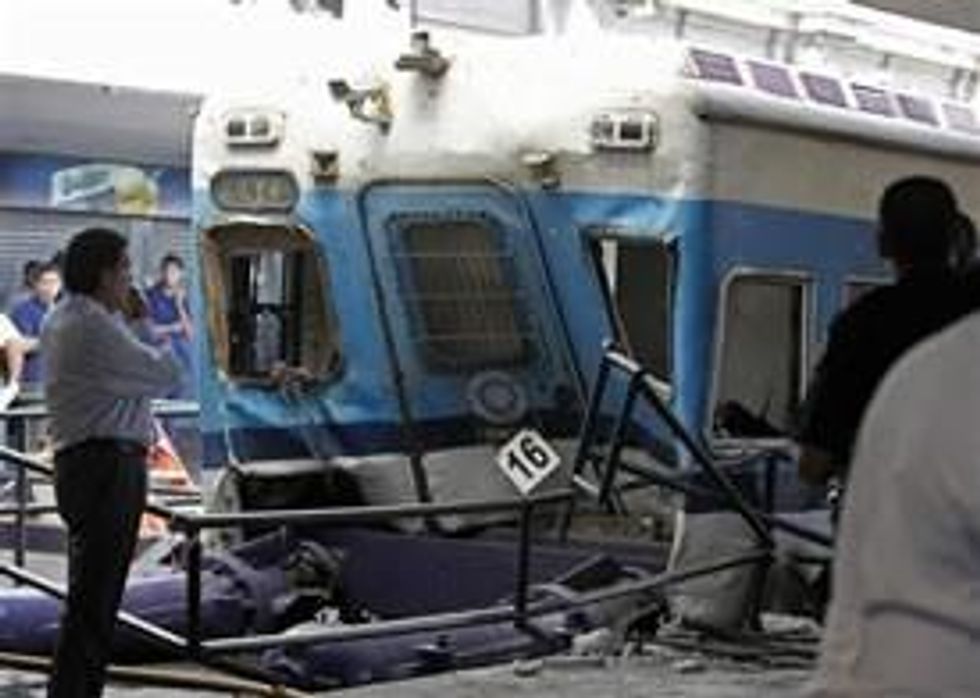
The debate on the state of Argentina's privatized and heavily subsidized rail network has flared up again in the wake of the Wednesday Feb. 22 crash, when a packed commuter train slammed into a retaining wall at a railway terminus in Buenos Aires.
The train entered the station at a speed of more than 20 km per hour and did not stop, for reasons that have yet to be determined, killing 51 people and injuring more than 700 others.
Some passengers said there were signs of problems with the train just before the accident.
The crash was the second in the Argentine capital in less than six months. The first occurred in September on the same line, Sarmiento, when a bus crossed the tracks in front of an oncoming train. The train crashed into the bus, and after it was derailed it was hit by a train approaching from the other direction. The accident left 11 dead and 212 injured.
Polino said the state of Argentina's rail system today is the direct result of the wave of privatizations carried out by the government of Carlos Menem (1989-1999), which put the railways into the hands of private companies. Since then, the system has been plagued by negligence, mismanagement, a lack of maintenance, and "connivance" between the companies running the rails and officials in charge of oversight, he said.
"The proof of that is Ricardo Jaime," he said, referring to the official who headed the transport secretariat during the government of late former president Nestor Kirchner (2003-2007), and who was kept in his post by Kirchner's widow and successor, Cristina Fernandez.
Jaime resigned as transport secretary in 2009, citing "personal reasons". But he was facing a number of corruption charges in cases that are still making their way through the courts.
Now he has been charged with receiving free vacation flights from Claudio Cirigliano, whose holding company owns Trenes de Buenos Aires (TBA), the company that runs the Sarmiento line and others.
According to the lawsuit, Cirigliano paid for plane tickets to Brazil for Jaime, who at the time was in charge of granting subsidies to the private concession-holders running the rail system, so that they would keep ticket prices down.
Polino pointed out that when he was in the lower house of Congress, Consumidores Libres got the courts to issue an interim measure to prevent the companies from raising ticket prices. Cirigliano tried repeatedly to meet with him, but outside of his office in the legislature.
"I always refused, so he went to my office to ask me to stop pressing forward with the case," Polino said. "A member of the transport workers union also came to ask me, in (Cirigliano's) name, to do the same thing."
The Argentine government received a massive World Bank loan to drastically reduce the workforce at Ferrocarriles Argentinos, the state enterprise that owned the entire national railway system until then.
After that, the private companies that were granted concessions whittled the country's railway network down to one-fourth of its capacity.
Although Kirchner cancelled one of the concessions on the grounds of breach of contract, the service was then handed to another private company.
In recent years, there have been some improvements to the rail services, but the underlying system has not changed, Polino said.
Cristina Suarez with the Frente de Usuarios Desesperados del Sarmiento, a rail users group, told IPS that they had filed "all kinds of complaints" between 2006 and 2010, to draw attention to the serious flaws in the system.
"Overcrowding, lack of safety, lighting and hygiene, and broken barrier arms" were some of the most serious problems she listed with regard to the Sarmiento line, which connects a populous district on the west side of Buenos Aires with the centre of the city.
The campaigns carried out raised awareness among users, but few improvements have been seen, Suarez said. "A few tracks were fixed and new units were purchased, but obviously the problems are still there," she added.
The creation of tunnels for some stretches of railway was announced, but work has not begun. And the incorporation of new carriages has been slow.
But the companies continue to receive hefty subsidies - a combined total of three billion pesos (698 million dollars) from the transport secretariat in 2011 alone.
Polino said he had gained access to a March 2010 report by the National Commission for Transport Regulation, which answers to the transport secretariat, in which inspectors pointed to serious violations by TBA and recommended that the company be fined.
The inspectors mentioned "steady deterioration of the infrastructure granted in concession" to TBA, due to "insufficient maintenance and failure to follow technical standards."
But the company was never fined, the former legislator said.
The inspectors' observations concurred with reports by the comptroller-general's office, which for nearly a decade has periodically pointed to serious maintenance and safety problems in the companies running the railways, and in TBA in particular.
Norberto Rosendo, a railways engineer who is the president of the Comision Nacional Salvemos al Tren (Save the Train National Commission) which plans to "battle the concession-holders," agreed with Polino and went a step further in his criticism.
"I know that the inspectors at the Commission for Transport Regulation have worn themselves out making complaints, but the problem is that the legislation protects the companies," he told IPS, referring to laws passed in the heat of the severe economic crisis that hit Argentina in late 2001 and 2002.
Rosendo said "the problems have to do with a system for which the state earmarks discretionary funds, which creates a breeding ground for corruption" because those funds can be diverted from their intended purposes.
But he acknowledged that under the current transport secretary, Juan Pablo Schiavi, "things have improved a great deal.
"Now there is an overall plan for the railways and a lot of investment, but it's not enough," he said. "There is a structure of corruption, and powerful underlying interests that involve government officials, the companies, and trade union leaders."
Increasingly frequent and tragic railway accidents in Argentina, like this week's crash, show that the rail system, run by private companies that receive hundreds of millions of dollars in subsidies from the state, constantly ignores warnings from inspectors and fines, observers say.
"Another catastrophe could happen at any time," former socialist lawmaker Hector Polino, founder of Consumidores Libres (Free Consumers), a citizens group that has filed numerous complaints against the companies running the railways, told IPS.
The debate on the state of Argentina's privatized and heavily subsidized rail network has flared up again in the wake of the Wednesday Feb. 22 crash, when a packed commuter train slammed into a retaining wall at a railway terminus in Buenos Aires.
The train entered the station at a speed of more than 20 km per hour and did not stop, for reasons that have yet to be determined, killing 51 people and injuring more than 700 others.
Some passengers said there were signs of problems with the train just before the accident.
The crash was the second in the Argentine capital in less than six months. The first occurred in September on the same line, Sarmiento, when a bus crossed the tracks in front of an oncoming train. The train crashed into the bus, and after it was derailed it was hit by a train approaching from the other direction. The accident left 11 dead and 212 injured.
Polino said the state of Argentina's rail system today is the direct result of the wave of privatizations carried out by the government of Carlos Menem (1989-1999), which put the railways into the hands of private companies. Since then, the system has been plagued by negligence, mismanagement, a lack of maintenance, and "connivance" between the companies running the rails and officials in charge of oversight, he said.
"The proof of that is Ricardo Jaime," he said, referring to the official who headed the transport secretariat during the government of late former president Nestor Kirchner (2003-2007), and who was kept in his post by Kirchner's widow and successor, Cristina Fernandez.
Jaime resigned as transport secretary in 2009, citing "personal reasons". But he was facing a number of corruption charges in cases that are still making their way through the courts.
Now he has been charged with receiving free vacation flights from Claudio Cirigliano, whose holding company owns Trenes de Buenos Aires (TBA), the company that runs the Sarmiento line and others.
According to the lawsuit, Cirigliano paid for plane tickets to Brazil for Jaime, who at the time was in charge of granting subsidies to the private concession-holders running the rail system, so that they would keep ticket prices down.
Polino pointed out that when he was in the lower house of Congress, Consumidores Libres got the courts to issue an interim measure to prevent the companies from raising ticket prices. Cirigliano tried repeatedly to meet with him, but outside of his office in the legislature.
"I always refused, so he went to my office to ask me to stop pressing forward with the case," Polino said. "A member of the transport workers union also came to ask me, in (Cirigliano's) name, to do the same thing."
The Argentine government received a massive World Bank loan to drastically reduce the workforce at Ferrocarriles Argentinos, the state enterprise that owned the entire national railway system until then.
After that, the private companies that were granted concessions whittled the country's railway network down to one-fourth of its capacity.
Although Kirchner cancelled one of the concessions on the grounds of breach of contract, the service was then handed to another private company.
In recent years, there have been some improvements to the rail services, but the underlying system has not changed, Polino said.
Cristina Suarez with the Frente de Usuarios Desesperados del Sarmiento, a rail users group, told IPS that they had filed "all kinds of complaints" between 2006 and 2010, to draw attention to the serious flaws in the system.
"Overcrowding, lack of safety, lighting and hygiene, and broken barrier arms" were some of the most serious problems she listed with regard to the Sarmiento line, which connects a populous district on the west side of Buenos Aires with the centre of the city.
The campaigns carried out raised awareness among users, but few improvements have been seen, Suarez said. "A few tracks were fixed and new units were purchased, but obviously the problems are still there," she added.
The creation of tunnels for some stretches of railway was announced, but work has not begun. And the incorporation of new carriages has been slow.
But the companies continue to receive hefty subsidies - a combined total of three billion pesos (698 million dollars) from the transport secretariat in 2011 alone.
Polino said he had gained access to a March 2010 report by the National Commission for Transport Regulation, which answers to the transport secretariat, in which inspectors pointed to serious violations by TBA and recommended that the company be fined.
The inspectors mentioned "steady deterioration of the infrastructure granted in concession" to TBA, due to "insufficient maintenance and failure to follow technical standards."
But the company was never fined, the former legislator said.
The inspectors' observations concurred with reports by the comptroller-general's office, which for nearly a decade has periodically pointed to serious maintenance and safety problems in the companies running the railways, and in TBA in particular.
Norberto Rosendo, a railways engineer who is the president of the Comision Nacional Salvemos al Tren (Save the Train National Commission) which plans to "battle the concession-holders," agreed with Polino and went a step further in his criticism.
"I know that the inspectors at the Commission for Transport Regulation have worn themselves out making complaints, but the problem is that the legislation protects the companies," he told IPS, referring to laws passed in the heat of the severe economic crisis that hit Argentina in late 2001 and 2002.
Rosendo said "the problems have to do with a system for which the state earmarks discretionary funds, which creates a breeding ground for corruption" because those funds can be diverted from their intended purposes.
But he acknowledged that under the current transport secretary, Juan Pablo Schiavi, "things have improved a great deal.
"Now there is an overall plan for the railways and a lot of investment, but it's not enough," he said. "There is a structure of corruption, and powerful underlying interests that involve government officials, the companies, and trade union leaders."
Increasingly frequent and tragic railway accidents in Argentina, like this week's crash, show that the rail system, run by private companies that receive hundreds of millions of dollars in subsidies from the state, constantly ignores warnings from inspectors and fines, observers say.
"Another catastrophe could happen at any time," former socialist lawmaker Hector Polino, founder of Consumidores Libres (Free Consumers), a citizens group that has filed numerous complaints against the companies running the railways, told IPS.
The debate on the state of Argentina's privatized and heavily subsidized rail network has flared up again in the wake of the Wednesday Feb. 22 crash, when a packed commuter train slammed into a retaining wall at a railway terminus in Buenos Aires.
The train entered the station at a speed of more than 20 km per hour and did not stop, for reasons that have yet to be determined, killing 51 people and injuring more than 700 others.
Some passengers said there were signs of problems with the train just before the accident.
The crash was the second in the Argentine capital in less than six months. The first occurred in September on the same line, Sarmiento, when a bus crossed the tracks in front of an oncoming train. The train crashed into the bus, and after it was derailed it was hit by a train approaching from the other direction. The accident left 11 dead and 212 injured.
Polino said the state of Argentina's rail system today is the direct result of the wave of privatizations carried out by the government of Carlos Menem (1989-1999), which put the railways into the hands of private companies. Since then, the system has been plagued by negligence, mismanagement, a lack of maintenance, and "connivance" between the companies running the rails and officials in charge of oversight, he said.
"The proof of that is Ricardo Jaime," he said, referring to the official who headed the transport secretariat during the government of late former president Nestor Kirchner (2003-2007), and who was kept in his post by Kirchner's widow and successor, Cristina Fernandez.
Jaime resigned as transport secretary in 2009, citing "personal reasons". But he was facing a number of corruption charges in cases that are still making their way through the courts.
Now he has been charged with receiving free vacation flights from Claudio Cirigliano, whose holding company owns Trenes de Buenos Aires (TBA), the company that runs the Sarmiento line and others.
According to the lawsuit, Cirigliano paid for plane tickets to Brazil for Jaime, who at the time was in charge of granting subsidies to the private concession-holders running the rail system, so that they would keep ticket prices down.
Polino pointed out that when he was in the lower house of Congress, Consumidores Libres got the courts to issue an interim measure to prevent the companies from raising ticket prices. Cirigliano tried repeatedly to meet with him, but outside of his office in the legislature.
"I always refused, so he went to my office to ask me to stop pressing forward with the case," Polino said. "A member of the transport workers union also came to ask me, in (Cirigliano's) name, to do the same thing."
The Argentine government received a massive World Bank loan to drastically reduce the workforce at Ferrocarriles Argentinos, the state enterprise that owned the entire national railway system until then.
After that, the private companies that were granted concessions whittled the country's railway network down to one-fourth of its capacity.
Although Kirchner cancelled one of the concessions on the grounds of breach of contract, the service was then handed to another private company.
In recent years, there have been some improvements to the rail services, but the underlying system has not changed, Polino said.
Cristina Suarez with the Frente de Usuarios Desesperados del Sarmiento, a rail users group, told IPS that they had filed "all kinds of complaints" between 2006 and 2010, to draw attention to the serious flaws in the system.
"Overcrowding, lack of safety, lighting and hygiene, and broken barrier arms" were some of the most serious problems she listed with regard to the Sarmiento line, which connects a populous district on the west side of Buenos Aires with the centre of the city.
The campaigns carried out raised awareness among users, but few improvements have been seen, Suarez said. "A few tracks were fixed and new units were purchased, but obviously the problems are still there," she added.
The creation of tunnels for some stretches of railway was announced, but work has not begun. And the incorporation of new carriages has been slow.
But the companies continue to receive hefty subsidies - a combined total of three billion pesos (698 million dollars) from the transport secretariat in 2011 alone.
Polino said he had gained access to a March 2010 report by the National Commission for Transport Regulation, which answers to the transport secretariat, in which inspectors pointed to serious violations by TBA and recommended that the company be fined.
The inspectors mentioned "steady deterioration of the infrastructure granted in concession" to TBA, due to "insufficient maintenance and failure to follow technical standards."
But the company was never fined, the former legislator said.
The inspectors' observations concurred with reports by the comptroller-general's office, which for nearly a decade has periodically pointed to serious maintenance and safety problems in the companies running the railways, and in TBA in particular.
Norberto Rosendo, a railways engineer who is the president of the Comision Nacional Salvemos al Tren (Save the Train National Commission) which plans to "battle the concession-holders," agreed with Polino and went a step further in his criticism.
"I know that the inspectors at the Commission for Transport Regulation have worn themselves out making complaints, but the problem is that the legislation protects the companies," he told IPS, referring to laws passed in the heat of the severe economic crisis that hit Argentina in late 2001 and 2002.
Rosendo said "the problems have to do with a system for which the state earmarks discretionary funds, which creates a breeding ground for corruption" because those funds can be diverted from their intended purposes.
But he acknowledged that under the current transport secretary, Juan Pablo Schiavi, "things have improved a great deal.
"Now there is an overall plan for the railways and a lot of investment, but it's not enough," he said. "There is a structure of corruption, and powerful underlying interests that involve government officials, the companies, and trade union leaders."