

SUBSCRIBE TO OUR FREE NEWSLETTER
Daily news & progressive opinion—funded by the people, not the corporations—delivered straight to your inbox.
5
#000000
#FFFFFF
To donate by check, phone, or other method, see our More Ways to Give page.
Daily news & progressive opinion—funded by the people, not the corporations—delivered straight to your inbox.
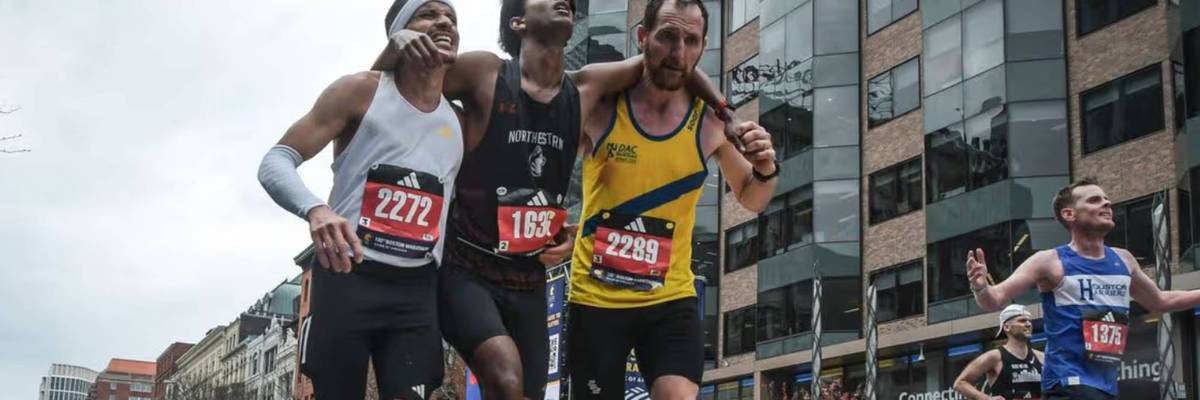
De Oliveira and Beggs help Ajay Haridasse finish the Boston Marathon
Needing a break, we honor the rare sweet sliver of comity during Monday's Boston Marathon when two runners, both on course to achieve their personal best, instead stopped to help Ajay Haridasse, collapsed on the ground and unable to stand back up, over the finish line just ahead - because, they explained, "This is what it's all about...Two is better than one." Hallelujah: For now, still human after all these years.
The "beautiful moment" of compassion and sportsmanship came almost at the end of the grueling, 26.2-mile marathon known as "the runner's Holy Grail" for its tough qualifying standards and steep terrain, including Newton's iconic "Heartbreak Hill." The world's oldest marathon was inspired by the inaugural 1896 Olympics and begun the next year; widely considered one of the most difficult races anywhere, it attracts 500,000 spectators and over 20,000 dogged participants from 96 countries. "It’s a slog. It’s a grind. It’s brilliant," said one aspirant. Another: "Nothing is like it. Runners train and train and train for this race."
So did Ajay Haridasse, a 21-year-old senior at Northeastern running his first Boston Marathon having grown up nearby and faithfully watched it for years. Haridasse had passed the 26-mile mark when, he later said, "the wheels kinda fell off." After running almost three hours and struggling against cramps, his legs abruptly gave out 1,000 feet from the finish line, when he wobbled and fell to the ground. As runners streamed by, he painfully tried to stand up again, fell, tried to stand up, fell. "You got this!" a woman yelled from the sidelines, as others joined in. "You were made for this! You can do it! You got it!"
"After falling down the fourth time, I was getting ready to crawl," Haridasse later recalled. That's when Aaron Beggs, a 40-year-old runner from Northern Ireland, suddenly appeared at his left. Beggs stopped, pulled Haridasse to his feet and tried to hold him upright; Haridasse began collapsing again, only to be caught from behind on his right by Robson De Oliveira, a 36-year-old runner from Brazil who swooped in. Beggs and De Oliveira quickly lifted Haridasse’s arms around their shoulders and put their arms around his waist; then the three men jogged and stumbled toward and over the finish line as the crowd roared.
"No marathon is easy - there's no fooling this distance," says one runner of a two, three, four hour challenge run on grit and blisters, and those who embrace it often cite the importance of "athletes taking care of each other." "It's not always about crossing the finish line first, but lifting others when they fall," said one. "We do it together." When Beggs, a member of North Down Athletic Club, paused to help Haridasse, sacrificing his own time and standing, he "embodied everything our club stands for - integrity, compassion and true sportsmanship," said Club chair Jamie Stevenson, who hailed him as "a superstar (who) couldn't pass an athlete in distress. What a gentleman!"
Beggs later said he saw Haridasse fall a couple of times out of the corner of his eye, and "my instinct was just to go over (and) do the right thing." He doesn't blame those who ran past: "It’s a once-in-a-lifetime achievement. You have to put yourself in front of others. This time, I just happened to put somebody else in front of me...It's one of those things in life - you've got an option at any moment in time. It could be me on my next marathon." As they crossed the finish line, a wheelchair "flew past." He thought it was for Haridasse, but it was for De Oliveira, who'd passed out: "He used everything in him to get Ajay across the line."
"It was a split-second decision," De Oliveira later wrote of stopping when he saw Haridasse collapse. “I knew I wouldn’t have the strength to help him on my own. In that moment, I thought, ‘God, if someone stops, I’ll stop too and help him. And God was so generous...because two are stronger than one." In the end, De Oliveira's time was 2hr 44min 26sec, followed by Haridasse at 2:44:32 and Beggs at 2:44:36. All three qualified for next year's race, and all plan to run again - "God willing," said De Oliveira. Haridasse later thanked his two rescuers; despite his own near-obliteration, he called the race "the greatest experience ever."
In a searing piece about the 2013 Boston Marathon terrorist bombing that killed five and wounded almost 300 - "All My Tears, All My Love" - Dave Zirin contrasted that tragedy with the historic joy of the Marathon. In 1967, Kathrine Switzer became the first woman to run it, registering as K.V. Switzer and dressing in loose sweats. Five miles in, when a rabid official noticed her and tried to force her out, male runners fought him off: "For them, Kathrine Switzer had every right to be there." The moment, Zirin wrote, "gave us all a glimpse of the possible...of the world we'd aspire to live in." This week, Beggs and De Oliveira gave us another.
"If you are losing faith in human nature, go out and watch a marathon." - Kathrine Switzer
Dear Common Dreams reader, It’s been nearly 30 years since I co-founded Common Dreams with my late wife, Lina Newhouser. We had the radical notion that journalism should serve the public good, not corporate profits. It was clear to us from the outset what it would take to build such a project. No paid advertisements. No corporate sponsors. No millionaire publisher telling us what to think or do. Many people said we wouldn't last a year, but we proved those doubters wrong. Together with a tremendous team of journalists and dedicated staff, we built an independent media outlet free from the constraints of profits and corporate control. Our mission has always been simple: To inform. To inspire. To ignite change for the common good. Building Common Dreams was not easy. Our survival was never guaranteed. When you take on the most powerful forces—Wall Street greed, fossil fuel industry destruction, Big Tech lobbyists, and uber-rich oligarchs who have spent billions upon billions rigging the economy and democracy in their favor—the only bulwark you have is supporters who believe in your work. But here’s the urgent message from me today. It's never been this bad out there. And it's never been this hard to keep us going. At the very moment Common Dreams is most needed, the threats we face are intensifying. We need your support now more than ever. We don't accept corporate advertising and never will. We don't have a paywall because we don't think people should be blocked from critical news based on their ability to pay. Everything we do is funded by the donations of readers like you. When everyone does the little they can afford, we are strong. But if that support retreats or dries up, so do we. Will you donate now to make sure Common Dreams not only survives but thrives? —Craig Brown, Co-founder |
Needing a break, we honor the rare sweet sliver of comity during Monday's Boston Marathon when two runners, both on course to achieve their personal best, instead stopped to help Ajay Haridasse, collapsed on the ground and unable to stand back up, over the finish line just ahead - because, they explained, "This is what it's all about...Two is better than one." Hallelujah: For now, still human after all these years.
The "beautiful moment" of compassion and sportsmanship came almost at the end of the grueling, 26.2-mile marathon known as "the runner's Holy Grail" for its tough qualifying standards and steep terrain, including Newton's iconic "Heartbreak Hill." The world's oldest marathon was inspired by the inaugural 1896 Olympics and begun the next year; widely considered one of the most difficult races anywhere, it attracts 500,000 spectators and over 20,000 dogged participants from 96 countries. "It’s a slog. It’s a grind. It’s brilliant," said one aspirant. Another: "Nothing is like it. Runners train and train and train for this race."
So did Ajay Haridasse, a 21-year-old senior at Northeastern running his first Boston Marathon having grown up nearby and faithfully watched it for years. Haridasse had passed the 26-mile mark when, he later said, "the wheels kinda fell off." After running almost three hours and struggling against cramps, his legs abruptly gave out 1,000 feet from the finish line, when he wobbled and fell to the ground. As runners streamed by, he painfully tried to stand up again, fell, tried to stand up, fell. "You got this!" a woman yelled from the sidelines, as others joined in. "You were made for this! You can do it! You got it!"
"After falling down the fourth time, I was getting ready to crawl," Haridasse later recalled. That's when Aaron Beggs, a 40-year-old runner from Northern Ireland, suddenly appeared at his left. Beggs stopped, pulled Haridasse to his feet and tried to hold him upright; Haridasse began collapsing again, only to be caught from behind on his right by Robson De Oliveira, a 36-year-old runner from Brazil who swooped in. Beggs and De Oliveira quickly lifted Haridasse’s arms around their shoulders and put their arms around his waist; then the three men jogged and stumbled toward and over the finish line as the crowd roared.
"No marathon is easy - there's no fooling this distance," says one runner of a two, three, four hour challenge run on grit and blisters, and those who embrace it often cite the importance of "athletes taking care of each other." "It's not always about crossing the finish line first, but lifting others when they fall," said one. "We do it together." When Beggs, a member of North Down Athletic Club, paused to help Haridasse, sacrificing his own time and standing, he "embodied everything our club stands for - integrity, compassion and true sportsmanship," said Club chair Jamie Stevenson, who hailed him as "a superstar (who) couldn't pass an athlete in distress. What a gentleman!"
Beggs later said he saw Haridasse fall a couple of times out of the corner of his eye, and "my instinct was just to go over (and) do the right thing." He doesn't blame those who ran past: "It’s a once-in-a-lifetime achievement. You have to put yourself in front of others. This time, I just happened to put somebody else in front of me...It's one of those things in life - you've got an option at any moment in time. It could be me on my next marathon." As they crossed the finish line, a wheelchair "flew past." He thought it was for Haridasse, but it was for De Oliveira, who'd passed out: "He used everything in him to get Ajay across the line."
"It was a split-second decision," De Oliveira later wrote of stopping when he saw Haridasse collapse. “I knew I wouldn’t have the strength to help him on my own. In that moment, I thought, ‘God, if someone stops, I’ll stop too and help him. And God was so generous...because two are stronger than one." In the end, De Oliveira's time was 2hr 44min 26sec, followed by Haridasse at 2:44:32 and Beggs at 2:44:36. All three qualified for next year's race, and all plan to run again - "God willing," said De Oliveira. Haridasse later thanked his two rescuers; despite his own near-obliteration, he called the race "the greatest experience ever."
In a searing piece about the 2013 Boston Marathon terrorist bombing that killed five and wounded almost 300 - "All My Tears, All My Love" - Dave Zirin contrasted that tragedy with the historic joy of the Marathon. In 1967, Kathrine Switzer became the first woman to run it, registering as K.V. Switzer and dressing in loose sweats. Five miles in, when a rabid official noticed her and tried to force her out, male runners fought him off: "For them, Kathrine Switzer had every right to be there." The moment, Zirin wrote, "gave us all a glimpse of the possible...of the world we'd aspire to live in." This week, Beggs and De Oliveira gave us another.
"If you are losing faith in human nature, go out and watch a marathon." - Kathrine Switzer
Needing a break, we honor the rare sweet sliver of comity during Monday's Boston Marathon when two runners, both on course to achieve their personal best, instead stopped to help Ajay Haridasse, collapsed on the ground and unable to stand back up, over the finish line just ahead - because, they explained, "This is what it's all about...Two is better than one." Hallelujah: For now, still human after all these years.
The "beautiful moment" of compassion and sportsmanship came almost at the end of the grueling, 26.2-mile marathon known as "the runner's Holy Grail" for its tough qualifying standards and steep terrain, including Newton's iconic "Heartbreak Hill." The world's oldest marathon was inspired by the inaugural 1896 Olympics and begun the next year; widely considered one of the most difficult races anywhere, it attracts 500,000 spectators and over 20,000 dogged participants from 96 countries. "It’s a slog. It’s a grind. It’s brilliant," said one aspirant. Another: "Nothing is like it. Runners train and train and train for this race."
So did Ajay Haridasse, a 21-year-old senior at Northeastern running his first Boston Marathon having grown up nearby and faithfully watched it for years. Haridasse had passed the 26-mile mark when, he later said, "the wheels kinda fell off." After running almost three hours and struggling against cramps, his legs abruptly gave out 1,000 feet from the finish line, when he wobbled and fell to the ground. As runners streamed by, he painfully tried to stand up again, fell, tried to stand up, fell. "You got this!" a woman yelled from the sidelines, as others joined in. "You were made for this! You can do it! You got it!"
"After falling down the fourth time, I was getting ready to crawl," Haridasse later recalled. That's when Aaron Beggs, a 40-year-old runner from Northern Ireland, suddenly appeared at his left. Beggs stopped, pulled Haridasse to his feet and tried to hold him upright; Haridasse began collapsing again, only to be caught from behind on his right by Robson De Oliveira, a 36-year-old runner from Brazil who swooped in. Beggs and De Oliveira quickly lifted Haridasse’s arms around their shoulders and put their arms around his waist; then the three men jogged and stumbled toward and over the finish line as the crowd roared.
"No marathon is easy - there's no fooling this distance," says one runner of a two, three, four hour challenge run on grit and blisters, and those who embrace it often cite the importance of "athletes taking care of each other." "It's not always about crossing the finish line first, but lifting others when they fall," said one. "We do it together." When Beggs, a member of North Down Athletic Club, paused to help Haridasse, sacrificing his own time and standing, he "embodied everything our club stands for - integrity, compassion and true sportsmanship," said Club chair Jamie Stevenson, who hailed him as "a superstar (who) couldn't pass an athlete in distress. What a gentleman!"
Beggs later said he saw Haridasse fall a couple of times out of the corner of his eye, and "my instinct was just to go over (and) do the right thing." He doesn't blame those who ran past: "It’s a once-in-a-lifetime achievement. You have to put yourself in front of others. This time, I just happened to put somebody else in front of me...It's one of those things in life - you've got an option at any moment in time. It could be me on my next marathon." As they crossed the finish line, a wheelchair "flew past." He thought it was for Haridasse, but it was for De Oliveira, who'd passed out: "He used everything in him to get Ajay across the line."
"It was a split-second decision," De Oliveira later wrote of stopping when he saw Haridasse collapse. “I knew I wouldn’t have the strength to help him on my own. In that moment, I thought, ‘God, if someone stops, I’ll stop too and help him. And God was so generous...because two are stronger than one." In the end, De Oliveira's time was 2hr 44min 26sec, followed by Haridasse at 2:44:32 and Beggs at 2:44:36. All three qualified for next year's race, and all plan to run again - "God willing," said De Oliveira. Haridasse later thanked his two rescuers; despite his own near-obliteration, he called the race "the greatest experience ever."
In a searing piece about the 2013 Boston Marathon terrorist bombing that killed five and wounded almost 300 - "All My Tears, All My Love" - Dave Zirin contrasted that tragedy with the historic joy of the Marathon. In 1967, Kathrine Switzer became the first woman to run it, registering as K.V. Switzer and dressing in loose sweats. Five miles in, when a rabid official noticed her and tried to force her out, male runners fought him off: "For them, Kathrine Switzer had every right to be there." The moment, Zirin wrote, "gave us all a glimpse of the possible...of the world we'd aspire to live in." This week, Beggs and De Oliveira gave us another.
"If you are losing faith in human nature, go out and watch a marathon." - Kathrine Switzer