

SUBSCRIBE TO OUR FREE NEWSLETTER
Daily news & progressive opinion—funded by the people, not the corporations—delivered straight to your inbox.
5
#000000
#FFFFFF
To donate by check, phone, or other method, see our More Ways to Give page.
Daily news & progressive opinion—funded by the people, not the corporations—delivered straight to your inbox.
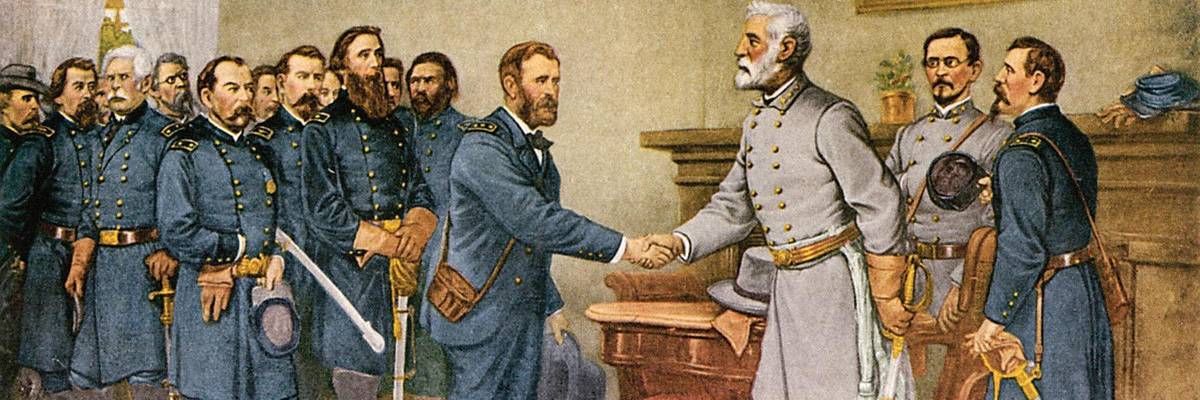
The surrender. One image commemorating the day shows an eagle in honor of the onset of peace with, "Slavery and Treason buried in the same grave!"
This weekend marked the surrender of the Confederate Army under "that genteel butcher Bobby Lee" to Ulysses S. Grant, and the end of the Civil War. After four years and 630,000 lives lost in the sordid name of Southern white supremacy, the date symbolizes an imperfect but hopeful turning point for a nation at bloody war with itself, a nation called on by Abraham Lincoln - himself struck down by hate just days later - to "strive on to finish the work we are in, to bind up the nation's wounds."
This weekend marked the surrender of the Confederate Army under "that genteel butcher Bobby Lee" to Ulysses S. Grant, and the end of a Civil War that in the sordid name of Southern white supremacy cost four years and 630,000 lives. On Sunday April 9, 1865, General Robert E. Lee surrendered his Confederate Army of North Virginia, fighting for the unholy right to own other human beings as property, to General Ulysses S. Grant; the ceremony at the home of Wilmer and Virginia McLean in the town of Appomattox Court House, VA took an hour and a half. Days before, Grant had ridden west to ask Lee's cornered band to surrender, declaring any "further effusion of blood" would be solely on Lee's traitorous hands. Lee declined, but did ask about a possible peace agreement; the gentlemanly Grant offered a possible military surrender instead. On that Sunday, writes Heather Cox Richardson, admirably bringing the historic down to human scale, Grant woke with a migraine, having spent the night treating it with mustard plasters that didn't work: "In the morning, Grant pulled on his dirty clothes and rode out to the head of his column with his head throbbing." Lee, ever the brutal but elegant plantation owner, had dressed grandly in dress uniform, expecting to be taken prisoner; instead, under the surrender's generous terms, his military leaders were spared criminal trials, and handsomely fed. Notes Thomas Levenson, "Looking forward, not back, is no new trope in American politics."
Though the war dragged on for several months, Appomattox marked the inevitable victory of the Union. About 150 miles away, President Abraham Lincoln spent the day steaming up a peaceful Potomac River with a small family party. His guests recalled him sitting in the cabin, reading aloud from Macbeth and stopping to ponder a passage about the slain king Duncan: "After life's fitful fever he sleeps well/Treason has done its worst/...Malice domestic, foreign levey, nothing/Can touch him further." Five days later, Lincoln was killed. Appotomattox was lauded in one image with a noble eagle and the declaration, "Lee has surrendered! Slavery and treason buried in the same grave!" Slavery, yes: Despite the enduring lie by Lost Cause apologists the Confederate fight was about Southern culture and states' rights, they were a slave-holding army fighting to own black people, and they lost that explicit right. As to treason, it still looms: Inexplicably on Page 15 - and below the fold - the once-estimable New York Times reports little Donnie Trump is still at it. But Appotomattox, argues Levenson, "is a great day." Conceding "too much was left undone (and) too much remains undone," the day "enshrined at least the possibility that Federal authority could remedy grievous wrong" - in itself "cause for remembrance of a great hope kindled," and the too-long wait, still ongoing, for its fulfillment. In the tragic end, he quotes the possibly-too-sangine Lincoln, the month before, on the way forward.
With malice toward none, with charity for all, with firmness in the right...let us strive on to finish the work we are in, to bind up the nation's wounds."
Dear Common Dreams reader, It’s been nearly 30 years since I co-founded Common Dreams with my late wife, Lina Newhouser. We had the radical notion that journalism should serve the public good, not corporate profits. It was clear to us from the outset what it would take to build such a project. No paid advertisements. No corporate sponsors. No millionaire publisher telling us what to think or do. Many people said we wouldn't last a year, but we proved those doubters wrong. Together with a tremendous team of journalists and dedicated staff, we built an independent media outlet free from the constraints of profits and corporate control. Our mission has always been simple: To inform. To inspire. To ignite change for the common good. Building Common Dreams was not easy. Our survival was never guaranteed. When you take on the most powerful forces—Wall Street greed, fossil fuel industry destruction, Big Tech lobbyists, and uber-rich oligarchs who have spent billions upon billions rigging the economy and democracy in their favor—the only bulwark you have is supporters who believe in your work. But here’s the urgent message from me today. It's never been this bad out there. And it's never been this hard to keep us going. At the very moment Common Dreams is most needed, the threats we face are intensifying. We need your support now more than ever. We don't accept corporate advertising and never will. We don't have a paywall because we don't think people should be blocked from critical news based on their ability to pay. Everything we do is funded by the donations of readers like you. When everyone does the little they can afford, we are strong. But if that support retreats or dries up, so do we. Will you donate now to make sure Common Dreams not only survives but thrives? —Craig Brown, Co-founder |
This weekend marked the surrender of the Confederate Army under "that genteel butcher Bobby Lee" to Ulysses S. Grant, and the end of a Civil War that in the sordid name of Southern white supremacy cost four years and 630,000 lives. On Sunday April 9, 1865, General Robert E. Lee surrendered his Confederate Army of North Virginia, fighting for the unholy right to own other human beings as property, to General Ulysses S. Grant; the ceremony at the home of Wilmer and Virginia McLean in the town of Appomattox Court House, VA took an hour and a half. Days before, Grant had ridden west to ask Lee's cornered band to surrender, declaring any "further effusion of blood" would be solely on Lee's traitorous hands. Lee declined, but did ask about a possible peace agreement; the gentlemanly Grant offered a possible military surrender instead. On that Sunday, writes Heather Cox Richardson, admirably bringing the historic down to human scale, Grant woke with a migraine, having spent the night treating it with mustard plasters that didn't work: "In the morning, Grant pulled on his dirty clothes and rode out to the head of his column with his head throbbing." Lee, ever the brutal but elegant plantation owner, had dressed grandly in dress uniform, expecting to be taken prisoner; instead, under the surrender's generous terms, his military leaders were spared criminal trials, and handsomely fed. Notes Thomas Levenson, "Looking forward, not back, is no new trope in American politics."
Though the war dragged on for several months, Appomattox marked the inevitable victory of the Union. About 150 miles away, President Abraham Lincoln spent the day steaming up a peaceful Potomac River with a small family party. His guests recalled him sitting in the cabin, reading aloud from Macbeth and stopping to ponder a passage about the slain king Duncan: "After life's fitful fever he sleeps well/Treason has done its worst/...Malice domestic, foreign levey, nothing/Can touch him further." Five days later, Lincoln was killed. Appotomattox was lauded in one image with a noble eagle and the declaration, "Lee has surrendered! Slavery and treason buried in the same grave!" Slavery, yes: Despite the enduring lie by Lost Cause apologists the Confederate fight was about Southern culture and states' rights, they were a slave-holding army fighting to own black people, and they lost that explicit right. As to treason, it still looms: Inexplicably on Page 15 - and below the fold - the once-estimable New York Times reports little Donnie Trump is still at it. But Appotomattox, argues Levenson, "is a great day." Conceding "too much was left undone (and) too much remains undone," the day "enshrined at least the possibility that Federal authority could remedy grievous wrong" - in itself "cause for remembrance of a great hope kindled," and the too-long wait, still ongoing, for its fulfillment. In the tragic end, he quotes the possibly-too-sangine Lincoln, the month before, on the way forward.
With malice toward none, with charity for all, with firmness in the right...let us strive on to finish the work we are in, to bind up the nation's wounds."
This weekend marked the surrender of the Confederate Army under "that genteel butcher Bobby Lee" to Ulysses S. Grant, and the end of a Civil War that in the sordid name of Southern white supremacy cost four years and 630,000 lives. On Sunday April 9, 1865, General Robert E. Lee surrendered his Confederate Army of North Virginia, fighting for the unholy right to own other human beings as property, to General Ulysses S. Grant; the ceremony at the home of Wilmer and Virginia McLean in the town of Appomattox Court House, VA took an hour and a half. Days before, Grant had ridden west to ask Lee's cornered band to surrender, declaring any "further effusion of blood" would be solely on Lee's traitorous hands. Lee declined, but did ask about a possible peace agreement; the gentlemanly Grant offered a possible military surrender instead. On that Sunday, writes Heather Cox Richardson, admirably bringing the historic down to human scale, Grant woke with a migraine, having spent the night treating it with mustard plasters that didn't work: "In the morning, Grant pulled on his dirty clothes and rode out to the head of his column with his head throbbing." Lee, ever the brutal but elegant plantation owner, had dressed grandly in dress uniform, expecting to be taken prisoner; instead, under the surrender's generous terms, his military leaders were spared criminal trials, and handsomely fed. Notes Thomas Levenson, "Looking forward, not back, is no new trope in American politics."
Though the war dragged on for several months, Appomattox marked the inevitable victory of the Union. About 150 miles away, President Abraham Lincoln spent the day steaming up a peaceful Potomac River with a small family party. His guests recalled him sitting in the cabin, reading aloud from Macbeth and stopping to ponder a passage about the slain king Duncan: "After life's fitful fever he sleeps well/Treason has done its worst/...Malice domestic, foreign levey, nothing/Can touch him further." Five days later, Lincoln was killed. Appotomattox was lauded in one image with a noble eagle and the declaration, "Lee has surrendered! Slavery and treason buried in the same grave!" Slavery, yes: Despite the enduring lie by Lost Cause apologists the Confederate fight was about Southern culture and states' rights, they were a slave-holding army fighting to own black people, and they lost that explicit right. As to treason, it still looms: Inexplicably on Page 15 - and below the fold - the once-estimable New York Times reports little Donnie Trump is still at it. But Appotomattox, argues Levenson, "is a great day." Conceding "too much was left undone (and) too much remains undone," the day "enshrined at least the possibility that Federal authority could remedy grievous wrong" - in itself "cause for remembrance of a great hope kindled," and the too-long wait, still ongoing, for its fulfillment. In the tragic end, he quotes the possibly-too-sangine Lincoln, the month before, on the way forward.
With malice toward none, with charity for all, with firmness in the right...let us strive on to finish the work we are in, to bind up the nation's wounds."