

SUBSCRIBE TO OUR FREE NEWSLETTER
Daily news & progressive opinion—funded by the people, not the corporations—delivered straight to your inbox.
5
#000000
#FFFFFF
To donate by check, phone, or other method, see our More Ways to Give page.
Daily news & progressive opinion—funded by the people, not the corporations—delivered straight to your inbox.
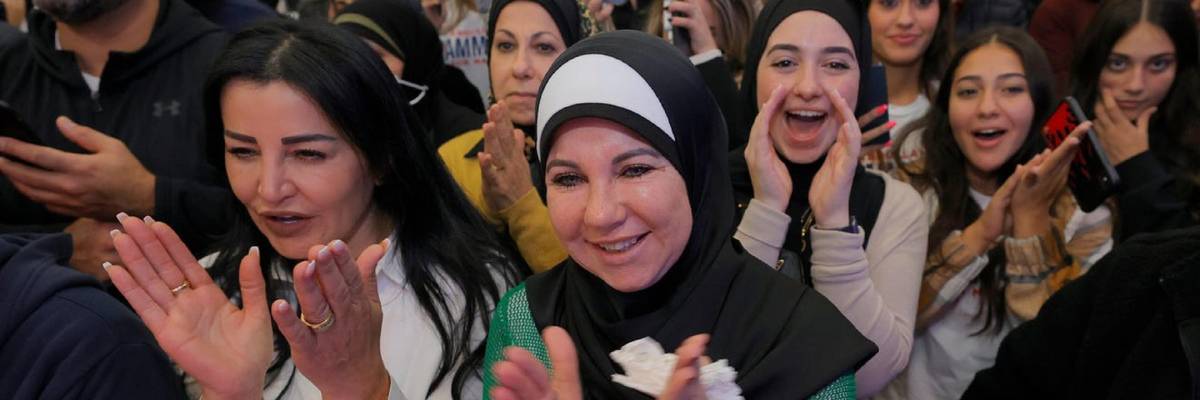
Mayor-elect Abdullah Hammoud's mother Ghada and sister Laila (second row in middle) celebrate his victory with a Dearborn crowd of supporters at Mohammed Turfe Community Center. Photo by Eric Seals/ Detroit Free Press
Okay, so the effort to replace Minneapolis' brutish police department failed. But close to half the city voted for it, marking a newly vital national conversation about change, race and power also reflected in a week that saw three Michigan towns elect their first Muslim and Arab-American mayors. In Dearborn, aka the capital of Arab America, Lebanese Mayor-elect Abdullah Hammoud stressed, "We never ran to be the first, we ran to be the best." Still, he told any kids "who have ever been ridiculed for their faith or ethnicity...Today is proof that you are as American as anyone else."
Okay, so the effort to replace Minneapolis' brutish police department with a community-minded Department of Public Safety failed. But almost half the city voted for it, marking, amidst a national conversation about change, race and power, what organizers called "a consensus that the status quo is not an option." And in a taste of Raymond Carver's "small good" things, that shift was reflected across the country: In police reform measures passed in Austin and Cleveland; the re-election in Waterloo, Iowa of its first black mayor - despite the opposition of cranky back-the-blue retired cops mad the city was replacing their longtime, KKK-dragon-like emblem - and the election of its first majority black city council; and the election in three Michigan towns of their first Muslim and Arab-American mayors newly giving voice to their communities. In Dearborn Heights, which is about a third Arab-American, Mayor Bill Bazzi, a Lebanese immigrant and 21-year veteran of the Marine Corps, became the first elected Muslim mayor after having been appointed when the former mayor died. He easily defeated his opponent, who once accused him of faking his Marine service - a charge Bazzi said rendered him "speechless." In Hamtramck, Amer Ghalib, a health care worker and immigrant from Yemen who came here at 17, became both the town's first Muslim and Arab-American mayor and its first non-Polish mayor in 100 years when he crushed Mayor Karen Majewski with 68% of the vote; three Muslims were also newly elected to the city council, making it now entirely Muslim. In a town with a large population of Muslims from Yemen and Bangladesh who've long struggled to be heard, he was mobbed by jubilant supporters after his victory.
Finally, in Dearborn, 31-year-old state lawmaker and self-described "pragmatic progressive" Abdullah Hammoud became the first Muslim mayor in a city that's almost half Arab-American. His win was especially historic in light of the city's past: Known as the capital of Arab America, Dearborn boasts the country's largest mosque, its first Arab-American museum, and its second largest Arab population after California; it's also infamous for its racist leaders. Its longest-serving mayor Orville Hubbard was nationally known for his racism, and the city's last mayor used to rage about "the Arab problem." Born to Lebanese immigrant parents who eventually became successful small-business owners, Hammoud has a master's degree in public health and an MBA from the University of Michigan. He was elected to the state legislature at 26, moved by the sudden death of a brother who told him to do good. In a victory speech, his mother and nine-months-pregnant wife Dr. Fatima Beydoun beside him, he thanked God - "Allah (has) all the glory" - proclaimed "a new era in Dearborn," and noted, "We never ran to be the first, we ran to be the best." "To the young girls and boys who have ever been ridiculed for their faith or ethnicity...to (our) elders and others who are humiliated for their broken English and yet still persist, today is proof that you are as American as anyone else," he declared. "We said that together we can (and) will bring change. Tonight, together, we did it." His resolute call and hope for change movingly echoes the tireless Rev. Jesse Jackson, 80, who despite his Parkinson's and recent bout of COVID was at Howard University last week to support students protesting against "unlivable" housing conditions. On Monday, he fell, hit his head, and was hospitalized. On Tuesday, he thanked the health workers and returned to campus, explaining, "I want to get back to work now."
Dear Common Dreams reader, It’s been nearly 30 years since I co-founded Common Dreams with my late wife, Lina Newhouser. We had the radical notion that journalism should serve the public good, not corporate profits. It was clear to us from the outset what it would take to build such a project. No paid advertisements. No corporate sponsors. No millionaire publisher telling us what to think or do. Many people said we wouldn't last a year, but we proved those doubters wrong. Together with a tremendous team of journalists and dedicated staff, we built an independent media outlet free from the constraints of profits and corporate control. Our mission has always been simple: To inform. To inspire. To ignite change for the common good. Building Common Dreams was not easy. Our survival was never guaranteed. When you take on the most powerful forces—Wall Street greed, fossil fuel industry destruction, Big Tech lobbyists, and uber-rich oligarchs who have spent billions upon billions rigging the economy and democracy in their favor—the only bulwark you have is supporters who believe in your work. But here’s the urgent message from me today. It's never been this bad out there. And it's never been this hard to keep us going. At the very moment Common Dreams is most needed, the threats we face are intensifying. We need your support now more than ever. We don't accept corporate advertising and never will. We don't have a paywall because we don't think people should be blocked from critical news based on their ability to pay. Everything we do is funded by the donations of readers like you. When everyone does the little they can afford, we are strong. But if that support retreats or dries up, so do we. Will you donate now to make sure Common Dreams not only survives but thrives? —Craig Brown, Co-founder |
Okay, so the effort to replace Minneapolis' brutish police department with a community-minded Department of Public Safety failed. But almost half the city voted for it, marking, amidst a national conversation about change, race and power, what organizers called "a consensus that the status quo is not an option." And in a taste of Raymond Carver's "small good" things, that shift was reflected across the country: In police reform measures passed in Austin and Cleveland; the re-election in Waterloo, Iowa of its first black mayor - despite the opposition of cranky back-the-blue retired cops mad the city was replacing their longtime, KKK-dragon-like emblem - and the election of its first majority black city council; and the election in three Michigan towns of their first Muslim and Arab-American mayors newly giving voice to their communities. In Dearborn Heights, which is about a third Arab-American, Mayor Bill Bazzi, a Lebanese immigrant and 21-year veteran of the Marine Corps, became the first elected Muslim mayor after having been appointed when the former mayor died. He easily defeated his opponent, who once accused him of faking his Marine service - a charge Bazzi said rendered him "speechless." In Hamtramck, Amer Ghalib, a health care worker and immigrant from Yemen who came here at 17, became both the town's first Muslim and Arab-American mayor and its first non-Polish mayor in 100 years when he crushed Mayor Karen Majewski with 68% of the vote; three Muslims were also newly elected to the city council, making it now entirely Muslim. In a town with a large population of Muslims from Yemen and Bangladesh who've long struggled to be heard, he was mobbed by jubilant supporters after his victory.
Finally, in Dearborn, 31-year-old state lawmaker and self-described "pragmatic progressive" Abdullah Hammoud became the first Muslim mayor in a city that's almost half Arab-American. His win was especially historic in light of the city's past: Known as the capital of Arab America, Dearborn boasts the country's largest mosque, its first Arab-American museum, and its second largest Arab population after California; it's also infamous for its racist leaders. Its longest-serving mayor Orville Hubbard was nationally known for his racism, and the city's last mayor used to rage about "the Arab problem." Born to Lebanese immigrant parents who eventually became successful small-business owners, Hammoud has a master's degree in public health and an MBA from the University of Michigan. He was elected to the state legislature at 26, moved by the sudden death of a brother who told him to do good. In a victory speech, his mother and nine-months-pregnant wife Dr. Fatima Beydoun beside him, he thanked God - "Allah (has) all the glory" - proclaimed "a new era in Dearborn," and noted, "We never ran to be the first, we ran to be the best." "To the young girls and boys who have ever been ridiculed for their faith or ethnicity...to (our) elders and others who are humiliated for their broken English and yet still persist, today is proof that you are as American as anyone else," he declared. "We said that together we can (and) will bring change. Tonight, together, we did it." His resolute call and hope for change movingly echoes the tireless Rev. Jesse Jackson, 80, who despite his Parkinson's and recent bout of COVID was at Howard University last week to support students protesting against "unlivable" housing conditions. On Monday, he fell, hit his head, and was hospitalized. On Tuesday, he thanked the health workers and returned to campus, explaining, "I want to get back to work now."
Okay, so the effort to replace Minneapolis' brutish police department with a community-minded Department of Public Safety failed. But almost half the city voted for it, marking, amidst a national conversation about change, race and power, what organizers called "a consensus that the status quo is not an option." And in a taste of Raymond Carver's "small good" things, that shift was reflected across the country: In police reform measures passed in Austin and Cleveland; the re-election in Waterloo, Iowa of its first black mayor - despite the opposition of cranky back-the-blue retired cops mad the city was replacing their longtime, KKK-dragon-like emblem - and the election of its first majority black city council; and the election in three Michigan towns of their first Muslim and Arab-American mayors newly giving voice to their communities. In Dearborn Heights, which is about a third Arab-American, Mayor Bill Bazzi, a Lebanese immigrant and 21-year veteran of the Marine Corps, became the first elected Muslim mayor after having been appointed when the former mayor died. He easily defeated his opponent, who once accused him of faking his Marine service - a charge Bazzi said rendered him "speechless." In Hamtramck, Amer Ghalib, a health care worker and immigrant from Yemen who came here at 17, became both the town's first Muslim and Arab-American mayor and its first non-Polish mayor in 100 years when he crushed Mayor Karen Majewski with 68% of the vote; three Muslims were also newly elected to the city council, making it now entirely Muslim. In a town with a large population of Muslims from Yemen and Bangladesh who've long struggled to be heard, he was mobbed by jubilant supporters after his victory.
Finally, in Dearborn, 31-year-old state lawmaker and self-described "pragmatic progressive" Abdullah Hammoud became the first Muslim mayor in a city that's almost half Arab-American. His win was especially historic in light of the city's past: Known as the capital of Arab America, Dearborn boasts the country's largest mosque, its first Arab-American museum, and its second largest Arab population after California; it's also infamous for its racist leaders. Its longest-serving mayor Orville Hubbard was nationally known for his racism, and the city's last mayor used to rage about "the Arab problem." Born to Lebanese immigrant parents who eventually became successful small-business owners, Hammoud has a master's degree in public health and an MBA from the University of Michigan. He was elected to the state legislature at 26, moved by the sudden death of a brother who told him to do good. In a victory speech, his mother and nine-months-pregnant wife Dr. Fatima Beydoun beside him, he thanked God - "Allah (has) all the glory" - proclaimed "a new era in Dearborn," and noted, "We never ran to be the first, we ran to be the best." "To the young girls and boys who have ever been ridiculed for their faith or ethnicity...to (our) elders and others who are humiliated for their broken English and yet still persist, today is proof that you are as American as anyone else," he declared. "We said that together we can (and) will bring change. Tonight, together, we did it." His resolute call and hope for change movingly echoes the tireless Rev. Jesse Jackson, 80, who despite his Parkinson's and recent bout of COVID was at Howard University last week to support students protesting against "unlivable" housing conditions. On Monday, he fell, hit his head, and was hospitalized. On Tuesday, he thanked the health workers and returned to campus, explaining, "I want to get back to work now."