SUBSCRIBE TO OUR FREE NEWSLETTER
Daily news & progressive opinion—funded by the people, not the corporations—delivered straight to your inbox.
5
#000000
#FFFFFF
To donate by check, phone, or other method, see our More Ways to Give page.
Daily news & progressive opinion—funded by the people, not the corporations—delivered straight to your inbox.
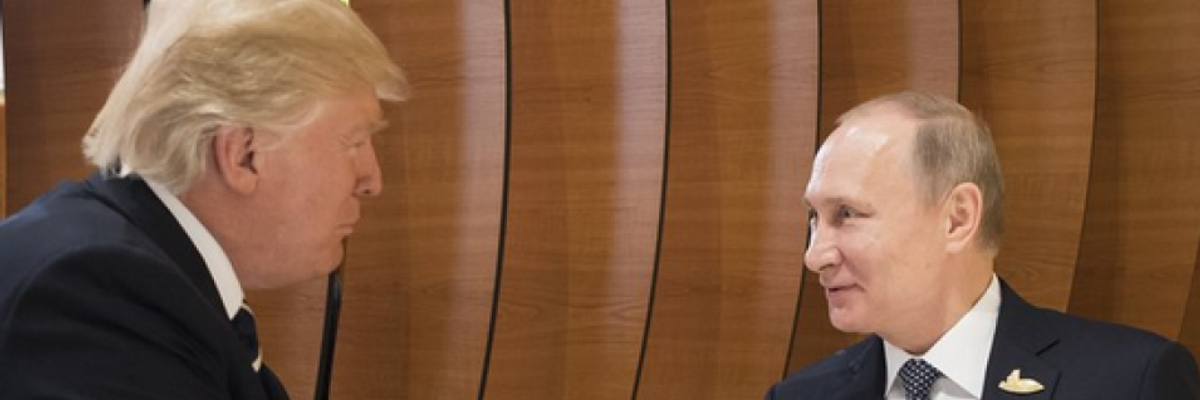
"Putin is known to especially dislike the US sanctions on his billionaire cronies, whose wealth he has often helped create through state mechanisms."(Photo: Screenshot)
The Trump administration has refused to implement new sanctions on the Russian defense sector, as mandated by Congress's "Countering America's Adversaries Through Sanctions Act," or CAATSA. Congress passed the bill last year and it was reluctantly finally signed by Trump in August. It is vaguely worded enough, however, that Trump's White House attorneys appear to have concluded that it need not actually be implemented.
The question of whether US sanctions on Russia, or further such sanctions, are wise or justified or even legal can be argued. But Trump's actions in this case are flatfooted and will give rise to further suspicions that Putin has some sort of hold over him. He could have declined to sign CAATSA on any number of grounds. Or he could have implemented it half-heartedly. Signing it and then not implementing it is the worst of all possible worlds politically.
The US already has sanctions on Russia, but the new law sought to increase them and to identify oligarchs close to President Vladimir Putin. Putin is known to especially dislike the US sanctions on his billionaire cronies, whose wealth he has often helped create through state mechanisms. Putin has long since crushed those oligarchs who were independent of him.
The Department of the Treasury did issue the list of oligarchs, but Trump has declined to place further sanctions on third parties doing business with them, as Congress mandated. The earlier round of sanctions came out of Congressional GOP distress at the unilateral Russian annexation of Crimea from the Ukraine and its support for ethnic Russian separatists in east Ukraine.
Secretary of State Rex Tillerson announced his non-compliance with the Congressional law, saying that the earlier round of sanctions had done billions of dollars of damage to the Russian arms industry, and that it was best to let that process of disruption continue rather than introducing new uncertainties, given that arms contracting is a multi-year endeavor.
If you could not understand how Tillerson's argument makes any sense, join the club-it seems nonsensical to yours truly, as well.
But you wonder if he let the cat out of the bag. Is the underlying motivation for these unilateral US sanctions on Russia now simply to give Lockheed Martin, Boeing and other US arms manufacturers an advantage over their Russian counterparts?
Meanwhile, BBC Monitoring translates some of the Russian concerns about the whole episode, from yesterday's papers before Trump announced his non-compliance.
Russian billionaire Alexei Mordashov said at Davos that US sanctions would not directly affect the general business climate, since they are targeted at the defense sector. He admitted, however, that they increase uncertainty, which is bad for business.
Yevsey Gurvich at the state-owned Rossiyskaya Gazeta said that US sanctions have an up side, in that they will bring Russian investments back to Russia. The government is offering an amnesty for repatriating capital this spring, and the US congress may contribute to its success by increasing the riskiness of foreign investment.
Gee, Congress is Making Russia Great Again!
Analyst Alan Karashkin at the Russian Business Daily admitted that Western banks and financiers will be affected by the US Treasury Department's listing of "oligarchs."
Natalia Orlova feared that the US move might increase the volatility of the rouble exchange rate.
So a lot of Russian analysts see a negative impact from the mere threat of further US sanctions contained in CAATSA, which they see as creating a negative business environment for Russian investments abroad.
Dear Common Dreams reader, It’s been nearly 30 years since I co-founded Common Dreams with my late wife, Lina Newhouser. We had the radical notion that journalism should serve the public good, not corporate profits. It was clear to us from the outset what it would take to build such a project. No paid advertisements. No corporate sponsors. No millionaire publisher telling us what to think or do. Many people said we wouldn't last a year, but we proved those doubters wrong. Together with a tremendous team of journalists and dedicated staff, we built an independent media outlet free from the constraints of profits and corporate control. Our mission has always been simple: To inform. To inspire. To ignite change for the common good. Building Common Dreams was not easy. Our survival was never guaranteed. When you take on the most powerful forces—Wall Street greed, fossil fuel industry destruction, Big Tech lobbyists, and uber-rich oligarchs who have spent billions upon billions rigging the economy and democracy in their favor—the only bulwark you have is supporters who believe in your work. But here’s the urgent message from me today. It's never been this bad out there. And it's never been this hard to keep us going. At the very moment Common Dreams is most needed, the threats we face are intensifying. We need your support now more than ever. We don't accept corporate advertising and never will. We don't have a paywall because we don't think people should be blocked from critical news based on their ability to pay. Everything we do is funded by the donations of readers like you. When everyone does the little they can afford, we are strong. But if that support retreats or dries up, so do we. Will you donate now to make sure Common Dreams not only survives but thrives? —Craig Brown, Co-founder |
The Trump administration has refused to implement new sanctions on the Russian defense sector, as mandated by Congress's "Countering America's Adversaries Through Sanctions Act," or CAATSA. Congress passed the bill last year and it was reluctantly finally signed by Trump in August. It is vaguely worded enough, however, that Trump's White House attorneys appear to have concluded that it need not actually be implemented.
The question of whether US sanctions on Russia, or further such sanctions, are wise or justified or even legal can be argued. But Trump's actions in this case are flatfooted and will give rise to further suspicions that Putin has some sort of hold over him. He could have declined to sign CAATSA on any number of grounds. Or he could have implemented it half-heartedly. Signing it and then not implementing it is the worst of all possible worlds politically.
The US already has sanctions on Russia, but the new law sought to increase them and to identify oligarchs close to President Vladimir Putin. Putin is known to especially dislike the US sanctions on his billionaire cronies, whose wealth he has often helped create through state mechanisms. Putin has long since crushed those oligarchs who were independent of him.
The Department of the Treasury did issue the list of oligarchs, but Trump has declined to place further sanctions on third parties doing business with them, as Congress mandated. The earlier round of sanctions came out of Congressional GOP distress at the unilateral Russian annexation of Crimea from the Ukraine and its support for ethnic Russian separatists in east Ukraine.
Secretary of State Rex Tillerson announced his non-compliance with the Congressional law, saying that the earlier round of sanctions had done billions of dollars of damage to the Russian arms industry, and that it was best to let that process of disruption continue rather than introducing new uncertainties, given that arms contracting is a multi-year endeavor.
If you could not understand how Tillerson's argument makes any sense, join the club-it seems nonsensical to yours truly, as well.
But you wonder if he let the cat out of the bag. Is the underlying motivation for these unilateral US sanctions on Russia now simply to give Lockheed Martin, Boeing and other US arms manufacturers an advantage over their Russian counterparts?
Meanwhile, BBC Monitoring translates some of the Russian concerns about the whole episode, from yesterday's papers before Trump announced his non-compliance.
Russian billionaire Alexei Mordashov said at Davos that US sanctions would not directly affect the general business climate, since they are targeted at the defense sector. He admitted, however, that they increase uncertainty, which is bad for business.
Yevsey Gurvich at the state-owned Rossiyskaya Gazeta said that US sanctions have an up side, in that they will bring Russian investments back to Russia. The government is offering an amnesty for repatriating capital this spring, and the US congress may contribute to its success by increasing the riskiness of foreign investment.
Gee, Congress is Making Russia Great Again!
Analyst Alan Karashkin at the Russian Business Daily admitted that Western banks and financiers will be affected by the US Treasury Department's listing of "oligarchs."
Natalia Orlova feared that the US move might increase the volatility of the rouble exchange rate.
So a lot of Russian analysts see a negative impact from the mere threat of further US sanctions contained in CAATSA, which they see as creating a negative business environment for Russian investments abroad.
The Trump administration has refused to implement new sanctions on the Russian defense sector, as mandated by Congress's "Countering America's Adversaries Through Sanctions Act," or CAATSA. Congress passed the bill last year and it was reluctantly finally signed by Trump in August. It is vaguely worded enough, however, that Trump's White House attorneys appear to have concluded that it need not actually be implemented.
The question of whether US sanctions on Russia, or further such sanctions, are wise or justified or even legal can be argued. But Trump's actions in this case are flatfooted and will give rise to further suspicions that Putin has some sort of hold over him. He could have declined to sign CAATSA on any number of grounds. Or he could have implemented it half-heartedly. Signing it and then not implementing it is the worst of all possible worlds politically.
The US already has sanctions on Russia, but the new law sought to increase them and to identify oligarchs close to President Vladimir Putin. Putin is known to especially dislike the US sanctions on his billionaire cronies, whose wealth he has often helped create through state mechanisms. Putin has long since crushed those oligarchs who were independent of him.
The Department of the Treasury did issue the list of oligarchs, but Trump has declined to place further sanctions on third parties doing business with them, as Congress mandated. The earlier round of sanctions came out of Congressional GOP distress at the unilateral Russian annexation of Crimea from the Ukraine and its support for ethnic Russian separatists in east Ukraine.
Secretary of State Rex Tillerson announced his non-compliance with the Congressional law, saying that the earlier round of sanctions had done billions of dollars of damage to the Russian arms industry, and that it was best to let that process of disruption continue rather than introducing new uncertainties, given that arms contracting is a multi-year endeavor.
If you could not understand how Tillerson's argument makes any sense, join the club-it seems nonsensical to yours truly, as well.
But you wonder if he let the cat out of the bag. Is the underlying motivation for these unilateral US sanctions on Russia now simply to give Lockheed Martin, Boeing and other US arms manufacturers an advantage over their Russian counterparts?
Meanwhile, BBC Monitoring translates some of the Russian concerns about the whole episode, from yesterday's papers before Trump announced his non-compliance.
Russian billionaire Alexei Mordashov said at Davos that US sanctions would not directly affect the general business climate, since they are targeted at the defense sector. He admitted, however, that they increase uncertainty, which is bad for business.
Yevsey Gurvich at the state-owned Rossiyskaya Gazeta said that US sanctions have an up side, in that they will bring Russian investments back to Russia. The government is offering an amnesty for repatriating capital this spring, and the US congress may contribute to its success by increasing the riskiness of foreign investment.
Gee, Congress is Making Russia Great Again!
Analyst Alan Karashkin at the Russian Business Daily admitted that Western banks and financiers will be affected by the US Treasury Department's listing of "oligarchs."
Natalia Orlova feared that the US move might increase the volatility of the rouble exchange rate.
So a lot of Russian analysts see a negative impact from the mere threat of further US sanctions contained in CAATSA, which they see as creating a negative business environment for Russian investments abroad.