

SUBSCRIBE TO OUR FREE NEWSLETTER
Daily news & progressive opinion—funded by the people, not the corporations—delivered straight to your inbox.
5
#000000
#FFFFFF
To donate by check, phone, or other method, see our More Ways to Give page.
Daily news & progressive opinion—funded by the people, not the corporations—delivered straight to your inbox.
The Israeli prime minister has made it explicitly clear that he has no intention of following any peace road map, planning instead for the permanent incremental takeover of Gaza.
Gaza requires urgent international attention.
What is happening in the besieged and devastated strip at the moment by far exceeds an unfolding humanitarian disaster; it is a calculated geopolitical reshaping. Israel is actively executing a plan to permanently occupy the vast majority of Gaza, with consequences that require little elaboration considering what we already know about the ongoing genocide.
Currently, much of the international debate centers on a single official: Bulgarian diplomat Nickolay Mladenov. The former United Nations special coordinator has been designated by the United States as the executive director of the Trump administration’s newly established ‘Board of Peace’—an international council founded to oversee the implementation of Washington's 20-point Gaza road map.
The issue, however, is much bigger than a single Washington-backed bureaucrat. A growing number of Palestinians and political analysts accuse Mladenov of manufacturing the very conditions that continue to obstruct progress on the agreement’s transition to its second phase.
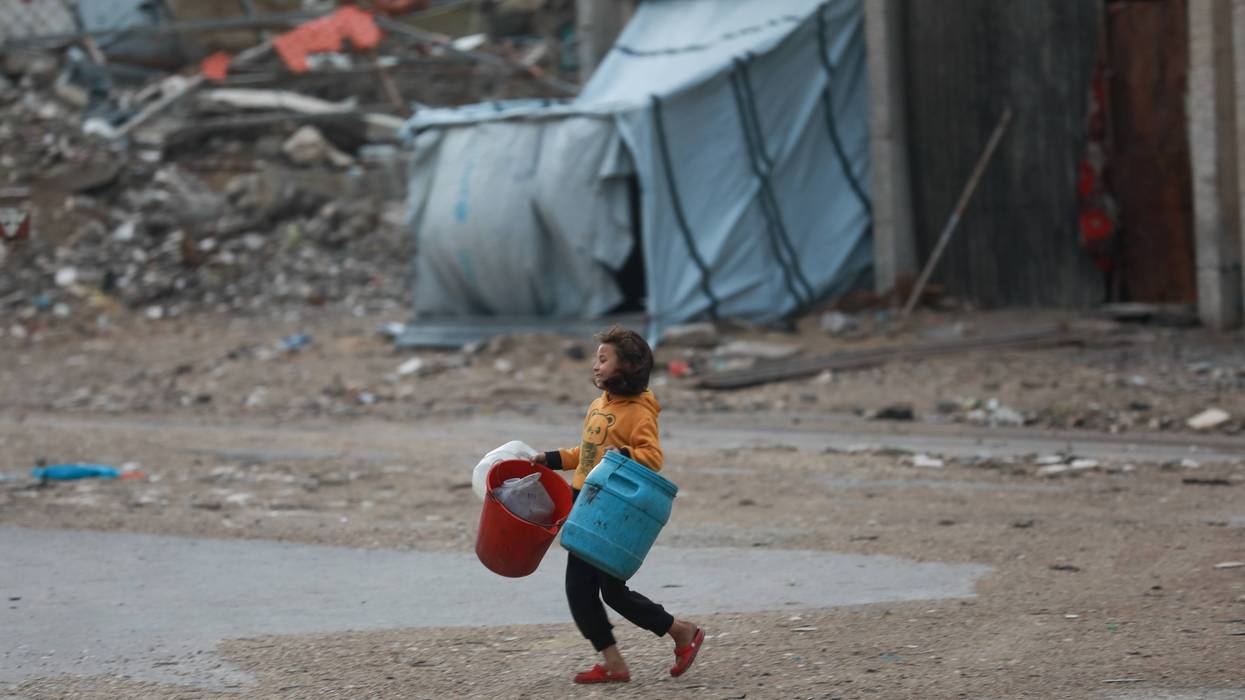
With nearly the entire population of Gaza living in sub-standard tents and surviving on the meager rations permitted through Israeli checkpoints, it is the highest form of immorality to demand political concessions in exchange for basic sustenance.
Under the framework, the official transition to this second phase—which President Donald Trump and the Board of Peace declared to have begun in January 2026—demands sweeping, one-sided Palestinian concessions, most notably the total disarmament of armed factions.
This demand is a recipe for the failure of the entire project, especially given that Israel has completely failed to implement the most basic requirements of the agreement's first phase. It has refused to halt its routine military incursions, has failed to withdraw its forces to the originally mandated "Yellow Line" demarcation, and continues to deny entry permits to the technocratic committee slated to assume civil governance of the Strip.
Mladenov's insistence on Palestinian disarmament before the agreement can advance—without a single guarantee of Israeli compliance—conveniently flips the narrative. It cynically reframes systematic starvation and the blockade of medical and construction supplies as a Palestinian failure to honor commitments.
In reality, Mladenov holds no real cards; he is merely a cog in a larger machinery controlled by Benjamin Netanyahu. The Israeli prime minister has made it explicitly clear that he has no intention of following any peace road map, planning instead for the permanent incremental takeover of Gaza.
Speaking at a conference in an occupied West Bank settlement on May 28, Netanyahu explained his strategy with total clarity, abandoning all diplomatic doublespeak: "We are currently squeezing Hamas; we now control 60% of the territory of the strip—you know this. We were at 50, we moved to 60. My directive is to move to..." he said, pausing as an audience member shouted "100!"
Netanyahu smiled and responded: "Let's go step by step. First of all, 70. Let's start with that. We're pressing them from all sides, we'll deal with the remnants."
This is the actual blueprint of the Israeli government, declared openly to domestic audiences. The admission was so brazen that even US Secretary of State Marco Rubio expressed frustration at Netanyahu's candor. Testifying before Congress on June 2, Rubio remarked, “We have a plan—it doesn’t call for that,” referring to further Israeli territorial expansion.
Yet, Rubio quickly reverted to Washington's standard line: “And at the end of the day, we understand that what we want, and I think what the Israelis would ultimately want, is a Gaza that is governed by a non-Hamas entity.”
While the immediate priority for Palestinians is not governance but lifesaving food, clean water, medicine, and basic survival, Netanyahu and Rubio view the entire crisis through a political lens. The US-Israeli plan is predicated on achieving, through diplomatic strangulation and engineered famine, what they failed to fully achieve through military might.
A rare, decisive answer came from United Nations spokesperson Stéphane Dujarric, who summed up the UN position plainly: “One hundred percent of Gaza should be for the Palestinian people." The problem, however, is that the UN’s rhetoric is backed by no real enforcement mechanisms.
The international community has walked directly into a trap, outsourcing the future of the Gaza Strip to the Trump administration and its Board of Peace. Even the designated technocratic committee has been rendered entirely irrelevant, excluded from a decision-making process left solely to diplomats beholden to the White House.
The situation on the ground remains catastrophic. Since the fragile, heavily compromised ceasefire took effect on October 10, regular Israeli violations and airstrikes have killed nearly 1,000 Palestinians and wounded thousands more—the vast majority women and children. When added to the horrific toll of the initial two years of war, the official number of Palestinians killed has surpassed 73,000, with over 173,000 injured.
Furthermore, credible epidemiological studies and medical journals have concluded that the true death toll is vastly higher.
With nearly the entire population of Gaza living in sub-standard tents and surviving on the meager rations permitted through Israeli checkpoints, it is the highest form of immorality to demand political concessions in exchange for basic sustenance.
Netanyahu's "step-by-step" annexation does not hinge on what Palestinian factions decide to do; his expansionist timeline is shaped independently of Palestinian compliance.
Arab, Muslim, and allied nations must fundamentally shift their diplomatic strategy. They must firmly insist on completely delinking humanitarian aid from the future governance or demilitarization of the Gaza Strip.
Starvation cannot be tolerated as political leverage for war criminals. Netanyahu is emboldened by a history of international impunity, speaking openly of expanding his military footprint regardless of the consequences of such action.
The international community must remind Israel’s government that the survival of millions of Palestinians cannot be held hostage to the political ambitions of an extremist coalition.
The number of people who were forcibly displaced at the end of last year dropped from 2024 levels, but that change was largely driven by people who were forced to return home, sometimes to precarious conditions.
The number of people forcibly displaced around the world fell last year for the first time in years, dropping by more than 5 million—but with that trend driven in part by countries that have forced refugees to return home, often to precarious or dangerous conditions, advocacy groups warned that the world's refugee and displacement crises are far from being solved.
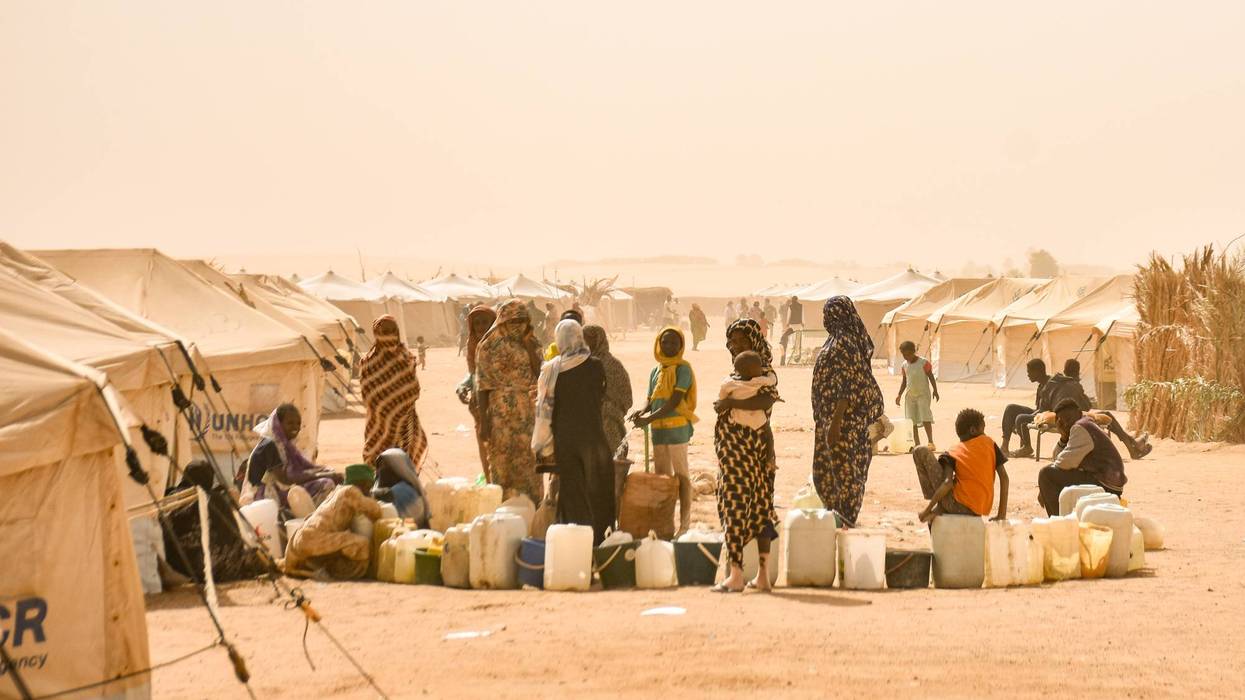
At the end of last year, 117.8 million people were forcibly displaced around the world, according to data released Thursday by the United Nations High Commissioner for Refugees (UNHCR). That number includes 41.6 million refugees, 9 million asylum-seekers, and 68.7 million internally displaced people.
While the number of displaced people fell from 123.2 million in 2024, the UNHCR emphasized that the change reflected "a sharp increase in the returns of refugees, mostly to Afghanistan, Syria, and Sudan."
"Many of the returns occurred under adverse circumstances and the reintegration conditions remain extremely challenging," said the agency.
Jan Egeland, secretary general of the Norwegian Refugee Council (NRC), said that "in Afghanistan, millions were forcibly returned from neighboring Pakistan and Iran, and in [the Democratic Republic of] Congo some displacement camps were evacuated at gunpoint, sending thousands of families back to homes that no longer exist."
Of 2.9 million Afghans who were no longer considered forcibly displaced last year, most of their returns to their home country were "involuntary in nature due to changes in the policies of host countries."
In the US, the Trump administration last year terminated Temporary Protected Status for Afghan nationals, between 9,500 and 11,700 of whom were legally residing in the US. Hundreds of thousands of Afghans were deported from Iran, Pakistan, and Tajikistan last year.
"The first fall in global displacement in over a decade should be good news. Instead, it reflects misery on a historic scale," said David Milliband, president of the International Rescue Committee. "These numbers tell a story of both forced returns and forced displacement. People are returning to countries mired in crisis, most with no choice, with every route to safety collapsed around them."
The number of refugees who were successfully resettled dropped precipitously last year along with the number of people who were classified as displaced. Just 81,800 people found new homes through resettlement programs or sponsorship pathways, representing a year-on-year drop of more than half.
The top countries that continued to host refugees last year were Colombia, Turkey, and Germany, and more than 70% of refugees came from just six countries: Afghanistan, South Sudan, Sudan, Syria, Ukraine, and Venezuela.
Egeland emphasized that while the number of forcibly displaced people fell last year, "the number of people who have fled their home because of violence and conflict has nearly tripled over the last 15 years."
"The 117.8 million people now violently displaced around the globe would constitute the world’s 13th-largest country by population. Larger than Egypt, Germany, or the UK. A human toll of vast proportions, and a collective failure of humanity," said Egeland.
The numbers released by UNHCR indicated that while millions "continued to be uprooted" last year, "many more endured protracted crises with no solution in sight. The world continues to fail civilians caught by conflict and violence."
UNHCR warned that among those who remain forcibly displaced, 7 in 10 refugees have been exiled from their homes for at least five years with little prospect of ever leaving refugee camps with precarious living conditions.
“For too many refugees, displacement starts as a lifeline but lasts a lifetime," said Barham Salih, the UN high commissioner for refugees. "Humanitarian aid saves lives, but it is not the end point and does not enable refugees to become active agents in control of their futures. We need a paradigm shift that creates a new sense of hope and opportunity for people fleeing war and persecution."
Salih called for a reduction by more than half, over the next decade, in the number of refugees who are reliant on humanitarian assistance and are living in temporary shelters.
"The initiative would expand opportunities for voluntary returns, humanitarian visas, and relocation, while transitioning refugees from aid dependency to self-reliance through access to education, healthcare, financial services, and labor markets," said the UNHCR.
The large numbers of people who have been forced from their homes—and in a rising number of cases, forced to return home under duress—"are almost impossible to comprehend," said Egeland. "And as an increasingly nationalistic world becomes increasingly desensitized to what it truly means to be forced to flee home, the gap between decision makers and donors and displaced people continues to widen. This cannot be accepted as the new normal."
“As humanitarians our work is to support displaced people in their hour of greatest need," he added. “But we cannot do this without a world that is willing to stand up for humanity... We must support diplomatic solutions to end crisis, and fund aid to relieve suffering. We must protect civilians and stand up for international humanitarian law. We must all remember our humanity.”
“Those who remain silent in the face of this growing unlawfulness and aggressiveness assume a grave responsibility," said the head of the International Association of Democratic Lawyers.
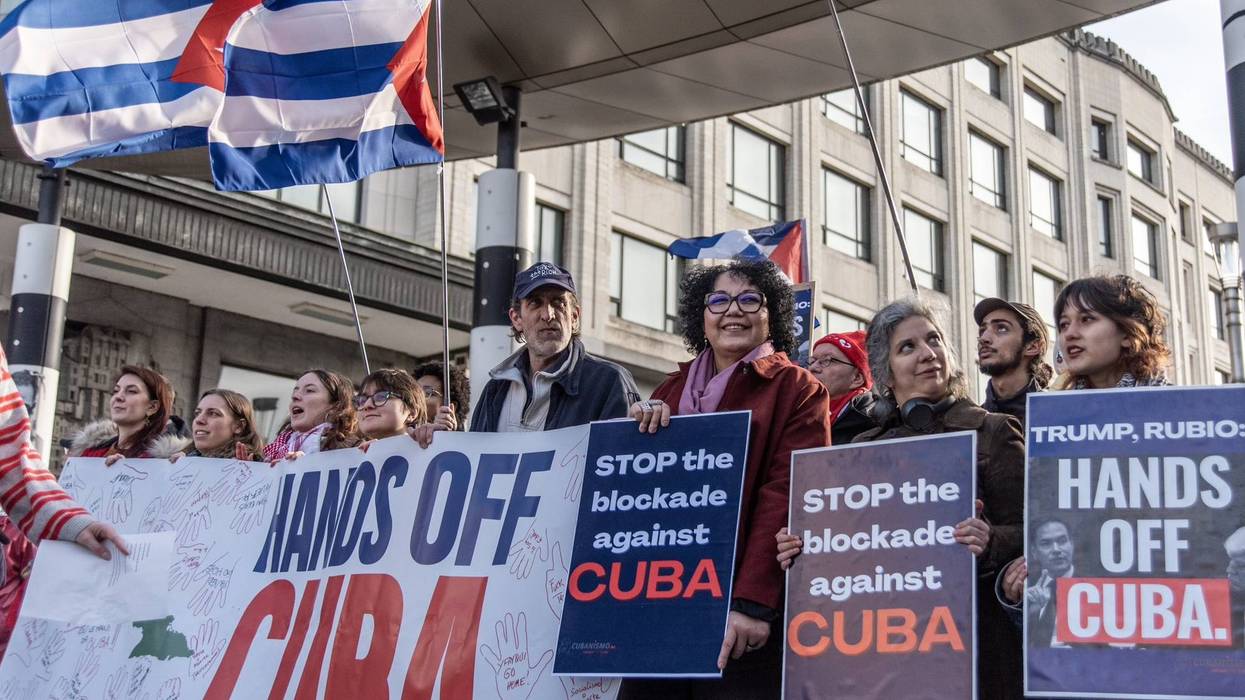
An international group of leftist lawyers on Tuesday condemned the US blockade, sanctions, and war threats against Cuba, and the mounting repression of solidarity with the long-suffering Cuban people.
The International Association of Democratic Lawyers (IADL) held a virtual press conference "to condemn escalating United States measures against Cuba and to call for renewed international action in defense of international law, Cuban sovereignty, and the rights of the Cuban people."
"The United States continues to threaten Cuba while imposing unilateral coercive economic measures designed to destabilize the country and facilitate regime change," IADL noted. "In recent months, restrictions on fuel shipments have further intensified the hardships faced by the Cuban people, with severe consequences for daily life."
"For more than three decades, the United Nations General Assembly has overwhelmingly called for an end to the US blockade of Cuba, with the United States and Israel consistently standing alone in opposition to the international consensus," the group added. "While these annual resolutions represent a powerful condemnation of the blockade, symbolic measures alone are insufficient. International law imposes obligations on states to act in the face of ongoing violations."
Speakers at the press conference warned that the Trump administration's recent actions—including war threats and a deadly fuel blockade—are serious violations of international law that threaten the rights and well-being of millions of Cubans.
"The illegality of the blockade is not in doubt. What is at stake today is the impunity that allows it to continue," IADL general secretary Micòl Savia said. "What is at stake is the complete disregard of the United States for international law and collective institutions and their contempt for the common values of humankind."
"The actions of successive US administrations against Cuba make it very clear that they do not consider themselves bound by the principles of sovereign equality, peaceful coexistence, and self-determination that form the foundation of the international legal order," she continued.
“Another dimension of the blockade and sanctions against Cuba is the pressure imposed on third countries," Savia said. "The threat of punishment against institutions, banks, companies, and individuals that seek to establish commercial, financial, or diplomatic relations with Cuba is an intervention not only against Cuba, but also into the sovereign sphere of other countries."
"This shows how broad and arbitrary the sanctions policy has become as a tool of coercion," she added. "The threat of sanctions against companies from third countries that trade with Cuba violates their sovereignty.”
Speakers at the event excoriated the Trump administration's escalating war threats and politically motivated indictment of former Cuban President Raúl Castro, a hero of his country's successful revolution against a US-backed dictatorship.
"Cuba is now under the direct threat of [a] US imperialist war of aggression after a long period of economic and financial blockade," said Filipino jurist Edwin De La Cruz of the Amistad Philippines-Cuba Friendship Association and National Union of People's Lawyers.
"Serious transgressions on Cuba’s sovereignty, from failed efforts to foment unrest among the population, to the personal assault on the integrity of Comrade Raúl Castro by [President] Donald Trump intensified, with a threat of armed invasion tweeted by Donald Trump himself," he continued.
"Cuba and the Philippines share a common history of US imperialist domination. We share a common enemy and a common struggle," De La Cruz noted, pointing to the so-called Spanish-American War, in which the United States conquered both countries, along with Puerto Rico and Guam, from Spain under the false pretense of a Spanish attack on the battleship USS Maine. The US colonized the Philippines from 1898-1946, except for a brief period of Japanese occupation during World War II.
Deborah Jackson, president of the US group National Conference of Black Lawyers, called the Castro indictment "a transparently political prosecution that serves no legitimate law enforcement purpose."
Castro—who served as Cuba's president for a decade after his older brother, Fidel Castro, stepped down in 2008—was indicted by the US Department of Justice (DOJ) last month for his alleged role in the 1996 shoot-down of planes operated by Brothers to the Rescue, a counter-revolutionary group founded by a CIA-trained operative and Bay of Pigs veteran, after repeated warnings that they had violated Cuban airspace.
Critics noted Trump's ongoing campaign of illegal boat bombings in the Caribbean Sea and Pacific Ocean, as well as the long history of US state terrorism against Cuba and support for the perpetrators of attacks carried out by right-wing Cuban exiles, including the 1976 bombing of a commercial flight with 73 people aboard.
Jackson said the charges against Castro "are clearly invalid... attempts to criminalize legitimate acts of self-defense by a sovereign nation" that "have been brought nearly three decades after the incident in question against a 94-year-old former head of state who will never be extradited to the United States."
Kerry McLean, an international human rights attorney with the National Lawyers' Guild in the United States, warned that “the indictment of Castro, a foreign leader and former head of state, threatens a repeat of the illegal abduction on January 3, 2026 of Venezuela’s president and his wife."
Trump ordered the invasion and arrest of President Nicolás Maduro and Cilia Flores on dubious drug trafficking, illegal weapons possession, and narco-terrorism charges. The DOJ has since admitted that the cartel which Trump claimed was led by Maduro does not, in fact, exist.
McLean added that the US invasion of Venezuela—during which more than 75 people, including 32 Cuban members of Maduro's security team, were killed—violated the UN Charter, a treaty that, under the US Constitution, is "the supreme law of the land."
Speakers at the IADL event also decried US efforts to intimidate, investigate, and criminalize solidarity organizations.
“Like the designation of Cuba as a 'state supporter of terror' and the designations of many of the leading organizations and figures of the Cuba solidarity movement, these organizations and individuals are designated and targeted to impose state terror on the Palestine and Cuba solidarity movements, divide people from their homelands, and blunt the effectiveness of any opposition to US imperialism," IADL deputy general secretary Charlotte Kates said.
"The aim of such designations is not only to prohibit financial transactions, but to isolate those organizations and individuals that the US views as key networks of solidarity against imperialism and to prevent meaningful action to bring its crimes to an end," she contended.
Savia said, “Those who remain silent in the face of this growing unlawfulness and aggressiveness assume a grave responsibility, particularly when such conduct is carried out by one of the most powerful and heavily armed states in the world."
"By letting these policies continue unabated," she added, "and by applying double standards and selectivity while granting widespread impunity to rich and powerful states, they contribute to the erosion of the international legal order and pave the way for a world without the rule of law."