

SUBSCRIBE TO OUR FREE NEWSLETTER
Daily news & progressive opinion—funded by the people, not the corporations—delivered straight to your inbox.
5
#000000
#FFFFFF
To donate by check, phone, or other method, see our More Ways to Give page.
Daily news & progressive opinion—funded by the people, not the corporations—delivered straight to your inbox.
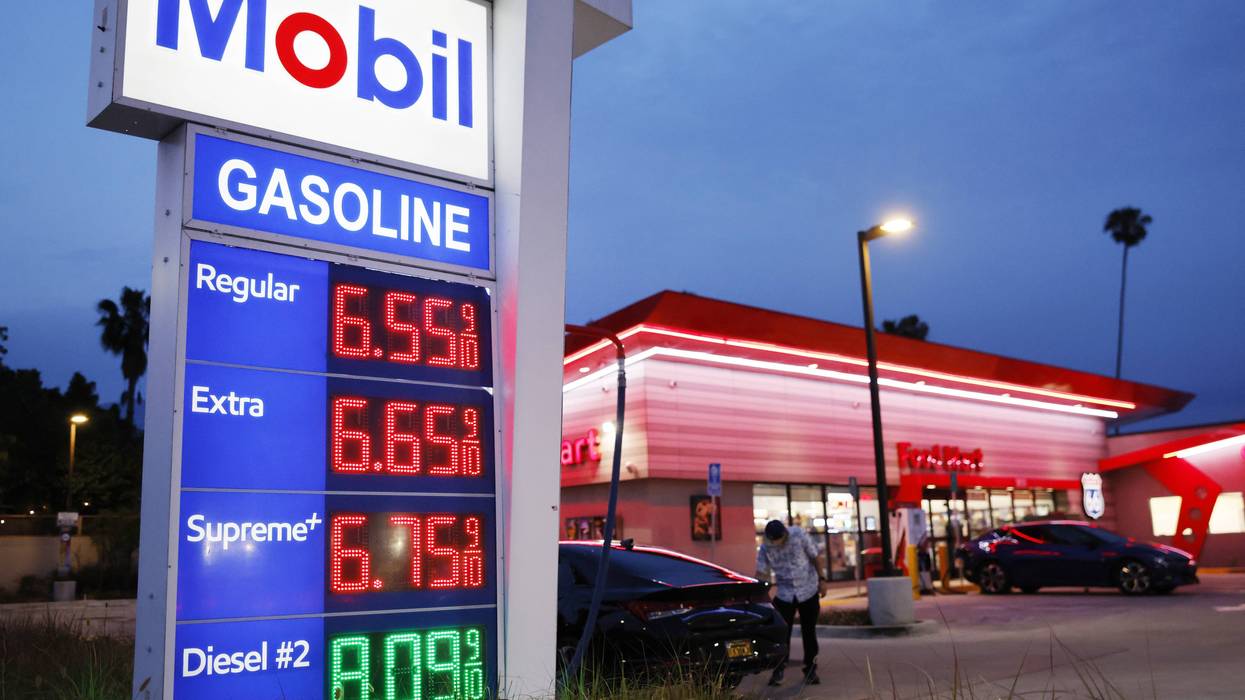
“It is obscene that companies like TotalEnergies are making enormous profits from war, while ordinary people’s lives are being shattered and the world faces a spiraling economic crisis," said one campaigner.
As energy and finance officials from across the European Union prepared to review energy supply levels amid the US-Israeli war on Iran on Tuesday, campaigners from a leading climate action group renewed their call for officials to go further than just releasing oil reserves in order to keep costs down.
Oil giants that have benefited from the growing global energy crisis set off by the US-Israeli attacks and Iran's retaliatory closing of the Strait of Hormuz should be held to account for their "fossil fuel profiteering," said 350.org.
After a virtual meeting of energy ministers from the G7 countries on Monday, 350.org called on officials to tax the windfall profits of companies like France's TotalEnergies, which is estimated to have made $1 billion in profits in just the last month since Iran closed the strait in retaliation for the US and Israeli attacks.
Total has reportedly "monopolized" about 70 crude oil shipments from the UAE and Oman in the last month, as Murban crude prices surged from $70 to $170 per barrel.
As Common Dreams reported Monday, 350.org released an analysis showing that spiking oil and gas prices resulting from the US-Israeli war have cost consumers and businesses more than $100 billion in the past month.
“It is obscene that companies like TotalEnergies are making enormous profits from war, while ordinary people’s lives are being shattered and the world faces a spiraling economic crisis," said Fanny Petitbon, France team lead for 350.org. "At a time of such profound human suffering, no company should be allowed to exploit chaos and conflict for financial gain. The G7’s deafening silence on these windfall profits speaks volumes, signaling a failure to hold corporate greed accountable while the rest of the world pays the price.”
Revenues from taxing windfall profits could "be used to support vulnerable households, accelerate the transition to renewable energy, and fund recovery efforts in regions affected by conflict," said Petitbon.
“The principle is clear: extraordinary profits made in times of crisis should be redirected for the public good, not concentrated in the hands of a few," she said.
The ministers from the G7 countries—which include the United States, Canada, Japan, Britain, France, Germany, and Italy—met virtually to discuss how the war in Iran is affecting energy and commodity markets and inflation. They called on countries “to refrain from imposing unjustified export restrictions” on oil and gas, but did not announce any specific steps they plan to take.
"We stand ready to take all necessary measures in close coordination with our partners, including to preserve the stability and security of the energy market," the ministers said in a statement. "We recognize the importance of coordinated international action to mitigate spill overs and safeguard macroeconomic stability."
Earlier this month, the International Energy Agency coordinated the release of 400 million barrels of oil to mitigate the supply shortfall caused by the closing of the Strait of Hormuz, from which about one-fifth of the world's oil supply flows.
But gas prices across Europe have continued to rise by 70% nonetheless. In the US, the average price of gas rose to $4 per gallon on Tuesday for the first time since August 2022.
Brent crude oil, which cost about $70 per barrel before the war, has gone up to $119 per barrel, and analysts are projecting prices as high as $200 as the conflict continues.
Monday's virtual summit was held ahead of an emergency meeting of EU energy ministers, who were told by EU Energy Commissioner Dan Jørgensen in a letter Monday that they were "encouraged to make timely preparations in anticipation of a potentially prolonged disruption" of energy imports.
Jørgensen emphasized in a video posted on social media Monday that the growing energy crisis underscores how a transition away from oil and gas toward renewable sources is crucial for economies as well as the planet.
The crisis in the Middle East is affecting energy prices also here in Europe.
My message on what we must do to protect our citizens and businesses.
Now and in the future.
↓ pic.twitter.com/jiLmavxV8K
— Dan Jørgensen (@DanJoergensen) March 30, 2026
"We will need immediate targeted measures to combat this crisis, but all of these measures need to be in line with our long-term strategy, which is more renewables as fast as possible," said Jørgensen.

"Governments are finding their pockets run deep to fund war today, but when it comes to stopping starvation they are suddenly broke," an Oxfam director said.
Oxfam International called for Group of Seven countries to redirect a fraction of military spending toward solving world hunger and relieving poor countries' sovereign debts as leaders prepare to gather in Italy this week.
In a new analysis, the nonprofit found that just 3% of the seven countries' annual military spending—$1.2 trillion in 2023, with the U.S. alone spending $916 billion, according to SIPRI data that Oxfam used—would be enough to "help end world hunger and solve the debt crisis in the Global South," a statement said.
"Governments are finding their pockets run deep to fund war today, but when it comes to stopping starvation they are suddenly broke," Max Lawson, Oxfam International's head of inequality, said in the statement.
"We're talking about a small commitment with the potential for huge impact," he said. "Imagine a world where no one goes to bed hungry and where countries in the Global South can put money into public schools and hospitals instead of debt interest payments. The G7 not only has the means, but the moral and strategic imperative to make this happen."
Oxfam found that eradicating world hunger, both acute and chronic, would cost $31.7 billion per year—most of the proposed 3% redirection in funds. More than 281 million face severe hunger and malnutrition, Oxfam said. The nonprofit's statement cited Somalia, Guatemala, Yemen, and Kenya as places where hunger is on the rise. It also said that the G7 was complicit in the ongoing suffering and starvation in Gaza. The G7 nations are the United States, Japan, Germany, France, Italy, Canada, and the United Kingdom.
"The G7's collective failure has basically given the Israeli military a free pass to commit terrible atrocities against Palestinian people," Lawson said. "G7 leaders must do everything in their power to make sure there is an immediate and permanent cease-fire to stop the death and destruction. They also need to ensure full and permanent access of humanitarian aid through all ground crossings, and the release of all hostages and unlawfully detained Palestinian prisoners."
"Low- and middle-income countries are now spending nearly a third of their budgets on servicing debts―as much as on public education, healthcare, and social protection combined."
Oxfam also recommended redirecting a relatively small amount of military spending toward sovereign debt relief. Currently, Global South countries collectively are asked to pay $291 million a day in total debt payments, including on interest.
"Low- and middle-income countries are now spending nearly a third of their budgets on servicing debts―as much as on public education, healthcare, and social protection combined," the Oxfam statement said.
Poor countries currently owe about $4 billion to G7 governments, Oxfam found, based on World Bank and International Monetary Fund data, but G7 countries don't pay what they owe in social and climate aid: $15 trillion, according to Oxfam. This follows on an Oxfam analysis last year that found the figure was above $13 trillion.
"It's really the G7 which owes a debt to the low- and middle-income countries. It's not the other way around," Amitabh Behar, Oxfam International's interim executive director, told Al Jazeera last year.
"We need to shift that gaze," he added.
Oxfam also called for G7 countries to follow up on a recent G20 effort to tax the super rich. In April, top G20 ministers—from Brazil, Germany, Spain, and South Africa—called for a 2% wealth tax on billionaires "to invest in public goods such as health, education, the environment, and infrastructure."
Following preliminary meetings, G7 ministers pledged to "increase our efforts aimed at progressive and fair taxation of individuals" and work with Brazil, which currently holds the G20 presidency and is led by progressive President Luiz Inácio Lula da Silva.
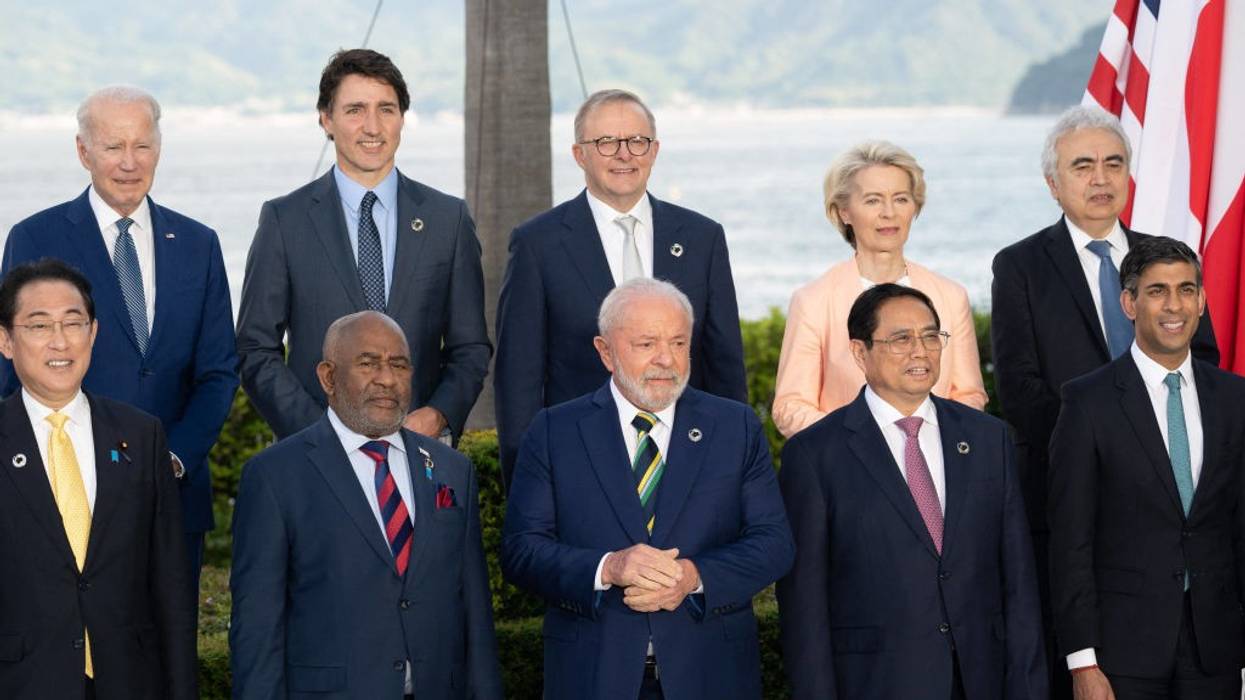
Summit in Hiroshima fails to meaningfully contribute to nuclear disarmament.
Last summer, after it was announced that Japan would host the G7 Summit of leaders from Canada, France, Germany, Italy, Japan, United Kingdom, and United States in Hiroshima, the nuclear disarmament movement was abuzz. The hope was that, after all these years of mostly avoiding the subject, the leaders were going to have a chance to listen to hibakusha, reflect deeply on the lessons learned from Hiroshima and Nagasaki, confront escalating dangers of nuclear war and the threat to all of humanity that this would pose, and finally make concrete commitments on nuclear disarmament.
Part of the reason for optimism, I think, was that many of those same activists had their lives changed by visits to Hiroshima. As if the whole city were a shrine to the horror, the devastation, the pain, the shame, the misery, but also the resilience and the beauty of humanity, people regularly depart Hiroshima with a changed worldview and a newfound or renewed passion for nuclear abolition. And so, the thinking went, surely the leaders would be similarly transformed and recognize that such collective civilian suffering must never happen again and that the only way to ensure that it wouldn’t is to get rid of nuclear weapons once and for all.
We were wrong.
This past weekend, the G7 leaders went to Hiroshima, laid wreaths in the Hiroshima Peace Memorial Park, staying there for just 30 minutes, and then published a statement that could have been produced as a result of meeting anywhere in the world. In fact, it was probably written long before they even arrived in Hiroshima. They didn’t need to go to Japan to offer empty words and zero concrete solutions or steps. According to them, a nuclear weapons-free world is just a dream, and they are determined to keep it that way.
[G7 leaders] didn’t need to go to Japan to offer empty words and zero concrete solutions or steps. According to them, a nuclear weapons-free world is just a dream, and they are determined to keep it that way.
Many people think that when it comes to nuclear weapons, those of us arguing for their abolition and elimination are trying to prevent another Hiroshima or Nagasaki from happening. And while a repeat of what took place during that tragic week in August of 1945 would be devastating, chances are that use of a nuclear weapon today would have far worse consequences. In 1945, the US used the only two weapons that were on hand, having tested the third in July in New Mexico. Today, there are nearly 13,000 nuclear warheads in the world, most of which are more powerful than the bomb used in Hiroshima on August 6. But even the use of a single, Hiroshima-sized - sometimes referred to as tactical nuclear weapon - is expected to lead to full-out nuclear war, according to simulations from Princeton’s Program on Science and Global Security. And nuclear war would in turn cause nuclear winter - due to soot in the atmosphere as a result of widespread fires - a state of prolonged climate cooling that would result in drastic reductions in agricultural output and starvation around the world. The stakes simply couldn’t be higher.
How has the G7 statement on nuclear disarmament failed? The answer is pretty much across the board. There are no concrete steps outlined for disarmament, no commitments to stop modernizing or to reduce stockpiles, and not even a mention of the Treaty on the Prohibition of Nuclear Weapons (TPNW), the one internationally binding instrument that actually provides a framework for getting to nuclear zero, while also acknowledging the tremendous humanitarian consequences of nuclear weapons use and testing.
The G7 leaders refused to understand that bringing about the end of the world as we know it is not why we elected them.
In fact, the G7 statement reaffirms the importance of the Nuclear Non-Proliferation Treaty (NPT), which a science and policy expert recently referred to as “being in a coma.” The NPT, having been in force for over 52 years, has failed miserably in its obligations to deliver nuclear and total and complete disarmament. The TPNW, rather than competing with the NPT, could help the NPT achieve their common objective.
Were we not loud enough? Not clear enough? Or do they just not want to hear what we have to say? In my own letters to each of the leaders, I wrote, “If there is a nuclear war and hundreds of millions of people die in the explosions and from ensuing radiation and billions die from starvation due to the onset of nuclear winter, there will be no history books to judge you. Human civilization, which we have patiently built for thousands of years, will have met its end. If you survive the initial stage, you will regret that you didn’t do more when you could. Don’t let that happen. You have the power to change the status quo.” This is about as clear as I could be.
At this summit, the G7 leaders refused to understand that bringing about the end of the world as we know it is not why we elected them. No national or alliance goals could possibly justify the risk to all of humanity. It’s time for regular people from all walks of life and a wide range of political opinions to demand real action on nuclear disarmament. The G7 leaders must sign the TPNW. There is a world to save.

"We can return to the path of progress. We can realize our ambitions for health and well-being for all," said António Guterres. "But only if the world works together... despite the tensions straining relations between nations."
"Progress is in peril."
That was United Nations Secretary-General António Guterres' warning Sunday to the 76th World Health Assembly.
Over seven decades ago, he noted, "countries came together and affirmed some fundamental truths: that peace depends on health; that disease in one nation endangers all; and that achieving the greatest possible health for everyone, everywhere relies on cooperation."
Since the creation of the World Health Organization (WHO), Guterres continued, "human health has advanced dramatically: global life expectancy—up over 50%; infant mortality—down 60% in 30 years; smallpox—eradicated; and polio on the verge of extinction."
But now, "war and conflict threaten millions. The health of billions is endangered by the climate crisis. And the Covid-19 pandemic has stalled, and even reversed, progress in public health," the U.N. leader said in a video address kicking off the assembly.
"We can return to the path of progress. We can realize our ambitions for health and well-being for all. But only if the world works together. If we cooperate, despite the tensions straining relations between nations," he stressed.
Guterres called for "strengthening the independence, authority, and financing of the World Health Organization," and said that "it is vital to prepare for the health threats to come—from new pandemics to climate dangers—so that we prevent where we can, and respond fast and effectively where we cannot."
WHO Director-General Tedros Adhanom Ghebreyesus—who earlier this month declared Covid-19 over as a global health emergency—similarly urged international coordination during his welcome speech to the assembly. The agency leader said that "in 2020, I described Covid-19 as a long, dark tunnel. We have now come out the end of that tunnel."
"To be clear, Covid-19 is still with us, it still kills, it's still changing, and it still demands our attention," Tedros continued. The end of the emergency "is not just the end of a bad dream from which we have woken. We cannot simply carry on as we did before."
"This is a moment to look behind us and remember the darkness of the tunnel, and then to look forward, and to move forward in the light of the many painful lessons it has taught us. Chief among those lessons is that we can only face shared threats with a shared response," Tedros added. He stressed that the pandemic accord now being negotiated "must be a historic agreement to make a paradigm shift in global health security, recognizing that our fates are interwoven."
As the assembly—scheduled through May 30—got underway in Geneva, Switzerland, Guterres was in Hiroshima, Japan, for the Group of Seven (G7) summit, where he also underscored the importance of global cooperation while speaking to the press on Sunday.
"My message to G7 leaders is clear: While the economic picture is uncertain everywhere, rich countries cannot ignore the fact that more than half the world—the vast majority of countries—are suffering through a deep financial crisis," Guterres said. "The crushing economic impact of the Covid-19 pandemic, the climate crisis, Russia's invasion of Ukraine, unsustainable levels of debt, rising interest rates, and inflation are devastating developing and emerging economies."
"There is a systemic and unjust bias in global economic and financial frameworks in favor of rich countries," he declared, highlighting that "access to Covid-19 vaccines was deeply unfair" and "the recovery has been extremely unbalanced."
While the U.N. chief argued that "it's time to reform both the Security Council and the Bretton Woods institutions," referring to the International Monetary Fund and World Bank, he also said that "even within the present unfair global rules, more can and must be done to support developing economies."
G7 countries are "central to climate action," Guterres said, noting the need for "faster timelines to phase out fossil fuels and ramp up renewables," an end to dirty energy subsidies, and financial support for developing nations that are disproportionately bearing the brunt of a crisis largely created by the Global North.
As Common Dreams reported earlier Sunday, since G7 leaders on Saturday put out a communiqué addressing a wide range of topics, campaigners around the world have decried the statement's support for further investments in planet-heating gas, calling it "a blunt denial of the climate emergency."

"Energy security can only be achieved by rapidly and equitably phasing out fossil fuels and transitioning to renewable energy, not locking in deadly fossil fuels and lining the pockets of oil and gas executives," said one critic.
Since Group of Seven leaders on Saturday put out a wide-ranging communiqué from a Japan-hosted summit in Hiroshima, climate action advocates from G7 countries and beyond have blasted the statement's support for future investments in planet-heating gas.
The statement comes after G7 climate, energy, and environment ministers were criticized for their communiqué from a meeting in Sapporo last month as well as protests around the world this week pressuring the summit's attendees to ditch fossil fuels and "deliver a clear and just renewable energy agenda for a peaceful world."
To meet the 1.5°C goal of the Paris climate agreement, the new statement commits to "accelerate the phaseout of unabated fossil fuels so as to achieve net-zero in energy systems by 2050 at the latest" along with "the elimination of inefficient fossil fuel subsidies by 2025 or sooner."
"The G7 must stop using fossil fuels immediately—the planet is on fire."
The statement also highlights that last year, G7 nations—Canada, France, Germany, Italy, Japan, the United Kingdom, and the United States—pledged to end "new direct public support for the international unabated fossil fuel energy sector, except in limited circumstances," though as recent analysis
shows, some are breaking that promise.
The communiqué then endorses liquefied natural gas (LNG) as a solution to "the global impact of Russia's war on energy supplies, gas prices and inflation, and people's lives," referencing the invasion of Ukraine:
In this context, we stress the important role that increased deliveries of LNG can play, and acknowledge that investment in the sector can be appropriate in response to the current crisis and to address potential gas market shortfalls provoked by the crisis. In the exceptional circumstance of accelerating the phaseout of our dependency on Russian energy, publicly supported investment in the gas sector can be appropriate as a temporary response, subject to clearly defined national circumstances, if implemented in a manner consistent with our climate objectives without creating lock-in effects, for example by ensuring that projects are integrated into national strategies for the development of low-carbon and renewable hydrogen.
"The G7 energy outcome correctly diagnoses a short-term need for energy security, then promotes a dangerous and inappropriate lock-in of fossil gas that would do nothing to address this need," responded Collin Rees, United States program manager at Oil Change International (OCI). "Energy security can only be achieved by rapidly and equitably phasing out fossil fuels and transitioning to renewable energy, not locking in deadly fossil fuels and lining the pockets of oil and gas executives."
After accusing the summit's attendees of "using the war as an excuse," deflecting blame for current conditions, and neglecting Global South countries disproportionately suffering from the climate crisis, Max Lawson, head of inequality policy at Oxfam, declared that "the G7 must stop using fossil fuels immediately—the planet is on fire."
Greenpeace International global climate politics expert Tracy Carty also demanded a swift end to fossil fuels, charging that "G7 leaders' endorsement of new fossil gas is a blunt denial of the climate emergency" which dooms "current and future generations."
Gerry Arances, executive director of the Philippine Center for Energy, Ecology, and Development, similarly argued that "the endorsement of increased LNG deliveries and investment in gas in the G7 communiqué is no mere backsliding—it is a death sentence being dealt by the G7 to the 1.5°C limit and, in consequence, to the climate survival of vulnerable peoples in the Philippines, Southeast Asia, and across the world."
"Unless they genuinely put forward the phaseout of all fossil fuels, Japan and all G7 nations spout nothing but lies when they say they have aligned to 1.5°C," he continued. "They cannot claim to be promoting development while subjecting our people to decades more of pollution and soaring energy prices. We reject this notion of a development powered by fossil fuels."
Looking to the United Nations Climate Change Conference (COP28) planned for later this year, Arances added that "Japan and G7 leaders should already be warned that civic movements will not tire in pushing back against fossil fuels and false solutions and in demanding a renewable energy transition."
"Civic movements will not tire in pushing back against fossil fuels and false solutions and in demanding a renewable energy transition."
Other campaigners also specifically called out the Hiroshima summit's host—including Ayumi Fukakusa, deputy executive director at Friends of the Earth Japan, who asserted that the country "has used the G7 presidency to derail the global energy transition."
"Japan has been driving the push to increase gas investments and has been promoting its so-called 'green transformation’ strategy," Fukakusa said of a "greenwashing scheme" featuring hydrogen, ammonia, nuclear, and carbon capture and storage technologies.
OCI Asia program manager Susanne Wong agreed that given the nation's promotion of gas expansion and technologies to prolong the use of coal, "this year's G7 is revealing Japan's failure of climate leadership at a global level."
"Activists mobilized 50 actions across 22 countries this week to demand that Japan end its fossil fuel finance and stop driving the expansion of gas and other fossil-based technologies," Wong added. "Japan will continue to face intense international scrutiny until it stops fueling the climate crisis."
Groups from other G7 countries also called out their political leaders. Petter Lydén, head of international climate policy at Germanwatch, said, "Most likely, the German chancellor, Olaf Scholz, has been a driving force behind the weak language on gas, which is a serious blow to Germany's international credibility on climate."
Citing sources familiar with summit negotiations,
The New York Times reported Saturday that "Britain and France fought the German effort" while U.S. President Joe Biden was caught between defending his climate agenda and "aiding other United States allies intent on increasing their access to fossil fuels."
OCI's Rees said the that "this betrayal continues a disturbing turn by President Biden and Chancellor Scholz from rhetorically committing to climate leadership to openly boosting fossil fuel expansion. History will not look kindly on world leaders who accelerate the pace of fossil fuel buildout in the face of worsening climate crisis."
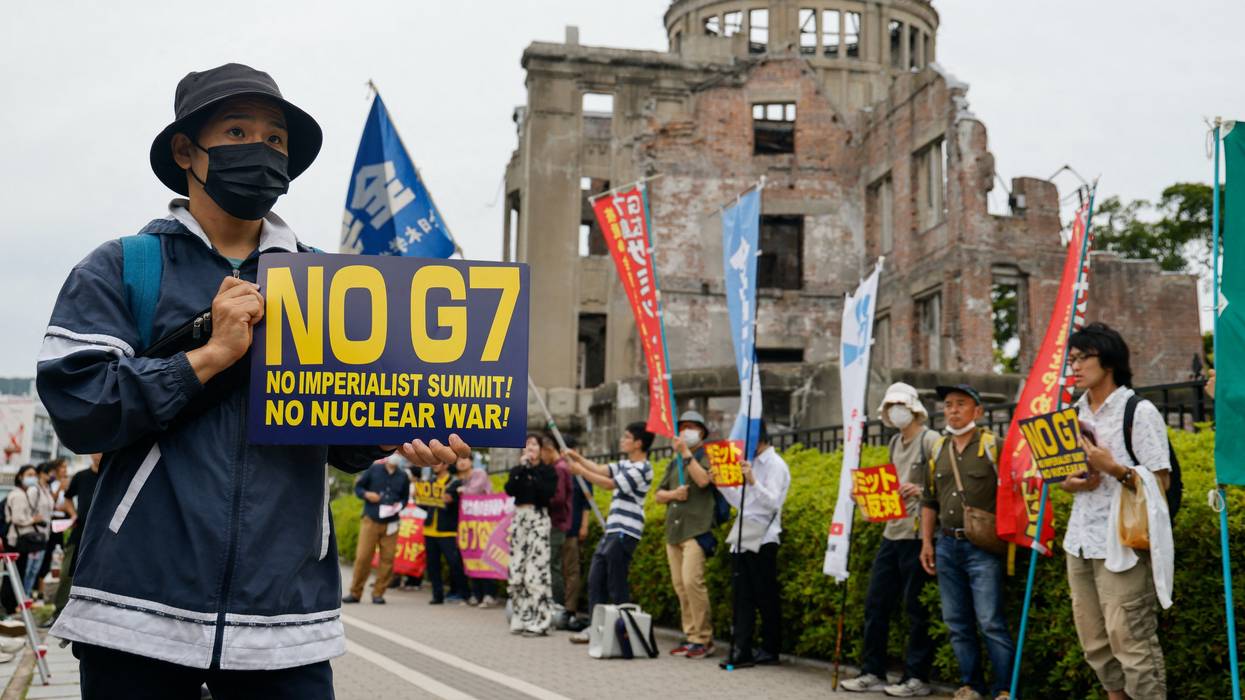
"The G7 are trying to sell decades-old and insufficient initiatives as a new 'vision' when at the same time they themselves are complicit in the rising nuclear risks," said the International Campaign to Abolish Nuclear Weapons.
The International Campaign to Abolish Nuclear Weapons—which won the 2017 Nobel Peace Prize for its work on a landmark treaty banning nukes—and others including survivors of the U.S. atomic bombings of Japan on Friday criticized a Group of Seven joint statement on disarmament as "missing the moment to make the world safer" from the threat of thermonuclear annihilation.
As the G7 summit got underway in Hiroshima, leaders of Japan, Germany, Italy, Canada, France, the United Kingdom, United States—the latter three of which have nuclear arsenals—reiterated their belief that "a nuclear war cannot be won and must never be fought."
While the statement acknowledges "the unprecedented devastation and immense human suffering the people of Hiroshima and Nagasaki experienced as a result of the atomic bombings" and reaffirms G7 members' "commitment to achieving a world without nuclear weapons," the International Campaign to Abolish Nuclear Weapons (ICAN) lamented that "it fails to commit to concrete measures towards that goal and even emphasizes the importance of reserving the right to use nuclear weapons."
"The G7 are trying to sell decades-old and insufficient initiatives as a new 'vision' when at the same time they themselves are complicit in the rising nuclear risks and promoting mass murder of civilians as a legitimate form of national security policy," ICAN added.
ICAN said that "the G7's inaction is an insult to the hibakusha, and the memory of those who died in Hiroshima," referring to the Japanese word for survivors of the atomic bombings, which killed between 110,000 and 210,000 people.
G7 leaders spent less than half an hour visiting the Hiroshima Peace Memorial Museum near ground zero of the August 6, 1945 U.S. nuclear attack. They laid wreaths at the cenotaph memorializing the at least tens of thousands of people who died from the bombing and related illnesses and also met with a handful of hibakusha.
U.S. President Joe Biden drew fire for his refusal to apologize for the Hiroshima and Nagasaki bombings.
"If the U.S. admitted that murdering noncombatants in Hiroshima and Nagasaki was inexcusable, it might face questions about [the] legitimacy of maintaining [a] vastly more destructive stockpile now," writer and activist Jon Reinsch tweeted, referring to the approximately 5,400 nuclear warheads in the American arsenal—the world's second-largest after Russia, which has around 6,000 warheads, according to the Union of Concerned Scientists.
Meanwhile, street protesters condemned nuclear weapons, the "imperialist summit," military aid to Ukraine, and Japan's complicity in U.S. militarism—especially toward China.
"Japan is saying it will send a peaceful message of abolishing nuclear weapons to the world through this summit, but at the same time it is seeking to rely on nuclear weapons to achieve 'national security.' This is contradictory," Ichiro Yuasa, a spokesperson for the advocacy group Peace Depot, told teleSUR.
Some hibakusha renewed criticism of leaders of nuclear-armed nations for failing to pursue meaningful disarmament, including their refusal to join scores of countries in signing the landmark Treaty on the Prohibition of Nuclear Weapons (TPNW).
"This is not the genuine nuclear disarmament that hibakusha are calling for. This is an evasion of their responsibility," Satoshi Tanaka, a survivor of the atomic bombing and secretary general of the Liaison Conference of Hiroshima Hibakusha Organizations, said of the G7 statement.
"Prime Minister [Fumio] Kishida has said that the Treaty on the Prohibition of Nuclear Weapons is the final passage for a nuclear weapons-free world," Tanaka added. "No, it is not a final passage. It is the entry point. Prime Minister Kishida and other G7 leaders should accept the TPNW and start the real process of eliminating nuclear weapons."
Derek Johnson, managing partner of the Global Zero movement for the abolition of nuclear weapons, said that "while the G7 statement embraces the goal of global zero and recites a familiar list of worthwhile ambitions, none acknowledge the fierce urgency of now."
"This is long on vision but short on strategy; Hiroshima deserves to be more than a symbolic setting, and the world deserves more than thoughts and prayers for disarmament," he added.
ICAN executive director Daniel Hogstra responded to the G7 statement by asserting that "this is more than a missed opportunity."
"With the world facing the acute risk that nuclear weapons could be used for the first time since Hiroshima and Nagasaki were bombed, this is a gross failure of global leadership," Hogstra contended, referring to rising fears since Russia invaded Ukraine last year.
"Simply pointing fingers at Russia and China is insufficient," he added. "We need the G7 countries, which all either possess, host, or endorse the use of nuclear weapons, to step up and engage the other nuclear powers in disarmament talks if we are to reach their professed goal of a world without nuclear weapons."

"We are an example to the world," wrote one American economist. "An example of what not to do."
Nations around the world are looking on with a mixture of alarm and bafflement as the United States hurtles toward an economy-wrecking default, with the Republican Party refusing to raise the country's globally unique debt limit without massive, harmful spending cuts.
The possibility of a U.S. default—a failure to pay the government's obligations—has already rattled global markets and prompted grave warnings from major institutions such as the International Monetary Fund, which said last week that a default would have "severe repercussions" for a world economy already facing the prospect of a central bank-induced recession.
The Washington Post reported Friday that the finance ministers of G7 nations have privately asked U.S. Treasury Secretary Janet Yellen for "updates on the status of negotiations between the White House and House Republicans" as officials from the rich countries gather in Hiroshima for their annual summit.
Finance ministers have also voiced their concerns publicly. German finance chief Christian Lindner said last week that he hopes "an adult decision will be made with regard to the development of American government finances and the associated effects on the global economy."
Kazuo Ueda, governor of the Bank of Japan, cautioned that a U.S. default could become a "big problem" that the Federal Reserve "may not be able to counteract."
"The United States is one among the few polities that have adopted and retained debt limits."
The U.S. debt limit, which currently sits at $31.4 trillion, is a "global outlier," the Atlantic Council's Mrugank Bhusari wrote in March, noting that "the United States is one among the few polities that have adopted and retained debt limits."
"Debt limits like the United States'... are not the norm—and they rarely cause major deadlocks in the few countries that have adopted this tool," Bhusari observed. "Like the United States, Denmark also sets its debt limit as a nominal value. But that’s where the similarity ends. The Danish Parliament intentionally sets the ceiling sufficiently high such that it will not be crossed, rendering it no more than a formality."
"Like the United States and Denmark, Kenya also has a nominal debt limit. However, it is under the process of replacing the nominal limit with a limit as a percentage of GDP at 55%," Bhusari continued. "Australia briefly experimented with a debt limit similar to that of the United States, experienced the political infighting that Washington is familiar with, and abolished it soon after."
Citing one Latin America expert, the Post noted Friday that "a debt ceiling like the one that exists in the U.S. stirred debate" in Brazil, where the Lula government is aiming to loosen existing restraints on government spending.
The idea of imposing a strict debt limit "was shot down vehemently, thanks to the U.S. example," the Post reported.
"We are an example to the world," Stephanie Kelton, an American economist, wrote on Twitter. "An example of what not to do."
The international community's reaction to the perilous U.S. debt ceiling standoff comes as President Joe Biden is facing growing pressure from lawmakers at home to end the crisis unilaterally if necessary by invoking the 14th Amendment, which states that "the public debt of the United States... shall not be questioned."
Progressives and legal scholars have long argued that the debt limit, first imposed by Congress in 1917, is unconstitutional and should be abolished—an argument that the National Association of Government Employees makes in a lawsuit filed in federal court 10 days ago.
But as The American Prospect's David Dayen wrote Friday, the plaintiffs "didn’t file a motion for immediate relief," so "the case has sat dormant."

The world leaders gathered in Hiroshima have a responsibility, to reflect on the obliteration of that city almost 80 years ago, and to say no to nuclear war.
President Joe Biden is attending this year’s G7 summit, with Russia’s war in Ukraine and President Vladimir Putin’s threats to use nuclear weapons there at the top of the agenda. The G7 comprises Japan, Italy, Canada, France, the US, the UK, and Germany. Russia was briefly a member of what was then called the G8, but was expelled in 2014 after its military annexation of Crimea.
This year’s G7 meeting is being held in Japan. Of particular note is where in Japan: Hiroshima. There, on August 6th, 1945, the United States dropped the world’s first atomic bomb, leveling the city and killing an estimated 140,000 people and injuring 100,000 more. As the threat of nuclear war looms as a real possibility, the world leaders gathered in Hiroshima have a responsibility, to reflect on the obliteration of that city almost 80 years ago, and to say no to nuclear war.
“I want them, the G7 leaders, to seriously acknowledge the inhumanity of nuclear weapons,” 85-year-old Teruko Yahata, a survivor of the Hiroshima atomic bomb, said this week. “These are weapons that can destroy humankind. I want them to strongly feel that these are terrible things and that they have to be abolished.” Prime Minister Fumio Kishida’s family is from Hiroshima, and a number of his relatives perished in the atomic blast.
Survivors of the Hiroshima bomb and the one dropped on Nagasaki three days later, on August 9th, 1945, are referred to in Japanese as “hibakusha.” They have been joined in their call for nuclear abolition by the Nobel Peace Prize-winning International Campaign to Abolish Nuclear Weapons. ICAN is demanding that the G7 leaders condemn any and all threats to use nuclear weapons, recognize the catastrophic humanitarian consequences of nuclear war, remove nuclear weapons from non-nuclear states (demanded also of Russia, which plans to place nuclear arms in Belarus) and to join the UN Treaty on the Prohibition of Nuclear Weapons. The United States and Russia, along with the seven other nuclear-armed states (China, the UK, France, India, Pakistan, North Korea and Israel), refuse to sign the treaty.
A group of military and national security professionals just published a full-page open letter to President Biden in the New York Times, under the headline, “The U.S. Should Be a Force for Peace In the World.” Its fifteen signatories include a retired U.S. Army Major General, Pres. Ronald Reagan’s ambassador to the Soviet Union, and Dennis Fritz, a retired command chief master sergeant of the U.S. Air Force. He is the director of the Eisenhower Media Network, which organized the letter.
“I’ve been in and out of the Pentagon since the age of 22. I am now 66 years old. This is probably the most fearful I’ve ever been with a nuclear escalation,” Chief Fritz said on the Democracy Now! news hour. “I take their threat of not taking off their plate the use of nuclear weapons — I take that seriously. That is why, once again, we thought it was so important for us to send that open letter out to the president. Our hope is to educate the American public so that they could see how we got to this point.”
Another former national security advisor and military veteran is sounding alarm bells as well. Daniel Ellsberg, the legendary whistleblower who released the Pentagon Papers in 1971, revealing the secret history of U.S. involvement in the Vietnam war and the lies of presidential administrations, from Presidents Eisenhower through Johnson, that supported the U.S. military escalation there.
Earlier in his career, Ellsberg was deeply involved in developing the U.S. military’s plans for nuclear war. His book, “The Doomsday Machine: Confessions of a Nuclear War Planner” should be required reading. One of his greatest concerns was the dominant belief among war planners at the time that the U.S. would fare better in a nuclear war by initiating a “first strike.”
“The belief that we can do less bad by striking first than if we strike second is what confronts us in Ukraine with a real possibility of a nuclear war coming out of this conflict,” Dan Ellsberg said recently on Democracy Now!. “In other words, most life on Earth — not all, most life on Earth — being extinguished as a matter of the control of Crimea or the Donbas or Taiwan. That’s insane.”
Dan Ellsberg, now 92 years old, was recently diagnosed with inoperable pancreatic cancer. He remains tireless in warning the public of the risk of nuclear annihilation. In March, he wrote, “All the young activists rising up give me hope as I leave my life. As the movement against the Vietnam War showed, young people can save lives when they make their care known in action. Keep going. The world is in your hands.”

"The G7 in Hiroshima is an opportunity for PM Kishida and other leaders to deliver a clear and just renewable energy agenda for a peaceful world," said 350.org's Japan team lead.
As Group of Seven leaders and representatives from other key countries travel to Japan for a three-day summit set to start on Friday, the global movement for climate action is renewing demands for swiftly shifting away from planet-heating fossil fuels.
" The G7 leaders' summit in Hiroshima represents a crucial juncture at which the world's most powerful nations have the opportunity to demonstrate true leadership and make good on their promises," declared 350.org executive director May Boeve on Thursday. "There is no point powering up on renewables without powering down on fossil fuels—a commitment to expand renewable energy development is not enough."
Andreas Sieber, 350.org's associate director of global policy, pointed out that the summit comes after "a year of global suffering due to fossil fuel-driven inflation, soaring energy prices, and exorbitant profits for oil corporations, following the G7's 2022 pledge to end international fossil fuel support."
Stressing the necessity of cutting off international public financing of fossil fuels, Simone Ogno, finance and climate campaigner at the Italian group ReCommon, said that "what will emerge from the G7 will also strongly influence the decisions" at COP28, the next United Nations climate conference, later this year.
"For the United States and the G7 to continue doubling down on this suicidal fossil fuel dependency... is beyond careless."
Earlier this year,
Oil Change International (OCI) exposed multiple countries for breaking their promises to stop pouring money into international fossil fuel projects and released a briefing on how top economies—including G7 nations like Japan, the United States, Italy, and Germany—have dumped billions into new liquefied natural gas (LNG) export terminal capacity.
Leaders of G7 nations—which also include Canada, France, and the United Kingdom, plus the European Union—are headed to Hiroshima after their climate, energy, and environment ministers met in Sapporo last month and crafted a 36-page communiqué that critics said showed a "shameful disregard for what people and planet urgently need."
Campaigners noted this week that the communiqué ultimately wasn't as bad as it could have been—it stated that any gas sector investments should be "implemented in a manner consistent with our climate objectives and without creating lock-in effects." Still, leaving the door open to fossil fuels and recent actions by member nations concern climate action advocates.
"While just a month ago we saw G7 countries successfully pushing back against a Japan-led push for gas investments and fossil fuels, we now see Germany pushing the G7 to endorse gas investments and the United States approving financing for an oil refinery in Indonesia,"
said Laurie van der Burg, OCI's co-manager of global public finance.
"We cannot afford backsliding and the G7 must urgently get on track for 1.5°C," she continued, referring to the Paris climate agreement's more ambitious temperature goal for 2100. "This means closing the door to gas investments and instead providing their fair share of climate, loss and damage, and just transition finance."
Going into the summit, campaigners are taking aim at its host. Japanese Prime Minister Fumio Kishida "has acted as a laggard on the global stage by attempting to block a phaseout of coal and pushing false solutions like ammonia co-firing, dangerous nuclear, and LNG into the Sapporo communiqué," said Masayoshi Iyoda, 350.org's Japan team lead. "The G7 in Hiroshima is an opportunity for PM Kishida and other leaders to deliver a clear and just renewable energy agenda for a peaceful world."
OCI Asia program manager Susanne Wong highlighted that "activists are mobilizing across 20 countries for a global week of action to stop Japan's dirty energy strategy and expose Japan's dirty G7 presidency," which the prime minister is using "to benefit Japanese corporate interests over the health and security of people and our planet."
"Japan must stop derailing the global energy transition by pushing for the expansion of fossil gas and other dirty fossil-based technologies," said Wong. "Prime Minister Kishida and other G7 leaders must uphold and strengthen their commitment to end public finance for all fossil fuels and shift investment to renewable energy. This is the surest path to peace and security."
Kishida and U.S. President Joe Bidenmet Thursday to discuss various issues expected to dominate the summit—as American lawmakers reintroduced federal legislation that would ban fossil fuel exports from the United States.
"It is time for President Biden to take responsibility and ensure that the G7 is not co-opted for global LNG expansion and industry greenwashing," asserted Lukas Ross, senior program manager at Friends of the Earth (FOE) U.S. "Marketing ploys like Big Oil's so-called 'hydrogen-ready' LNG will only prolong our fossil fuel nightmare. The world cannot afford more dirty diplomacy."
FOE, OCI, and 350.org were among dozens of groups—including Center for Biological Diversity, Food & Water Watch, For a Better Bayou, Greenpeace USA, Mighty Earth, Public Citizen, Sierra Club, and Zero Hour—who sent a letter Wednesday to Mike Pyle, Biden's deputy national security adviser, urging the administration to "lead the way for fossil-free diplomacy."
"It would be a climate and environmental justice disaster if the coming G7 was hijacked to support LNG," the coalition wrote, calling on Biden to block "vague promises of hydrogen readiness," additional public financing for polluting projects, long-term LNG contracts, the promotion of so-called " certified gas," and permitting reforms that disregard frontline communities.
"As a resident of Southwest Louisiana, I have seen firsthand the devastating impact that gas export terminals have on our wetlands and communities," said James Hiatt, director of the Louisiana-based advocacy group For a Better Bayou. "For the United States and the G7 to continue doubling down on this suicidal fossil fuel dependency—one that inflicts suffering on already overburdened communities like mine and will inflict unlivable suffering on future generations—is beyond careless."
"We must prioritize protecting our people, environment, and a livable future over short-term privately held and heavily tax-subsidized corporate profits," he argued. "Environmental and climate justice are not just talking points—they require action that centers people and a livable planet. We cannot afford more deadly shortsightedness—enough is enough!"

While failing to pay what they owe, rich countries are forcing their poor counterparts to fork over $232 million each day for debt repayments—a clear expression of what one advocate called a "deadly double standard."
Wealthy Group of Seven nations owe low- and middle-income countries $13.3 trillion in unpaid development aid and climate funding, according to an Oxfam International analysis published Wednesday, two days before the start of the 49th annual G7 Summit.
Despite failing to meet their own obligations, G7 countries and their rich bankers are demanding that developing nations pay a combined $507 billion in debt repayments through 2028, Oxfam noted, thereby imposing devastating austerity on the Global South. The large sums of money currently allocated to debt repayments—collectively totaling about $232 million per day—could instead be spent on healthcare, education, climate action, and more.
"Wealthy G7 countries like to cast themselves as saviors but what they are is operating a deadly double standard—they play by one set of rules while their former colonies are forced to play by another," Oxfam International's interim executive director, Amitabh Behar, lamented. "It's do as I say, not as I do."
"It's the rich world that owes the Global South," said Behar. "The aid they promised decades ago but never gave. The huge costs from climate damage caused by their reckless burning of fossil fuels. The immense wealth built on colonialism and slavery."
"The G7 must pay its due. This isn't about benevolence or charity—it's a moral obligation."
Recent peer-reviewed research detailing how the prioritization of capitalist class interests has reproduced inequality between nations over time found that the Global North has "drained" more than $152 trillion from the Global South since 1960, and climate justice advocates stress that this plunder is reflected in rich countries' outsized share of historic and present greenhouse gas pollution.
According to Oxfam's new analysis, planet-heating emissions attributed to the G7 inflicted $8.7 trillion in climate change-related loss and damage on developing countries between 1979 and 2019—a figure that has since increased and will continue to grow.
At the United Nations COP27 climate conference last year, delegates agreed to establish a loss and damage fund after failing to commit to phasing out the fossil fuels causing so much harm. It remains to be seen how the new fund will operate, but Oxfam on Wednesday condemned G7 members for continuing to push for public investment in fracked gas and oil development despite vowing to wind down climate-wrecking dirty energy production at a faster rate.
Previous efforts to facilitate climate aid from the Global North to the Global South have fallen far short of what's needed due to the stinginess of wealthy countries, especially the United States.
In 2009, developed nations agreed at COP15 to allocate $100 billion in green finance per year to the developing world by 2020 and every year after through 2025, at which point a new goal would be established. However, only $83.3 billion was mobilized in the first year, and governments are not expected to hit their annual target, which has been denounced as woefully inadequate, until this year.
Based on Oxfam's calculations, the G7 is $72 billion behind on the pledge to help impoverished countries ramp up clean energy and respond to increasingly frequent and intense extreme weather.
Oxfam's $13.3 trillion estimate is based on a combination of the $8.7 trillion in uncompensated climate destruction caused by the G7 since 1979 and its $72 billion climate finance shortfall, plus nearly $4.5 trillion in unfulfilled development funding.
In 1970, rich nations including the G7 agreed to spend 0.7% of their gross national income (GNI) on Official Development Assistance (ODA). As of last year, however, they had provided just 0.27%. For their part, G7 members contributed a total of $2.8 trillion in ODA from 1970 to 2022, leaving a cumulative gap of $4.49 trillion between what they promised and what they've delivered.
"This money could have been transformational," said Behar. "It could have paid for children to go to school, hospitals, and lifesaving medicines, improving access to water, better roads, agriculture and food security, and so much more. The G7 must pay its due. This isn't about benevolence or charity—it's a moral obligation."
The upcoming G7 meeting, held this year in Japan, gives members of the powerful club a perfect opportunity to make good on their unmet commitments to uplift the poor, Oxfam said.
"G7 leaders are meeting at a moment where billions of workers face real-term pay cuts and impossible rises in the prices of basics like food," Oxfam pointed out. "Global hunger has risen for a fifth consecutive year, while extreme wealth and extreme poverty have increased simultaneously for the first time in 25 years."
"Two hundred fifty-eight million people across 58 countries are currently experiencing acute hunger, up 34% over the last year," the organization continued. "In East Africa alone, drought and conflict have left a record 36 million people facing extreme hunger, nearly equivalent to the population of Canada. Oxfam estimates that up to two people are likely dying from hunger every minute in Ethiopia, Kenya Somalia, and South Sudan."
Meanwhile, "the fortunes of the world's 260 food billionaires have increased by $381 billion since 2020," Oxfam noted. "Synthetic fertilizer corporations increased their profits by ten times on average in 2022. According to the IMF, the 48 countries most affected by the global food crisis face an additional $9 billion in import bills in 2022 and 2023."
"The G7 is home to 1,123 billionaires with a combined wealth of $6.5 trillion," said Oxfam. "Their wealth has grown in real terms by 45% over the past ten years. A wealth tax on the G7's millionaires starting at just 2%, and 5% on billionaires, could generate $900 billion a year. This is money that could be used to help ordinary people in G7 countries and in the Global South who are facing rising prices and falling wages."
Oxfam called on G7 governments to take the following steps immediately:
"Each and every day, the Global South pays hundreds of millions of dollars to the G7 and their rich bankers. This has to stop," Behar said. "It's time to call the G7's hypocrisy for what it is: an attempt to dodge responsibility and maintain the neo-colonial status quo."
The need for debt relief and redistribution is only poised to grow.
"At least an additional $27.4 trillion is needed between now and 2030 to fill financing gaps in health, education, social protection, and tackling climate change in low- and middle-income countries," Oxfam estimates. "That equates to an annual financing gap of $3.9 trillion."