
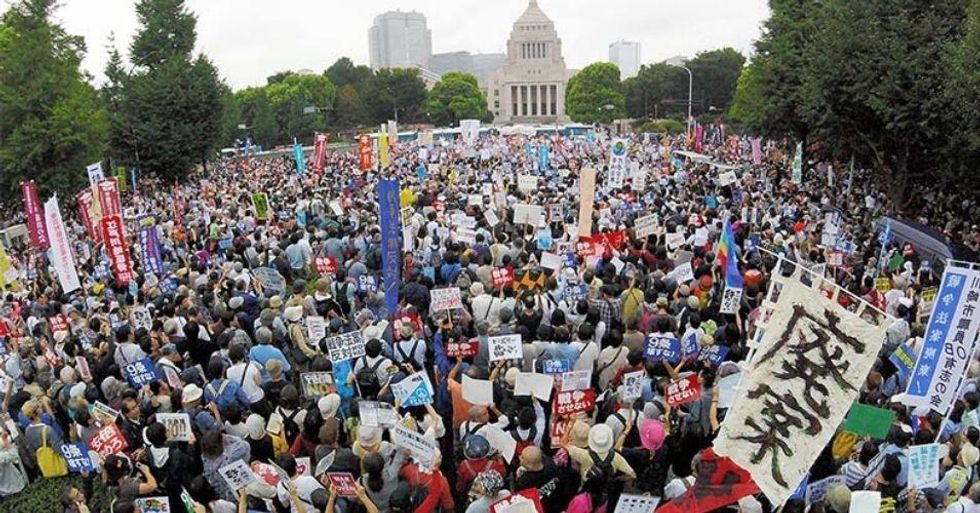
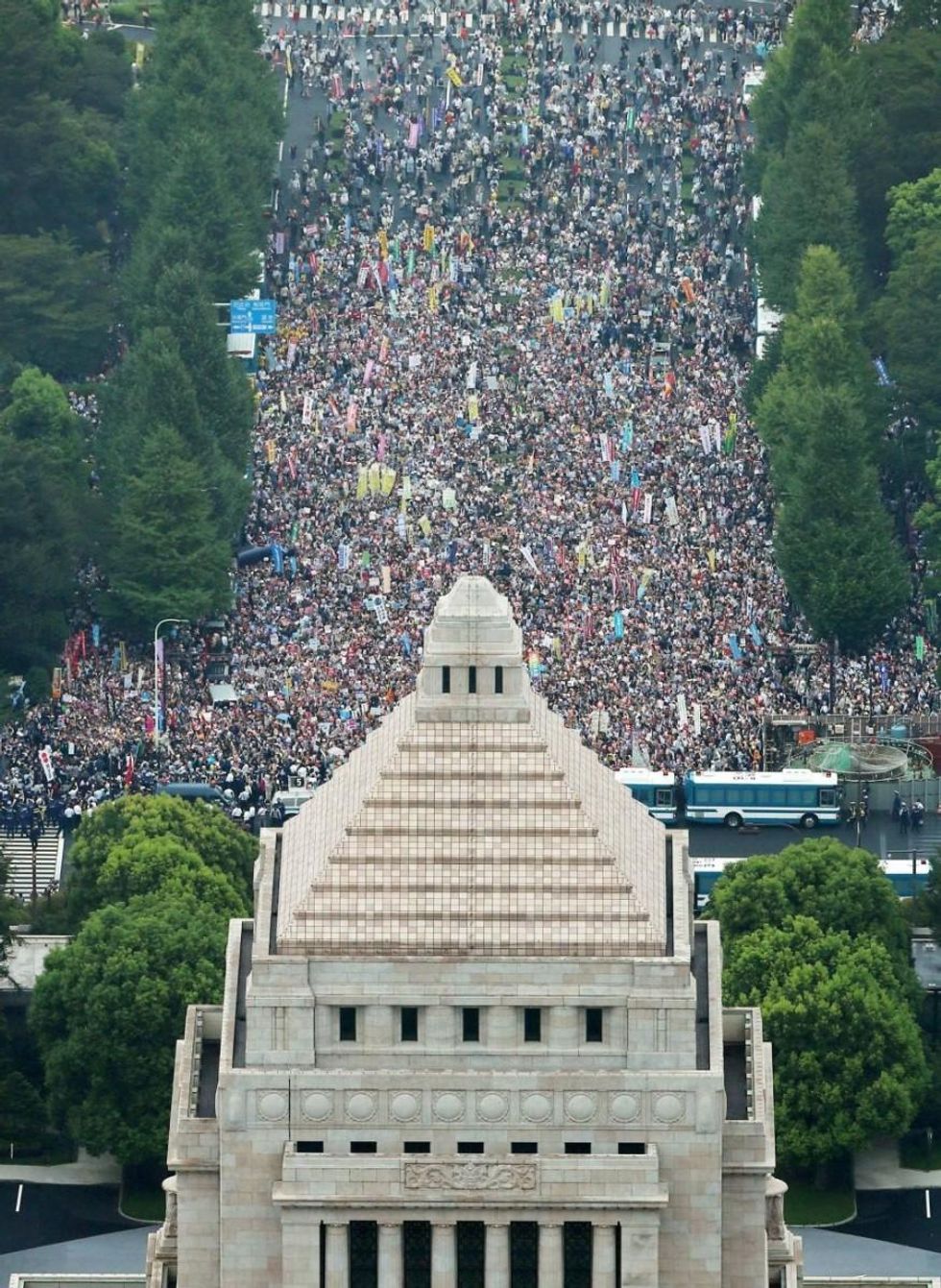
Tens of thousands gathered outside the Japanese parliament building on Sunday to reject plans by Prime Minister Shinzo Abe that would see an aggressive expansion of the nation's armed forces despite a long-standing constitutional mandate for a "defense only" military posture.
| Tweets about Japan protest |
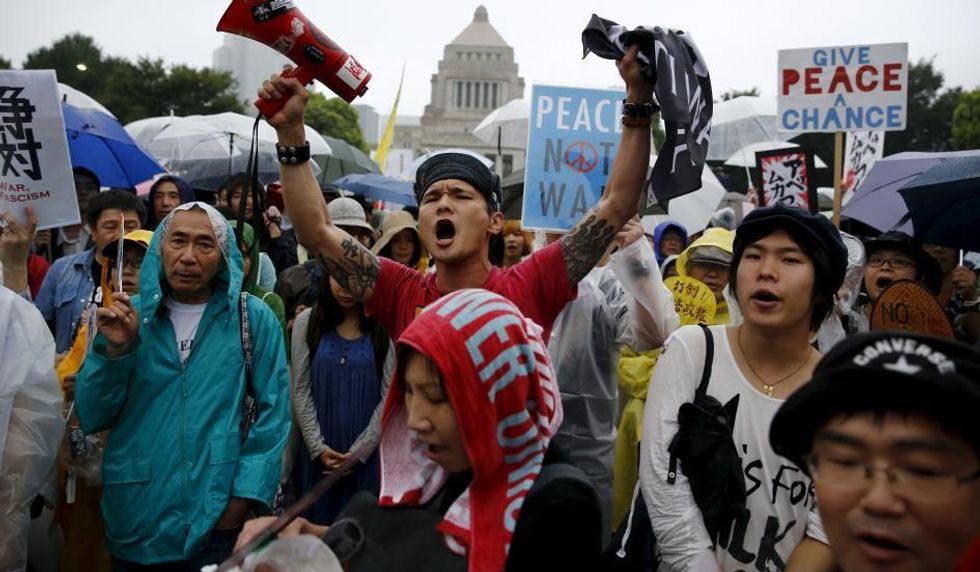
The enormous crowd--estimated by organizers as more than 120,000 people--is opposing a set of bills moving through the country's legislature which would allow the country's military to engage in overseas fighting and ratchet up spending on new weapons systems. Despite loud public protests against the plan, Abe has continued to defend the plan. Demonstrators carried banners reading "Peace Not War" and "Abe, Quit!"
"Sitting in front of the TV and just complaining wouldn't do," Naoko Hiramatsu, a 44-year-old associate professor in French and one of the Tokyo protesters, told Reuters. Holding his four-year-old son in her arms, she continued, "If I don't take action and try to put a stop to this, I will not be able to explain myself to my child in the future."
As the Asahi Shimbum reports:
In one of the largest postwar demonstrations in Japan, tens of thousands of protesters swarmed in front of the Diet building in Tokyo on Aug. 30 to oppose the Abe administration's contentious security legislation.
Following a wave of weekly protests near the Diet building in recent months, rally organizers had worked to mobilize 100,000 participants from across the nation.
Amid the gloomy and rainy weather, protesters held up placards and banners and chanted slogans against the legislation, which is being pushed through the Diet.
A huge banner hanging from dozens of balloons read: "Abe, Quit!"
Opponents blasted the security bills on concerns that they would drag Japan into unwanted conflicts overseas.
Organized by a union of three different anti-war citizens' groups, the Japan Times reports Sunday's rally was arguably the most massive in a string of similar protests in recent months.
The Times spoke with several people in the massive crowd who rejected Abe's arguments that Japan must return to a war footing more than half a century after the carnage that resulted from the Second World War:
Yamada, who at 5 years old witnessed the Great Tokyo Air Raid in 1945, said he was still haunted by the horrifying scene in which his neighbors in the Ryogoku area of northeast Tokyo jumped into the Sumida River in a desperate bid to escape the deadly blast and ensuing inferno.
"With the advance of technologies (over the past seven decades), war is likely to be more deadly than it used to be," Yamada said. "In this age of nuclear weapons, you will never know how massive a death toll is going to be. The danger is far bigger than before. "We should never let it happen again," he added.
A 38-year-old mother, who only gave her first name, Naoko, said she was worried about possible consequences of the bills that her children would have to face.
The bills, which she said ran counter to the pacifist policies Japan has adhered to over the past 70 years, could see her children embroiled in wars.
"Instead of enacting such pro-war bills, I want Japan to exert leadership roles in facilitating world peace as has done (since World War II)," she said.
Translator Hiromi Miyasaka, 49, said she resented the way the government was trying to steamroll the bills into enactment despite widespread public concerns.
"The way the government brushes aside public worries . . . it's as though Japan is slipping back into its pre-World War II state," she said.
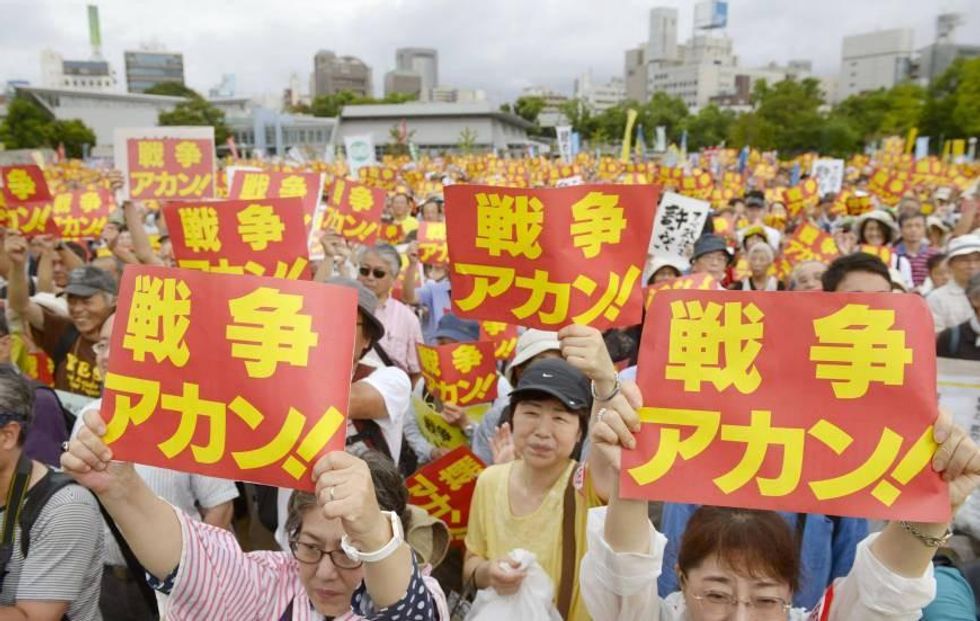
Tens of thousands gathered outside the Japanese parliament building on Sunday to reject plans by Prime Minister Shinzo Abe that would see an aggressive expansion of the nation's armed forces despite a long-standing constitutional mandate for a "defense only" military posture.
| Tweets about Japan protest |
The enormous crowd--estimated by organizers as more than 120,000 people--is opposing a set of bills moving through the country's legislature which would allow the country's military to engage in overseas fighting and ratchet up spending on new weapons systems. Despite loud public protests against the plan, Abe has continued to defend the plan. Demonstrators carried banners reading "Peace Not War" and "Abe, Quit!"
"Sitting in front of the TV and just complaining wouldn't do," Naoko Hiramatsu, a 44-year-old associate professor in French and one of the Tokyo protesters, told Reuters. Holding his four-year-old son in her arms, she continued, "If I don't take action and try to put a stop to this, I will not be able to explain myself to my child in the future."
As the Asahi Shimbum reports:
In one of the largest postwar demonstrations in Japan, tens of thousands of protesters swarmed in front of the Diet building in Tokyo on Aug. 30 to oppose the Abe administration's contentious security legislation.
Following a wave of weekly protests near the Diet building in recent months, rally organizers had worked to mobilize 100,000 participants from across the nation.
Amid the gloomy and rainy weather, protesters held up placards and banners and chanted slogans against the legislation, which is being pushed through the Diet.
A huge banner hanging from dozens of balloons read: "Abe, Quit!"
Opponents blasted the security bills on concerns that they would drag Japan into unwanted conflicts overseas.
Organized by a union of three different anti-war citizens' groups, the Japan Times reports Sunday's rally was arguably the most massive in a string of similar protests in recent months.
The Times spoke with several people in the massive crowd who rejected Abe's arguments that Japan must return to a war footing more than half a century after the carnage that resulted from the Second World War:
Yamada, who at 5 years old witnessed the Great Tokyo Air Raid in 1945, said he was still haunted by the horrifying scene in which his neighbors in the Ryogoku area of northeast Tokyo jumped into the Sumida River in a desperate bid to escape the deadly blast and ensuing inferno.
"With the advance of technologies (over the past seven decades), war is likely to be more deadly than it used to be," Yamada said. "In this age of nuclear weapons, you will never know how massive a death toll is going to be. The danger is far bigger than before. "We should never let it happen again," he added.
A 38-year-old mother, who only gave her first name, Naoko, said she was worried about possible consequences of the bills that her children would have to face.
The bills, which she said ran counter to the pacifist policies Japan has adhered to over the past 70 years, could see her children embroiled in wars.
"Instead of enacting such pro-war bills, I want Japan to exert leadership roles in facilitating world peace as has done (since World War II)," she said.
Translator Hiromi Miyasaka, 49, said she resented the way the government was trying to steamroll the bills into enactment despite widespread public concerns.
"The way the government brushes aside public worries . . . it's as though Japan is slipping back into its pre-World War II state," she said.
Tens of thousands gathered outside the Japanese parliament building on Sunday to reject plans by Prime Minister Shinzo Abe that would see an aggressive expansion of the nation's armed forces despite a long-standing constitutional mandate for a "defense only" military posture.
| Tweets about Japan protest |
The enormous crowd--estimated by organizers as more than 120,000 people--is opposing a set of bills moving through the country's legislature which would allow the country's military to engage in overseas fighting and ratchet up spending on new weapons systems. Despite loud public protests against the plan, Abe has continued to defend the plan. Demonstrators carried banners reading "Peace Not War" and "Abe, Quit!"
"Sitting in front of the TV and just complaining wouldn't do," Naoko Hiramatsu, a 44-year-old associate professor in French and one of the Tokyo protesters, told Reuters. Holding his four-year-old son in her arms, she continued, "If I don't take action and try to put a stop to this, I will not be able to explain myself to my child in the future."
As the Asahi Shimbum reports:
In one of the largest postwar demonstrations in Japan, tens of thousands of protesters swarmed in front of the Diet building in Tokyo on Aug. 30 to oppose the Abe administration's contentious security legislation.
Following a wave of weekly protests near the Diet building in recent months, rally organizers had worked to mobilize 100,000 participants from across the nation.
Amid the gloomy and rainy weather, protesters held up placards and banners and chanted slogans against the legislation, which is being pushed through the Diet.
A huge banner hanging from dozens of balloons read: "Abe, Quit!"
Opponents blasted the security bills on concerns that they would drag Japan into unwanted conflicts overseas.
Organized by a union of three different anti-war citizens' groups, the Japan Times reports Sunday's rally was arguably the most massive in a string of similar protests in recent months.
The Times spoke with several people in the massive crowd who rejected Abe's arguments that Japan must return to a war footing more than half a century after the carnage that resulted from the Second World War:
Yamada, who at 5 years old witnessed the Great Tokyo Air Raid in 1945, said he was still haunted by the horrifying scene in which his neighbors in the Ryogoku area of northeast Tokyo jumped into the Sumida River in a desperate bid to escape the deadly blast and ensuing inferno.
"With the advance of technologies (over the past seven decades), war is likely to be more deadly than it used to be," Yamada said. "In this age of nuclear weapons, you will never know how massive a death toll is going to be. The danger is far bigger than before. "We should never let it happen again," he added.
A 38-year-old mother, who only gave her first name, Naoko, said she was worried about possible consequences of the bills that her children would have to face.
The bills, which she said ran counter to the pacifist policies Japan has adhered to over the past 70 years, could see her children embroiled in wars.
"Instead of enacting such pro-war bills, I want Japan to exert leadership roles in facilitating world peace as has done (since World War II)," she said.
Translator Hiromi Miyasaka, 49, said she resented the way the government was trying to steamroll the bills into enactment despite widespread public concerns.
"The way the government brushes aside public worries . . . it's as though Japan is slipping back into its pre-World War II state," she said.