SUBSCRIBE TO OUR FREE NEWSLETTER
Daily news & progressive opinion—funded by the people, not the corporations—delivered straight to your inbox.
5
#000000
#FFFFFF
To donate by check, phone, or other method, see our More Ways to Give page.
Daily news & progressive opinion—funded by the people, not the corporations—delivered straight to your inbox.
As the World Health Organization declares the Ebola outbreak in areas of West Africa a "Public Health Emergency of International Concern," humanitarian organizations and medical doctors are urging aggressive action, 'not just words,' to help all people threatened by the disease.
The W.H.O. announced Friday that its Emergency Committee came to a unanimous decision to label to label the outbreak an "extraordinary event" that requires a "coordinated international response." While the organization explicitly stated, "There should be no general ban on international travel or trade," it urged heads of state in affected countries to declare "national emergencies," screen people crossing borders by land, air, or sea, and prevent people suspected of infection from traveling.
Dr. Bart Janssens, director of operations for humanitarian aid organization Doctors Without Borders, said in a press statement released Friday, "Declaring Ebola an international public health emergency shows how seriously the World Health Organization (WHO) is taking the current outbreak; but statements won't save lives. Now we need this statement to translate into immediate action on the ground."
"The Ebola virus is a very virulent and deadly disease and spreads very quickly," Dr. Dougbeh Chris Nyan, medical doctor and biomedical researcher for the Food and Drug Administration, told Common Dreams. "Necessary health care measures have to be put in place to contain it."
The W.H.O. reports that, since this latest outbreak began in March, Ebola has killed at least 932 people, making it the worst outbreak ever recorded. Meanwhile, the total number of suspected and confirmed cases has reached 1,779, with infections and deaths reported in Guinea, Liberia and Sierra Leone, and Nigeria. Doctors Without Borders reports that teams on the ground have seen a "worrying surge" in the disease in recent weeks, with drastic increases of infections in Sierra Leone and Liberia. Meanwhile, scientists warn that global climate change may have played a role in fueling this latest outbreak.
The disease, which is transmitted through contact with organs and bodily fluids, has a fatality rate of 50 to 90 percent with no known cure.
Two U.S. aid workers who contracted the disease in Libya were recently evacuated to the United States and administered an experimental vaccine produced by pharmaceutical company Mapp Biopharmaceutical.
The failure to treat West African residents who contracted the disease with equally aggressive measures touched off considerable controversy, including criticism from three of the world's top Ebola specialists, who say people in the affected areas should have access to the vaccines. Liberia's assistant health minister, Tolbert Nyenswah, told the Wall Street Journal that officials are facing pleas from dying Liberians and their families for the same access to the medicine.
Meanwhile, as Leslie Savan points out in the Nation, media sensationalism over the disease has stoked racist and xenophobic sentiments on the U.S. right-wing.
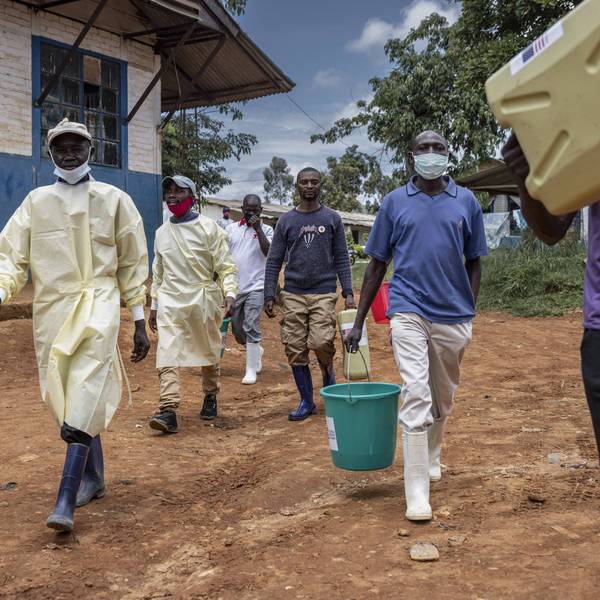
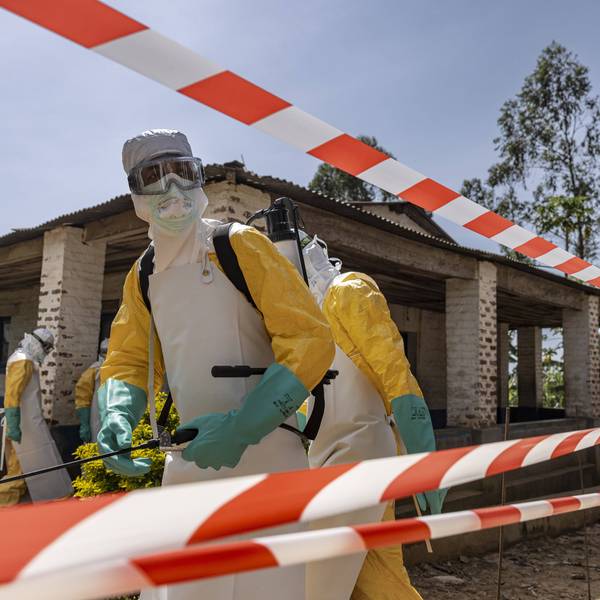
Humanitarian workers say that aggressive action--not fear--is needed to quell the disease. "In concrete terms, all of the following need to be radically scaled up: medical care, training of health staff, infection control, contact tracing, epidemiological surveillance, alert and referral systems, community mobilization, and education," stated Janssens.
"Lives are being lost because the response is too slow."
Dear Common Dreams reader, It’s been nearly 30 years since I co-founded Common Dreams with my late wife, Lina Newhouser. We had the radical notion that journalism should serve the public good, not corporate profits. It was clear to us from the outset what it would take to build such a project. No paid advertisements. No corporate sponsors. No millionaire publisher telling us what to think or do. Many people said we wouldn't last a year, but we proved those doubters wrong. Together with a tremendous team of journalists and dedicated staff, we built an independent media outlet free from the constraints of profits and corporate control. Our mission has always been simple: To inform. To inspire. To ignite change for the common good. Building Common Dreams was not easy. Our survival was never guaranteed. When you take on the most powerful forces—Wall Street greed, fossil fuel industry destruction, Big Tech lobbyists, and uber-rich oligarchs who have spent billions upon billions rigging the economy and democracy in their favor—the only bulwark you have is supporters who believe in your work. But here’s the urgent message from me today. It's never been this bad out there. And it's never been this hard to keep us going. At the very moment Common Dreams is most needed, the threats we face are intensifying. We need your support now more than ever. We don't accept corporate advertising and never will. We don't have a paywall because we don't think people should be blocked from critical news based on their ability to pay. Everything we do is funded by the donations of readers like you. When everyone does the little they can afford, we are strong. But if that support retreats or dries up, so do we. Will you donate now to make sure Common Dreams not only survives but thrives? —Craig Brown, Co-founder |
As the World Health Organization declares the Ebola outbreak in areas of West Africa a "Public Health Emergency of International Concern," humanitarian organizations and medical doctors are urging aggressive action, 'not just words,' to help all people threatened by the disease.
The W.H.O. announced Friday that its Emergency Committee came to a unanimous decision to label to label the outbreak an "extraordinary event" that requires a "coordinated international response." While the organization explicitly stated, "There should be no general ban on international travel or trade," it urged heads of state in affected countries to declare "national emergencies," screen people crossing borders by land, air, or sea, and prevent people suspected of infection from traveling.
Dr. Bart Janssens, director of operations for humanitarian aid organization Doctors Without Borders, said in a press statement released Friday, "Declaring Ebola an international public health emergency shows how seriously the World Health Organization (WHO) is taking the current outbreak; but statements won't save lives. Now we need this statement to translate into immediate action on the ground."
"The Ebola virus is a very virulent and deadly disease and spreads very quickly," Dr. Dougbeh Chris Nyan, medical doctor and biomedical researcher for the Food and Drug Administration, told Common Dreams. "Necessary health care measures have to be put in place to contain it."
The W.H.O. reports that, since this latest outbreak began in March, Ebola has killed at least 932 people, making it the worst outbreak ever recorded. Meanwhile, the total number of suspected and confirmed cases has reached 1,779, with infections and deaths reported in Guinea, Liberia and Sierra Leone, and Nigeria. Doctors Without Borders reports that teams on the ground have seen a "worrying surge" in the disease in recent weeks, with drastic increases of infections in Sierra Leone and Liberia. Meanwhile, scientists warn that global climate change may have played a role in fueling this latest outbreak.
The disease, which is transmitted through contact with organs and bodily fluids, has a fatality rate of 50 to 90 percent with no known cure.
Two U.S. aid workers who contracted the disease in Libya were recently evacuated to the United States and administered an experimental vaccine produced by pharmaceutical company Mapp Biopharmaceutical.
The failure to treat West African residents who contracted the disease with equally aggressive measures touched off considerable controversy, including criticism from three of the world's top Ebola specialists, who say people in the affected areas should have access to the vaccines. Liberia's assistant health minister, Tolbert Nyenswah, told the Wall Street Journal that officials are facing pleas from dying Liberians and their families for the same access to the medicine.
Meanwhile, as Leslie Savan points out in the Nation, media sensationalism over the disease has stoked racist and xenophobic sentiments on the U.S. right-wing.
Humanitarian workers say that aggressive action--not fear--is needed to quell the disease. "In concrete terms, all of the following need to be radically scaled up: medical care, training of health staff, infection control, contact tracing, epidemiological surveillance, alert and referral systems, community mobilization, and education," stated Janssens.
"Lives are being lost because the response is too slow."
As the World Health Organization declares the Ebola outbreak in areas of West Africa a "Public Health Emergency of International Concern," humanitarian organizations and medical doctors are urging aggressive action, 'not just words,' to help all people threatened by the disease.
The W.H.O. announced Friday that its Emergency Committee came to a unanimous decision to label to label the outbreak an "extraordinary event" that requires a "coordinated international response." While the organization explicitly stated, "There should be no general ban on international travel or trade," it urged heads of state in affected countries to declare "national emergencies," screen people crossing borders by land, air, or sea, and prevent people suspected of infection from traveling.
Dr. Bart Janssens, director of operations for humanitarian aid organization Doctors Without Borders, said in a press statement released Friday, "Declaring Ebola an international public health emergency shows how seriously the World Health Organization (WHO) is taking the current outbreak; but statements won't save lives. Now we need this statement to translate into immediate action on the ground."
"The Ebola virus is a very virulent and deadly disease and spreads very quickly," Dr. Dougbeh Chris Nyan, medical doctor and biomedical researcher for the Food and Drug Administration, told Common Dreams. "Necessary health care measures have to be put in place to contain it."
The W.H.O. reports that, since this latest outbreak began in March, Ebola has killed at least 932 people, making it the worst outbreak ever recorded. Meanwhile, the total number of suspected and confirmed cases has reached 1,779, with infections and deaths reported in Guinea, Liberia and Sierra Leone, and Nigeria. Doctors Without Borders reports that teams on the ground have seen a "worrying surge" in the disease in recent weeks, with drastic increases of infections in Sierra Leone and Liberia. Meanwhile, scientists warn that global climate change may have played a role in fueling this latest outbreak.
The disease, which is transmitted through contact with organs and bodily fluids, has a fatality rate of 50 to 90 percent with no known cure.
Two U.S. aid workers who contracted the disease in Libya were recently evacuated to the United States and administered an experimental vaccine produced by pharmaceutical company Mapp Biopharmaceutical.
The failure to treat West African residents who contracted the disease with equally aggressive measures touched off considerable controversy, including criticism from three of the world's top Ebola specialists, who say people in the affected areas should have access to the vaccines. Liberia's assistant health minister, Tolbert Nyenswah, told the Wall Street Journal that officials are facing pleas from dying Liberians and their families for the same access to the medicine.
Meanwhile, as Leslie Savan points out in the Nation, media sensationalism over the disease has stoked racist and xenophobic sentiments on the U.S. right-wing.
Humanitarian workers say that aggressive action--not fear--is needed to quell the disease. "In concrete terms, all of the following need to be radically scaled up: medical care, training of health staff, infection control, contact tracing, epidemiological surveillance, alert and referral systems, community mobilization, and education," stated Janssens.
"Lives are being lost because the response is too slow."