SUBSCRIBE TO OUR FREE NEWSLETTER
Daily news & progressive opinion—funded by the people, not the corporations—delivered straight to your inbox.
5
#000000
#FFFFFF
To donate by check, phone, or other method, see our More Ways to Give page.
"This is the driest year in 100 years," grower Joe Del Bosque told Al Jazeera, expressing concern that the hundreds of workers he employs for each year's harvest could be without a job this season.
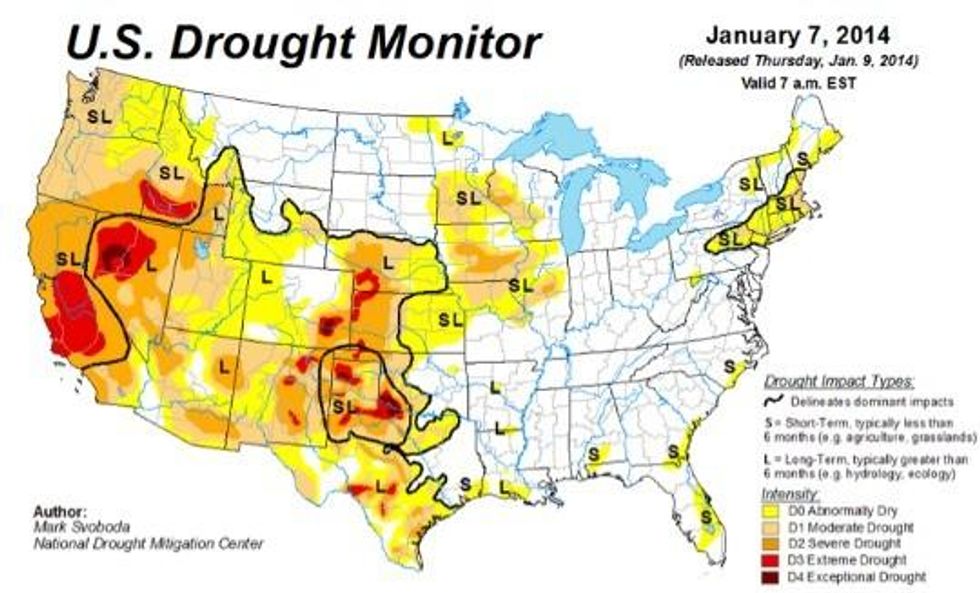
According to the U.S. Drought Monitor, 2013 was the driest on record for most areas of California, "smashing previous record dry years" across the state, including regions where approximately half the fruits, vegetables and nuts in the U.S. are grown.
Those conditions have not relented as 2014 begins with most of the state experiencing official 'severe' or 'extreme drought' conditions.
And as Al Jazeera reports, reservoirs, which store water that flows from the snow pack in the Sierra Nevada mountains, are at less than 50 percent capacity--20 percent below average for this time of year.
"That's rather dismal," said Nancy Vogel, spokeswoman for the California Department of Water Resources. "If we don't get big storms to build up that snow pack, we can't expect much in reservoirs."
Additionally, earlier this month firefighters were forced to Northern California to battle wildfires that were unprecedented for the time of year, and officials are concerned more fires could be on the way.
Fire experts in the state are worried, The San Francisco Chronicle reported earlier this month, "because January is a time of year when the northern reaches of the state normally are too wet to ignite."
"It's unprecedented for us to do this in January," said Battalion Chief Mike Giannini, whose Marin County Fire Department is one of the first to be called upon to send aid north.
"We've sent crews this early in the year in the past to Southern California, because their fire season never seems to end," Giannini said. "But not up there. Not to places like Humboldt, which has coastal, high-humidity, forested types of conditions we would normally equate with low fire danger."
All of these conditions, particularly those in mid-to-nothern California, where a large percentage of U.S. food is produced, have implications far beyond the state. As the Al Jazeera report continues:
The drought's effects will ripple far beyond the fields. Consumers can expect tighter supplies and higher prices for some fruits and vegetables by summer. And farm suppliers will feel the pinch.
"We're in the middle of what potentially is looking like a huge catastrophe," said Ryan Jacobsen, chief executive of the Fresno County Farm Bureau. "We're looking at some very harsh realities, as far as water allocations."
"Possibly hundreds of thousands of acres of land will go fallow," Jacobsen said.
_______________________
"This is the driest year in 100 years," grower Joe Del Bosque told Al Jazeera, expressing concern that the hundreds of workers he employs for each year's harvest could be without a job this season.
According to the U.S. Drought Monitor, 2013 was the driest on record for most areas of California, "smashing previous record dry years" across the state, including regions where approximately half the fruits, vegetables and nuts in the U.S. are grown.
Those conditions have not relented as 2014 begins with most of the state experiencing official 'severe' or 'extreme drought' conditions.
And as Al Jazeera reports, reservoirs, which store water that flows from the snow pack in the Sierra Nevada mountains, are at less than 50 percent capacity--20 percent below average for this time of year.
"That's rather dismal," said Nancy Vogel, spokeswoman for the California Department of Water Resources. "If we don't get big storms to build up that snow pack, we can't expect much in reservoirs."
Additionally, earlier this month firefighters were forced to Northern California to battle wildfires that were unprecedented for the time of year, and officials are concerned more fires could be on the way.
Fire experts in the state are worried, The San Francisco Chronicle reported earlier this month, "because January is a time of year when the northern reaches of the state normally are too wet to ignite."
"It's unprecedented for us to do this in January," said Battalion Chief Mike Giannini, whose Marin County Fire Department is one of the first to be called upon to send aid north.
"We've sent crews this early in the year in the past to Southern California, because their fire season never seems to end," Giannini said. "But not up there. Not to places like Humboldt, which has coastal, high-humidity, forested types of conditions we would normally equate with low fire danger."
All of these conditions, particularly those in mid-to-nothern California, where a large percentage of U.S. food is produced, have implications far beyond the state. As the Al Jazeera report continues:
The drought's effects will ripple far beyond the fields. Consumers can expect tighter supplies and higher prices for some fruits and vegetables by summer. And farm suppliers will feel the pinch.
"We're in the middle of what potentially is looking like a huge catastrophe," said Ryan Jacobsen, chief executive of the Fresno County Farm Bureau. "We're looking at some very harsh realities, as far as water allocations."
"Possibly hundreds of thousands of acres of land will go fallow," Jacobsen said.
_______________________
"This is the driest year in 100 years," grower Joe Del Bosque told Al Jazeera, expressing concern that the hundreds of workers he employs for each year's harvest could be without a job this season.
According to the U.S. Drought Monitor, 2013 was the driest on record for most areas of California, "smashing previous record dry years" across the state, including regions where approximately half the fruits, vegetables and nuts in the U.S. are grown.
Those conditions have not relented as 2014 begins with most of the state experiencing official 'severe' or 'extreme drought' conditions.
And as Al Jazeera reports, reservoirs, which store water that flows from the snow pack in the Sierra Nevada mountains, are at less than 50 percent capacity--20 percent below average for this time of year.
"That's rather dismal," said Nancy Vogel, spokeswoman for the California Department of Water Resources. "If we don't get big storms to build up that snow pack, we can't expect much in reservoirs."
Additionally, earlier this month firefighters were forced to Northern California to battle wildfires that were unprecedented for the time of year, and officials are concerned more fires could be on the way.
Fire experts in the state are worried, The San Francisco Chronicle reported earlier this month, "because January is a time of year when the northern reaches of the state normally are too wet to ignite."
"It's unprecedented for us to do this in January," said Battalion Chief Mike Giannini, whose Marin County Fire Department is one of the first to be called upon to send aid north.
"We've sent crews this early in the year in the past to Southern California, because their fire season never seems to end," Giannini said. "But not up there. Not to places like Humboldt, which has coastal, high-humidity, forested types of conditions we would normally equate with low fire danger."
All of these conditions, particularly those in mid-to-nothern California, where a large percentage of U.S. food is produced, have implications far beyond the state. As the Al Jazeera report continues:
The drought's effects will ripple far beyond the fields. Consumers can expect tighter supplies and higher prices for some fruits and vegetables by summer. And farm suppliers will feel the pinch.
"We're in the middle of what potentially is looking like a huge catastrophe," said Ryan Jacobsen, chief executive of the Fresno County Farm Bureau. "We're looking at some very harsh realities, as far as water allocations."
"Possibly hundreds of thousands of acres of land will go fallow," Jacobsen said.
_______________________