SUBSCRIBE TO OUR FREE NEWSLETTER
Daily news & progressive opinion—funded by the people, not the corporations—delivered straight to your inbox.
5
#000000
#FFFFFF
To donate by check, phone, or other method, see our More Ways to Give page.
By 2050 there will not be enough water in the world to continue the global trends of a Western-style, high animal protein diet. Rather, a primarily vegetarian diet is necessary to address growing water insecurity, according to a report released to coincide with the 2012 World Water Week in Stockholm from August 26-31.
In part of the report, Food Security: Overcoming Water Scarcity Realities, Malin Falkenmark, Senior Scientific Advisor to the Stockholm International Water Institute (SIWI), writes that almost half the world population will be living in chronic water shortage, and that sustainable water consumption means eating a diet with no more than 5% of calories coming from animal protein:
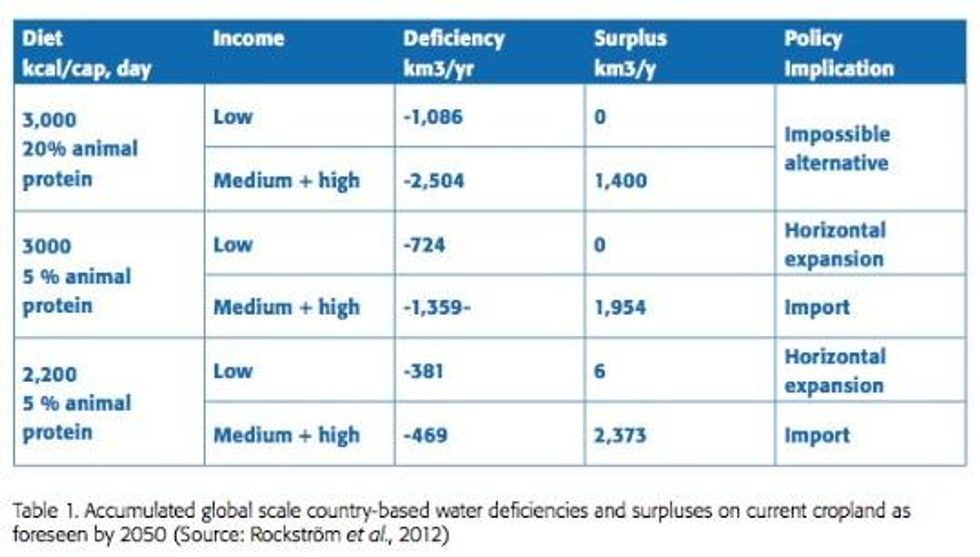
"[T]here will not be enough water available on current croplands to produce food for the expected population in 2050 if we follow current trends and changes towards diets common in Western nations (3,000 kcal produced per capita, including 20 per cent of calories produced coming from animal proteins). There will, however, be just enough water, if the proportion of animal based foods is limited to 5 per cent of total calories and considerable regional water deficits can be met by a well organised and reliable system of food trade."
Describing a revealing exhibition at the Stockholm conference on the water-heavy resource of animals raised for food production, Thalif Deen writes in Inter Press Service, "[T]he production of an average hamburger - two slices of bread, beef, tomato, lettuce, onions and cheese - consumes about 2,389 litres of water, compared to 140 litres for a cup of coffee and 135 for a single egg."
"An average meal of rice, beef and vegetables requires about 4,230 litres of water while a chunky, succulent beef steak, a staple among the rich in the world's industrial countries, consumes one of the largest quantum of water: about 7,000 litres," writes Deen.
The analysis also foresees a future with "virtual water trade" and competition over increasingly scarce water resources.
From Food Security: Overcoming Water Scarcity Realities:
By 2050 there will not be enough water in the world to continue the global trends of a Western-style, high animal protein diet. Rather, a primarily vegetarian diet is necessary to address growing water insecurity, according to a report released to coincide with the 2012 World Water Week in Stockholm from August 26-31.
In part of the report, Food Security: Overcoming Water Scarcity Realities, Malin Falkenmark, Senior Scientific Advisor to the Stockholm International Water Institute (SIWI), writes that almost half the world population will be living in chronic water shortage, and that sustainable water consumption means eating a diet with no more than 5% of calories coming from animal protein:
"[T]here will not be enough water available on current croplands to produce food for the expected population in 2050 if we follow current trends and changes towards diets common in Western nations (3,000 kcal produced per capita, including 20 per cent of calories produced coming from animal proteins). There will, however, be just enough water, if the proportion of animal based foods is limited to 5 per cent of total calories and considerable regional water deficits can be met by a well organised and reliable system of food trade."
Describing a revealing exhibition at the Stockholm conference on the water-heavy resource of animals raised for food production, Thalif Deen writes in Inter Press Service, "[T]he production of an average hamburger - two slices of bread, beef, tomato, lettuce, onions and cheese - consumes about 2,389 litres of water, compared to 140 litres for a cup of coffee and 135 for a single egg."
"An average meal of rice, beef and vegetables requires about 4,230 litres of water while a chunky, succulent beef steak, a staple among the rich in the world's industrial countries, consumes one of the largest quantum of water: about 7,000 litres," writes Deen.
The analysis also foresees a future with "virtual water trade" and competition over increasingly scarce water resources.
From Food Security: Overcoming Water Scarcity Realities:
By 2050 there will not be enough water in the world to continue the global trends of a Western-style, high animal protein diet. Rather, a primarily vegetarian diet is necessary to address growing water insecurity, according to a report released to coincide with the 2012 World Water Week in Stockholm from August 26-31.
In part of the report, Food Security: Overcoming Water Scarcity Realities, Malin Falkenmark, Senior Scientific Advisor to the Stockholm International Water Institute (SIWI), writes that almost half the world population will be living in chronic water shortage, and that sustainable water consumption means eating a diet with no more than 5% of calories coming from animal protein:
"[T]here will not be enough water available on current croplands to produce food for the expected population in 2050 if we follow current trends and changes towards diets common in Western nations (3,000 kcal produced per capita, including 20 per cent of calories produced coming from animal proteins). There will, however, be just enough water, if the proportion of animal based foods is limited to 5 per cent of total calories and considerable regional water deficits can be met by a well organised and reliable system of food trade."
Describing a revealing exhibition at the Stockholm conference on the water-heavy resource of animals raised for food production, Thalif Deen writes in Inter Press Service, "[T]he production of an average hamburger - two slices of bread, beef, tomato, lettuce, onions and cheese - consumes about 2,389 litres of water, compared to 140 litres for a cup of coffee and 135 for a single egg."
"An average meal of rice, beef and vegetables requires about 4,230 litres of water while a chunky, succulent beef steak, a staple among the rich in the world's industrial countries, consumes one of the largest quantum of water: about 7,000 litres," writes Deen.
The analysis also foresees a future with "virtual water trade" and competition over increasingly scarce water resources.
From Food Security: Overcoming Water Scarcity Realities: