SUBSCRIBE TO OUR FREE NEWSLETTER
Daily news & progressive opinion—funded by the people, not the corporations—delivered straight to your inbox.
5
#000000
#FFFFFF
To donate by check, phone, or other method, see our More Ways to Give page.
Daily news & progressive opinion—funded by the people, not the corporations—delivered straight to your inbox.
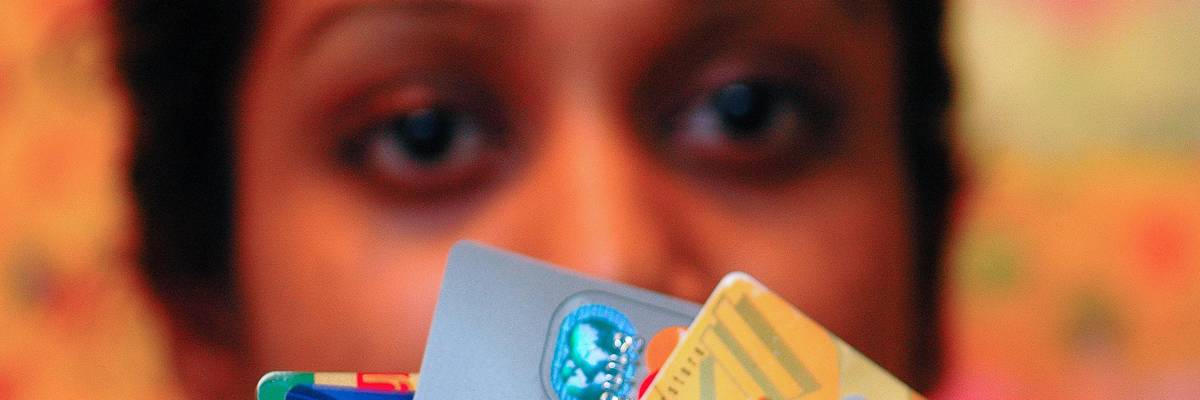
A woman holds a handful of credit cards. (Photo: michael_swan/flickr/cc)
The most perceptive ancient historians and philosophers could not have foreseen a time when a certain type of mass convenience and abundance becomes a threat to democracy, justice and dispersed power. Welcome to the incarcerations of the credit card payment systems Gulag and the corporate state's drive to stop consumers from paying with cash.
The ever-increasing loss of consumer freedom is a daily work in regress by the fine-print commercial planners of growing consumer peonage.
So long as you have a credit card and a credit score, you're in a world of easy credit (no down payments, etc.), and high interest rates, especially on unpaid monthly balances. All it takes is swiping your card and pushing buttons at retail establishments or online to make a purchase.
If you are in the lower 20% of the income scale, unbanked and outside the Gulag, consumer protections are really weak. Rip-off practices such as pay-day loan rackets and check cashing gouges proliferate.
For over a decade the screws have been tightening to coerce people into the credit-debt economy. Both the corporations and the government are to blame.
Try renting a car or getting home insurance without a credit card and credit history. Try using FedEx or UPS without a credit card. More retail outlets are experimenting with cashless transactions, even in places like the District of Columbia where a law barring discrimination against cash purchases goes unenforced.
"Cash" is defined for this article as paper money, checks and money orders. Many state laws define cash as only paper money.
The government, for example, is turning the screws by forcing Social Security recipients into receiving electronic monthly direct deposits or prepaid debit cards instead of receiving a check in the mail. This started in 2010. If you don't have an "E-ZPass" on the Massachusetts Turnpike, an electronic camera catches your license plate and bills you with an added fee, even though you were willing to pay cash for which there is no toll gate.
Last month, the city of Newburgh, New York, converted its coin-only parking meters to cashless meters on the city's business corridor streets. According to Blaise Gomez of "News12 Hudson Valley," florist Christine Bello said the city is out of touch with its largely low-income demographic. "They eliminated an entire portion of my customer base by making this strictly cards," she related. "So many of my customers do not have credit cards. They don't have bank accounts. They don't have smartphones. What were they thinking?"
Ms. Bello is speaking for tens of millions of poorer Americans who are being denied, excluded, penalized and harassed simply because they want to use paper cash which is "legal tender." Isn't that what 31 U.S.C. 5103 stipulates - that "United States coins and currency [including Federal Reserve notes and circulating notes of Federal Reserve Banks and national banks] are legal tender for all debts, public charges, taxes and dues"? Except for the loophole, which is that vendors can give you notice that they don't accept cash, unless you are in one of the few states with laws declaring cash must be accepted.
There are many inducements for vendors getting you into the credit-card economy. First, you lose control over your money. The ever-tightening tentacles of their fine-print contracts dictate the terms of their grip over you and any remedies you may have to challenge abuses. While losing your bargaining power under this consumer servitude, you also are losing your privacy big time, compared to buying with cash. "Data mining" takes over and sends your purchase history and profiles to anyone in the world willing to pay or anyone able to hack. Corporate Big Brother - Equifax and Facebook - are profiting from your personal data.
With credit, you are more likely to make impulsive purchases and not be able to control your children's buying escapades. Debt, high interest payments, and maybe harassment by bill collectors enter your life. Some who live beyond their means are seduced by the gambling industry's lure of riches.
A new Gallup Poll reports that 64% of respondents say it is "likely the U.S. will be cashless in their lifetime!" Other countries are moving to cashless faster - some for authoritarian motivations. Just try being a tourist in Europe without a credit card.
There is a class stratification in the poll. The lower people's income, the more likely they use cash for most purchases. The higher income and the younger they are, the more likely they use credit/debit cards or other digital payment systems. Interestingly, however, far more U.S. adults say they would be "upset" if the U.S. becomes a cashless society (46%) than the ones who say they would be "happy" with such an outcome (only 9%).
A majority (56%) of Americans, Gallup finds, say they "like to have cash with them at all times when they are outside their home."
The poll registers a sharp partisan difference: "Republicans are most resistant to a shift to a cashless economy, with 60% saying they would not like it. Independents register 45% and Democrats register 28% taking that rejectionist position.
While the Covid-19 pandemic contributed to the shift from cash, all the corporate pressures and extreme surveillance capitalism are in that direction. Even the union-owned Amalgamated Bank recently announced that its Washington, D.C. branch is now "a cashless bank." Imagine "a cashless bank" so you can no longer cash a check or get money for petty cash!
The ever-increasing loss of consumer freedom is a daily work in regress by the fine-print commercial planners of growing consumer peonage. They have corporate contract attorneys who brag about each step they originate, including blocking you from going to court for your grievances and relinquishing other rights.
There is no time to lose. Consumers need an all-American advocacy organization to protect and defend the use of paper cash, checks and money orders for the consumers' control, freedom and the privacy these payment systems enable. We invite people interested in helping to create such an organization to write to Protect Cash, P.O. Box 19367, Washington DC 20036, or send an email to info@csrl.org.
Dear Common Dreams reader, It’s been nearly 30 years since I co-founded Common Dreams with my late wife, Lina Newhouser. We had the radical notion that journalism should serve the public good, not corporate profits. It was clear to us from the outset what it would take to build such a project. No paid advertisements. No corporate sponsors. No millionaire publisher telling us what to think or do. Many people said we wouldn't last a year, but we proved those doubters wrong. Together with a tremendous team of journalists and dedicated staff, we built an independent media outlet free from the constraints of profits and corporate control. Our mission has always been simple: To inform. To inspire. To ignite change for the common good. Building Common Dreams was not easy. Our survival was never guaranteed. When you take on the most powerful forces—Wall Street greed, fossil fuel industry destruction, Big Tech lobbyists, and uber-rich oligarchs who have spent billions upon billions rigging the economy and democracy in their favor—the only bulwark you have is supporters who believe in your work. But here’s the urgent message from me today. It's never been this bad out there. And it's never been this hard to keep us going. At the very moment Common Dreams is most needed, the threats we face are intensifying. We need your support now more than ever. We don't accept corporate advertising and never will. We don't have a paywall because we don't think people should be blocked from critical news based on their ability to pay. Everything we do is funded by the donations of readers like you. When everyone does the little they can afford, we are strong. But if that support retreats or dries up, so do we. Will you donate now to make sure Common Dreams not only survives but thrives? —Craig Brown, Co-founder |
The most perceptive ancient historians and philosophers could not have foreseen a time when a certain type of mass convenience and abundance becomes a threat to democracy, justice and dispersed power. Welcome to the incarcerations of the credit card payment systems Gulag and the corporate state's drive to stop consumers from paying with cash.
The ever-increasing loss of consumer freedom is a daily work in regress by the fine-print commercial planners of growing consumer peonage.
So long as you have a credit card and a credit score, you're in a world of easy credit (no down payments, etc.), and high interest rates, especially on unpaid monthly balances. All it takes is swiping your card and pushing buttons at retail establishments or online to make a purchase.
If you are in the lower 20% of the income scale, unbanked and outside the Gulag, consumer protections are really weak. Rip-off practices such as pay-day loan rackets and check cashing gouges proliferate.
For over a decade the screws have been tightening to coerce people into the credit-debt economy. Both the corporations and the government are to blame.
Try renting a car or getting home insurance without a credit card and credit history. Try using FedEx or UPS without a credit card. More retail outlets are experimenting with cashless transactions, even in places like the District of Columbia where a law barring discrimination against cash purchases goes unenforced.
"Cash" is defined for this article as paper money, checks and money orders. Many state laws define cash as only paper money.
The government, for example, is turning the screws by forcing Social Security recipients into receiving electronic monthly direct deposits or prepaid debit cards instead of receiving a check in the mail. This started in 2010. If you don't have an "E-ZPass" on the Massachusetts Turnpike, an electronic camera catches your license plate and bills you with an added fee, even though you were willing to pay cash for which there is no toll gate.
Last month, the city of Newburgh, New York, converted its coin-only parking meters to cashless meters on the city's business corridor streets. According to Blaise Gomez of "News12 Hudson Valley," florist Christine Bello said the city is out of touch with its largely low-income demographic. "They eliminated an entire portion of my customer base by making this strictly cards," she related. "So many of my customers do not have credit cards. They don't have bank accounts. They don't have smartphones. What were they thinking?"
Ms. Bello is speaking for tens of millions of poorer Americans who are being denied, excluded, penalized and harassed simply because they want to use paper cash which is "legal tender." Isn't that what 31 U.S.C. 5103 stipulates - that "United States coins and currency [including Federal Reserve notes and circulating notes of Federal Reserve Banks and national banks] are legal tender for all debts, public charges, taxes and dues"? Except for the loophole, which is that vendors can give you notice that they don't accept cash, unless you are in one of the few states with laws declaring cash must be accepted.
There are many inducements for vendors getting you into the credit-card economy. First, you lose control over your money. The ever-tightening tentacles of their fine-print contracts dictate the terms of their grip over you and any remedies you may have to challenge abuses. While losing your bargaining power under this consumer servitude, you also are losing your privacy big time, compared to buying with cash. "Data mining" takes over and sends your purchase history and profiles to anyone in the world willing to pay or anyone able to hack. Corporate Big Brother - Equifax and Facebook - are profiting from your personal data.
With credit, you are more likely to make impulsive purchases and not be able to control your children's buying escapades. Debt, high interest payments, and maybe harassment by bill collectors enter your life. Some who live beyond their means are seduced by the gambling industry's lure of riches.
A new Gallup Poll reports that 64% of respondents say it is "likely the U.S. will be cashless in their lifetime!" Other countries are moving to cashless faster - some for authoritarian motivations. Just try being a tourist in Europe without a credit card.
There is a class stratification in the poll. The lower people's income, the more likely they use cash for most purchases. The higher income and the younger they are, the more likely they use credit/debit cards or other digital payment systems. Interestingly, however, far more U.S. adults say they would be "upset" if the U.S. becomes a cashless society (46%) than the ones who say they would be "happy" with such an outcome (only 9%).
A majority (56%) of Americans, Gallup finds, say they "like to have cash with them at all times when they are outside their home."
The poll registers a sharp partisan difference: "Republicans are most resistant to a shift to a cashless economy, with 60% saying they would not like it. Independents register 45% and Democrats register 28% taking that rejectionist position.
While the Covid-19 pandemic contributed to the shift from cash, all the corporate pressures and extreme surveillance capitalism are in that direction. Even the union-owned Amalgamated Bank recently announced that its Washington, D.C. branch is now "a cashless bank." Imagine "a cashless bank" so you can no longer cash a check or get money for petty cash!
The ever-increasing loss of consumer freedom is a daily work in regress by the fine-print commercial planners of growing consumer peonage. They have corporate contract attorneys who brag about each step they originate, including blocking you from going to court for your grievances and relinquishing other rights.
There is no time to lose. Consumers need an all-American advocacy organization to protect and defend the use of paper cash, checks and money orders for the consumers' control, freedom and the privacy these payment systems enable. We invite people interested in helping to create such an organization to write to Protect Cash, P.O. Box 19367, Washington DC 20036, or send an email to info@csrl.org.
The most perceptive ancient historians and philosophers could not have foreseen a time when a certain type of mass convenience and abundance becomes a threat to democracy, justice and dispersed power. Welcome to the incarcerations of the credit card payment systems Gulag and the corporate state's drive to stop consumers from paying with cash.
The ever-increasing loss of consumer freedom is a daily work in regress by the fine-print commercial planners of growing consumer peonage.
So long as you have a credit card and a credit score, you're in a world of easy credit (no down payments, etc.), and high interest rates, especially on unpaid monthly balances. All it takes is swiping your card and pushing buttons at retail establishments or online to make a purchase.
If you are in the lower 20% of the income scale, unbanked and outside the Gulag, consumer protections are really weak. Rip-off practices such as pay-day loan rackets and check cashing gouges proliferate.
For over a decade the screws have been tightening to coerce people into the credit-debt economy. Both the corporations and the government are to blame.
Try renting a car or getting home insurance without a credit card and credit history. Try using FedEx or UPS without a credit card. More retail outlets are experimenting with cashless transactions, even in places like the District of Columbia where a law barring discrimination against cash purchases goes unenforced.
"Cash" is defined for this article as paper money, checks and money orders. Many state laws define cash as only paper money.
The government, for example, is turning the screws by forcing Social Security recipients into receiving electronic monthly direct deposits or prepaid debit cards instead of receiving a check in the mail. This started in 2010. If you don't have an "E-ZPass" on the Massachusetts Turnpike, an electronic camera catches your license plate and bills you with an added fee, even though you were willing to pay cash for which there is no toll gate.
Last month, the city of Newburgh, New York, converted its coin-only parking meters to cashless meters on the city's business corridor streets. According to Blaise Gomez of "News12 Hudson Valley," florist Christine Bello said the city is out of touch with its largely low-income demographic. "They eliminated an entire portion of my customer base by making this strictly cards," she related. "So many of my customers do not have credit cards. They don't have bank accounts. They don't have smartphones. What were they thinking?"
Ms. Bello is speaking for tens of millions of poorer Americans who are being denied, excluded, penalized and harassed simply because they want to use paper cash which is "legal tender." Isn't that what 31 U.S.C. 5103 stipulates - that "United States coins and currency [including Federal Reserve notes and circulating notes of Federal Reserve Banks and national banks] are legal tender for all debts, public charges, taxes and dues"? Except for the loophole, which is that vendors can give you notice that they don't accept cash, unless you are in one of the few states with laws declaring cash must be accepted.
There are many inducements for vendors getting you into the credit-card economy. First, you lose control over your money. The ever-tightening tentacles of their fine-print contracts dictate the terms of their grip over you and any remedies you may have to challenge abuses. While losing your bargaining power under this consumer servitude, you also are losing your privacy big time, compared to buying with cash. "Data mining" takes over and sends your purchase history and profiles to anyone in the world willing to pay or anyone able to hack. Corporate Big Brother - Equifax and Facebook - are profiting from your personal data.
With credit, you are more likely to make impulsive purchases and not be able to control your children's buying escapades. Debt, high interest payments, and maybe harassment by bill collectors enter your life. Some who live beyond their means are seduced by the gambling industry's lure of riches.
A new Gallup Poll reports that 64% of respondents say it is "likely the U.S. will be cashless in their lifetime!" Other countries are moving to cashless faster - some for authoritarian motivations. Just try being a tourist in Europe without a credit card.
There is a class stratification in the poll. The lower people's income, the more likely they use cash for most purchases. The higher income and the younger they are, the more likely they use credit/debit cards or other digital payment systems. Interestingly, however, far more U.S. adults say they would be "upset" if the U.S. becomes a cashless society (46%) than the ones who say they would be "happy" with such an outcome (only 9%).
A majority (56%) of Americans, Gallup finds, say they "like to have cash with them at all times when they are outside their home."
The poll registers a sharp partisan difference: "Republicans are most resistant to a shift to a cashless economy, with 60% saying they would not like it. Independents register 45% and Democrats register 28% taking that rejectionist position.
While the Covid-19 pandemic contributed to the shift from cash, all the corporate pressures and extreme surveillance capitalism are in that direction. Even the union-owned Amalgamated Bank recently announced that its Washington, D.C. branch is now "a cashless bank." Imagine "a cashless bank" so you can no longer cash a check or get money for petty cash!
The ever-increasing loss of consumer freedom is a daily work in regress by the fine-print commercial planners of growing consumer peonage. They have corporate contract attorneys who brag about each step they originate, including blocking you from going to court for your grievances and relinquishing other rights.
There is no time to lose. Consumers need an all-American advocacy organization to protect and defend the use of paper cash, checks and money orders for the consumers' control, freedom and the privacy these payment systems enable. We invite people interested in helping to create such an organization to write to Protect Cash, P.O. Box 19367, Washington DC 20036, or send an email to info@csrl.org.