SUBSCRIBE TO OUR FREE NEWSLETTER
Daily news & progressive opinion—funded by the people, not the corporations—delivered straight to your inbox.
5
#000000
#FFFFFF
To donate by check, phone, or other method, see our More Ways to Give page.
Daily news & progressive opinion—funded by the people, not the corporations—delivered straight to your inbox.
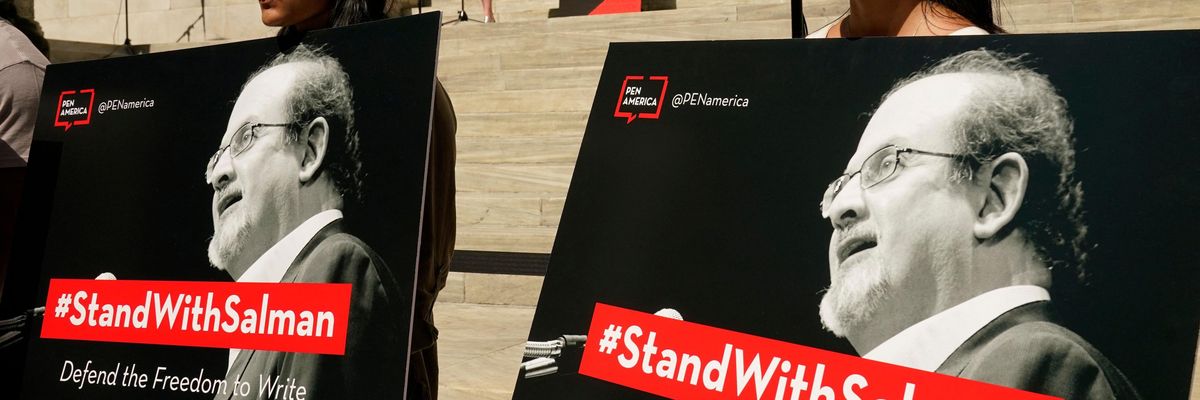
People listen as writers gather to read selected works of British author Salman Rushdie, one week after he was stabbed while on stage, during a rally to show solidarity for free expression outside the New York Public Library in New York City on August 19, 2022. Hadi Matar has pleaded not guilty to attempted murder charges after being accused of stabbing British author Salman Rushdie multiple times on stage during a literary event at the Chautauqua Institution. The severely injured author is recovering well according to family and friends, after the assault left him with multiple stab wounds on August 12, 2022. (Photo: Timothy A. Clary/AFP via Getty Images)
The despicable violent attack on Salman Rushdie not only saddened the world, many Muslims included, it demonstrated how a single ignorant attacker could take Ayatollah Khomeini's fatwa seriously--when the vast majority of Islamic scholars around the world never have--and reanimate the same old tropes about Islam. Under Islamic law, the attack on Rushdie was assault and attempted murder, and as such Muslims overwhelmingly condemn this attack. If they don't, they should, because, despite the common perception, Islam allows violence only in self-defense or in legitimate warfare against soldiers.
Why are we so quick to assume Khomeini's actions and the acts of Rushdie's attackers stem from religion? Buddhist monks in Sri Lanka have fought with Hindu Tamils and Muslims and Christians in the name of religion, as Buddhist monks in Myanmar have carried about massacres of Muslim civilians, including children, also in the name of Buddhism; yet, journalists who are quick to attribute the attack on Salman Rushdie to Islam would never attribute the actions of these Buddhist monks to Buddhism.
Fatwa does not mean death sentence, because under Islamic law everyone deserves a fair trial. A fatwa is a non-binding legal opinion, achieved by an accepted methodology, and issued by a recognized Islamic legal scholar. The vast majority of Islamic scholars rejected the death fatwa against Rushdie because Khomeini didn't follow Islamic law to arrive at his result. Even Al-Azhar University, one of the most authoritative and venerated bastions of Islamic scholarship in the world, disagreed with the fatwa. (And Al-Azhar is much more authoritative than Khomeini, who was not followed by most Muslims around the world, much less even all Iranian Muslims.)
The fatwa did not result from religion or even religious extremism; it resulted from political extremism. Khomeini wished to burn bridges with the West and avenge himself against Rushdie, who had ridiculed him. Even later Iranian clerics said they wouldn't enforce the fatwa. Which makes it even more tragic that some 24-year-old decades later lost his head and acted out his violent urges by using the fatwa as justification.
Rushdie's book was indeed banned by many Muslim-majority countries, but banning is a far cry from violence. India, a Hindu-majority country, banned it first. There's no dearth of book-banning in the West, either, nor mass protests of all kinds of religious depictions, including the films The Last Temptation of Christ or Monty Python's Life of Brian. Indeed, it's worth remembering that the Danish publishers who published the cartoons depicting Muhammad as terrorist refused to publish cartoons about Jesus and other cartoons about the Holocaust; yet no public outcry of "Free speech!" was raised in these two cases.
Because of one flawed fatwa by one Islamic scholar motivated by politics and revenge, the West rests secure in its misperception that Islam forbids free speech. Since the fatwa, behavior exhibited by Muslims against free speech is seen as evidence and simply slotted into that same confirmation bias. Non-Muslim incidents of suppressing free speech--which happen in our own country not infrequently--are hardly publicized.
Nothing in Islam forbids free speech. Most Islamic religious scholars throughout history "refused to classify even intentional jabs at the Prophet as criminally blasphemous." Prophet Muhammad (d. 632 CE) himself never retaliated against personal physical or verbal attacks. His companion, Umar, once asked if he could kill someone who insulted the Prophet, and the Prophet said no. The blasphemy laws that exist in some Muslim-majority countries were actually put there by the British when they colonized those countries.
Most Muslims in the world opposed violence against Rushdie and the publisher. According to Gallup polls, more Muslims around the world than Americans oppose violence against civilians. Also according to polls, significant majorities in nearly all Muslim-majority countries say they would guarantee free speech if they could.
The key, then, is to educate Muslims and others about Islam. Studies have shown that formal Islamic education prevents radicalization; indeed, only 10% of violent Islamists have been exposed to it. If Salman Rushdie's assailant had truly understood Islamic law, perhaps he wouldn't have attacked an innocent man.
Dear Common Dreams reader, It’s been nearly 30 years since I co-founded Common Dreams with my late wife, Lina Newhouser. We had the radical notion that journalism should serve the public good, not corporate profits. It was clear to us from the outset what it would take to build such a project. No paid advertisements. No corporate sponsors. No millionaire publisher telling us what to think or do. Many people said we wouldn't last a year, but we proved those doubters wrong. Together with a tremendous team of journalists and dedicated staff, we built an independent media outlet free from the constraints of profits and corporate control. Our mission has always been simple: To inform. To inspire. To ignite change for the common good. Building Common Dreams was not easy. Our survival was never guaranteed. When you take on the most powerful forces—Wall Street greed, fossil fuel industry destruction, Big Tech lobbyists, and uber-rich oligarchs who have spent billions upon billions rigging the economy and democracy in their favor—the only bulwark you have is supporters who believe in your work. But here’s the urgent message from me today. It's never been this bad out there. And it's never been this hard to keep us going. At the very moment Common Dreams is most needed, the threats we face are intensifying. We need your support now more than ever. We don't accept corporate advertising and never will. We don't have a paywall because we don't think people should be blocked from critical news based on their ability to pay. Everything we do is funded by the donations of readers like you. When everyone does the little they can afford, we are strong. But if that support retreats or dries up, so do we. Will you donate now to make sure Common Dreams not only survives but thrives? —Craig Brown, Co-founder |
The despicable violent attack on Salman Rushdie not only saddened the world, many Muslims included, it demonstrated how a single ignorant attacker could take Ayatollah Khomeini's fatwa seriously--when the vast majority of Islamic scholars around the world never have--and reanimate the same old tropes about Islam. Under Islamic law, the attack on Rushdie was assault and attempted murder, and as such Muslims overwhelmingly condemn this attack. If they don't, they should, because, despite the common perception, Islam allows violence only in self-defense or in legitimate warfare against soldiers.
Why are we so quick to assume Khomeini's actions and the acts of Rushdie's attackers stem from religion? Buddhist monks in Sri Lanka have fought with Hindu Tamils and Muslims and Christians in the name of religion, as Buddhist monks in Myanmar have carried about massacres of Muslim civilians, including children, also in the name of Buddhism; yet, journalists who are quick to attribute the attack on Salman Rushdie to Islam would never attribute the actions of these Buddhist monks to Buddhism.
Fatwa does not mean death sentence, because under Islamic law everyone deserves a fair trial. A fatwa is a non-binding legal opinion, achieved by an accepted methodology, and issued by a recognized Islamic legal scholar. The vast majority of Islamic scholars rejected the death fatwa against Rushdie because Khomeini didn't follow Islamic law to arrive at his result. Even Al-Azhar University, one of the most authoritative and venerated bastions of Islamic scholarship in the world, disagreed with the fatwa. (And Al-Azhar is much more authoritative than Khomeini, who was not followed by most Muslims around the world, much less even all Iranian Muslims.)
The fatwa did not result from religion or even religious extremism; it resulted from political extremism. Khomeini wished to burn bridges with the West and avenge himself against Rushdie, who had ridiculed him. Even later Iranian clerics said they wouldn't enforce the fatwa. Which makes it even more tragic that some 24-year-old decades later lost his head and acted out his violent urges by using the fatwa as justification.
Rushdie's book was indeed banned by many Muslim-majority countries, but banning is a far cry from violence. India, a Hindu-majority country, banned it first. There's no dearth of book-banning in the West, either, nor mass protests of all kinds of religious depictions, including the films The Last Temptation of Christ or Monty Python's Life of Brian. Indeed, it's worth remembering that the Danish publishers who published the cartoons depicting Muhammad as terrorist refused to publish cartoons about Jesus and other cartoons about the Holocaust; yet no public outcry of "Free speech!" was raised in these two cases.
Because of one flawed fatwa by one Islamic scholar motivated by politics and revenge, the West rests secure in its misperception that Islam forbids free speech. Since the fatwa, behavior exhibited by Muslims against free speech is seen as evidence and simply slotted into that same confirmation bias. Non-Muslim incidents of suppressing free speech--which happen in our own country not infrequently--are hardly publicized.
Nothing in Islam forbids free speech. Most Islamic religious scholars throughout history "refused to classify even intentional jabs at the Prophet as criminally blasphemous." Prophet Muhammad (d. 632 CE) himself never retaliated against personal physical or verbal attacks. His companion, Umar, once asked if he could kill someone who insulted the Prophet, and the Prophet said no. The blasphemy laws that exist in some Muslim-majority countries were actually put there by the British when they colonized those countries.
Most Muslims in the world opposed violence against Rushdie and the publisher. According to Gallup polls, more Muslims around the world than Americans oppose violence against civilians. Also according to polls, significant majorities in nearly all Muslim-majority countries say they would guarantee free speech if they could.
The key, then, is to educate Muslims and others about Islam. Studies have shown that formal Islamic education prevents radicalization; indeed, only 10% of violent Islamists have been exposed to it. If Salman Rushdie's assailant had truly understood Islamic law, perhaps he wouldn't have attacked an innocent man.
The despicable violent attack on Salman Rushdie not only saddened the world, many Muslims included, it demonstrated how a single ignorant attacker could take Ayatollah Khomeini's fatwa seriously--when the vast majority of Islamic scholars around the world never have--and reanimate the same old tropes about Islam. Under Islamic law, the attack on Rushdie was assault and attempted murder, and as such Muslims overwhelmingly condemn this attack. If they don't, they should, because, despite the common perception, Islam allows violence only in self-defense or in legitimate warfare against soldiers.
Why are we so quick to assume Khomeini's actions and the acts of Rushdie's attackers stem from religion? Buddhist monks in Sri Lanka have fought with Hindu Tamils and Muslims and Christians in the name of religion, as Buddhist monks in Myanmar have carried about massacres of Muslim civilians, including children, also in the name of Buddhism; yet, journalists who are quick to attribute the attack on Salman Rushdie to Islam would never attribute the actions of these Buddhist monks to Buddhism.
Fatwa does not mean death sentence, because under Islamic law everyone deserves a fair trial. A fatwa is a non-binding legal opinion, achieved by an accepted methodology, and issued by a recognized Islamic legal scholar. The vast majority of Islamic scholars rejected the death fatwa against Rushdie because Khomeini didn't follow Islamic law to arrive at his result. Even Al-Azhar University, one of the most authoritative and venerated bastions of Islamic scholarship in the world, disagreed with the fatwa. (And Al-Azhar is much more authoritative than Khomeini, who was not followed by most Muslims around the world, much less even all Iranian Muslims.)
The fatwa did not result from religion or even religious extremism; it resulted from political extremism. Khomeini wished to burn bridges with the West and avenge himself against Rushdie, who had ridiculed him. Even later Iranian clerics said they wouldn't enforce the fatwa. Which makes it even more tragic that some 24-year-old decades later lost his head and acted out his violent urges by using the fatwa as justification.
Rushdie's book was indeed banned by many Muslim-majority countries, but banning is a far cry from violence. India, a Hindu-majority country, banned it first. There's no dearth of book-banning in the West, either, nor mass protests of all kinds of religious depictions, including the films The Last Temptation of Christ or Monty Python's Life of Brian. Indeed, it's worth remembering that the Danish publishers who published the cartoons depicting Muhammad as terrorist refused to publish cartoons about Jesus and other cartoons about the Holocaust; yet no public outcry of "Free speech!" was raised in these two cases.
Because of one flawed fatwa by one Islamic scholar motivated by politics and revenge, the West rests secure in its misperception that Islam forbids free speech. Since the fatwa, behavior exhibited by Muslims against free speech is seen as evidence and simply slotted into that same confirmation bias. Non-Muslim incidents of suppressing free speech--which happen in our own country not infrequently--are hardly publicized.
Nothing in Islam forbids free speech. Most Islamic religious scholars throughout history "refused to classify even intentional jabs at the Prophet as criminally blasphemous." Prophet Muhammad (d. 632 CE) himself never retaliated against personal physical or verbal attacks. His companion, Umar, once asked if he could kill someone who insulted the Prophet, and the Prophet said no. The blasphemy laws that exist in some Muslim-majority countries were actually put there by the British when they colonized those countries.
Most Muslims in the world opposed violence against Rushdie and the publisher. According to Gallup polls, more Muslims around the world than Americans oppose violence against civilians. Also according to polls, significant majorities in nearly all Muslim-majority countries say they would guarantee free speech if they could.
The key, then, is to educate Muslims and others about Islam. Studies have shown that formal Islamic education prevents radicalization; indeed, only 10% of violent Islamists have been exposed to it. If Salman Rushdie's assailant had truly understood Islamic law, perhaps he wouldn't have attacked an innocent man.