SUBSCRIBE TO OUR FREE NEWSLETTER
Daily news & progressive opinion—funded by the people, not the corporations—delivered straight to your inbox.
5
#000000
#FFFFFF
To donate by check, phone, or other method, see our More Ways to Give page.
Daily news & progressive opinion—funded by the people, not the corporations—delivered straight to your inbox.
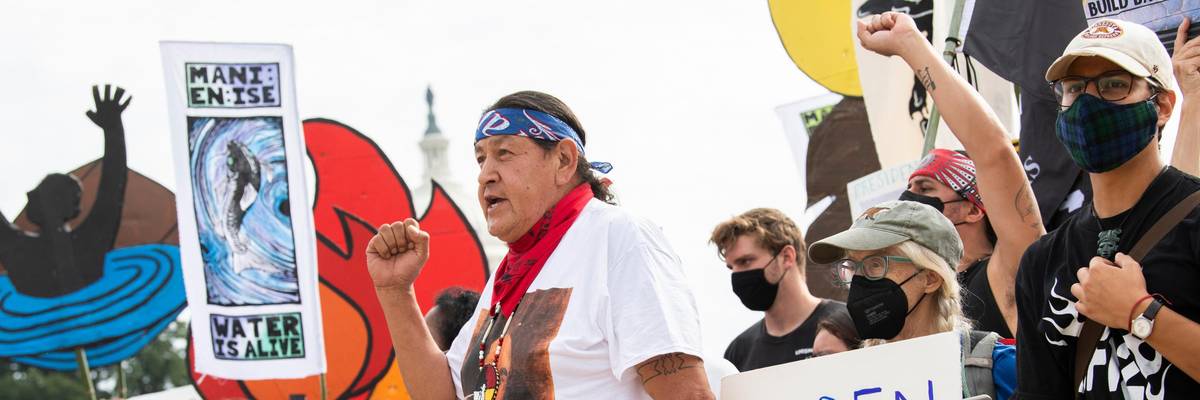
Climate activists and Indigenous leaders rally during a protest calling on President Joe Biden to cancel the Mountain Valley pipeline and other fossil fuel projects on October 15, 2021. (Photo: Tom Williams/CQ-Roll Call, Inc. via Getty Images)
The permit that greenlit the Mountain Valley Pipeline is about to expire. This means Mountain Valley is again seeking an extension from the Federal Energy Regulatory Commission (FERC). This wouldn't even be the first time that Mountain Valley needed an extension, as FERC already granted a two-year extension in 2020 (FERC recently faced sharp questioning in federal court for its handling of that review). On April 9, FERC approved the pipeline to bore under hundreds of streams, but not before it obtains other necessary permits. FERC should not give Mountain Valley any more bites at the apple. Prolonging this boondoggle would be unlawful because the Mountain Valley Pipeline is not needed and its construction would lead to significant environmental impacts that have been repeatedly ignored by FERC.
Now is the time to get it right--to stop the behind schedule, billions-over-budget, and boondoggle of a project that is known as the Mountain Valley Pipeline.
Ever since Mountain Valley was announced in 2014, numerous studies have shown that the project is unneeded. Even since FERC authorized Mountain Valley in 2017, projected gas demand in the region has declined. The project's poor commercial prospects have made it unattractive to potential shippers, so much so that NextEra, one of the project's biggest backers, announced in February that it is reevaluating its investment in the pipeline after a federal court rejected two necessary approvals earlier this year. They also admitted to its investors there is a "a very low probability of pipeline completion."
FERC has stated it can deny a permit extension when the project is no longer commercially viable. To the extent there ever was a potential public benefit to the Mountain Valley Pipeline, none exists today, and it's wholly inconsistent with the public interest to allow a financially unstable project to continue to seize private property and cause irreparable environmental damage.
Even if the pipeline somehow found the money to finish construction, the environmental costs still make its continuation unlawful. Mountain Valley Pipeline would exacerbate climate change significantly. In just one year, the project's estimated lifecycle emissions would be more than 25 coal-fired power plants. And because those are annual emissions, Mountain Valley could continue to emit at those levels for 40-50 years. Allowing the project to continue would also directly conflict with the Biden Administration's professed climate goals.
The project would also cause a litany of other serious environmental effects. For example, Mountain Valley proposes building a compressor station that would connect the project's mainline to its proposed Southgate extension in North Carolina. Compressor stations are used to push gas along a pipeline. They are widely known for leaking methane and other toxic chemicals which can cause detrimental health problems. It is estimated the proposed Lambert Compressor Station would, by itself, increase particulate matter pollution in the area by almost 30%. Given four environmental justice communities live within 5 miles of the site, the Lambert Compressor Station would have a tremendous impact on public health.
A peer-reviewed study published in September 2021 found that among a sample of 46 long distance gas pipelines in the U.S., the Mountain Valley Pipeline would cross the most "high landslide risk areas"--225 miles in total. Project construction has already had a serious and perhaps irreparable effect on water quality and endangered species. Furthermore there are more than six hundred stream crossings that remain, and some of the most difficult terrain.
When FERC was first tasked with reviewing the pipeline's environmental effects in 2017, it utterly failed to properly identify these risks, and it ignored the project's contribution to climate change altogether. FERC should approve an extension only when its original environmental review can still reasonably be assumed to assess a project's environmental impacts. It now has four years of evidence to show the project's environmental effects are far more severe than originally predicted.
FERC must not fail to meet this moment. The Commission has a real opportunity here to make a decision that follows the law and advances common-sense climate objectives.
Now is the time to get it right--to stop the behind schedule, billions-over-budget, and boondoggle of a project that is known as the Mountain Valley Pipeline.
Dear Common Dreams reader, It’s been nearly 30 years since I co-founded Common Dreams with my late wife, Lina Newhouser. We had the radical notion that journalism should serve the public good, not corporate profits. It was clear to us from the outset what it would take to build such a project. No paid advertisements. No corporate sponsors. No millionaire publisher telling us what to think or do. Many people said we wouldn't last a year, but we proved those doubters wrong. Together with a tremendous team of journalists and dedicated staff, we built an independent media outlet free from the constraints of profits and corporate control. Our mission has always been simple: To inform. To inspire. To ignite change for the common good. Building Common Dreams was not easy. Our survival was never guaranteed. When you take on the most powerful forces—Wall Street greed, fossil fuel industry destruction, Big Tech lobbyists, and uber-rich oligarchs who have spent billions upon billions rigging the economy and democracy in their favor—the only bulwark you have is supporters who believe in your work. But here’s the urgent message from me today. It's never been this bad out there. And it's never been this hard to keep us going. At the very moment Common Dreams is most needed, the threats we face are intensifying. We need your support now more than ever. We don't accept corporate advertising and never will. We don't have a paywall because we don't think people should be blocked from critical news based on their ability to pay. Everything we do is funded by the donations of readers like you. When everyone does the little they can afford, we are strong. But if that support retreats or dries up, so do we. Will you donate now to make sure Common Dreams not only survives but thrives? —Craig Brown, Co-founder |
The permit that greenlit the Mountain Valley Pipeline is about to expire. This means Mountain Valley is again seeking an extension from the Federal Energy Regulatory Commission (FERC). This wouldn't even be the first time that Mountain Valley needed an extension, as FERC already granted a two-year extension in 2020 (FERC recently faced sharp questioning in federal court for its handling of that review). On April 9, FERC approved the pipeline to bore under hundreds of streams, but not before it obtains other necessary permits. FERC should not give Mountain Valley any more bites at the apple. Prolonging this boondoggle would be unlawful because the Mountain Valley Pipeline is not needed and its construction would lead to significant environmental impacts that have been repeatedly ignored by FERC.
Now is the time to get it right--to stop the behind schedule, billions-over-budget, and boondoggle of a project that is known as the Mountain Valley Pipeline.
Ever since Mountain Valley was announced in 2014, numerous studies have shown that the project is unneeded. Even since FERC authorized Mountain Valley in 2017, projected gas demand in the region has declined. The project's poor commercial prospects have made it unattractive to potential shippers, so much so that NextEra, one of the project's biggest backers, announced in February that it is reevaluating its investment in the pipeline after a federal court rejected two necessary approvals earlier this year. They also admitted to its investors there is a "a very low probability of pipeline completion."
FERC has stated it can deny a permit extension when the project is no longer commercially viable. To the extent there ever was a potential public benefit to the Mountain Valley Pipeline, none exists today, and it's wholly inconsistent with the public interest to allow a financially unstable project to continue to seize private property and cause irreparable environmental damage.
Even if the pipeline somehow found the money to finish construction, the environmental costs still make its continuation unlawful. Mountain Valley Pipeline would exacerbate climate change significantly. In just one year, the project's estimated lifecycle emissions would be more than 25 coal-fired power plants. And because those are annual emissions, Mountain Valley could continue to emit at those levels for 40-50 years. Allowing the project to continue would also directly conflict with the Biden Administration's professed climate goals.
The project would also cause a litany of other serious environmental effects. For example, Mountain Valley proposes building a compressor station that would connect the project's mainline to its proposed Southgate extension in North Carolina. Compressor stations are used to push gas along a pipeline. They are widely known for leaking methane and other toxic chemicals which can cause detrimental health problems. It is estimated the proposed Lambert Compressor Station would, by itself, increase particulate matter pollution in the area by almost 30%. Given four environmental justice communities live within 5 miles of the site, the Lambert Compressor Station would have a tremendous impact on public health.
A peer-reviewed study published in September 2021 found that among a sample of 46 long distance gas pipelines in the U.S., the Mountain Valley Pipeline would cross the most "high landslide risk areas"--225 miles in total. Project construction has already had a serious and perhaps irreparable effect on water quality and endangered species. Furthermore there are more than six hundred stream crossings that remain, and some of the most difficult terrain.
When FERC was first tasked with reviewing the pipeline's environmental effects in 2017, it utterly failed to properly identify these risks, and it ignored the project's contribution to climate change altogether. FERC should approve an extension only when its original environmental review can still reasonably be assumed to assess a project's environmental impacts. It now has four years of evidence to show the project's environmental effects are far more severe than originally predicted.
FERC must not fail to meet this moment. The Commission has a real opportunity here to make a decision that follows the law and advances common-sense climate objectives.
Now is the time to get it right--to stop the behind schedule, billions-over-budget, and boondoggle of a project that is known as the Mountain Valley Pipeline.
The permit that greenlit the Mountain Valley Pipeline is about to expire. This means Mountain Valley is again seeking an extension from the Federal Energy Regulatory Commission (FERC). This wouldn't even be the first time that Mountain Valley needed an extension, as FERC already granted a two-year extension in 2020 (FERC recently faced sharp questioning in federal court for its handling of that review). On April 9, FERC approved the pipeline to bore under hundreds of streams, but not before it obtains other necessary permits. FERC should not give Mountain Valley any more bites at the apple. Prolonging this boondoggle would be unlawful because the Mountain Valley Pipeline is not needed and its construction would lead to significant environmental impacts that have been repeatedly ignored by FERC.
Now is the time to get it right--to stop the behind schedule, billions-over-budget, and boondoggle of a project that is known as the Mountain Valley Pipeline.
Ever since Mountain Valley was announced in 2014, numerous studies have shown that the project is unneeded. Even since FERC authorized Mountain Valley in 2017, projected gas demand in the region has declined. The project's poor commercial prospects have made it unattractive to potential shippers, so much so that NextEra, one of the project's biggest backers, announced in February that it is reevaluating its investment in the pipeline after a federal court rejected two necessary approvals earlier this year. They also admitted to its investors there is a "a very low probability of pipeline completion."
FERC has stated it can deny a permit extension when the project is no longer commercially viable. To the extent there ever was a potential public benefit to the Mountain Valley Pipeline, none exists today, and it's wholly inconsistent with the public interest to allow a financially unstable project to continue to seize private property and cause irreparable environmental damage.
Even if the pipeline somehow found the money to finish construction, the environmental costs still make its continuation unlawful. Mountain Valley Pipeline would exacerbate climate change significantly. In just one year, the project's estimated lifecycle emissions would be more than 25 coal-fired power plants. And because those are annual emissions, Mountain Valley could continue to emit at those levels for 40-50 years. Allowing the project to continue would also directly conflict with the Biden Administration's professed climate goals.
The project would also cause a litany of other serious environmental effects. For example, Mountain Valley proposes building a compressor station that would connect the project's mainline to its proposed Southgate extension in North Carolina. Compressor stations are used to push gas along a pipeline. They are widely known for leaking methane and other toxic chemicals which can cause detrimental health problems. It is estimated the proposed Lambert Compressor Station would, by itself, increase particulate matter pollution in the area by almost 30%. Given four environmental justice communities live within 5 miles of the site, the Lambert Compressor Station would have a tremendous impact on public health.
A peer-reviewed study published in September 2021 found that among a sample of 46 long distance gas pipelines in the U.S., the Mountain Valley Pipeline would cross the most "high landslide risk areas"--225 miles in total. Project construction has already had a serious and perhaps irreparable effect on water quality and endangered species. Furthermore there are more than six hundred stream crossings that remain, and some of the most difficult terrain.
When FERC was first tasked with reviewing the pipeline's environmental effects in 2017, it utterly failed to properly identify these risks, and it ignored the project's contribution to climate change altogether. FERC should approve an extension only when its original environmental review can still reasonably be assumed to assess a project's environmental impacts. It now has four years of evidence to show the project's environmental effects are far more severe than originally predicted.
FERC must not fail to meet this moment. The Commission has a real opportunity here to make a decision that follows the law and advances common-sense climate objectives.
Now is the time to get it right--to stop the behind schedule, billions-over-budget, and boondoggle of a project that is known as the Mountain Valley Pipeline.