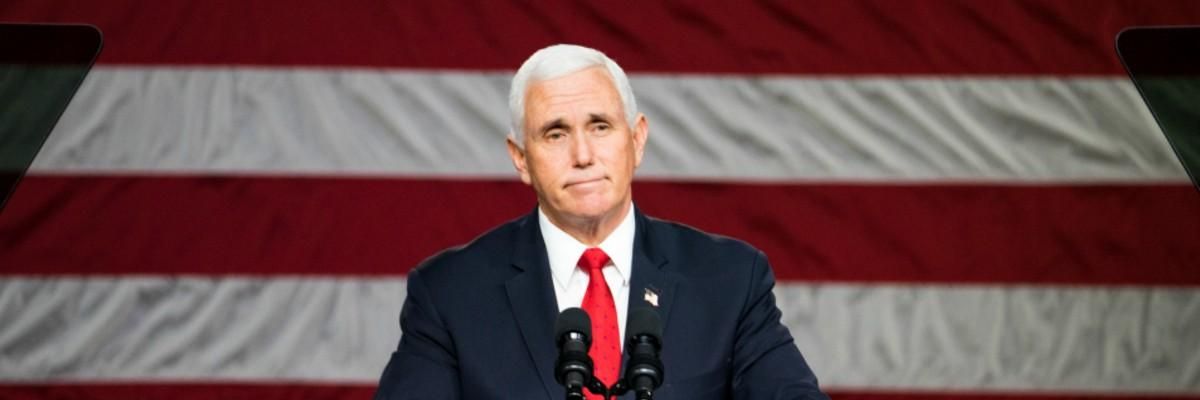
Vice President Mike Pence visits Rock Springs Church to campaign for GOP Senate candidates on January 4, 2021 in Milner, Georgia. (Photo: Megan Varner/Getty Images)
Mike Pence Says GOP Will Rip Up Any Nuclear Deal With Iran
Why could Tehran want to sign anything now? To have a likely '24 presidential candidate say this now is a deal killer.
Former Vice President Mike Pence told an Israeli newspaper on Tuesday that a future Republican administration will tear up any new nuclear deal made with Iran today. Beyond all of the political bloviation, it is important to understand how Pence's statement undermines the U.S. bargaining position right now in Vienna.
One can't ask for more when one simultaneously admits that no American promise can be kept longer than four years.
'"If the JCPOA finds a way to be resurrected, we will be a part and a voice of a chorus of Americans with that new administration coming into office to end the JCPOA just as quickly as we ended it under the Trump-Pence administration,'" he charged in Israel Hayom.
Not only would Republicans withdraw from any new agreement they would bring back President Trump's (fundamentally counterproductive) aggressive posture against Tehran, he boasted:
'"During our administration, it wasn't just that we got out of the JCPOA, it was that we isolated Iran like never before, we challenged their malign activities. We not only took down ISIS [the Islamic State] and Abu Bakr al-Baghdadi, but it was our administration that took down Qassem Soleimani.'" He then added, '"We made it clear to Iran and all of their affiliate organizations and terrorist groups across the region that the day of them sowing violence across the wider Arab world was over.'"
One of the biggest sticking points on behalf of the Iranian negotiators has been the inability to ensure that any future White House won't waltz in and rip up the renewed agreement. So far they haven't been able to get that kind of assurance, even from the Democrats who are supposedly behind getting a deal out the door. Now the GOP in the form of Mike Pence, one of the most high-profile likely candidates for president in 2024, is openly saying it will kill it.
So what does this do?
It means that any carrots the U.S. puts forward in the talks are devalued precisely because we are explicit about their lack of durability. Therefore, Washington has to offer more to achieve the same because of this open lack of trustworthiness.
As I have written elsewhere, this has been a major challenge throughout these nuclear talks. Being unreliable does not put you in a good position to ask for a '"longer and stronger'" deal.
At the same time, Pence is not lying. If the GOP wins in 2024, I see only two scenarios: either Washington walks out of the deal a la Trump, or it adopts an ambiguous position in which it doesn't commit to staying and flirts with leaving.
In the latter case, the United States injects so much uncertainty into the situation that international businesses will begin exiting the Iranian market, whether or not any sanctions are lifted from a renewed deal. As such, uncertainty is a de facto sanction.
Not getting what it has been promised, Tehran will likely quit the deal or it will reduce its obligations, as it did from 2019 and onward. But this time around, the JCPOA would likely not be able to take that pressure without collapsing. The nuclear deal dies and with it any hope for achieving any peaceful resolution with Iran.
Naively, many in D.C. are still thinking of how to '"strengthen'" the deal once it is revived. But I fear that very few have internalized how weak the Western bargaining position is: One can't ask for more when one simultaneously admits that no American promise can be kept longer than four years.
We are at a crossroads
This country and this world are at a monumental crossroads. In a few short weeks, US voters will have an opportunity to beat back the forces of fascism and confront the billionaires who are rigging the economy, our media system, and our democracy, making it increasingly impossible for ordinary people to get by. We’re not just talking about the election. We’re talking about what must be done once these fascist elements are vanquished from power. We need a bolder set of solutions than what either major party has so far been willing to offer and a working-class movement ready to fight like hell for it. Trump didn't emerge from nowhere. The conditions that fueled MAGA authoritarianism were created by decades of radical neoliberal economic policies and a corrupt political system dominated by corporate interests. They slashed taxes on the super-rich, promising that the benefits would trickle down. They said giveaways to the corporate titans would make life more affordable for the rest of us. It was all bullshit. And when a bitter, betrayed populace searches for someone to blame, right-wing demagogues have little trouble finding scapegoats. People know when they're being lied to, but you won't hear any of this from the corporate media. Only independent journalism—powered and funded by people who believe in building a better world—can deliver truly trustworthy daily news. Our Fall Campaign is underway, and we need your help. To power our newsroom through the rest of the year, we need to raise $125,000 by midnight on October 31. So if you share our vision, please contribute whatever you can to sustain our work. |
Former Vice President Mike Pence told an Israeli newspaper on Tuesday that a future Republican administration will tear up any new nuclear deal made with Iran today. Beyond all of the political bloviation, it is important to understand how Pence's statement undermines the U.S. bargaining position right now in Vienna.
One can't ask for more when one simultaneously admits that no American promise can be kept longer than four years.
'"If the JCPOA finds a way to be resurrected, we will be a part and a voice of a chorus of Americans with that new administration coming into office to end the JCPOA just as quickly as we ended it under the Trump-Pence administration,'" he charged in Israel Hayom.
Not only would Republicans withdraw from any new agreement they would bring back President Trump's (fundamentally counterproductive) aggressive posture against Tehran, he boasted:
'"During our administration, it wasn't just that we got out of the JCPOA, it was that we isolated Iran like never before, we challenged their malign activities. We not only took down ISIS [the Islamic State] and Abu Bakr al-Baghdadi, but it was our administration that took down Qassem Soleimani.'" He then added, '"We made it clear to Iran and all of their affiliate organizations and terrorist groups across the region that the day of them sowing violence across the wider Arab world was over.'"
One of the biggest sticking points on behalf of the Iranian negotiators has been the inability to ensure that any future White House won't waltz in and rip up the renewed agreement. So far they haven't been able to get that kind of assurance, even from the Democrats who are supposedly behind getting a deal out the door. Now the GOP in the form of Mike Pence, one of the most high-profile likely candidates for president in 2024, is openly saying it will kill it.
So what does this do?
It means that any carrots the U.S. puts forward in the talks are devalued precisely because we are explicit about their lack of durability. Therefore, Washington has to offer more to achieve the same because of this open lack of trustworthiness.
As I have written elsewhere, this has been a major challenge throughout these nuclear talks. Being unreliable does not put you in a good position to ask for a '"longer and stronger'" deal.
At the same time, Pence is not lying. If the GOP wins in 2024, I see only two scenarios: either Washington walks out of the deal a la Trump, or it adopts an ambiguous position in which it doesn't commit to staying and flirts with leaving.
In the latter case, the United States injects so much uncertainty into the situation that international businesses will begin exiting the Iranian market, whether or not any sanctions are lifted from a renewed deal. As such, uncertainty is a de facto sanction.
Not getting what it has been promised, Tehran will likely quit the deal or it will reduce its obligations, as it did from 2019 and onward. But this time around, the JCPOA would likely not be able to take that pressure without collapsing. The nuclear deal dies and with it any hope for achieving any peaceful resolution with Iran.
Naively, many in D.C. are still thinking of how to '"strengthen'" the deal once it is revived. But I fear that very few have internalized how weak the Western bargaining position is: One can't ask for more when one simultaneously admits that no American promise can be kept longer than four years.
Former Vice President Mike Pence told an Israeli newspaper on Tuesday that a future Republican administration will tear up any new nuclear deal made with Iran today. Beyond all of the political bloviation, it is important to understand how Pence's statement undermines the U.S. bargaining position right now in Vienna.
One can't ask for more when one simultaneously admits that no American promise can be kept longer than four years.
'"If the JCPOA finds a way to be resurrected, we will be a part and a voice of a chorus of Americans with that new administration coming into office to end the JCPOA just as quickly as we ended it under the Trump-Pence administration,'" he charged in Israel Hayom.
Not only would Republicans withdraw from any new agreement they would bring back President Trump's (fundamentally counterproductive) aggressive posture against Tehran, he boasted:
'"During our administration, it wasn't just that we got out of the JCPOA, it was that we isolated Iran like never before, we challenged their malign activities. We not only took down ISIS [the Islamic State] and Abu Bakr al-Baghdadi, but it was our administration that took down Qassem Soleimani.'" He then added, '"We made it clear to Iran and all of their affiliate organizations and terrorist groups across the region that the day of them sowing violence across the wider Arab world was over.'"
One of the biggest sticking points on behalf of the Iranian negotiators has been the inability to ensure that any future White House won't waltz in and rip up the renewed agreement. So far they haven't been able to get that kind of assurance, even from the Democrats who are supposedly behind getting a deal out the door. Now the GOP in the form of Mike Pence, one of the most high-profile likely candidates for president in 2024, is openly saying it will kill it.
So what does this do?
It means that any carrots the U.S. puts forward in the talks are devalued precisely because we are explicit about their lack of durability. Therefore, Washington has to offer more to achieve the same because of this open lack of trustworthiness.
As I have written elsewhere, this has been a major challenge throughout these nuclear talks. Being unreliable does not put you in a good position to ask for a '"longer and stronger'" deal.
At the same time, Pence is not lying. If the GOP wins in 2024, I see only two scenarios: either Washington walks out of the deal a la Trump, or it adopts an ambiguous position in which it doesn't commit to staying and flirts with leaving.
In the latter case, the United States injects so much uncertainty into the situation that international businesses will begin exiting the Iranian market, whether or not any sanctions are lifted from a renewed deal. As such, uncertainty is a de facto sanction.
Not getting what it has been promised, Tehran will likely quit the deal or it will reduce its obligations, as it did from 2019 and onward. But this time around, the JCPOA would likely not be able to take that pressure without collapsing. The nuclear deal dies and with it any hope for achieving any peaceful resolution with Iran.
Naively, many in D.C. are still thinking of how to '"strengthen'" the deal once it is revived. But I fear that very few have internalized how weak the Western bargaining position is: One can't ask for more when one simultaneously admits that no American promise can be kept longer than four years.