SUBSCRIBE TO OUR FREE NEWSLETTER
Daily news & progressive opinion—funded by the people, not the corporations—delivered straight to your inbox.
5
#000000
#FFFFFF
To donate by check, phone, or other method, see our More Ways to Give page.
Daily news & progressive opinion—funded by the people, not the corporations—delivered straight to your inbox.
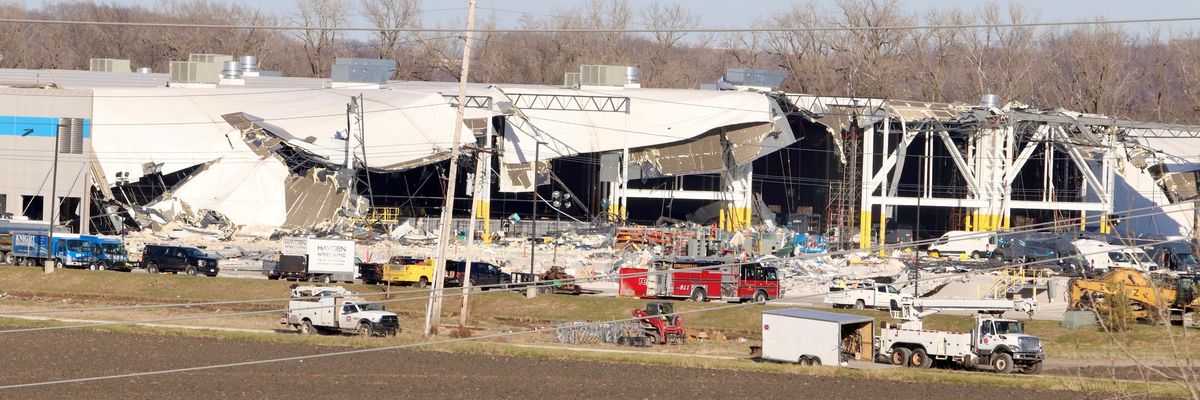
Photo taken on Dec. 13, 2021 shows the damaged Amazon Fulfillment Center in Edwardsville, Illinois, the United States. Tornadoes swept parts of the U.S. midwest and south late Friday and early Saturday, causing severe casualties and damages. The distribution center of Amazon in Edwardsville was struck by tornadoes and collapsed. (Photo: Jason Tan/Xinhua via Getty Images)
The fight for justice and accountability continues for six Amazon employees who were killed when a warehouse roof collapsed during a tornado in December.
Despite multiple severe tornado watch alerts in the surrounding area, Amazon workers were advised not to leave the facility the night of the storm.
Federal officials are investigating possible health and safety violations at the facility in Edwardsville, Illinois, a suburb of St. Louis. Illinois lawmakers are considering raising statewide standards for warehouse construction to prevent future tragedies. And family members of one of the employees, Austin McEwen, recently filed a wrongful death suit against the giant retailer.
"My daughter was not expendable," said Jeffrey Hebb at a January rally in front of the Edwardsville facility. Hebb's daughter, 34-year-old Etheria Hebb, died in the warehouse collapse, leaving behind a one-year-old daughter.
"Amazon was supposed to keep them safe," Hebb said. "They didn't do that. How does a company worth over $1 trillion let this happen?"
Despite multiple severe tornado watch alerts in the surrounding area, Amazon workers were advised not to leave the facility the night of the storm. With Amazon forbidding personal cell phone use at work, workers were also cut off from all communication with loved ones. While the e-commerce giant claims the building was up to code and that workers followed safety procedures to shelter during the storm, that offers little solace to the workers and their loved ones who believe this tragedy could have been prevented.
"This was negligence from the richest company in the world, owned by the richest man in the world," said Cheryl Sommer, a local faith leader and mother of an Amazon warehouse worker. "I understand that these safety procedures take time and money and would have impacted the company's bottom line and that profits are good, but how much profit is worth it when it comes to the dignity and safety of workers who contribute to that profit? How many homes for one person are enough? How many yachts? How many trips into space?"
Workers for other large low-wage employers are showing support for the Amazon warehouse workers and their families.
"Why are fast food workers here standing with Amazon workers? Because an injury to one is an injury to all," said Terrence Wise, a McDonald's employee and organizer with the Fight for $15 and Stand Up Kansas City at the Edwardsville rally. "Amazon and McDonald's are the second- and third-largest employers in the US. What happens to us and the workers at trillion-dollar corporations is going to set the standard for workers across the whole economy."
The Occupational Safety and Health Administration (OSHA) has embarked on a six-month investigation of the warehouse collapse to review whether Amazon had a proper emergency action plan in place and will "issue citations and propose monetary penalties if violations of workplace safety and or health regulations are found."
Meanwhile, workers will continue to build cross-movement solidarity to fight for a world where everyone can work with dignity.
The fight for accountability for the Edwardsville Amazon workers is happening at a time of increased organizing activity at the retailer's operations. A new labor group, called Amazon Labor Union, is attempting to organize workers in warehouses on New York's Staten Island. Amazon warehouse workers in Bessemer, Alabama, are getting a second chance to vote on unionization, after the National Labor Relations Board ruled that the company had interfered with the election process at that site last year. Results of the revote are expected by March 28.
"Last month it was them, but it can be any of us," said McDonald's worker Wise at the Edwardsville rally. "It's time we organize. It's time for all of us to build worker movements that are powerful enough to raise wages and win a union."
Dear Common Dreams reader, It’s been nearly 30 years since I co-founded Common Dreams with my late wife, Lina Newhouser. We had the radical notion that journalism should serve the public good, not corporate profits. It was clear to us from the outset what it would take to build such a project. No paid advertisements. No corporate sponsors. No millionaire publisher telling us what to think or do. Many people said we wouldn't last a year, but we proved those doubters wrong. Together with a tremendous team of journalists and dedicated staff, we built an independent media outlet free from the constraints of profits and corporate control. Our mission has always been simple: To inform. To inspire. To ignite change for the common good. Building Common Dreams was not easy. Our survival was never guaranteed. When you take on the most powerful forces—Wall Street greed, fossil fuel industry destruction, Big Tech lobbyists, and uber-rich oligarchs who have spent billions upon billions rigging the economy and democracy in their favor—the only bulwark you have is supporters who believe in your work. But here’s the urgent message from me today. It's never been this bad out there. And it's never been this hard to keep us going. At the very moment Common Dreams is most needed, the threats we face are intensifying. We need your support now more than ever. We don't accept corporate advertising and never will. We don't have a paywall because we don't think people should be blocked from critical news based on their ability to pay. Everything we do is funded by the donations of readers like you. When everyone does the little they can afford, we are strong. But if that support retreats or dries up, so do we. Will you donate now to make sure Common Dreams not only survives but thrives? —Craig Brown, Co-founder |
The fight for justice and accountability continues for six Amazon employees who were killed when a warehouse roof collapsed during a tornado in December.
Despite multiple severe tornado watch alerts in the surrounding area, Amazon workers were advised not to leave the facility the night of the storm.
Federal officials are investigating possible health and safety violations at the facility in Edwardsville, Illinois, a suburb of St. Louis. Illinois lawmakers are considering raising statewide standards for warehouse construction to prevent future tragedies. And family members of one of the employees, Austin McEwen, recently filed a wrongful death suit against the giant retailer.
"My daughter was not expendable," said Jeffrey Hebb at a January rally in front of the Edwardsville facility. Hebb's daughter, 34-year-old Etheria Hebb, died in the warehouse collapse, leaving behind a one-year-old daughter.
"Amazon was supposed to keep them safe," Hebb said. "They didn't do that. How does a company worth over $1 trillion let this happen?"
Despite multiple severe tornado watch alerts in the surrounding area, Amazon workers were advised not to leave the facility the night of the storm. With Amazon forbidding personal cell phone use at work, workers were also cut off from all communication with loved ones. While the e-commerce giant claims the building was up to code and that workers followed safety procedures to shelter during the storm, that offers little solace to the workers and their loved ones who believe this tragedy could have been prevented.
"This was negligence from the richest company in the world, owned by the richest man in the world," said Cheryl Sommer, a local faith leader and mother of an Amazon warehouse worker. "I understand that these safety procedures take time and money and would have impacted the company's bottom line and that profits are good, but how much profit is worth it when it comes to the dignity and safety of workers who contribute to that profit? How many homes for one person are enough? How many yachts? How many trips into space?"
Workers for other large low-wage employers are showing support for the Amazon warehouse workers and their families.
"Why are fast food workers here standing with Amazon workers? Because an injury to one is an injury to all," said Terrence Wise, a McDonald's employee and organizer with the Fight for $15 and Stand Up Kansas City at the Edwardsville rally. "Amazon and McDonald's are the second- and third-largest employers in the US. What happens to us and the workers at trillion-dollar corporations is going to set the standard for workers across the whole economy."
The Occupational Safety and Health Administration (OSHA) has embarked on a six-month investigation of the warehouse collapse to review whether Amazon had a proper emergency action plan in place and will "issue citations and propose monetary penalties if violations of workplace safety and or health regulations are found."
Meanwhile, workers will continue to build cross-movement solidarity to fight for a world where everyone can work with dignity.
The fight for accountability for the Edwardsville Amazon workers is happening at a time of increased organizing activity at the retailer's operations. A new labor group, called Amazon Labor Union, is attempting to organize workers in warehouses on New York's Staten Island. Amazon warehouse workers in Bessemer, Alabama, are getting a second chance to vote on unionization, after the National Labor Relations Board ruled that the company had interfered with the election process at that site last year. Results of the revote are expected by March 28.
"Last month it was them, but it can be any of us," said McDonald's worker Wise at the Edwardsville rally. "It's time we organize. It's time for all of us to build worker movements that are powerful enough to raise wages and win a union."
The fight for justice and accountability continues for six Amazon employees who were killed when a warehouse roof collapsed during a tornado in December.
Despite multiple severe tornado watch alerts in the surrounding area, Amazon workers were advised not to leave the facility the night of the storm.
Federal officials are investigating possible health and safety violations at the facility in Edwardsville, Illinois, a suburb of St. Louis. Illinois lawmakers are considering raising statewide standards for warehouse construction to prevent future tragedies. And family members of one of the employees, Austin McEwen, recently filed a wrongful death suit against the giant retailer.
"My daughter was not expendable," said Jeffrey Hebb at a January rally in front of the Edwardsville facility. Hebb's daughter, 34-year-old Etheria Hebb, died in the warehouse collapse, leaving behind a one-year-old daughter.
"Amazon was supposed to keep them safe," Hebb said. "They didn't do that. How does a company worth over $1 trillion let this happen?"
Despite multiple severe tornado watch alerts in the surrounding area, Amazon workers were advised not to leave the facility the night of the storm. With Amazon forbidding personal cell phone use at work, workers were also cut off from all communication with loved ones. While the e-commerce giant claims the building was up to code and that workers followed safety procedures to shelter during the storm, that offers little solace to the workers and their loved ones who believe this tragedy could have been prevented.
"This was negligence from the richest company in the world, owned by the richest man in the world," said Cheryl Sommer, a local faith leader and mother of an Amazon warehouse worker. "I understand that these safety procedures take time and money and would have impacted the company's bottom line and that profits are good, but how much profit is worth it when it comes to the dignity and safety of workers who contribute to that profit? How many homes for one person are enough? How many yachts? How many trips into space?"
Workers for other large low-wage employers are showing support for the Amazon warehouse workers and their families.
"Why are fast food workers here standing with Amazon workers? Because an injury to one is an injury to all," said Terrence Wise, a McDonald's employee and organizer with the Fight for $15 and Stand Up Kansas City at the Edwardsville rally. "Amazon and McDonald's are the second- and third-largest employers in the US. What happens to us and the workers at trillion-dollar corporations is going to set the standard for workers across the whole economy."
The Occupational Safety and Health Administration (OSHA) has embarked on a six-month investigation of the warehouse collapse to review whether Amazon had a proper emergency action plan in place and will "issue citations and propose monetary penalties if violations of workplace safety and or health regulations are found."
Meanwhile, workers will continue to build cross-movement solidarity to fight for a world where everyone can work with dignity.
The fight for accountability for the Edwardsville Amazon workers is happening at a time of increased organizing activity at the retailer's operations. A new labor group, called Amazon Labor Union, is attempting to organize workers in warehouses on New York's Staten Island. Amazon warehouse workers in Bessemer, Alabama, are getting a second chance to vote on unionization, after the National Labor Relations Board ruled that the company had interfered with the election process at that site last year. Results of the revote are expected by March 28.
"Last month it was them, but it can be any of us," said McDonald's worker Wise at the Edwardsville rally. "It's time we organize. It's time for all of us to build worker movements that are powerful enough to raise wages and win a union."