SUBSCRIBE TO OUR FREE NEWSLETTER
Daily news & progressive opinion—funded by the people, not the corporations—delivered straight to your inbox.
5
#000000
#FFFFFF
To donate by check, phone, or other method, see our More Ways to Give page.
Daily news & progressive opinion—funded by the people, not the corporations—delivered straight to your inbox.
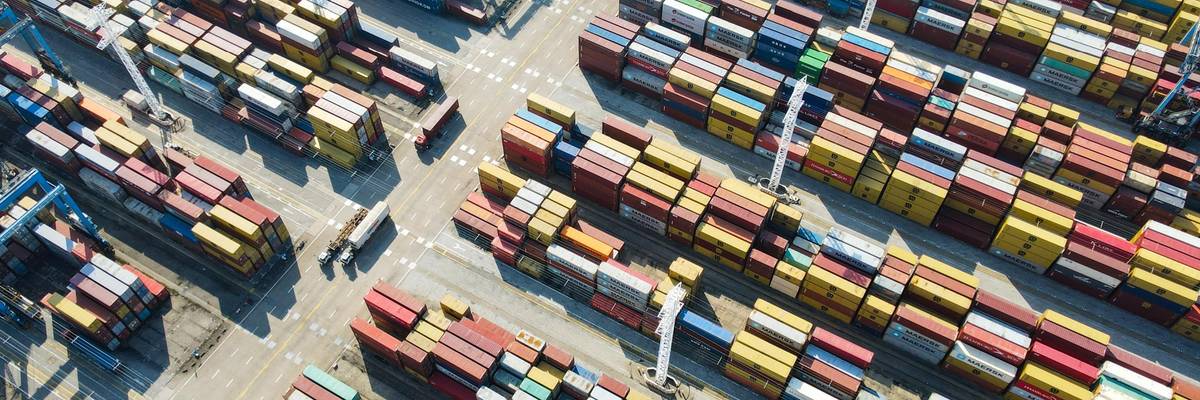
Aerial view of shipping containers sitting stacked at Zhoushan Port on November 11, 2021 in Zhoushan, Zhejiang Province of China. (Photo: Dong Xiaofei/VCG via Getty Images)
Headlines are screaming that inflation is here to stay.
U.S. consumer prices have risen by an average of 6.2 percent in the past year, the sharpest increase since 1991. Although Americans are supposedly--in the words of the New York Times--"flush with cash and jobs," they are also deeply unhappy with the state of the economy.
It's no wonder Republicans are thrilled and are drawing a line between inflation, public anxiety about the economy, and Joe Biden's presidency.
Americans have spent decades being disappointed with the sustained suppression of wages and increasingly insecure jobs. This is a direct consequence of the offshoring and deregulation accelerated by corporate globalization.
What is surprising is that President Biden himself is helping them by citing his administration's achievement of putting more money into people's pockets as part of the explanation for the current spike in inflation.
In a November 10 speech, Biden said, "You all got checks for $1,400. You got checks for a whole range of things." He went on to explain, "Well, with more people with money buying product and less product to buy, what happens? Prices go up."
The New York Post, a conservative paper, jumped on the speech, claiming that the president "concedes his COVID stimulus checks fueled [the] spike in inflation."
But the paper downplayed Biden's assertion that "the supply chain is the reason."
In fact, the president led his audience through a fairly clear explanation of how globalization works. By artificially driving down the cost of goods for decades, this far-flung system is especially vulnerable to disruptions like the pandemic.
As Biden explained, "Products like smartphones often bring together parts from France, Italy; chips from the Netherlands; touchscreens from New York State; camera components from Japan--a supply chain that crosses dozens of countries."
"That's just the nature of a modern economy," he concluded. But should it be?
The massive web of consumer manufacturing isn't a fact of nature. It's a systematically deregulated system designed by multinational corporations to minimize the cost of materials and labor--and maximize their profits. This was precisely what the anti-globalization movements of the 1990s were protesting.
When Biden said in his speech that you "have to use wood from Brazil" and "graphite from India before it comes together at a factory in the United States to get a pencil," he didn't reveal that pencil manufacturers might be relying on illegal logging in the Brazilian Amazon. Nor did he mention that transporting goods from far reaches of the globe generates massive carbon pollution.
Now this system is hurting consumers too. In fact, they've been feeling the pinch for years.
Go back to polls conducted even before the pandemic--including a Gallup poll from 2018 and the General Social Survey from 2019--and one can find widespread malaise about the state of the economy.
In other words, Americans have spent decades being disappointed with the sustained suppression of wages and increasingly insecure jobs. This is a direct consequence of the offshoring and deregulation accelerated by corporate globalization.
But instead of drawing the connection, conservative Republicans are blaming pandemic assistance and other government help, as though ending child care subsidies could restock store shelves. Conservative Democratic Senator Joe Manchin of West Virginia is making similar assertions to justify stymying Biden's proposals to expand government assistance.
A better takeaway from our current economic situation is that there is nothing natural about being at the mercy and whims of an economy designed by corporate profiteers for corporate profiteers.
We need to make the global economy fairer and more sustainable--not pull up the few remaining supports for American families.
Dear Common Dreams reader, It’s been nearly 30 years since I co-founded Common Dreams with my late wife, Lina Newhouser. We had the radical notion that journalism should serve the public good, not corporate profits. It was clear to us from the outset what it would take to build such a project. No paid advertisements. No corporate sponsors. No millionaire publisher telling us what to think or do. Many people said we wouldn't last a year, but we proved those doubters wrong. Together with a tremendous team of journalists and dedicated staff, we built an independent media outlet free from the constraints of profits and corporate control. Our mission has always been simple: To inform. To inspire. To ignite change for the common good. Building Common Dreams was not easy. Our survival was never guaranteed. When you take on the most powerful forces—Wall Street greed, fossil fuel industry destruction, Big Tech lobbyists, and uber-rich oligarchs who have spent billions upon billions rigging the economy and democracy in their favor—the only bulwark you have is supporters who believe in your work. But here’s the urgent message from me today. It's never been this bad out there. And it's never been this hard to keep us going. At the very moment Common Dreams is most needed, the threats we face are intensifying. We need your support now more than ever. We don't accept corporate advertising and never will. We don't have a paywall because we don't think people should be blocked from critical news based on their ability to pay. Everything we do is funded by the donations of readers like you. When everyone does the little they can afford, we are strong. But if that support retreats or dries up, so do we. Will you donate now to make sure Common Dreams not only survives but thrives? —Craig Brown, Co-founder |
Headlines are screaming that inflation is here to stay.
U.S. consumer prices have risen by an average of 6.2 percent in the past year, the sharpest increase since 1991. Although Americans are supposedly--in the words of the New York Times--"flush with cash and jobs," they are also deeply unhappy with the state of the economy.
It's no wonder Republicans are thrilled and are drawing a line between inflation, public anxiety about the economy, and Joe Biden's presidency.
Americans have spent decades being disappointed with the sustained suppression of wages and increasingly insecure jobs. This is a direct consequence of the offshoring and deregulation accelerated by corporate globalization.
What is surprising is that President Biden himself is helping them by citing his administration's achievement of putting more money into people's pockets as part of the explanation for the current spike in inflation.
In a November 10 speech, Biden said, "You all got checks for $1,400. You got checks for a whole range of things." He went on to explain, "Well, with more people with money buying product and less product to buy, what happens? Prices go up."
The New York Post, a conservative paper, jumped on the speech, claiming that the president "concedes his COVID stimulus checks fueled [the] spike in inflation."
But the paper downplayed Biden's assertion that "the supply chain is the reason."
In fact, the president led his audience through a fairly clear explanation of how globalization works. By artificially driving down the cost of goods for decades, this far-flung system is especially vulnerable to disruptions like the pandemic.
As Biden explained, "Products like smartphones often bring together parts from France, Italy; chips from the Netherlands; touchscreens from New York State; camera components from Japan--a supply chain that crosses dozens of countries."
"That's just the nature of a modern economy," he concluded. But should it be?
The massive web of consumer manufacturing isn't a fact of nature. It's a systematically deregulated system designed by multinational corporations to minimize the cost of materials and labor--and maximize their profits. This was precisely what the anti-globalization movements of the 1990s were protesting.
When Biden said in his speech that you "have to use wood from Brazil" and "graphite from India before it comes together at a factory in the United States to get a pencil," he didn't reveal that pencil manufacturers might be relying on illegal logging in the Brazilian Amazon. Nor did he mention that transporting goods from far reaches of the globe generates massive carbon pollution.
Now this system is hurting consumers too. In fact, they've been feeling the pinch for years.
Go back to polls conducted even before the pandemic--including a Gallup poll from 2018 and the General Social Survey from 2019--and one can find widespread malaise about the state of the economy.
In other words, Americans have spent decades being disappointed with the sustained suppression of wages and increasingly insecure jobs. This is a direct consequence of the offshoring and deregulation accelerated by corporate globalization.
But instead of drawing the connection, conservative Republicans are blaming pandemic assistance and other government help, as though ending child care subsidies could restock store shelves. Conservative Democratic Senator Joe Manchin of West Virginia is making similar assertions to justify stymying Biden's proposals to expand government assistance.
A better takeaway from our current economic situation is that there is nothing natural about being at the mercy and whims of an economy designed by corporate profiteers for corporate profiteers.
We need to make the global economy fairer and more sustainable--not pull up the few remaining supports for American families.
Headlines are screaming that inflation is here to stay.
U.S. consumer prices have risen by an average of 6.2 percent in the past year, the sharpest increase since 1991. Although Americans are supposedly--in the words of the New York Times--"flush with cash and jobs," they are also deeply unhappy with the state of the economy.
It's no wonder Republicans are thrilled and are drawing a line between inflation, public anxiety about the economy, and Joe Biden's presidency.
Americans have spent decades being disappointed with the sustained suppression of wages and increasingly insecure jobs. This is a direct consequence of the offshoring and deregulation accelerated by corporate globalization.
What is surprising is that President Biden himself is helping them by citing his administration's achievement of putting more money into people's pockets as part of the explanation for the current spike in inflation.
In a November 10 speech, Biden said, "You all got checks for $1,400. You got checks for a whole range of things." He went on to explain, "Well, with more people with money buying product and less product to buy, what happens? Prices go up."
The New York Post, a conservative paper, jumped on the speech, claiming that the president "concedes his COVID stimulus checks fueled [the] spike in inflation."
But the paper downplayed Biden's assertion that "the supply chain is the reason."
In fact, the president led his audience through a fairly clear explanation of how globalization works. By artificially driving down the cost of goods for decades, this far-flung system is especially vulnerable to disruptions like the pandemic.
As Biden explained, "Products like smartphones often bring together parts from France, Italy; chips from the Netherlands; touchscreens from New York State; camera components from Japan--a supply chain that crosses dozens of countries."
"That's just the nature of a modern economy," he concluded. But should it be?
The massive web of consumer manufacturing isn't a fact of nature. It's a systematically deregulated system designed by multinational corporations to minimize the cost of materials and labor--and maximize their profits. This was precisely what the anti-globalization movements of the 1990s were protesting.
When Biden said in his speech that you "have to use wood from Brazil" and "graphite from India before it comes together at a factory in the United States to get a pencil," he didn't reveal that pencil manufacturers might be relying on illegal logging in the Brazilian Amazon. Nor did he mention that transporting goods from far reaches of the globe generates massive carbon pollution.
Now this system is hurting consumers too. In fact, they've been feeling the pinch for years.
Go back to polls conducted even before the pandemic--including a Gallup poll from 2018 and the General Social Survey from 2019--and one can find widespread malaise about the state of the economy.
In other words, Americans have spent decades being disappointed with the sustained suppression of wages and increasingly insecure jobs. This is a direct consequence of the offshoring and deregulation accelerated by corporate globalization.
But instead of drawing the connection, conservative Republicans are blaming pandemic assistance and other government help, as though ending child care subsidies could restock store shelves. Conservative Democratic Senator Joe Manchin of West Virginia is making similar assertions to justify stymying Biden's proposals to expand government assistance.
A better takeaway from our current economic situation is that there is nothing natural about being at the mercy and whims of an economy designed by corporate profiteers for corporate profiteers.
We need to make the global economy fairer and more sustainable--not pull up the few remaining supports for American families.