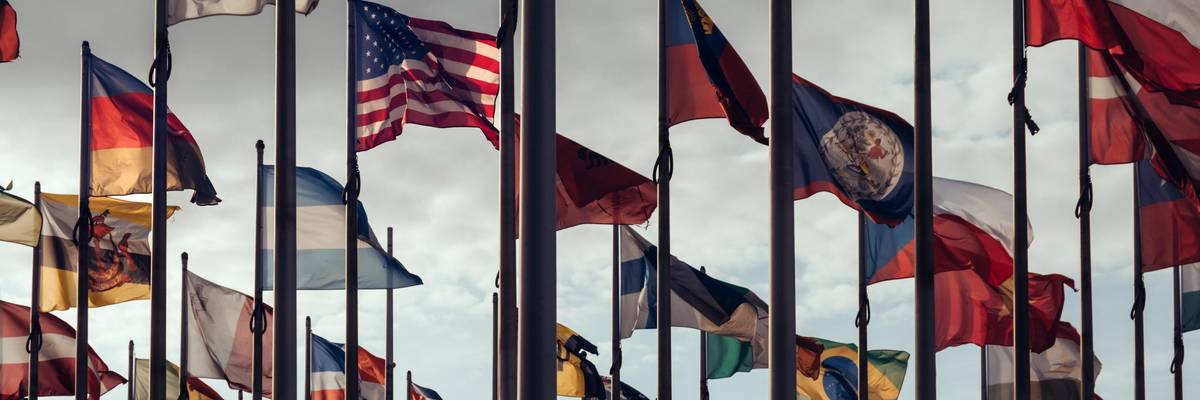
The goal of a global constitution plays a central role and needs to be strategized. (Photo: Oliver Helbig/Getty/Stock photo)
Why We Must Revise the UN Charter to Create a Truly Democratic World
A democratic world parliament that is freely elected by all world’s citizens needs to be a centerpiece of any legitimate future global organization.
The nation-state certainly is not the last word in human socio-political development. At least it should not be if a planetary human civilization is to survive long-term. The failure of the Westphalian system in managing and providing global common goods to the benefit of humanity and future generations by now should be obvious for all to see. Insofar, it is right, as Paul Raskin, Zhao Tingyang, and others have done, to describe the current order as a failed state. But the problem runs deeper: there is no global state to start with that could fail.
If a global constitution is supposed to come into force for all countries, which by definition should be the goal, the best way is to aim at a full revision of the UN Charter according to Article 109.
As Jo Leinen and I argued in our book A World Parliament, the process of state formation that can be traced long into history is an ongoing one that now expands to the whole world system. At many levels, global political integration is faced with unique conceptual challenges, in particular those related to identity formation. The key question of our time, as I see it, is whether this process nonetheless will result in overcoming the paradigm of national sovereignty and in the formation of a planetary polity or whether instead there will be a general breakdown.
In all of this, the goal of a global constitution plays a central role and needs to be strategized. A constitution represents the legal foundation for any polity and describes how it is to be governed. In a new long-term theory of change that has the hundredth anniversary of the United Nations in 2045 as a starting point, my organization Democracy Without Borders envisages that by then it might be possible to work out and adopt a global constitution. We suggest that a resulting world organization would have to be based on the principles of federalism and subsidiarity, equal global citizenship, separation of powers, checks and balances, the rule of law, fundamental human rights, and the protection of minorities.
Apart from the Earth Constitution promoted by Glen Martin and the World Constitution and Parliament Association, there have been many attempts at drafting such a document. They may serve as an inspiration and may be helpful examples to draw upon in the future. For the purpose of this comment, I will refrain from entering into a debate whether this or that provision makes sense from my point of view. By all means, in my opinion a global constitution is no place for experiments. It needs to be based on experience and should be informed by arrangements that exist and worked elsewhere, such as in national constitutions and particularly those of federal states. The key point I wish to raise here is a different one, however: the process that leads to a constitution is no less important than the constitution itself, if not perhaps much more so.
Establishing a global constitution and a global polity is a formidable task that requires the highest possible standards in terms of a broad, public, inclusive, transparent, and legitimate process. Why are certain arrangements accepted and others not? Who is taking these decisions and how? Where does the mandate come from? What options have been looked at and discarded, and why? What examples are there to draw upon in different legal systems and national constitutions?
Creating a constitution is not an academic exercise. It is political. It is a matter of bringing together and including major stakeholders and balancing their views and interests so that they feel sufficiently represented in the process. Only then will they accept the result as legitimate. A global constitution will eventually require the support of a majority of the world's citizens, ideally expressed in a world referendum. This is the broadest possible threshold, and no risks should be taken.
The Convention on the Future of Europe held in 2002/2003 is an interesting example. The effort to establish a European Constitution failed at the time because the draft was rejected in popular referendums in France and The Netherlands. The process did not come from thin air. It was based on decades of debates and successive creation of common political institutions. If such a process fails, it cannot be repeated quickly. All the more, it is important that it is done right, from the outset, insofar as a global constitution is concerned.
At this point in time, it is quite obvious that key stakeholders--national governments--do not share the basic premises of a global constitution, namely, to transfer real power to a higher global political entity in some way, let alone a democratic one. Hence some suggest to move forward without them and let them ratify some given document later that was put together by a small group of self-appointed drafters. This approach in my opinion is deeply misguided. A global constitutional process that sidesteps governments is stillborn. Whether one likes it or not, governments are the most important actors in today's world. Of course, there are other ones, too, like multinational corporations. Still, with some few exceptions and qualifications, it is national governments who control taxation, redistribution, the use of physical force, and rule-making and implementation. While it is true that a growing number of governments are not legitimate from the standpoint of democratic standards, the fact remains that many do represent their population and that big shares of people do identify with their nation-state. At the very least, the legislative branches need to be involved, representatives who were actually elected and have a mandate to speak on behalf of their constituents. This is not to say that governments and parliaments are the only relevant stakeholders. Far from it. But the notion that they can be excluded seems outlandish.
Yes, the UN is fundamentally flawed; however, any alternative path that is not accepted by governments will be even more flawed. We have been thinking about this over and over. Eventually, if a global constitution is supposed to come into force for all countries, which by definition should be the goal, the best way is to aim at a full revision of the UN Charter according to Article 109. There are big obstacles to surmount, such as securing the agreement of not only two thirds of states but also the five permanent members of the Security Council. Those who believe in the goal of a planetary polity and a universal global constitution need to face this political reality. If such a constitution were to enter into force with just a limited number of ratifications, the problem remains the same: how do we eventually get all states on board?
In my opinion, small successive steps may lead to success starting with a modest UN Parliamentary Assembly that may serve as an engine for change within the system that helps prepare favorable conditions for UN Charter review. A democratic world parliament that is freely elected by all world's citizens needs to be a centerpiece of any legitimate future global organization. From this standpoint, a belief in common democratic values and ongoing democratization at the level of nation-states seems to be a major precondition for any viable global constitutional process. This may be a dire conclusion as there seems to be a trend of autocratization across the world at this time. For this reason, as Swiss Senator Daniel Jositsch and I pointed out a year ago, the first thing that is needed in our view is defending and strengthening democracy at all levels, in particular globally. As we wrote at the time: "A global democratic revolution needs to push for a legitimate, inclusive and representative global body....The creation of a UN Parliamentary Assembly could be an important stepping stone to launch a global constitutional process and a transformation of global governance.
This article was originally published on the Great Transition Initiative as part of the Forum "An Earth Constitution: Has Its Time Come?"
Urgent. It's never been this bad.
Dear Common Dreams reader, It’s been nearly 30 years since I co-founded Common Dreams with my late wife, Lina Newhouser. We had the radical notion that journalism should serve the public good, not corporate profits. It was clear to us from the outset what it would take to build such a project. No paid advertisements. No corporate sponsors. No millionaire publisher telling us what to think or do. Many people said we wouldn't last a year, but we proved those doubters wrong. Together with a tremendous team of journalists and dedicated staff, we built an independent media outlet free from the constraints of profits and corporate control. Our mission from the outset was simple. To inform. To inspire. To ignite change for the common good. Building Common Dreams was not easy. Our survival was never guaranteed. When you take on the most powerful forces—Wall Street greed, fossil fuel industry destruction, Big Tech lobbyists, and uber-rich oligarchs who have spent billions upon billions rigging the economy and democracy in their favor—the only bulwark you have is supporters who believe in your work. But here’s the urgent message from me today. It’s never been this bad out there. And it’s never been this hard to keep us going. At the very moment Common Dreams is most needed and doing some of its best and most important work, the threats we face are intensifying. Right now, with just two days to go in our Spring Campaign, we're falling short of our make-or-break goal. When everyone does the little they can afford, we are strong. But if that support retreats or dries up, so do we. Can you make a gift right now to make sure Common Dreams not only survives but thrives? There is no backup plan or rainy day fund. There is only you. —Craig Brown, Co-founder |
The nation-state certainly is not the last word in human socio-political development. At least it should not be if a planetary human civilization is to survive long-term. The failure of the Westphalian system in managing and providing global common goods to the benefit of humanity and future generations by now should be obvious for all to see. Insofar, it is right, as Paul Raskin, Zhao Tingyang, and others have done, to describe the current order as a failed state. But the problem runs deeper: there is no global state to start with that could fail.
If a global constitution is supposed to come into force for all countries, which by definition should be the goal, the best way is to aim at a full revision of the UN Charter according to Article 109.
As Jo Leinen and I argued in our book A World Parliament, the process of state formation that can be traced long into history is an ongoing one that now expands to the whole world system. At many levels, global political integration is faced with unique conceptual challenges, in particular those related to identity formation. The key question of our time, as I see it, is whether this process nonetheless will result in overcoming the paradigm of national sovereignty and in the formation of a planetary polity or whether instead there will be a general breakdown.
In all of this, the goal of a global constitution plays a central role and needs to be strategized. A constitution represents the legal foundation for any polity and describes how it is to be governed. In a new long-term theory of change that has the hundredth anniversary of the United Nations in 2045 as a starting point, my organization Democracy Without Borders envisages that by then it might be possible to work out and adopt a global constitution. We suggest that a resulting world organization would have to be based on the principles of federalism and subsidiarity, equal global citizenship, separation of powers, checks and balances, the rule of law, fundamental human rights, and the protection of minorities.
Apart from the Earth Constitution promoted by Glen Martin and the World Constitution and Parliament Association, there have been many attempts at drafting such a document. They may serve as an inspiration and may be helpful examples to draw upon in the future. For the purpose of this comment, I will refrain from entering into a debate whether this or that provision makes sense from my point of view. By all means, in my opinion a global constitution is no place for experiments. It needs to be based on experience and should be informed by arrangements that exist and worked elsewhere, such as in national constitutions and particularly those of federal states. The key point I wish to raise here is a different one, however: the process that leads to a constitution is no less important than the constitution itself, if not perhaps much more so.
Establishing a global constitution and a global polity is a formidable task that requires the highest possible standards in terms of a broad, public, inclusive, transparent, and legitimate process. Why are certain arrangements accepted and others not? Who is taking these decisions and how? Where does the mandate come from? What options have been looked at and discarded, and why? What examples are there to draw upon in different legal systems and national constitutions?
Creating a constitution is not an academic exercise. It is political. It is a matter of bringing together and including major stakeholders and balancing their views and interests so that they feel sufficiently represented in the process. Only then will they accept the result as legitimate. A global constitution will eventually require the support of a majority of the world's citizens, ideally expressed in a world referendum. This is the broadest possible threshold, and no risks should be taken.
The Convention on the Future of Europe held in 2002/2003 is an interesting example. The effort to establish a European Constitution failed at the time because the draft was rejected in popular referendums in France and The Netherlands. The process did not come from thin air. It was based on decades of debates and successive creation of common political institutions. If such a process fails, it cannot be repeated quickly. All the more, it is important that it is done right, from the outset, insofar as a global constitution is concerned.
At this point in time, it is quite obvious that key stakeholders--national governments--do not share the basic premises of a global constitution, namely, to transfer real power to a higher global political entity in some way, let alone a democratic one. Hence some suggest to move forward without them and let them ratify some given document later that was put together by a small group of self-appointed drafters. This approach in my opinion is deeply misguided. A global constitutional process that sidesteps governments is stillborn. Whether one likes it or not, governments are the most important actors in today's world. Of course, there are other ones, too, like multinational corporations. Still, with some few exceptions and qualifications, it is national governments who control taxation, redistribution, the use of physical force, and rule-making and implementation. While it is true that a growing number of governments are not legitimate from the standpoint of democratic standards, the fact remains that many do represent their population and that big shares of people do identify with their nation-state. At the very least, the legislative branches need to be involved, representatives who were actually elected and have a mandate to speak on behalf of their constituents. This is not to say that governments and parliaments are the only relevant stakeholders. Far from it. But the notion that they can be excluded seems outlandish.
Yes, the UN is fundamentally flawed; however, any alternative path that is not accepted by governments will be even more flawed. We have been thinking about this over and over. Eventually, if a global constitution is supposed to come into force for all countries, which by definition should be the goal, the best way is to aim at a full revision of the UN Charter according to Article 109. There are big obstacles to surmount, such as securing the agreement of not only two thirds of states but also the five permanent members of the Security Council. Those who believe in the goal of a planetary polity and a universal global constitution need to face this political reality. If such a constitution were to enter into force with just a limited number of ratifications, the problem remains the same: how do we eventually get all states on board?
In my opinion, small successive steps may lead to success starting with a modest UN Parliamentary Assembly that may serve as an engine for change within the system that helps prepare favorable conditions for UN Charter review. A democratic world parliament that is freely elected by all world's citizens needs to be a centerpiece of any legitimate future global organization. From this standpoint, a belief in common democratic values and ongoing democratization at the level of nation-states seems to be a major precondition for any viable global constitutional process. This may be a dire conclusion as there seems to be a trend of autocratization across the world at this time. For this reason, as Swiss Senator Daniel Jositsch and I pointed out a year ago, the first thing that is needed in our view is defending and strengthening democracy at all levels, in particular globally. As we wrote at the time: "A global democratic revolution needs to push for a legitimate, inclusive and representative global body....The creation of a UN Parliamentary Assembly could be an important stepping stone to launch a global constitutional process and a transformation of global governance.
This article was originally published on the Great Transition Initiative as part of the Forum "An Earth Constitution: Has Its Time Come?"
The nation-state certainly is not the last word in human socio-political development. At least it should not be if a planetary human civilization is to survive long-term. The failure of the Westphalian system in managing and providing global common goods to the benefit of humanity and future generations by now should be obvious for all to see. Insofar, it is right, as Paul Raskin, Zhao Tingyang, and others have done, to describe the current order as a failed state. But the problem runs deeper: there is no global state to start with that could fail.
If a global constitution is supposed to come into force for all countries, which by definition should be the goal, the best way is to aim at a full revision of the UN Charter according to Article 109.
As Jo Leinen and I argued in our book A World Parliament, the process of state formation that can be traced long into history is an ongoing one that now expands to the whole world system. At many levels, global political integration is faced with unique conceptual challenges, in particular those related to identity formation. The key question of our time, as I see it, is whether this process nonetheless will result in overcoming the paradigm of national sovereignty and in the formation of a planetary polity or whether instead there will be a general breakdown.
In all of this, the goal of a global constitution plays a central role and needs to be strategized. A constitution represents the legal foundation for any polity and describes how it is to be governed. In a new long-term theory of change that has the hundredth anniversary of the United Nations in 2045 as a starting point, my organization Democracy Without Borders envisages that by then it might be possible to work out and adopt a global constitution. We suggest that a resulting world organization would have to be based on the principles of federalism and subsidiarity, equal global citizenship, separation of powers, checks and balances, the rule of law, fundamental human rights, and the protection of minorities.
Apart from the Earth Constitution promoted by Glen Martin and the World Constitution and Parliament Association, there have been many attempts at drafting such a document. They may serve as an inspiration and may be helpful examples to draw upon in the future. For the purpose of this comment, I will refrain from entering into a debate whether this or that provision makes sense from my point of view. By all means, in my opinion a global constitution is no place for experiments. It needs to be based on experience and should be informed by arrangements that exist and worked elsewhere, such as in national constitutions and particularly those of federal states. The key point I wish to raise here is a different one, however: the process that leads to a constitution is no less important than the constitution itself, if not perhaps much more so.
Establishing a global constitution and a global polity is a formidable task that requires the highest possible standards in terms of a broad, public, inclusive, transparent, and legitimate process. Why are certain arrangements accepted and others not? Who is taking these decisions and how? Where does the mandate come from? What options have been looked at and discarded, and why? What examples are there to draw upon in different legal systems and national constitutions?
Creating a constitution is not an academic exercise. It is political. It is a matter of bringing together and including major stakeholders and balancing their views and interests so that they feel sufficiently represented in the process. Only then will they accept the result as legitimate. A global constitution will eventually require the support of a majority of the world's citizens, ideally expressed in a world referendum. This is the broadest possible threshold, and no risks should be taken.
The Convention on the Future of Europe held in 2002/2003 is an interesting example. The effort to establish a European Constitution failed at the time because the draft was rejected in popular referendums in France and The Netherlands. The process did not come from thin air. It was based on decades of debates and successive creation of common political institutions. If such a process fails, it cannot be repeated quickly. All the more, it is important that it is done right, from the outset, insofar as a global constitution is concerned.
At this point in time, it is quite obvious that key stakeholders--national governments--do not share the basic premises of a global constitution, namely, to transfer real power to a higher global political entity in some way, let alone a democratic one. Hence some suggest to move forward without them and let them ratify some given document later that was put together by a small group of self-appointed drafters. This approach in my opinion is deeply misguided. A global constitutional process that sidesteps governments is stillborn. Whether one likes it or not, governments are the most important actors in today's world. Of course, there are other ones, too, like multinational corporations. Still, with some few exceptions and qualifications, it is national governments who control taxation, redistribution, the use of physical force, and rule-making and implementation. While it is true that a growing number of governments are not legitimate from the standpoint of democratic standards, the fact remains that many do represent their population and that big shares of people do identify with their nation-state. At the very least, the legislative branches need to be involved, representatives who were actually elected and have a mandate to speak on behalf of their constituents. This is not to say that governments and parliaments are the only relevant stakeholders. Far from it. But the notion that they can be excluded seems outlandish.
Yes, the UN is fundamentally flawed; however, any alternative path that is not accepted by governments will be even more flawed. We have been thinking about this over and over. Eventually, if a global constitution is supposed to come into force for all countries, which by definition should be the goal, the best way is to aim at a full revision of the UN Charter according to Article 109. There are big obstacles to surmount, such as securing the agreement of not only two thirds of states but also the five permanent members of the Security Council. Those who believe in the goal of a planetary polity and a universal global constitution need to face this political reality. If such a constitution were to enter into force with just a limited number of ratifications, the problem remains the same: how do we eventually get all states on board?
In my opinion, small successive steps may lead to success starting with a modest UN Parliamentary Assembly that may serve as an engine for change within the system that helps prepare favorable conditions for UN Charter review. A democratic world parliament that is freely elected by all world's citizens needs to be a centerpiece of any legitimate future global organization. From this standpoint, a belief in common democratic values and ongoing democratization at the level of nation-states seems to be a major precondition for any viable global constitutional process. This may be a dire conclusion as there seems to be a trend of autocratization across the world at this time. For this reason, as Swiss Senator Daniel Jositsch and I pointed out a year ago, the first thing that is needed in our view is defending and strengthening democracy at all levels, in particular globally. As we wrote at the time: "A global democratic revolution needs to push for a legitimate, inclusive and representative global body....The creation of a UN Parliamentary Assembly could be an important stepping stone to launch a global constitutional process and a transformation of global governance.
This article was originally published on the Great Transition Initiative as part of the Forum "An Earth Constitution: Has Its Time Come?"