

SUBSCRIBE TO OUR FREE NEWSLETTER
Daily news & progressive opinion—funded by the people, not the corporations—delivered straight to your inbox.
5
#000000
#FFFFFF
To donate by check, phone, or other method, see our More Ways to Give page.


Daily news & progressive opinion—funded by the people, not the corporations—delivered straight to your inbox.

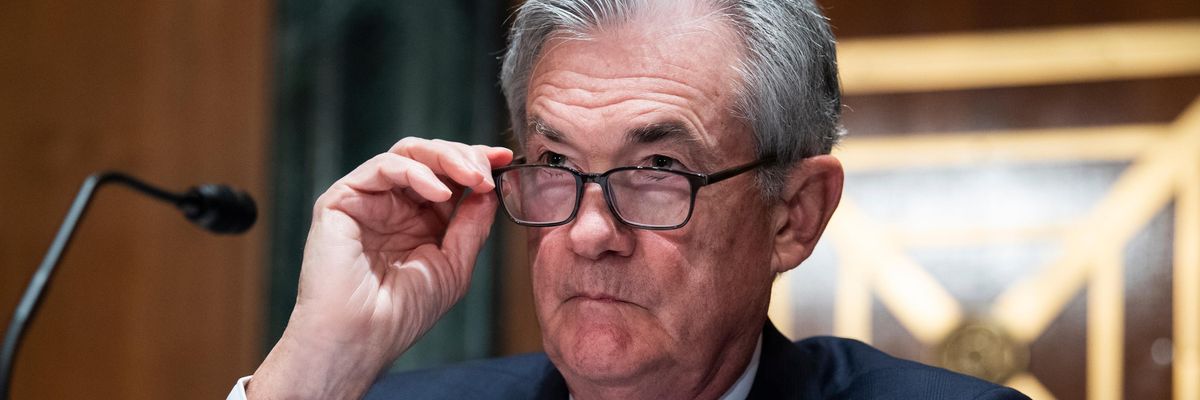
Federal Reserve Chairman Jerome Powell testifies during a Senate hearing on July 15, 2021. (Photo: Tom Williams/CQ-Roll Call, Inc. via Getty Images)
Climate change is a destabilizing force that impacts all facets of our lives. It disrupts weather patterns, food systems, national security, and public health. Through heat waves, wildfires, storms, rising seas, and other disasters, it heightens our exposure to many kinds of threats--both physical and fiscal. We need a whole-of-government response to defend against this upheaval on every front. Our banking authority, the Federal Reserve, must take an active role in protecting the banking system, and all those who depend upon it, from financial risks fueled by climate change.
The climate crisis is too big for the Fed to fail. Rather than stand idly by, the Federal Reserve should lead the way in providing stability and a path forward for financial institutions to protect themselves and their customers from climate change risks.
We need leaders in place who are willing to use the Federal Reserve's existing authority to protect Americans from climate change. Unfortunately, the Federal Reserve chair, Jerome Powell, has not shown the necessary leadership in safeguarding our financial system from the risks of climate change. In June, he said, "Today, climate change is not something we directly consider in monetary policy."
But even among the banks themselves, that is an increasingly unshared opinion. At the recent United Nations COP26 climate change conference in Glasgow, a group of banks, investors, and insurers that collectively control $130 trillion in assets pledged to decarbonize their portfolios to achieve net-zero greenhouse gas emissions by 2050. The supervisor of the US financial system should not be more hesitant to act on climate than the regulated entities themselves. Without intentional action and commitment to President Biden's solution to the climate crisis, Powell is not the right Federal Reserve chair for this moment.
Banks that significantly invest in emissions-intensive projects are endangering us on two counts: first, by continuing to fuel the climate crisis already wreaking havoc on the economy; and second, by exposing all their customers to the risks of tying up investments in the outdated fossil fuel projects that will not survive in a clean-energy economy. The top four financiers of fossil fuels globally are all American banks--JP Morgan Chase, Citi, Wells Fargo, and Bank of America--with $975 billion of financing committed to fossil fuel life-cycle projects from 2016 to 2020. That's nearly a trillion dollars tied up in risky projects that are incompatible with the scientific targets in the Paris climate agreement and the pledges made by the United States and countries around the world.
Our financial system is already feeling shocks of property destruction and supply chain disruption caused by the climate crisis, with $640 billion in damage from extreme weather disasters in the United States alone over that same 2016-to-2020 time period. Imagine the shocks that will take place when $1 trillion in carbon emissions-intensive project investments lose their value as countries take action to meet their climate targets. We could see another financial crash similar to the subprime mortgage crisis of 2008.
The Fed and the big banks must be compelled, through federal legislation, to act on the threat that climate change poses to our financial system and the planet. This includes mandating that major banks and financial institutions stop the financing of projects and activities that emit greenhouse gases and prohibiting the financing of new or expanded fossil fuel projects by 2022, the financing of all fossil fuel projects by 2030, and thermal coal financing by 2025.
Even in the absence of additional congressional action, the Federal Reserve should use its existing authority to include climate in its supervisory activities. Powell said that climate change is "an issue that is assigned to lots of other government agencies, not so much the Fed." This is a short-sighted view that fails to properly reflect the Federal Reserve's powers, priorities, and mandates. The Fed should integrate climate into its oversight of community investment, fostering equitable investments in vulnerable communities. It should require stress tests to determine whether big banks are resilient to near-term and long-term climate-related shocks. It should integrate climate into a broader set of regulatory tools--restricting the riskiest investments, policing concentrations of climate-related risk, and requiring banks to begin closing the wide gap between their current lending practices and what climate science and world targets say is necessary.
Prudent regulation must ensure that our financial system is stable, safe, and sound. Climate change is an obvious risk to those three virtues that the Fed, under Jerome Powell's leadership, has so far refused to address. The climate crisis is too big for the Fed to fail. Rather than stand idly by, the Federal Reserve should lead the way in providing stability and a path forward for financial institutions to protect themselves and their customers from climate change risks.

Dear Common Dreams reader, It’s been nearly 30 years since I co-founded Common Dreams with my late wife, Lina Newhouser. We had the radical notion that journalism should serve the public good, not corporate profits. It was clear to us from the outset what it would take to build such a project. No paid advertisements. No corporate sponsors. No millionaire publisher telling us what to think or do. Many people said we wouldn't last a year, but we proved those doubters wrong. Together with a tremendous team of journalists and dedicated staff, we built an independent media outlet free from the constraints of profits and corporate control. Our mission has always been simple: To inform. To inspire. To ignite change for the common good. Building Common Dreams was not easy. Our survival was never guaranteed. When you take on the most powerful forces—Wall Street greed, fossil fuel industry destruction, Big Tech lobbyists, and uber-rich oligarchs who have spent billions upon billions rigging the economy and democracy in their favor—the only bulwark you have is supporters who believe in your work. But here’s the urgent message from me today. It's never been this bad out there. And it's never been this hard to keep us going. At the very moment Common Dreams is most needed, the threats we face are intensifying. We need your support now more than ever. We don't accept corporate advertising and never will. We don't have a paywall because we don't think people should be blocked from critical news based on their ability to pay. Everything we do is funded by the donations of readers like you. When everyone does the little they can afford, we are strong. But if that support retreats or dries up, so do we. Will you donate now to make sure Common Dreams not only survives but thrives? —Craig Brown, Co-founder |
Climate change is a destabilizing force that impacts all facets of our lives. It disrupts weather patterns, food systems, national security, and public health. Through heat waves, wildfires, storms, rising seas, and other disasters, it heightens our exposure to many kinds of threats--both physical and fiscal. We need a whole-of-government response to defend against this upheaval on every front. Our banking authority, the Federal Reserve, must take an active role in protecting the banking system, and all those who depend upon it, from financial risks fueled by climate change.
The climate crisis is too big for the Fed to fail. Rather than stand idly by, the Federal Reserve should lead the way in providing stability and a path forward for financial institutions to protect themselves and their customers from climate change risks.

We need leaders in place who are willing to use the Federal Reserve's existing authority to protect Americans from climate change. Unfortunately, the Federal Reserve chair, Jerome Powell, has not shown the necessary leadership in safeguarding our financial system from the risks of climate change. In June, he said, "Today, climate change is not something we directly consider in monetary policy."
But even among the banks themselves, that is an increasingly unshared opinion. At the recent United Nations COP26 climate change conference in Glasgow, a group of banks, investors, and insurers that collectively control $130 trillion in assets pledged to decarbonize their portfolios to achieve net-zero greenhouse gas emissions by 2050. The supervisor of the US financial system should not be more hesitant to act on climate than the regulated entities themselves. Without intentional action and commitment to President Biden's solution to the climate crisis, Powell is not the right Federal Reserve chair for this moment.
Banks that significantly invest in emissions-intensive projects are endangering us on two counts: first, by continuing to fuel the climate crisis already wreaking havoc on the economy; and second, by exposing all their customers to the risks of tying up investments in the outdated fossil fuel projects that will not survive in a clean-energy economy. The top four financiers of fossil fuels globally are all American banks--JP Morgan Chase, Citi, Wells Fargo, and Bank of America--with $975 billion of financing committed to fossil fuel life-cycle projects from 2016 to 2020. That's nearly a trillion dollars tied up in risky projects that are incompatible with the scientific targets in the Paris climate agreement and the pledges made by the United States and countries around the world.
Our financial system is already feeling shocks of property destruction and supply chain disruption caused by the climate crisis, with $640 billion in damage from extreme weather disasters in the United States alone over that same 2016-to-2020 time period. Imagine the shocks that will take place when $1 trillion in carbon emissions-intensive project investments lose their value as countries take action to meet their climate targets. We could see another financial crash similar to the subprime mortgage crisis of 2008.
The Fed and the big banks must be compelled, through federal legislation, to act on the threat that climate change poses to our financial system and the planet. This includes mandating that major banks and financial institutions stop the financing of projects and activities that emit greenhouse gases and prohibiting the financing of new or expanded fossil fuel projects by 2022, the financing of all fossil fuel projects by 2030, and thermal coal financing by 2025.
Even in the absence of additional congressional action, the Federal Reserve should use its existing authority to include climate in its supervisory activities. Powell said that climate change is "an issue that is assigned to lots of other government agencies, not so much the Fed." This is a short-sighted view that fails to properly reflect the Federal Reserve's powers, priorities, and mandates. The Fed should integrate climate into its oversight of community investment, fostering equitable investments in vulnerable communities. It should require stress tests to determine whether big banks are resilient to near-term and long-term climate-related shocks. It should integrate climate into a broader set of regulatory tools--restricting the riskiest investments, policing concentrations of climate-related risk, and requiring banks to begin closing the wide gap between their current lending practices and what climate science and world targets say is necessary.
Prudent regulation must ensure that our financial system is stable, safe, and sound. Climate change is an obvious risk to those three virtues that the Fed, under Jerome Powell's leadership, has so far refused to address. The climate crisis is too big for the Fed to fail. Rather than stand idly by, the Federal Reserve should lead the way in providing stability and a path forward for financial institutions to protect themselves and their customers from climate change risks.
Climate change is a destabilizing force that impacts all facets of our lives. It disrupts weather patterns, food systems, national security, and public health. Through heat waves, wildfires, storms, rising seas, and other disasters, it heightens our exposure to many kinds of threats--both physical and fiscal. We need a whole-of-government response to defend against this upheaval on every front. Our banking authority, the Federal Reserve, must take an active role in protecting the banking system, and all those who depend upon it, from financial risks fueled by climate change.
The climate crisis is too big for the Fed to fail. Rather than stand idly by, the Federal Reserve should lead the way in providing stability and a path forward for financial institutions to protect themselves and their customers from climate change risks.
We need leaders in place who are willing to use the Federal Reserve's existing authority to protect Americans from climate change. Unfortunately, the Federal Reserve chair, Jerome Powell, has not shown the necessary leadership in safeguarding our financial system from the risks of climate change. In June, he said, "Today, climate change is not something we directly consider in monetary policy."
But even among the banks themselves, that is an increasingly unshared opinion. At the recent United Nations COP26 climate change conference in Glasgow, a group of banks, investors, and insurers that collectively control $130 trillion in assets pledged to decarbonize their portfolios to achieve net-zero greenhouse gas emissions by 2050. The supervisor of the US financial system should not be more hesitant to act on climate than the regulated entities themselves. Without intentional action and commitment to President Biden's solution to the climate crisis, Powell is not the right Federal Reserve chair for this moment.
Banks that significantly invest in emissions-intensive projects are endangering us on two counts: first, by continuing to fuel the climate crisis already wreaking havoc on the economy; and second, by exposing all their customers to the risks of tying up investments in the outdated fossil fuel projects that will not survive in a clean-energy economy. The top four financiers of fossil fuels globally are all American banks--JP Morgan Chase, Citi, Wells Fargo, and Bank of America--with $975 billion of financing committed to fossil fuel life-cycle projects from 2016 to 2020. That's nearly a trillion dollars tied up in risky projects that are incompatible with the scientific targets in the Paris climate agreement and the pledges made by the United States and countries around the world.
Our financial system is already feeling shocks of property destruction and supply chain disruption caused by the climate crisis, with $640 billion in damage from extreme weather disasters in the United States alone over that same 2016-to-2020 time period. Imagine the shocks that will take place when $1 trillion in carbon emissions-intensive project investments lose their value as countries take action to meet their climate targets. We could see another financial crash similar to the subprime mortgage crisis of 2008.
The Fed and the big banks must be compelled, through federal legislation, to act on the threat that climate change poses to our financial system and the planet. This includes mandating that major banks and financial institutions stop the financing of projects and activities that emit greenhouse gases and prohibiting the financing of new or expanded fossil fuel projects by 2022, the financing of all fossil fuel projects by 2030, and thermal coal financing by 2025.
Even in the absence of additional congressional action, the Federal Reserve should use its existing authority to include climate in its supervisory activities. Powell said that climate change is "an issue that is assigned to lots of other government agencies, not so much the Fed." This is a short-sighted view that fails to properly reflect the Federal Reserve's powers, priorities, and mandates. The Fed should integrate climate into its oversight of community investment, fostering equitable investments in vulnerable communities. It should require stress tests to determine whether big banks are resilient to near-term and long-term climate-related shocks. It should integrate climate into a broader set of regulatory tools--restricting the riskiest investments, policing concentrations of climate-related risk, and requiring banks to begin closing the wide gap between their current lending practices and what climate science and world targets say is necessary.
Prudent regulation must ensure that our financial system is stable, safe, and sound. Climate change is an obvious risk to those three virtues that the Fed, under Jerome Powell's leadership, has so far refused to address. The climate crisis is too big for the Fed to fail. Rather than stand idly by, the Federal Reserve should lead the way in providing stability and a path forward for financial institutions to protect themselves and their customers from climate change risks.