SUBSCRIBE TO OUR FREE NEWSLETTER
Daily news & progressive opinion—funded by the people, not the corporations—delivered straight to your inbox.
5
#000000
#FFFFFF
To donate by check, phone, or other method, see our More Ways to Give page.
Daily news & progressive opinion—funded by the people, not the corporations—delivered straight to your inbox.
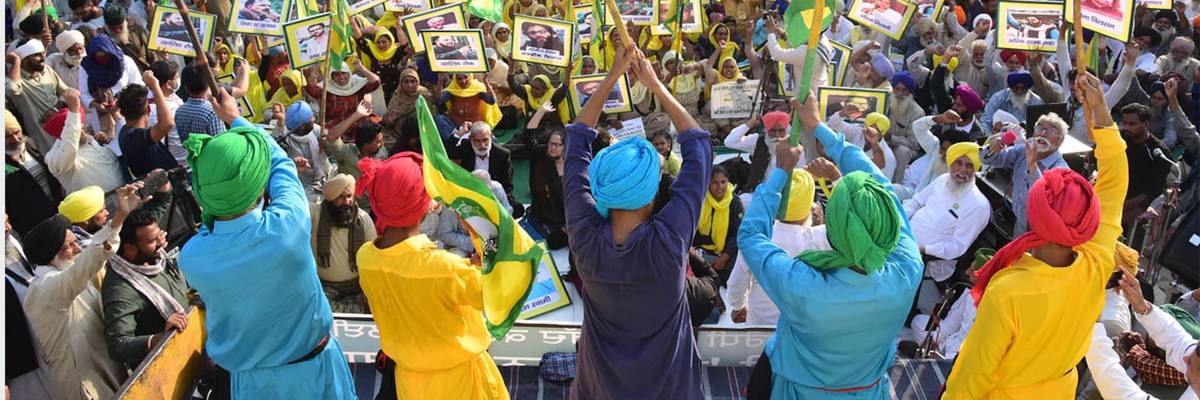
Indian farmers protest near New Delhi on December 11, 2020. (Photo: Randeep Maddoke/Wikimedia Commons)
India's farmers have mobilized to create one of the world's most vibrant protests in history, camping on the outskirts of New Delhi for one year now. Friday, November 26, 2021, marked the one-year anniversary of the day when these farmers faced water cannons and tear gas at the Delhi border as they tried to reach the Capital. On November 19, they got a big win, as Narendra Modi, the prime minister of India, announced that he has decided to repeal the three controversial farm laws.
"This historic victory of the Indian farmers is being celebrated by millions across the world."
There was no cabinet meeting and no ordinance repealing the three laws -- simply an announcement. But this historic victory of the Indian farmers is being celebrated by millions across the world. The timing of the announcement is, of course, political: The announcement was made in advance of upcoming elections in key states, and on the birth anniversary of the first Sikh guru, Guru Nanak. The Sikh community as a whole has been a pillar of support for the protesting farmers, and farmers from key states such as Uttar Pradesh and Punjab (where elections are due) form the backbone of the protests.
Samyukta Kisan Morcha (SKM) -- a united front of over 40 Indian farmers unions that has been leading the farmers' strike -- has rightly asked that the laws be repealed through parliamentary process. In a letter to the prime minister, they pointed out that the repeal of the three laws will meet just one of several demands made by the farmers' unions. They have reiterated six other demands, three of them longstanding, including legally guaranteed Minimum Support Price (MSP) for all crops and for all farmers.
The three laws threatened to corporatize the food and agricultural sector in India. (A comprehensive article explaining what the massive historic farmers' protests in India are about can be found here.) The protest began in Punjab with a key demand to repeal three controversial farm laws, and as the farmers reached Delhi, it began gathering the attention of the world for its scale, longevity and for the tenacious and well-organized, yet nonviolent, collective organizing efforts. Farmers' organizations and civil society organizations across the world have been following these developments closely since the fall of 2020. Early in 2021, two and a half months into the protests, over 87 farmer organizations and allied agroecology, farm and food justice groups in the United States (including IATP), came together to deliver a solidarity statement in support of the Indian farmers' protests. Our statement drew attention to the fact that what the Indian farmers are enduring now happened in the U.S. almost four decades ago.
It has been invigorating to see how the farmer mobilization has grown in strength, building bridges across the divisions of castes, religions and regions, emphasizing unity as annadata or food-providers, whether as farmers or farm workers, women or men, and at the same time, building alliances with other progressive struggles. As India's farmers go ahead with their plans around the one-year anniversary of their historic protests,1 it is an honor for us to continue to stand in solidarity with them and support their demands.
The solidarity statement had specifically lifted up one of the key demands of the movement, asking for farmers to receive a MSP -- currently assured for just a few crops -- for all produce including vegetables, which are essential for healthy diets, and argued that this would ensure that farmers in India, already burdened by huge debts, receive a fair price for their produce. Ensuring remunerative MSP and procurement as a legal entitlement for all farmers and for all agricultural produce continues to be one of the most crucial demands of the farmers moving forward.
The concept of parity is grounded in fair prices for farmers, but it extends beyond that to issues of environmental, cultural and social justice for food producers and their communities. The solidarity statement acknowledged that "much work remains to be done on parity and environmental and racial justice in relation to food and agricultural policy domestically, as well as internationally."
It is time that both the Indian and U.S. governments include parity pricing and public crop procurement to support independent family farmers and localized food systems, ensuring food sovereignty and securing the livelihoods of millions who are the bedrock of its food security and nutritional wellbeing.
In a letter to the Biden administration in October 2021, the U.S. farm, food and trade justice community lifted up some of the asks in the solidarity statement, asking that the Biden administration stop prioritizing the interests of agribusiness over small farmers, so abetting further corporatization of the food system here and in other countries. The letter had called on the administration to endorse multilateral governance norms that will support other countries' ability to transition to climate-resilient, biodiverse and water-conserving food systems that reach all producers. As the WTO meets next week, there is much that both the governments can do in the interest of farmers and food system workers.
1. A. The farmers' body has also called for massive mahapanchayats in all state capitals, with the first one held on November 22, in Lucknow -- the Capital of election bound Uttar Pradesh, B. November 24, 2021, in honor of messiah of peasants, Sir Choudhary Choturam's birthday, to be celebrated as kisan-mazdoor-sangharsh-diwas (farmer-worker-struggle-day), at all protest sites. C. November 26, SKM appeals for a "dilli chalo" as had already been planned 500 farmers will participate in a "peaceful" tractor march to Parliament every day during the Winter Session. D. From November 29 until the end of this Parliament session, December 23, the 500 selected farmer volunteers will move to Parliament every day in tractor trollies peacefully and with full discipline, to assert their rights to protest in the national capital. Source: https://www.deccanchronicle.com/nation/current-affairs/101121/farmers-plan-tractor-rally-to-parliament-on-november-29-as-session-beg.html.
Dear Common Dreams reader, It’s been nearly 30 years since I co-founded Common Dreams with my late wife, Lina Newhouser. We had the radical notion that journalism should serve the public good, not corporate profits. It was clear to us from the outset what it would take to build such a project. No paid advertisements. No corporate sponsors. No millionaire publisher telling us what to think or do. Many people said we wouldn't last a year, but we proved those doubters wrong. Together with a tremendous team of journalists and dedicated staff, we built an independent media outlet free from the constraints of profits and corporate control. Our mission has always been simple: To inform. To inspire. To ignite change for the common good. Building Common Dreams was not easy. Our survival was never guaranteed. When you take on the most powerful forces—Wall Street greed, fossil fuel industry destruction, Big Tech lobbyists, and uber-rich oligarchs who have spent billions upon billions rigging the economy and democracy in their favor—the only bulwark you have is supporters who believe in your work. But here’s the urgent message from me today. It's never been this bad out there. And it's never been this hard to keep us going. At the very moment Common Dreams is most needed, the threats we face are intensifying. We need your support now more than ever. We don't accept corporate advertising and never will. We don't have a paywall because we don't think people should be blocked from critical news based on their ability to pay. Everything we do is funded by the donations of readers like you. When everyone does the little they can afford, we are strong. But if that support retreats or dries up, so do we. Will you donate now to make sure Common Dreams not only survives but thrives? —Craig Brown, Co-founder |
India's farmers have mobilized to create one of the world's most vibrant protests in history, camping on the outskirts of New Delhi for one year now. Friday, November 26, 2021, marked the one-year anniversary of the day when these farmers faced water cannons and tear gas at the Delhi border as they tried to reach the Capital. On November 19, they got a big win, as Narendra Modi, the prime minister of India, announced that he has decided to repeal the three controversial farm laws.
"This historic victory of the Indian farmers is being celebrated by millions across the world."
There was no cabinet meeting and no ordinance repealing the three laws -- simply an announcement. But this historic victory of the Indian farmers is being celebrated by millions across the world. The timing of the announcement is, of course, political: The announcement was made in advance of upcoming elections in key states, and on the birth anniversary of the first Sikh guru, Guru Nanak. The Sikh community as a whole has been a pillar of support for the protesting farmers, and farmers from key states such as Uttar Pradesh and Punjab (where elections are due) form the backbone of the protests.
Samyukta Kisan Morcha (SKM) -- a united front of over 40 Indian farmers unions that has been leading the farmers' strike -- has rightly asked that the laws be repealed through parliamentary process. In a letter to the prime minister, they pointed out that the repeal of the three laws will meet just one of several demands made by the farmers' unions. They have reiterated six other demands, three of them longstanding, including legally guaranteed Minimum Support Price (MSP) for all crops and for all farmers.
The three laws threatened to corporatize the food and agricultural sector in India. (A comprehensive article explaining what the massive historic farmers' protests in India are about can be found here.) The protest began in Punjab with a key demand to repeal three controversial farm laws, and as the farmers reached Delhi, it began gathering the attention of the world for its scale, longevity and for the tenacious and well-organized, yet nonviolent, collective organizing efforts. Farmers' organizations and civil society organizations across the world have been following these developments closely since the fall of 2020. Early in 2021, two and a half months into the protests, over 87 farmer organizations and allied agroecology, farm and food justice groups in the United States (including IATP), came together to deliver a solidarity statement in support of the Indian farmers' protests. Our statement drew attention to the fact that what the Indian farmers are enduring now happened in the U.S. almost four decades ago.
It has been invigorating to see how the farmer mobilization has grown in strength, building bridges across the divisions of castes, religions and regions, emphasizing unity as annadata or food-providers, whether as farmers or farm workers, women or men, and at the same time, building alliances with other progressive struggles. As India's farmers go ahead with their plans around the one-year anniversary of their historic protests,1 it is an honor for us to continue to stand in solidarity with them and support their demands.
The solidarity statement had specifically lifted up one of the key demands of the movement, asking for farmers to receive a MSP -- currently assured for just a few crops -- for all produce including vegetables, which are essential for healthy diets, and argued that this would ensure that farmers in India, already burdened by huge debts, receive a fair price for their produce. Ensuring remunerative MSP and procurement as a legal entitlement for all farmers and for all agricultural produce continues to be one of the most crucial demands of the farmers moving forward.
The concept of parity is grounded in fair prices for farmers, but it extends beyond that to issues of environmental, cultural and social justice for food producers and their communities. The solidarity statement acknowledged that "much work remains to be done on parity and environmental and racial justice in relation to food and agricultural policy domestically, as well as internationally."
It is time that both the Indian and U.S. governments include parity pricing and public crop procurement to support independent family farmers and localized food systems, ensuring food sovereignty and securing the livelihoods of millions who are the bedrock of its food security and nutritional wellbeing.
In a letter to the Biden administration in October 2021, the U.S. farm, food and trade justice community lifted up some of the asks in the solidarity statement, asking that the Biden administration stop prioritizing the interests of agribusiness over small farmers, so abetting further corporatization of the food system here and in other countries. The letter had called on the administration to endorse multilateral governance norms that will support other countries' ability to transition to climate-resilient, biodiverse and water-conserving food systems that reach all producers. As the WTO meets next week, there is much that both the governments can do in the interest of farmers and food system workers.
1. A. The farmers' body has also called for massive mahapanchayats in all state capitals, with the first one held on November 22, in Lucknow -- the Capital of election bound Uttar Pradesh, B. November 24, 2021, in honor of messiah of peasants, Sir Choudhary Choturam's birthday, to be celebrated as kisan-mazdoor-sangharsh-diwas (farmer-worker-struggle-day), at all protest sites. C. November 26, SKM appeals for a "dilli chalo" as had already been planned 500 farmers will participate in a "peaceful" tractor march to Parliament every day during the Winter Session. D. From November 29 until the end of this Parliament session, December 23, the 500 selected farmer volunteers will move to Parliament every day in tractor trollies peacefully and with full discipline, to assert their rights to protest in the national capital. Source: https://www.deccanchronicle.com/nation/current-affairs/101121/farmers-plan-tractor-rally-to-parliament-on-november-29-as-session-beg.html.
India's farmers have mobilized to create one of the world's most vibrant protests in history, camping on the outskirts of New Delhi for one year now. Friday, November 26, 2021, marked the one-year anniversary of the day when these farmers faced water cannons and tear gas at the Delhi border as they tried to reach the Capital. On November 19, they got a big win, as Narendra Modi, the prime minister of India, announced that he has decided to repeal the three controversial farm laws.
"This historic victory of the Indian farmers is being celebrated by millions across the world."
There was no cabinet meeting and no ordinance repealing the three laws -- simply an announcement. But this historic victory of the Indian farmers is being celebrated by millions across the world. The timing of the announcement is, of course, political: The announcement was made in advance of upcoming elections in key states, and on the birth anniversary of the first Sikh guru, Guru Nanak. The Sikh community as a whole has been a pillar of support for the protesting farmers, and farmers from key states such as Uttar Pradesh and Punjab (where elections are due) form the backbone of the protests.
Samyukta Kisan Morcha (SKM) -- a united front of over 40 Indian farmers unions that has been leading the farmers' strike -- has rightly asked that the laws be repealed through parliamentary process. In a letter to the prime minister, they pointed out that the repeal of the three laws will meet just one of several demands made by the farmers' unions. They have reiterated six other demands, three of them longstanding, including legally guaranteed Minimum Support Price (MSP) for all crops and for all farmers.
The three laws threatened to corporatize the food and agricultural sector in India. (A comprehensive article explaining what the massive historic farmers' protests in India are about can be found here.) The protest began in Punjab with a key demand to repeal three controversial farm laws, and as the farmers reached Delhi, it began gathering the attention of the world for its scale, longevity and for the tenacious and well-organized, yet nonviolent, collective organizing efforts. Farmers' organizations and civil society organizations across the world have been following these developments closely since the fall of 2020. Early in 2021, two and a half months into the protests, over 87 farmer organizations and allied agroecology, farm and food justice groups in the United States (including IATP), came together to deliver a solidarity statement in support of the Indian farmers' protests. Our statement drew attention to the fact that what the Indian farmers are enduring now happened in the U.S. almost four decades ago.
It has been invigorating to see how the farmer mobilization has grown in strength, building bridges across the divisions of castes, religions and regions, emphasizing unity as annadata or food-providers, whether as farmers or farm workers, women or men, and at the same time, building alliances with other progressive struggles. As India's farmers go ahead with their plans around the one-year anniversary of their historic protests,1 it is an honor for us to continue to stand in solidarity with them and support their demands.
The solidarity statement had specifically lifted up one of the key demands of the movement, asking for farmers to receive a MSP -- currently assured for just a few crops -- for all produce including vegetables, which are essential for healthy diets, and argued that this would ensure that farmers in India, already burdened by huge debts, receive a fair price for their produce. Ensuring remunerative MSP and procurement as a legal entitlement for all farmers and for all agricultural produce continues to be one of the most crucial demands of the farmers moving forward.
The concept of parity is grounded in fair prices for farmers, but it extends beyond that to issues of environmental, cultural and social justice for food producers and their communities. The solidarity statement acknowledged that "much work remains to be done on parity and environmental and racial justice in relation to food and agricultural policy domestically, as well as internationally."
It is time that both the Indian and U.S. governments include parity pricing and public crop procurement to support independent family farmers and localized food systems, ensuring food sovereignty and securing the livelihoods of millions who are the bedrock of its food security and nutritional wellbeing.
In a letter to the Biden administration in October 2021, the U.S. farm, food and trade justice community lifted up some of the asks in the solidarity statement, asking that the Biden administration stop prioritizing the interests of agribusiness over small farmers, so abetting further corporatization of the food system here and in other countries. The letter had called on the administration to endorse multilateral governance norms that will support other countries' ability to transition to climate-resilient, biodiverse and water-conserving food systems that reach all producers. As the WTO meets next week, there is much that both the governments can do in the interest of farmers and food system workers.
1. A. The farmers' body has also called for massive mahapanchayats in all state capitals, with the first one held on November 22, in Lucknow -- the Capital of election bound Uttar Pradesh, B. November 24, 2021, in honor of messiah of peasants, Sir Choudhary Choturam's birthday, to be celebrated as kisan-mazdoor-sangharsh-diwas (farmer-worker-struggle-day), at all protest sites. C. November 26, SKM appeals for a "dilli chalo" as had already been planned 500 farmers will participate in a "peaceful" tractor march to Parliament every day during the Winter Session. D. From November 29 until the end of this Parliament session, December 23, the 500 selected farmer volunteers will move to Parliament every day in tractor trollies peacefully and with full discipline, to assert their rights to protest in the national capital. Source: https://www.deccanchronicle.com/nation/current-affairs/101121/farmers-plan-tractor-rally-to-parliament-on-november-29-as-session-beg.html.