SUBSCRIBE TO OUR FREE NEWSLETTER
Daily news & progressive opinion—funded by the people, not the corporations—delivered straight to your inbox.
5
#000000
#FFFFFF
To donate by check, phone, or other method, see our More Ways to Give page.
Daily news & progressive opinion—funded by the people, not the corporations—delivered straight to your inbox.
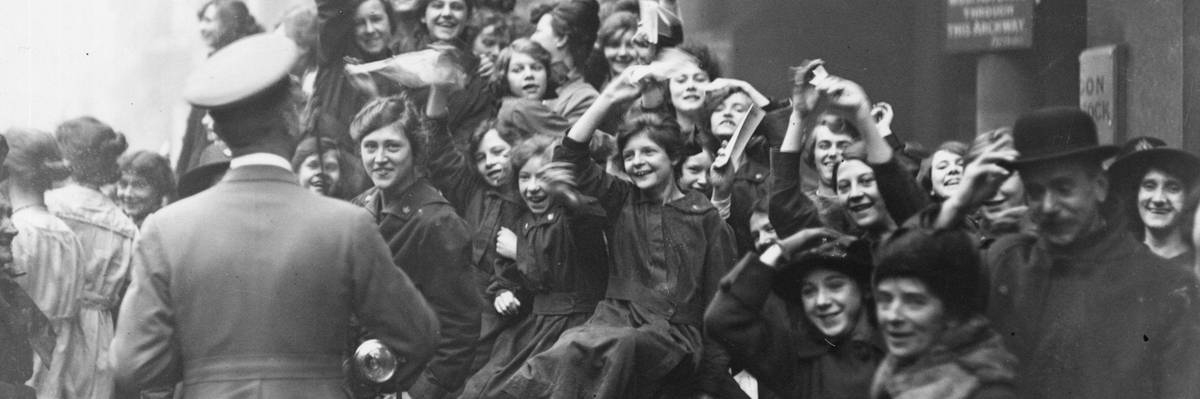
11th November 1918: Crowds celebrating the armistice in London, at the end of World War I. (Photo: A. R. Coster/Topical Press Agency/Getty Images)
The first Armistice Day was a celebration of the moment--the 11th hour of the 11th day of the 11th month in 1918--that the brutality of that first industrial war, which robbed 40 million soldiers and civilians of life, ended and peace began.
On Veterans Day, peace groups across the country on November 11 reclaim the original intent of Armistice Day: peace among nations achieved by seeking nonviolent, effective alternatives to war.
Veterans for Peace, made up of veterans of all wars since World War II and peacetime veterans, march in Veterans Day parades to honor the day's original, nobler history. In doing so, they serve their fellow veterans by insisting that the best way to honor veterans is to stop creating more of them. Consider that today more veterans die through suicide than in war from "soldier's heart," shell shock, PTSD, combat guilt, and moral injury, as these war wounds of heart, mind, and spirit have been variously designated since the Civil War.
In 1926 the US Congress declared an Armistice Day resolution calling for "exercises designed to perpetuate peace through goodwill and mutual understanding...inviting the people of the United States to observe the day in schools and churches with appropriate ceremonies of friendly relations with all other peoples."
A 1914 soldiers' truce foreshadowed the 1918 Armistice. World War I soldiers had only one another in the face of death--a reality incarnated in the 1914 Christmas truce spontaneously initiated by British, French, and German soldiers facing each other in trenches only yards apart.
Soldiers on both sides lay down their weapons, crossed over barbed wire and shell holes, and greeted each other with their Christmas gifts of food, beer, champagne, and schnapps. Together they buried corpses of the fallen that lay in the narrow, no man's land between them, played soccer with tin cans and straw-filled sandbags for balls, sang carols, took photos, and exchanged mementos and addresses. Their governments forbade soldiers to celebrate a Christmas truce in future years lest it weaken their willingness to kill each other.
The unique comradeship of war lingered in Erich Maria Remarque, who enlisted in the German army at the age of 19 and fought during World War I. He admitted bitterly that a sense of the romance of war, propagated by the state's total propaganda campaign, turned high school boys into willing recruits for slaughter. Some ten years after the war's end, he published his first anti-war novel, All Quiet on the Western Front. In perhaps the most incisive moment of this novel, a young German soldier gazes upon a young French soldier he has killed and ponders their common humanity, with words that undercut the war's hard-bitten hatred and national chauvinism. "Why do they never tell us that you are poor devils like us, that your mothers are just as anxious as ours, and that we have the same fear of death, and the same dying and the same agony."
All public ideals of peace among nations were discarded on June 1, 1954, when the US government renamed Armistice Day as Veterans Day. This erasure of Armistice Day tragically matched our country's history of militarism after World War II: bombing North Korea nearly out of existence and metastasizing into a pathological military-industrial government complex that claims the lion share of our discretionary federal taxes.
In the past few years, China and Russia-each for different reasons-have risen in the purview of the Pentagon, president, and Congress to top place as threats to US security and superpower status in the world. A new cold war among the so-called great powers threatens to become a hot war, especially with China, while diplomatic intelligence and wisdom are in extremely short supply. Yet, these are the very countries with which we must negotiate radically reducing climate emissions to avoid an unstoppable global climate breakdown.
Let us reclaim November 11 in its original purpose: a day dedicated to the cause of world peace. Our most respectful act for soldiers, future veterans, and life on Earth, is to end war for good.
This is not a pipe dream. On June 10, 1963, President Kennedy publicly called for an end to the Cold War with the Soviet Union; his assassination foreshortened his goal. Consider that European nations, twice engaged in a bloodbath in two world wars, are now the European Union, which was awarded the Nobel Peace Prize in 2012 for transforming "Europe from a continent of war to a continent of peace."
Dear Common Dreams reader, It’s been nearly 30 years since I co-founded Common Dreams with my late wife, Lina Newhouser. We had the radical notion that journalism should serve the public good, not corporate profits. It was clear to us from the outset what it would take to build such a project. No paid advertisements. No corporate sponsors. No millionaire publisher telling us what to think or do. Many people said we wouldn't last a year, but we proved those doubters wrong. Together with a tremendous team of journalists and dedicated staff, we built an independent media outlet free from the constraints of profits and corporate control. Our mission has always been simple: To inform. To inspire. To ignite change for the common good. Building Common Dreams was not easy. Our survival was never guaranteed. When you take on the most powerful forces—Wall Street greed, fossil fuel industry destruction, Big Tech lobbyists, and uber-rich oligarchs who have spent billions upon billions rigging the economy and democracy in their favor—the only bulwark you have is supporters who believe in your work. But here’s the urgent message from me today. It's never been this bad out there. And it's never been this hard to keep us going. At the very moment Common Dreams is most needed, the threats we face are intensifying. We need your support now more than ever. We don't accept corporate advertising and never will. We don't have a paywall because we don't think people should be blocked from critical news based on their ability to pay. Everything we do is funded by the donations of readers like you. When everyone does the little they can afford, we are strong. But if that support retreats or dries up, so do we. Will you donate now to make sure Common Dreams not only survives but thrives? —Craig Brown, Co-founder |
The first Armistice Day was a celebration of the moment--the 11th hour of the 11th day of the 11th month in 1918--that the brutality of that first industrial war, which robbed 40 million soldiers and civilians of life, ended and peace began.
On Veterans Day, peace groups across the country on November 11 reclaim the original intent of Armistice Day: peace among nations achieved by seeking nonviolent, effective alternatives to war.
Veterans for Peace, made up of veterans of all wars since World War II and peacetime veterans, march in Veterans Day parades to honor the day's original, nobler history. In doing so, they serve their fellow veterans by insisting that the best way to honor veterans is to stop creating more of them. Consider that today more veterans die through suicide than in war from "soldier's heart," shell shock, PTSD, combat guilt, and moral injury, as these war wounds of heart, mind, and spirit have been variously designated since the Civil War.
In 1926 the US Congress declared an Armistice Day resolution calling for "exercises designed to perpetuate peace through goodwill and mutual understanding...inviting the people of the United States to observe the day in schools and churches with appropriate ceremonies of friendly relations with all other peoples."
A 1914 soldiers' truce foreshadowed the 1918 Armistice. World War I soldiers had only one another in the face of death--a reality incarnated in the 1914 Christmas truce spontaneously initiated by British, French, and German soldiers facing each other in trenches only yards apart.
Soldiers on both sides lay down their weapons, crossed over barbed wire and shell holes, and greeted each other with their Christmas gifts of food, beer, champagne, and schnapps. Together they buried corpses of the fallen that lay in the narrow, no man's land between them, played soccer with tin cans and straw-filled sandbags for balls, sang carols, took photos, and exchanged mementos and addresses. Their governments forbade soldiers to celebrate a Christmas truce in future years lest it weaken their willingness to kill each other.
The unique comradeship of war lingered in Erich Maria Remarque, who enlisted in the German army at the age of 19 and fought during World War I. He admitted bitterly that a sense of the romance of war, propagated by the state's total propaganda campaign, turned high school boys into willing recruits for slaughter. Some ten years after the war's end, he published his first anti-war novel, All Quiet on the Western Front. In perhaps the most incisive moment of this novel, a young German soldier gazes upon a young French soldier he has killed and ponders their common humanity, with words that undercut the war's hard-bitten hatred and national chauvinism. "Why do they never tell us that you are poor devils like us, that your mothers are just as anxious as ours, and that we have the same fear of death, and the same dying and the same agony."
All public ideals of peace among nations were discarded on June 1, 1954, when the US government renamed Armistice Day as Veterans Day. This erasure of Armistice Day tragically matched our country's history of militarism after World War II: bombing North Korea nearly out of existence and metastasizing into a pathological military-industrial government complex that claims the lion share of our discretionary federal taxes.
In the past few years, China and Russia-each for different reasons-have risen in the purview of the Pentagon, president, and Congress to top place as threats to US security and superpower status in the world. A new cold war among the so-called great powers threatens to become a hot war, especially with China, while diplomatic intelligence and wisdom are in extremely short supply. Yet, these are the very countries with which we must negotiate radically reducing climate emissions to avoid an unstoppable global climate breakdown.
Let us reclaim November 11 in its original purpose: a day dedicated to the cause of world peace. Our most respectful act for soldiers, future veterans, and life on Earth, is to end war for good.
This is not a pipe dream. On June 10, 1963, President Kennedy publicly called for an end to the Cold War with the Soviet Union; his assassination foreshortened his goal. Consider that European nations, twice engaged in a bloodbath in two world wars, are now the European Union, which was awarded the Nobel Peace Prize in 2012 for transforming "Europe from a continent of war to a continent of peace."
The first Armistice Day was a celebration of the moment--the 11th hour of the 11th day of the 11th month in 1918--that the brutality of that first industrial war, which robbed 40 million soldiers and civilians of life, ended and peace began.
On Veterans Day, peace groups across the country on November 11 reclaim the original intent of Armistice Day: peace among nations achieved by seeking nonviolent, effective alternatives to war.
Veterans for Peace, made up of veterans of all wars since World War II and peacetime veterans, march in Veterans Day parades to honor the day's original, nobler history. In doing so, they serve their fellow veterans by insisting that the best way to honor veterans is to stop creating more of them. Consider that today more veterans die through suicide than in war from "soldier's heart," shell shock, PTSD, combat guilt, and moral injury, as these war wounds of heart, mind, and spirit have been variously designated since the Civil War.
In 1926 the US Congress declared an Armistice Day resolution calling for "exercises designed to perpetuate peace through goodwill and mutual understanding...inviting the people of the United States to observe the day in schools and churches with appropriate ceremonies of friendly relations with all other peoples."
A 1914 soldiers' truce foreshadowed the 1918 Armistice. World War I soldiers had only one another in the face of death--a reality incarnated in the 1914 Christmas truce spontaneously initiated by British, French, and German soldiers facing each other in trenches only yards apart.
Soldiers on both sides lay down their weapons, crossed over barbed wire and shell holes, and greeted each other with their Christmas gifts of food, beer, champagne, and schnapps. Together they buried corpses of the fallen that lay in the narrow, no man's land between them, played soccer with tin cans and straw-filled sandbags for balls, sang carols, took photos, and exchanged mementos and addresses. Their governments forbade soldiers to celebrate a Christmas truce in future years lest it weaken their willingness to kill each other.
The unique comradeship of war lingered in Erich Maria Remarque, who enlisted in the German army at the age of 19 and fought during World War I. He admitted bitterly that a sense of the romance of war, propagated by the state's total propaganda campaign, turned high school boys into willing recruits for slaughter. Some ten years after the war's end, he published his first anti-war novel, All Quiet on the Western Front. In perhaps the most incisive moment of this novel, a young German soldier gazes upon a young French soldier he has killed and ponders their common humanity, with words that undercut the war's hard-bitten hatred and national chauvinism. "Why do they never tell us that you are poor devils like us, that your mothers are just as anxious as ours, and that we have the same fear of death, and the same dying and the same agony."
All public ideals of peace among nations were discarded on June 1, 1954, when the US government renamed Armistice Day as Veterans Day. This erasure of Armistice Day tragically matched our country's history of militarism after World War II: bombing North Korea nearly out of existence and metastasizing into a pathological military-industrial government complex that claims the lion share of our discretionary federal taxes.
In the past few years, China and Russia-each for different reasons-have risen in the purview of the Pentagon, president, and Congress to top place as threats to US security and superpower status in the world. A new cold war among the so-called great powers threatens to become a hot war, especially with China, while diplomatic intelligence and wisdom are in extremely short supply. Yet, these are the very countries with which we must negotiate radically reducing climate emissions to avoid an unstoppable global climate breakdown.
Let us reclaim November 11 in its original purpose: a day dedicated to the cause of world peace. Our most respectful act for soldiers, future veterans, and life on Earth, is to end war for good.
This is not a pipe dream. On June 10, 1963, President Kennedy publicly called for an end to the Cold War with the Soviet Union; his assassination foreshortened his goal. Consider that European nations, twice engaged in a bloodbath in two world wars, are now the European Union, which was awarded the Nobel Peace Prize in 2012 for transforming "Europe from a continent of war to a continent of peace."