SUBSCRIBE TO OUR FREE NEWSLETTER
Daily news & progressive opinion—funded by the people, not the corporations—delivered straight to your inbox.
5
#000000
#FFFFFF
To donate by check, phone, or other method, see our More Ways to Give page.
Daily news & progressive opinion—funded by the people, not the corporations—delivered straight to your inbox.
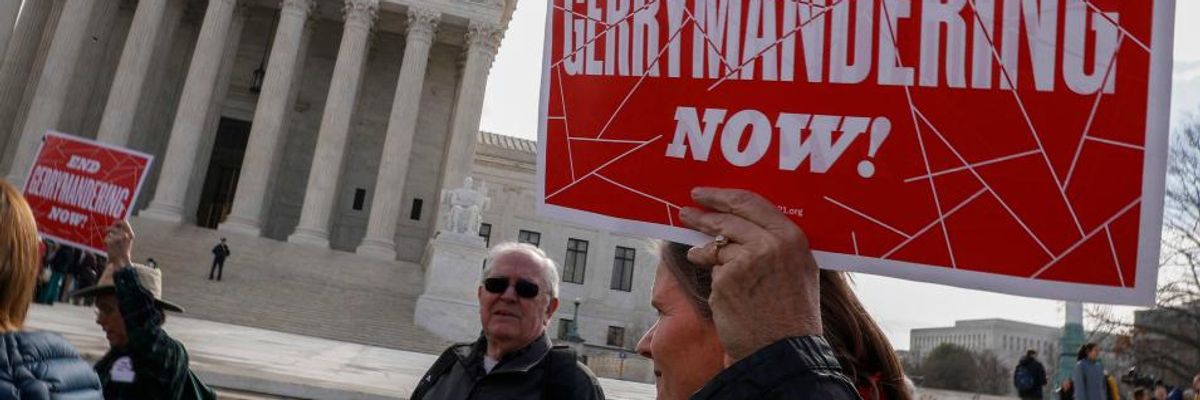
Protesters demonstrate outside the Supreme Court as justices considered partisan gerrymandering. (Photo: Shawn Thew/EPA-EFE)
The Wisconsin Legislature is now openly at war with democracy.
Assembly Speaker Robin Vos, R-Rochester, and his allies say they are prepared to spend nearly three-quarters of a million dollars to examine the results of the 2020 presidential election in the state, despite the fact that those results have been certified, reviewed, counted and recounted to conform their absolute accuracy.
When legislative districts are drawn to be noncompetitive... they don't just lock-in the political dominance of a district. They lock in the authority of the most extreme faction of the dominant party.
As Gov. Tony Evers says, "It's a $700,000 boondoggle to prove something that's already been proven probably 100 times."
The casual explanation for this fiasco says that Vos is simply doing Donald Trump's bidding after the Assembly speaker was called out by the defeated former president for failing to show sufficient deference to the Big Lie that says the 2020 election was stolen. But that's only part of the explanation.
While Vos is surely a toady to Trump, the reason that the speaker and his GOP colleagues are willing and able to go to extremes has a deeper explanation in the nightmare that is gerrymandering.
The nightmare won't end until the Legislature changes. And it won't change if the maps of the legislative districts of state Assembly and Senate members remain unchanged. Yet that's exactly what the extremists who currently control those chambers propose.
Last week, the Republican-controlled Senate voted 19-12 to use Wisconsin's current legislative district maps as the basis for drawing new maps based on data from the 2020 Census. The Republican-controlled Assembly voted 60-38 for the same scheme, which would effectively maintain the partisan gerrymandering that has warped the Legislature from 2011 through 2021.
For those who are satisfied with the current character of the Republican Party, that's good news. But for Republicans who would like to see their party edge back toward the political mainstream -- and for everyone else who cares about the future of Wisconsin and the country -- it's a jarring political threat.
One of the mistakes that politicians and pundits make when writing about the fight over redistricting of legislative maps is to make the assumption that this is a simple fight between Republicans and Democrats. But that misses the most insidious impact of gerrymandering.
When legislative districts are drawn to be noncompetitive, as is the case with the Wisconsin maps that Republicans drew in 2011 and that they hope to maintain, they don't just lock-in the political dominance of a district. They lock in the authority of the most extreme faction of the dominant party.
That's what has happened to the GOP in Wisconsin.
Republican legislators don't have to worry about partisan competition in November. They're going to win no matter what. Even when Democrats prevail by a wide majority statewide, as they did in 2012 when Barack Obama was reelected and Tammy Baldwin was first elected to the U.S. Senate, the Republicans can't lose. That year, Democrats won 174,000 more votes in the state's 99 Assembly districts than Republicans, but Republicans finished the election with 60 seats to just 39 for the Democrats.
In every election cycle since then, Republicans have maintained their outsized majorities in the Assembly and the Senate -- not as a reflection of voter sentiment but as a reflection of the gerrymandered district lines.
This certainty of election does not make legislators of either party more responsible or representative. Politicians who are certain of victory in November stop worrying about working across lines of partisanship and taking stands that appeal to the great mass of voters. They worry only about primary elections, where only the most intensely partisan voters cast ballots, and where there are rewards for going to ideological extremes.
How extreme?
To the point where now Wisconsin legislators are fostering distrust in Wisconsin's election system. They are not doing so because the counted and recounted system is flawed. They are doing so because that's what Donald Trump wants -- and because they know that, with their gerrymandered district lines, there will be no consequences.
Dear Common Dreams reader, It’s been nearly 30 years since I co-founded Common Dreams with my late wife, Lina Newhouser. We had the radical notion that journalism should serve the public good, not corporate profits. It was clear to us from the outset what it would take to build such a project. No paid advertisements. No corporate sponsors. No millionaire publisher telling us what to think or do. Many people said we wouldn't last a year, but we proved those doubters wrong. Together with a tremendous team of journalists and dedicated staff, we built an independent media outlet free from the constraints of profits and corporate control. Our mission has always been simple: To inform. To inspire. To ignite change for the common good. Building Common Dreams was not easy. Our survival was never guaranteed. When you take on the most powerful forces—Wall Street greed, fossil fuel industry destruction, Big Tech lobbyists, and uber-rich oligarchs who have spent billions upon billions rigging the economy and democracy in their favor—the only bulwark you have is supporters who believe in your work. But here’s the urgent message from me today. It's never been this bad out there. And it's never been this hard to keep us going. At the very moment Common Dreams is most needed, the threats we face are intensifying. We need your support now more than ever. We don't accept corporate advertising and never will. We don't have a paywall because we don't think people should be blocked from critical news based on their ability to pay. Everything we do is funded by the donations of readers like you. When everyone does the little they can afford, we are strong. But if that support retreats or dries up, so do we. Will you donate now to make sure Common Dreams not only survives but thrives? —Craig Brown, Co-founder |
The Wisconsin Legislature is now openly at war with democracy.
Assembly Speaker Robin Vos, R-Rochester, and his allies say they are prepared to spend nearly three-quarters of a million dollars to examine the results of the 2020 presidential election in the state, despite the fact that those results have been certified, reviewed, counted and recounted to conform their absolute accuracy.
When legislative districts are drawn to be noncompetitive... they don't just lock-in the political dominance of a district. They lock in the authority of the most extreme faction of the dominant party.
As Gov. Tony Evers says, "It's a $700,000 boondoggle to prove something that's already been proven probably 100 times."
The casual explanation for this fiasco says that Vos is simply doing Donald Trump's bidding after the Assembly speaker was called out by the defeated former president for failing to show sufficient deference to the Big Lie that says the 2020 election was stolen. But that's only part of the explanation.
While Vos is surely a toady to Trump, the reason that the speaker and his GOP colleagues are willing and able to go to extremes has a deeper explanation in the nightmare that is gerrymandering.
The nightmare won't end until the Legislature changes. And it won't change if the maps of the legislative districts of state Assembly and Senate members remain unchanged. Yet that's exactly what the extremists who currently control those chambers propose.
Last week, the Republican-controlled Senate voted 19-12 to use Wisconsin's current legislative district maps as the basis for drawing new maps based on data from the 2020 Census. The Republican-controlled Assembly voted 60-38 for the same scheme, which would effectively maintain the partisan gerrymandering that has warped the Legislature from 2011 through 2021.
For those who are satisfied with the current character of the Republican Party, that's good news. But for Republicans who would like to see their party edge back toward the political mainstream -- and for everyone else who cares about the future of Wisconsin and the country -- it's a jarring political threat.
One of the mistakes that politicians and pundits make when writing about the fight over redistricting of legislative maps is to make the assumption that this is a simple fight between Republicans and Democrats. But that misses the most insidious impact of gerrymandering.
When legislative districts are drawn to be noncompetitive, as is the case with the Wisconsin maps that Republicans drew in 2011 and that they hope to maintain, they don't just lock-in the political dominance of a district. They lock in the authority of the most extreme faction of the dominant party.
That's what has happened to the GOP in Wisconsin.
Republican legislators don't have to worry about partisan competition in November. They're going to win no matter what. Even when Democrats prevail by a wide majority statewide, as they did in 2012 when Barack Obama was reelected and Tammy Baldwin was first elected to the U.S. Senate, the Republicans can't lose. That year, Democrats won 174,000 more votes in the state's 99 Assembly districts than Republicans, but Republicans finished the election with 60 seats to just 39 for the Democrats.
In every election cycle since then, Republicans have maintained their outsized majorities in the Assembly and the Senate -- not as a reflection of voter sentiment but as a reflection of the gerrymandered district lines.
This certainty of election does not make legislators of either party more responsible or representative. Politicians who are certain of victory in November stop worrying about working across lines of partisanship and taking stands that appeal to the great mass of voters. They worry only about primary elections, where only the most intensely partisan voters cast ballots, and where there are rewards for going to ideological extremes.
How extreme?
To the point where now Wisconsin legislators are fostering distrust in Wisconsin's election system. They are not doing so because the counted and recounted system is flawed. They are doing so because that's what Donald Trump wants -- and because they know that, with their gerrymandered district lines, there will be no consequences.
The Wisconsin Legislature is now openly at war with democracy.
Assembly Speaker Robin Vos, R-Rochester, and his allies say they are prepared to spend nearly three-quarters of a million dollars to examine the results of the 2020 presidential election in the state, despite the fact that those results have been certified, reviewed, counted and recounted to conform their absolute accuracy.
When legislative districts are drawn to be noncompetitive... they don't just lock-in the political dominance of a district. They lock in the authority of the most extreme faction of the dominant party.
As Gov. Tony Evers says, "It's a $700,000 boondoggle to prove something that's already been proven probably 100 times."
The casual explanation for this fiasco says that Vos is simply doing Donald Trump's bidding after the Assembly speaker was called out by the defeated former president for failing to show sufficient deference to the Big Lie that says the 2020 election was stolen. But that's only part of the explanation.
While Vos is surely a toady to Trump, the reason that the speaker and his GOP colleagues are willing and able to go to extremes has a deeper explanation in the nightmare that is gerrymandering.
The nightmare won't end until the Legislature changes. And it won't change if the maps of the legislative districts of state Assembly and Senate members remain unchanged. Yet that's exactly what the extremists who currently control those chambers propose.
Last week, the Republican-controlled Senate voted 19-12 to use Wisconsin's current legislative district maps as the basis for drawing new maps based on data from the 2020 Census. The Republican-controlled Assembly voted 60-38 for the same scheme, which would effectively maintain the partisan gerrymandering that has warped the Legislature from 2011 through 2021.
For those who are satisfied with the current character of the Republican Party, that's good news. But for Republicans who would like to see their party edge back toward the political mainstream -- and for everyone else who cares about the future of Wisconsin and the country -- it's a jarring political threat.
One of the mistakes that politicians and pundits make when writing about the fight over redistricting of legislative maps is to make the assumption that this is a simple fight between Republicans and Democrats. But that misses the most insidious impact of gerrymandering.
When legislative districts are drawn to be noncompetitive, as is the case with the Wisconsin maps that Republicans drew in 2011 and that they hope to maintain, they don't just lock-in the political dominance of a district. They lock in the authority of the most extreme faction of the dominant party.
That's what has happened to the GOP in Wisconsin.
Republican legislators don't have to worry about partisan competition in November. They're going to win no matter what. Even when Democrats prevail by a wide majority statewide, as they did in 2012 when Barack Obama was reelected and Tammy Baldwin was first elected to the U.S. Senate, the Republicans can't lose. That year, Democrats won 174,000 more votes in the state's 99 Assembly districts than Republicans, but Republicans finished the election with 60 seats to just 39 for the Democrats.
In every election cycle since then, Republicans have maintained their outsized majorities in the Assembly and the Senate -- not as a reflection of voter sentiment but as a reflection of the gerrymandered district lines.
This certainty of election does not make legislators of either party more responsible or representative. Politicians who are certain of victory in November stop worrying about working across lines of partisanship and taking stands that appeal to the great mass of voters. They worry only about primary elections, where only the most intensely partisan voters cast ballots, and where there are rewards for going to ideological extremes.
How extreme?
To the point where now Wisconsin legislators are fostering distrust in Wisconsin's election system. They are not doing so because the counted and recounted system is flawed. They are doing so because that's what Donald Trump wants -- and because they know that, with their gerrymandered district lines, there will be no consequences.