SUBSCRIBE TO OUR FREE NEWSLETTER
Daily news & progressive opinion—funded by the people, not the corporations—delivered straight to your inbox.
5
#000000
#FFFFFF
To donate by check, phone, or other method, see our More Ways to Give page.
Daily news & progressive opinion—funded by the people, not the corporations—delivered straight to your inbox.
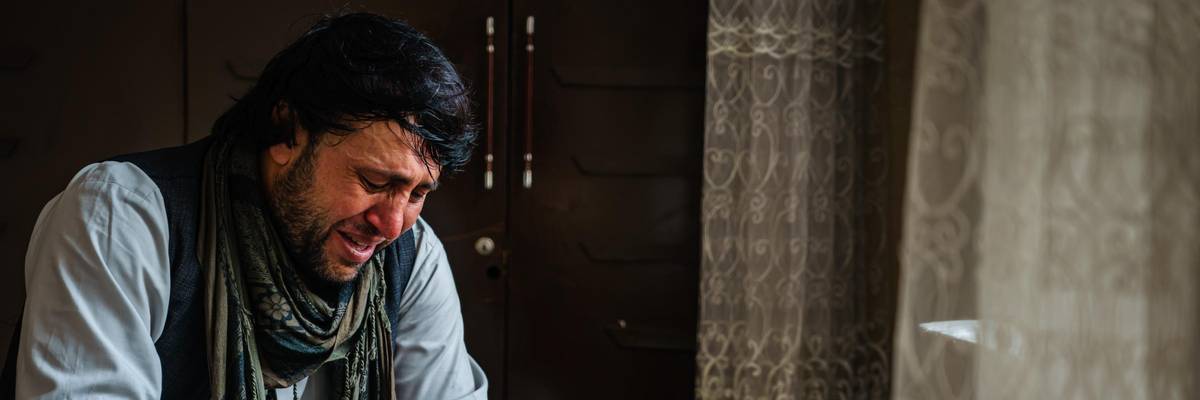
Ajmal Ahmadi weeps alone in a room after members of his family were killed in a U.S. drone strike in Kabul, Afghanistan on August 29, 2021. (Photo: Marcus Yam/Los Angeles Times)
US news outlets have reported stories about civilian casualties in Afghanistan with caution, often noting that claims from the Taliban had not been independently verified. But many outlets showed no inclination to be equally careful when evaluating the Pentagon's line on casualties.
CNN, for example, ordered reporters to frame reports of civilian deaths with reminders that "the Pentagon has repeatedly stressed that it is trying to minimize" such casualties, and that "the Taliban regime continues to harbor terrorists who are connected to the September 11 attacks that claimed thousands of innocent lives in the US" (Washington Post, 10/31/01).
Brit Hume, host of Fox News Channel's Special Report (11/5/01), wondered whether civilian deaths were getting too much attention, with or without disclaimers. "The question I have," said Hume, "is civilian casualties are historically, by definition, a part of war, really. Should they be as big news as they've been?"
The premise that civilian casualties have been "big news" in the US is dubious. The Fox discussion seemed motivated in part by a study of network news broadcasts done by the conservative Media Research Center; the group criticized ABC World News Tonight in particular for apparently giving civilian deaths too much airtime--nearly twice as much as NBC Nightly News and almost four times as much as the CBS Evening News. A close look at ABC's reporting, however, turns up only three segments during the MRC's three-week study period (10/8/01-10/31/01) that were primarily about civilian casualties in Afghanistan. The subject was mentioned in passing a few other times, sometimes to stress the Pentagon's claim that civilians were not being targeted. ABC reporters in general emphasized the difficulties in assessing claims made by the Taliban.
Nonetheless, Fox pundit Mara Liasson from National Public Radio seemed to feel that this was too much coverage: "No," she said in response to Hume's question. "Look, war is about killing people. Civilian casualties are unavoidable." Liasson added that she thought what was missing from television coverage was "a message from the US government that says we are trying to minimize them, but the Taliban isn't, and is putting their tanks in mosques, and themselves among women and children." (The Pentagon's assertions that it was avoiding civilian casualties were routinely featured in network newscasts; the uncorroborated claims that the Taliban were employing civilians as human shields were also featured in TV news.)
Fox commentator and US News & World Report columnist Michael Barone echoed Hume's earlier remarks: "I think the real problem here is that this is poor news judgment on the part of some of these news organizations. Civilian casualties are not, as Mara says, news. The fact is that they accompany wars."
If journalists shouldn't cover civilian deaths because they are a normal part of war, does that principle apply to all war coverage? Since dropping bombs is also standard procedure in a war, will Fox stop reporting airstrikes?
Fox's marketing slogan is "We report, you decide," but these Fox pundits have decided for you that some deaths aren't worth reporting. Then again, being impartial journalists might not be the first order of business. As Hume told the New York Times (11/7/01), "Look, neutrality as a general principle is an appropriate concept for journalists who are covering institutions of some comparable quality. . . . This is a conflict between the United States and murdering barbarians."
With both Fox and CNN trying to marginalize or minimize coverage of civilian deaths in Afghanistan, it's little wonder that self-censorship is taking place at smaller outlets. A memo circulated at the Panama City (Fla.) News Herald and leaked to Jim Romenesko's Media News (10/31/01) warned editors:
DO NOT USE photos on Page 1A showing civilian casualties from the US war on Afghanistan. Our sister paper in Fort Walton Beach has done so and received hundreds and hundreds of threatening e-mails and the like.... DO NOT USE wire stories which lead with civilian casualties from the US war on Afghanistan. They should be mentioned further down in the story. If the story needs rewriting to play down the civilian casualties, DO IT. The only exception is if the US hits an orphanage, school or similar facility and kills scores or hundreds of children.
This policy of consistently burying the facts about the impact of the war on Afghanistan must make the pundits at Fox proud. But journalists who care about the principles of the profession should be embarrassed.
Dear Common Dreams reader, It’s been nearly 30 years since I co-founded Common Dreams with my late wife, Lina Newhouser. We had the radical notion that journalism should serve the public good, not corporate profits. It was clear to us from the outset what it would take to build such a project. No paid advertisements. No corporate sponsors. No millionaire publisher telling us what to think or do. Many people said we wouldn't last a year, but we proved those doubters wrong. Together with a tremendous team of journalists and dedicated staff, we built an independent media outlet free from the constraints of profits and corporate control. Our mission has always been simple: To inform. To inspire. To ignite change for the common good. Building Common Dreams was not easy. Our survival was never guaranteed. When you take on the most powerful forces—Wall Street greed, fossil fuel industry destruction, Big Tech lobbyists, and uber-rich oligarchs who have spent billions upon billions rigging the economy and democracy in their favor—the only bulwark you have is supporters who believe in your work. But here’s the urgent message from me today. It's never been this bad out there. And it's never been this hard to keep us going. At the very moment Common Dreams is most needed, the threats we face are intensifying. We need your support now more than ever. We don't accept corporate advertising and never will. We don't have a paywall because we don't think people should be blocked from critical news based on their ability to pay. Everything we do is funded by the donations of readers like you. When everyone does the little they can afford, we are strong. But if that support retreats or dries up, so do we. Will you donate now to make sure Common Dreams not only survives but thrives? —Craig Brown, Co-founder |
US news outlets have reported stories about civilian casualties in Afghanistan with caution, often noting that claims from the Taliban had not been independently verified. But many outlets showed no inclination to be equally careful when evaluating the Pentagon's line on casualties.
CNN, for example, ordered reporters to frame reports of civilian deaths with reminders that "the Pentagon has repeatedly stressed that it is trying to minimize" such casualties, and that "the Taliban regime continues to harbor terrorists who are connected to the September 11 attacks that claimed thousands of innocent lives in the US" (Washington Post, 10/31/01).
Brit Hume, host of Fox News Channel's Special Report (11/5/01), wondered whether civilian deaths were getting too much attention, with or without disclaimers. "The question I have," said Hume, "is civilian casualties are historically, by definition, a part of war, really. Should they be as big news as they've been?"
The premise that civilian casualties have been "big news" in the US is dubious. The Fox discussion seemed motivated in part by a study of network news broadcasts done by the conservative Media Research Center; the group criticized ABC World News Tonight in particular for apparently giving civilian deaths too much airtime--nearly twice as much as NBC Nightly News and almost four times as much as the CBS Evening News. A close look at ABC's reporting, however, turns up only three segments during the MRC's three-week study period (10/8/01-10/31/01) that were primarily about civilian casualties in Afghanistan. The subject was mentioned in passing a few other times, sometimes to stress the Pentagon's claim that civilians were not being targeted. ABC reporters in general emphasized the difficulties in assessing claims made by the Taliban.
Nonetheless, Fox pundit Mara Liasson from National Public Radio seemed to feel that this was too much coverage: "No," she said in response to Hume's question. "Look, war is about killing people. Civilian casualties are unavoidable." Liasson added that she thought what was missing from television coverage was "a message from the US government that says we are trying to minimize them, but the Taliban isn't, and is putting their tanks in mosques, and themselves among women and children." (The Pentagon's assertions that it was avoiding civilian casualties were routinely featured in network newscasts; the uncorroborated claims that the Taliban were employing civilians as human shields were also featured in TV news.)
Fox commentator and US News & World Report columnist Michael Barone echoed Hume's earlier remarks: "I think the real problem here is that this is poor news judgment on the part of some of these news organizations. Civilian casualties are not, as Mara says, news. The fact is that they accompany wars."
If journalists shouldn't cover civilian deaths because they are a normal part of war, does that principle apply to all war coverage? Since dropping bombs is also standard procedure in a war, will Fox stop reporting airstrikes?
Fox's marketing slogan is "We report, you decide," but these Fox pundits have decided for you that some deaths aren't worth reporting. Then again, being impartial journalists might not be the first order of business. As Hume told the New York Times (11/7/01), "Look, neutrality as a general principle is an appropriate concept for journalists who are covering institutions of some comparable quality. . . . This is a conflict between the United States and murdering barbarians."
With both Fox and CNN trying to marginalize or minimize coverage of civilian deaths in Afghanistan, it's little wonder that self-censorship is taking place at smaller outlets. A memo circulated at the Panama City (Fla.) News Herald and leaked to Jim Romenesko's Media News (10/31/01) warned editors:
DO NOT USE photos on Page 1A showing civilian casualties from the US war on Afghanistan. Our sister paper in Fort Walton Beach has done so and received hundreds and hundreds of threatening e-mails and the like.... DO NOT USE wire stories which lead with civilian casualties from the US war on Afghanistan. They should be mentioned further down in the story. If the story needs rewriting to play down the civilian casualties, DO IT. The only exception is if the US hits an orphanage, school or similar facility and kills scores or hundreds of children.
This policy of consistently burying the facts about the impact of the war on Afghanistan must make the pundits at Fox proud. But journalists who care about the principles of the profession should be embarrassed.
US news outlets have reported stories about civilian casualties in Afghanistan with caution, often noting that claims from the Taliban had not been independently verified. But many outlets showed no inclination to be equally careful when evaluating the Pentagon's line on casualties.
CNN, for example, ordered reporters to frame reports of civilian deaths with reminders that "the Pentagon has repeatedly stressed that it is trying to minimize" such casualties, and that "the Taliban regime continues to harbor terrorists who are connected to the September 11 attacks that claimed thousands of innocent lives in the US" (Washington Post, 10/31/01).
Brit Hume, host of Fox News Channel's Special Report (11/5/01), wondered whether civilian deaths were getting too much attention, with or without disclaimers. "The question I have," said Hume, "is civilian casualties are historically, by definition, a part of war, really. Should they be as big news as they've been?"
The premise that civilian casualties have been "big news" in the US is dubious. The Fox discussion seemed motivated in part by a study of network news broadcasts done by the conservative Media Research Center; the group criticized ABC World News Tonight in particular for apparently giving civilian deaths too much airtime--nearly twice as much as NBC Nightly News and almost four times as much as the CBS Evening News. A close look at ABC's reporting, however, turns up only three segments during the MRC's three-week study period (10/8/01-10/31/01) that were primarily about civilian casualties in Afghanistan. The subject was mentioned in passing a few other times, sometimes to stress the Pentagon's claim that civilians were not being targeted. ABC reporters in general emphasized the difficulties in assessing claims made by the Taliban.
Nonetheless, Fox pundit Mara Liasson from National Public Radio seemed to feel that this was too much coverage: "No," she said in response to Hume's question. "Look, war is about killing people. Civilian casualties are unavoidable." Liasson added that she thought what was missing from television coverage was "a message from the US government that says we are trying to minimize them, but the Taliban isn't, and is putting their tanks in mosques, and themselves among women and children." (The Pentagon's assertions that it was avoiding civilian casualties were routinely featured in network newscasts; the uncorroborated claims that the Taliban were employing civilians as human shields were also featured in TV news.)
Fox commentator and US News & World Report columnist Michael Barone echoed Hume's earlier remarks: "I think the real problem here is that this is poor news judgment on the part of some of these news organizations. Civilian casualties are not, as Mara says, news. The fact is that they accompany wars."
If journalists shouldn't cover civilian deaths because they are a normal part of war, does that principle apply to all war coverage? Since dropping bombs is also standard procedure in a war, will Fox stop reporting airstrikes?
Fox's marketing slogan is "We report, you decide," but these Fox pundits have decided for you that some deaths aren't worth reporting. Then again, being impartial journalists might not be the first order of business. As Hume told the New York Times (11/7/01), "Look, neutrality as a general principle is an appropriate concept for journalists who are covering institutions of some comparable quality. . . . This is a conflict between the United States and murdering barbarians."
With both Fox and CNN trying to marginalize or minimize coverage of civilian deaths in Afghanistan, it's little wonder that self-censorship is taking place at smaller outlets. A memo circulated at the Panama City (Fla.) News Herald and leaked to Jim Romenesko's Media News (10/31/01) warned editors:
DO NOT USE photos on Page 1A showing civilian casualties from the US war on Afghanistan. Our sister paper in Fort Walton Beach has done so and received hundreds and hundreds of threatening e-mails and the like.... DO NOT USE wire stories which lead with civilian casualties from the US war on Afghanistan. They should be mentioned further down in the story. If the story needs rewriting to play down the civilian casualties, DO IT. The only exception is if the US hits an orphanage, school or similar facility and kills scores or hundreds of children.
This policy of consistently burying the facts about the impact of the war on Afghanistan must make the pundits at Fox proud. But journalists who care about the principles of the profession should be embarrassed.