SUBSCRIBE TO OUR FREE NEWSLETTER
Daily news & progressive opinion—funded by the people, not the corporations—delivered straight to your inbox.
5
#000000
#FFFFFF
To donate by check, phone, or other method, see our More Ways to Give page.
Daily news & progressive opinion—funded by the people, not the corporations—delivered straight to your inbox.
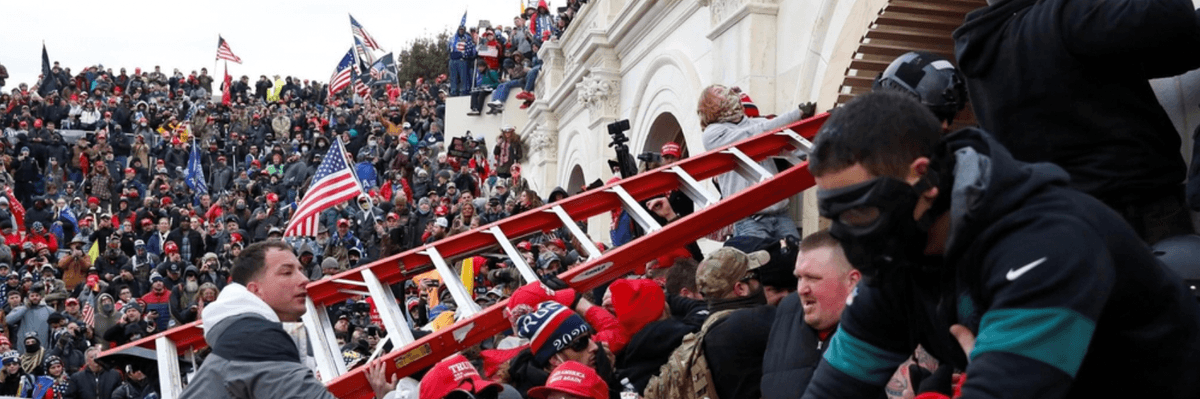
Pro-Trump extremists attack the Capitol as Congress convenes to certify Trump's election defeat. (Photo: Shutterstock)
As the congressional investigation into the January 6 insurrection gets underway, we're learning disturbing new details about Trump supporters' violent attempt to overturn the 2020 election.
As I watch, I see a chilling parallel to the rise of Chilean dictator Augusto Pinochet.
"The dictatorships of the 20th century prove that it's possible to manipulate public perception of reality enough to enable a coup."
Steve Stern's book Remembering Pinochet's Chile opens with a couple greeting the 1973 military coup that launched Pinochet's dictatorship by toasting the fighter jets with champagne. Decades later, they still remember Pinochet fondly.
Their version of their country's history differs starkly with its reality -- and they aren't alone.
They politically opposed the leftist Allende government that Pinochet overthrew, but that alone doesn't explain why they would cheer a regime known for torturing and murdering its political enemies.
So, why did they support Pinochet? Because he provided an entirely false and easily disproved story to justify his illegal coup and the brutality that followed -- and they believed it.
Pinochet falsely claimed that the Allende government was planning murder on a vast scale. Supporters believed Pinochet's own crimes were justified because he was preventing something worse.
It's possible to convince people to support a coup -- and even mass murder -- with phony evidence. It's crucial to the survival of our democracy that we prevent that.
The January 6 Commission will uncover new facts about the insurrection and the lies that underpinned it. But by itself, it won't change many minds. People don't easily give up strongly held beliefs -- even false beliefs -- that tie them to groups they identify with.
Simply presenting the facts to someone who doesn't want to believe them won't work. But as a sociologist, there's another framework that helps me when I want to understand multiple sides of a controversy without being clouded by my own biases.
To do this, I set aside my own beliefs temporarily. This can be emotionally challenging when engaging with viewpoints I believe are factually incorrect or immoral, but it's worth it.
First of all, what does each side claim is factually true? Do they provide any evidence to back up their claims? Can you verify their evidence?
Second, what are each side's professed values? These are often based in morality, and they cannot be proven true or false. "Most people believe murder is wrong" is a factual claim -- something that can be proven true or false -- but "murder is wrong" is a value.
Third, what does each side have to gain from their position? In this case, consider both partisan gain -- raising campaign contributions and winning votes in the next election -- as well as the more serious issue of risking the foundations of American democracy itself.
Often people make factual and moral arguments when they're advocating for a position that advances their own interests. Do they really care about morality or are they just out for their own gain?
The January 6 Commission offers us all an opportunity to examine factual claims, values, interests, and language.
Look at all of the evidence that emerges in its totality, not one or two cherry picked tidbits. Pay attention to first person accounts from people who were there. Law enforcement officers are testifying -- and they're not known for liberal bias.
In this case, I believe the perspectives of Republicans like Liz Cheney are crucial to listen to. Unlike Democrats in favor of the Commission and Republicans who oppose it, Cheney is paying a huge political price for her participation. Why? She wouldn't do that without a good reason
Our democracy is too precious to throw away for partisan gain. The dictatorships of the 20th century prove that it's possible to manipulate public perception of reality enough to enable a coup.
If you believe violence instead of voting is justified, I implore you to at least consider the alternative viewpoint. The costs of being wrong are too high.
Dear Common Dreams reader, It’s been nearly 30 years since I co-founded Common Dreams with my late wife, Lina Newhouser. We had the radical notion that journalism should serve the public good, not corporate profits. It was clear to us from the outset what it would take to build such a project. No paid advertisements. No corporate sponsors. No millionaire publisher telling us what to think or do. Many people said we wouldn't last a year, but we proved those doubters wrong. Together with a tremendous team of journalists and dedicated staff, we built an independent media outlet free from the constraints of profits and corporate control. Our mission has always been simple: To inform. To inspire. To ignite change for the common good. Building Common Dreams was not easy. Our survival was never guaranteed. When you take on the most powerful forces—Wall Street greed, fossil fuel industry destruction, Big Tech lobbyists, and uber-rich oligarchs who have spent billions upon billions rigging the economy and democracy in their favor—the only bulwark you have is supporters who believe in your work. But here’s the urgent message from me today. It's never been this bad out there. And it's never been this hard to keep us going. At the very moment Common Dreams is most needed, the threats we face are intensifying. We need your support now more than ever. We don't accept corporate advertising and never will. We don't have a paywall because we don't think people should be blocked from critical news based on their ability to pay. Everything we do is funded by the donations of readers like you. When everyone does the little they can afford, we are strong. But if that support retreats or dries up, so do we. Will you donate now to make sure Common Dreams not only survives but thrives? —Craig Brown, Co-founder |
As the congressional investigation into the January 6 insurrection gets underway, we're learning disturbing new details about Trump supporters' violent attempt to overturn the 2020 election.
As I watch, I see a chilling parallel to the rise of Chilean dictator Augusto Pinochet.
"The dictatorships of the 20th century prove that it's possible to manipulate public perception of reality enough to enable a coup."
Steve Stern's book Remembering Pinochet's Chile opens with a couple greeting the 1973 military coup that launched Pinochet's dictatorship by toasting the fighter jets with champagne. Decades later, they still remember Pinochet fondly.
Their version of their country's history differs starkly with its reality -- and they aren't alone.
They politically opposed the leftist Allende government that Pinochet overthrew, but that alone doesn't explain why they would cheer a regime known for torturing and murdering its political enemies.
So, why did they support Pinochet? Because he provided an entirely false and easily disproved story to justify his illegal coup and the brutality that followed -- and they believed it.
Pinochet falsely claimed that the Allende government was planning murder on a vast scale. Supporters believed Pinochet's own crimes were justified because he was preventing something worse.
It's possible to convince people to support a coup -- and even mass murder -- with phony evidence. It's crucial to the survival of our democracy that we prevent that.
The January 6 Commission will uncover new facts about the insurrection and the lies that underpinned it. But by itself, it won't change many minds. People don't easily give up strongly held beliefs -- even false beliefs -- that tie them to groups they identify with.
Simply presenting the facts to someone who doesn't want to believe them won't work. But as a sociologist, there's another framework that helps me when I want to understand multiple sides of a controversy without being clouded by my own biases.
To do this, I set aside my own beliefs temporarily. This can be emotionally challenging when engaging with viewpoints I believe are factually incorrect or immoral, but it's worth it.
First of all, what does each side claim is factually true? Do they provide any evidence to back up their claims? Can you verify their evidence?
Second, what are each side's professed values? These are often based in morality, and they cannot be proven true or false. "Most people believe murder is wrong" is a factual claim -- something that can be proven true or false -- but "murder is wrong" is a value.
Third, what does each side have to gain from their position? In this case, consider both partisan gain -- raising campaign contributions and winning votes in the next election -- as well as the more serious issue of risking the foundations of American democracy itself.
Often people make factual and moral arguments when they're advocating for a position that advances their own interests. Do they really care about morality or are they just out for their own gain?
The January 6 Commission offers us all an opportunity to examine factual claims, values, interests, and language.
Look at all of the evidence that emerges in its totality, not one or two cherry picked tidbits. Pay attention to first person accounts from people who were there. Law enforcement officers are testifying -- and they're not known for liberal bias.
In this case, I believe the perspectives of Republicans like Liz Cheney are crucial to listen to. Unlike Democrats in favor of the Commission and Republicans who oppose it, Cheney is paying a huge political price for her participation. Why? She wouldn't do that without a good reason
Our democracy is too precious to throw away for partisan gain. The dictatorships of the 20th century prove that it's possible to manipulate public perception of reality enough to enable a coup.
If you believe violence instead of voting is justified, I implore you to at least consider the alternative viewpoint. The costs of being wrong are too high.
As the congressional investigation into the January 6 insurrection gets underway, we're learning disturbing new details about Trump supporters' violent attempt to overturn the 2020 election.
As I watch, I see a chilling parallel to the rise of Chilean dictator Augusto Pinochet.
"The dictatorships of the 20th century prove that it's possible to manipulate public perception of reality enough to enable a coup."
Steve Stern's book Remembering Pinochet's Chile opens with a couple greeting the 1973 military coup that launched Pinochet's dictatorship by toasting the fighter jets with champagne. Decades later, they still remember Pinochet fondly.
Their version of their country's history differs starkly with its reality -- and they aren't alone.
They politically opposed the leftist Allende government that Pinochet overthrew, but that alone doesn't explain why they would cheer a regime known for torturing and murdering its political enemies.
So, why did they support Pinochet? Because he provided an entirely false and easily disproved story to justify his illegal coup and the brutality that followed -- and they believed it.
Pinochet falsely claimed that the Allende government was planning murder on a vast scale. Supporters believed Pinochet's own crimes were justified because he was preventing something worse.
It's possible to convince people to support a coup -- and even mass murder -- with phony evidence. It's crucial to the survival of our democracy that we prevent that.
The January 6 Commission will uncover new facts about the insurrection and the lies that underpinned it. But by itself, it won't change many minds. People don't easily give up strongly held beliefs -- even false beliefs -- that tie them to groups they identify with.
Simply presenting the facts to someone who doesn't want to believe them won't work. But as a sociologist, there's another framework that helps me when I want to understand multiple sides of a controversy without being clouded by my own biases.
To do this, I set aside my own beliefs temporarily. This can be emotionally challenging when engaging with viewpoints I believe are factually incorrect or immoral, but it's worth it.
First of all, what does each side claim is factually true? Do they provide any evidence to back up their claims? Can you verify their evidence?
Second, what are each side's professed values? These are often based in morality, and they cannot be proven true or false. "Most people believe murder is wrong" is a factual claim -- something that can be proven true or false -- but "murder is wrong" is a value.
Third, what does each side have to gain from their position? In this case, consider both partisan gain -- raising campaign contributions and winning votes in the next election -- as well as the more serious issue of risking the foundations of American democracy itself.
Often people make factual and moral arguments when they're advocating for a position that advances their own interests. Do they really care about morality or are they just out for their own gain?
The January 6 Commission offers us all an opportunity to examine factual claims, values, interests, and language.
Look at all of the evidence that emerges in its totality, not one or two cherry picked tidbits. Pay attention to first person accounts from people who were there. Law enforcement officers are testifying -- and they're not known for liberal bias.
In this case, I believe the perspectives of Republicans like Liz Cheney are crucial to listen to. Unlike Democrats in favor of the Commission and Republicans who oppose it, Cheney is paying a huge political price for her participation. Why? She wouldn't do that without a good reason
Our democracy is too precious to throw away for partisan gain. The dictatorships of the 20th century prove that it's possible to manipulate public perception of reality enough to enable a coup.
If you believe violence instead of voting is justified, I implore you to at least consider the alternative viewpoint. The costs of being wrong are too high.