SUBSCRIBE TO OUR FREE NEWSLETTER
Daily news & progressive opinion—funded by the people, not the corporations—delivered straight to your inbox.
5
#000000
#FFFFFF
To donate by check, phone, or other method, see our More Ways to Give page.
Daily news & progressive opinion—funded by the people, not the corporations—delivered straight to your inbox.
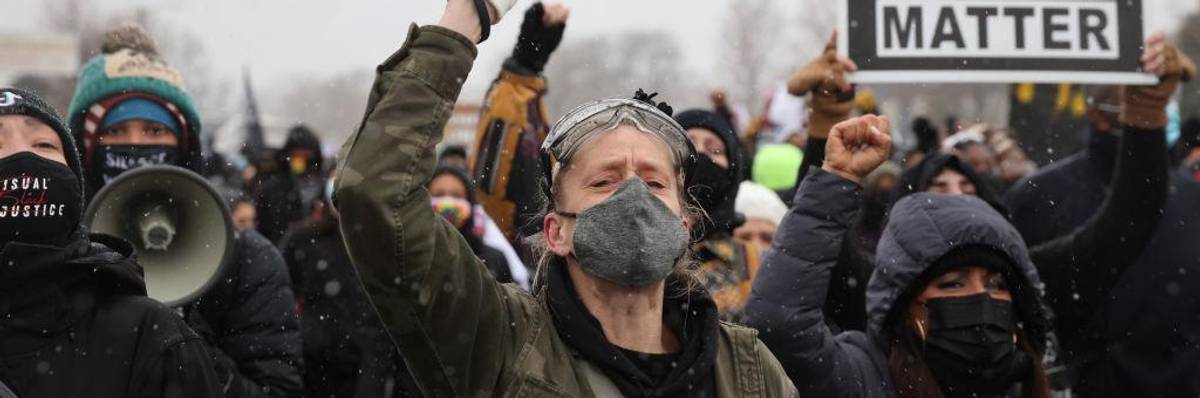
Demonstrators protest the shooting death of Daunte Wright outside the Brooklyn Center police station on April 13, 2021 in Brooklyn Center, Minnesota. Wright, a Black man whose car was stopped in town on Sunday reportedly for an expired registration, was shot and killed by an officer who police say mistook her service revolver for a Taser. (Photo by Scott Olson/Getty Images)
I'm starting to write this column only a few minutes after watching the mayor and police chief of Brooklyn Center, Minn.--a suburb of Minneapolis--try to explain the utterly inexplicable, which is how yet another young, unarmed Black man ended up dead in the street, felled by a police bullet. My hands are still shaking a bit with fury.
How could Daunte Wright--a 20-year-old Black man, father of a 2-year-old girl--die at the hands of police just 10 miles away from where justice is sought for last year's police killing of George Floyd, which was supposed to trigger some sort of racial reckoning in America? How could a veteran police officer make such a life-or-death mistake in firing her handgun thinking it was a Taser? And how could a traffic stop over something so trivial--either an expired registration tag, or an air freshener hung on the rear-view mirror--result in ending a human life?
Statistics suggest the real reason Daunte Wright was pulled over--which is the reason that he's no longer alive--was the color of his skin.
What's more, the police killing of Wright came as the nation was still processing the shocking video from another police traffic stop in Windsor, Va., where an officer was fired this weekend after body-cam footage showed him dousing a uniformed Black U.S. Army medic with pepper spray. The medic had been pulled over for lacking a license plate, even though the temporary tag for the newly purchased vehicle was prominently displayed in a rear window.
The outcome is Virginia was different (there, Lt. Caron Nazario now is suing two Windsor officers for using excessive force) but what's so striking is what these two incidents shared in common. Both drivers were Black men, and both were reportedly stopped for violations of traffic law that were inconsequential, and arguably trivial. As these events too often escalate, almost irrationally, into out-of-all-proportion violence, more experts are saying we should no longer ask, why did this traffic stop go bad? We should ask, why have these traffic stops at all?
"Traffic stops come fraught with problems," said Barry Friedman, the New York University Law School professor who is faculty director of its Policing Project and one of those experts questioning the purpose of most police encounters with motorists. He said that while safer roads are the ostensible purpose for police traffic enforcement, highway stops are also seen as a source of revenue for cash-strapped communities, and--most importantly--are often viewed by cops as a pretext to investigate other crimes, often around narcotics or guns.
Studies have shown that in communities with large Black and brown populations, these so-called pretextual traffic stops are the rule, not the exception. Busted tail lights, or a not-illuminated license plate, or an expired tag (although apparently thousands of motorists in Minnesota are driving with them, in the wake of COVID-19), or making a too-wide left turn or crossing a yellow line.
Or, incredibly, an air freshener dangling down from a driver's rear-view mirror. When I initially heard on Sunday night about the killing of Daunte Wright, and read that in his final seconds he'd called his mother and said his air freshener was the reason cops pulled him over, I was shocked. But--as Buzzfeed's Zoe Tillman reported last June--traffic stops over these air fresheners aren't just frequent but have been upheld by the courts. The claim is that they obstruct a driver's vision, although experts say cops may believe their purpose is to mask the smell of marijuana. Air fresheners shouldn't be illegal--if they're so deadly, why does Pep Boys have an aisle filled with them?--but then, marijuana shouldn't be, either.
In the end, Brooklyn Center police claimed the deadly stop wasn't over the air freshener you can buy at Autozone but over the expired tag that half of Minnesota apparently is also driving with. But statistics suggest the real reason Daunte Wright was pulled over--which is the reason that he's no longer alive--was the color of his skin.
Dear Common Dreams reader, It’s been nearly 30 years since I co-founded Common Dreams with my late wife, Lina Newhouser. We had the radical notion that journalism should serve the public good, not corporate profits. It was clear to us from the outset what it would take to build such a project. No paid advertisements. No corporate sponsors. No millionaire publisher telling us what to think or do. Many people said we wouldn't last a year, but we proved those doubters wrong. Together with a tremendous team of journalists and dedicated staff, we built an independent media outlet free from the constraints of profits and corporate control. Our mission has always been simple: To inform. To inspire. To ignite change for the common good. Building Common Dreams was not easy. Our survival was never guaranteed. When you take on the most powerful forces—Wall Street greed, fossil fuel industry destruction, Big Tech lobbyists, and uber-rich oligarchs who have spent billions upon billions rigging the economy and democracy in their favor—the only bulwark you have is supporters who believe in your work. But here’s the urgent message from me today. It's never been this bad out there. And it's never been this hard to keep us going. At the very moment Common Dreams is most needed, the threats we face are intensifying. We need your support now more than ever. We don't accept corporate advertising and never will. We don't have a paywall because we don't think people should be blocked from critical news based on their ability to pay. Everything we do is funded by the donations of readers like you. When everyone does the little they can afford, we are strong. But if that support retreats or dries up, so do we. Will you donate now to make sure Common Dreams not only survives but thrives? —Craig Brown, Co-founder |
I'm starting to write this column only a few minutes after watching the mayor and police chief of Brooklyn Center, Minn.--a suburb of Minneapolis--try to explain the utterly inexplicable, which is how yet another young, unarmed Black man ended up dead in the street, felled by a police bullet. My hands are still shaking a bit with fury.
How could Daunte Wright--a 20-year-old Black man, father of a 2-year-old girl--die at the hands of police just 10 miles away from where justice is sought for last year's police killing of George Floyd, which was supposed to trigger some sort of racial reckoning in America? How could a veteran police officer make such a life-or-death mistake in firing her handgun thinking it was a Taser? And how could a traffic stop over something so trivial--either an expired registration tag, or an air freshener hung on the rear-view mirror--result in ending a human life?
Statistics suggest the real reason Daunte Wright was pulled over--which is the reason that he's no longer alive--was the color of his skin.
What's more, the police killing of Wright came as the nation was still processing the shocking video from another police traffic stop in Windsor, Va., where an officer was fired this weekend after body-cam footage showed him dousing a uniformed Black U.S. Army medic with pepper spray. The medic had been pulled over for lacking a license plate, even though the temporary tag for the newly purchased vehicle was prominently displayed in a rear window.
The outcome is Virginia was different (there, Lt. Caron Nazario now is suing two Windsor officers for using excessive force) but what's so striking is what these two incidents shared in common. Both drivers were Black men, and both were reportedly stopped for violations of traffic law that were inconsequential, and arguably trivial. As these events too often escalate, almost irrationally, into out-of-all-proportion violence, more experts are saying we should no longer ask, why did this traffic stop go bad? We should ask, why have these traffic stops at all?
"Traffic stops come fraught with problems," said Barry Friedman, the New York University Law School professor who is faculty director of its Policing Project and one of those experts questioning the purpose of most police encounters with motorists. He said that while safer roads are the ostensible purpose for police traffic enforcement, highway stops are also seen as a source of revenue for cash-strapped communities, and--most importantly--are often viewed by cops as a pretext to investigate other crimes, often around narcotics or guns.
Studies have shown that in communities with large Black and brown populations, these so-called pretextual traffic stops are the rule, not the exception. Busted tail lights, or a not-illuminated license plate, or an expired tag (although apparently thousands of motorists in Minnesota are driving with them, in the wake of COVID-19), or making a too-wide left turn or crossing a yellow line.
Or, incredibly, an air freshener dangling down from a driver's rear-view mirror. When I initially heard on Sunday night about the killing of Daunte Wright, and read that in his final seconds he'd called his mother and said his air freshener was the reason cops pulled him over, I was shocked. But--as Buzzfeed's Zoe Tillman reported last June--traffic stops over these air fresheners aren't just frequent but have been upheld by the courts. The claim is that they obstruct a driver's vision, although experts say cops may believe their purpose is to mask the smell of marijuana. Air fresheners shouldn't be illegal--if they're so deadly, why does Pep Boys have an aisle filled with them?--but then, marijuana shouldn't be, either.
In the end, Brooklyn Center police claimed the deadly stop wasn't over the air freshener you can buy at Autozone but over the expired tag that half of Minnesota apparently is also driving with. But statistics suggest the real reason Daunte Wright was pulled over--which is the reason that he's no longer alive--was the color of his skin.
I'm starting to write this column only a few minutes after watching the mayor and police chief of Brooklyn Center, Minn.--a suburb of Minneapolis--try to explain the utterly inexplicable, which is how yet another young, unarmed Black man ended up dead in the street, felled by a police bullet. My hands are still shaking a bit with fury.
How could Daunte Wright--a 20-year-old Black man, father of a 2-year-old girl--die at the hands of police just 10 miles away from where justice is sought for last year's police killing of George Floyd, which was supposed to trigger some sort of racial reckoning in America? How could a veteran police officer make such a life-or-death mistake in firing her handgun thinking it was a Taser? And how could a traffic stop over something so trivial--either an expired registration tag, or an air freshener hung on the rear-view mirror--result in ending a human life?
Statistics suggest the real reason Daunte Wright was pulled over--which is the reason that he's no longer alive--was the color of his skin.
What's more, the police killing of Wright came as the nation was still processing the shocking video from another police traffic stop in Windsor, Va., where an officer was fired this weekend after body-cam footage showed him dousing a uniformed Black U.S. Army medic with pepper spray. The medic had been pulled over for lacking a license plate, even though the temporary tag for the newly purchased vehicle was prominently displayed in a rear window.
The outcome is Virginia was different (there, Lt. Caron Nazario now is suing two Windsor officers for using excessive force) but what's so striking is what these two incidents shared in common. Both drivers were Black men, and both were reportedly stopped for violations of traffic law that were inconsequential, and arguably trivial. As these events too often escalate, almost irrationally, into out-of-all-proportion violence, more experts are saying we should no longer ask, why did this traffic stop go bad? We should ask, why have these traffic stops at all?
"Traffic stops come fraught with problems," said Barry Friedman, the New York University Law School professor who is faculty director of its Policing Project and one of those experts questioning the purpose of most police encounters with motorists. He said that while safer roads are the ostensible purpose for police traffic enforcement, highway stops are also seen as a source of revenue for cash-strapped communities, and--most importantly--are often viewed by cops as a pretext to investigate other crimes, often around narcotics or guns.
Studies have shown that in communities with large Black and brown populations, these so-called pretextual traffic stops are the rule, not the exception. Busted tail lights, or a not-illuminated license plate, or an expired tag (although apparently thousands of motorists in Minnesota are driving with them, in the wake of COVID-19), or making a too-wide left turn or crossing a yellow line.
Or, incredibly, an air freshener dangling down from a driver's rear-view mirror. When I initially heard on Sunday night about the killing of Daunte Wright, and read that in his final seconds he'd called his mother and said his air freshener was the reason cops pulled him over, I was shocked. But--as Buzzfeed's Zoe Tillman reported last June--traffic stops over these air fresheners aren't just frequent but have been upheld by the courts. The claim is that they obstruct a driver's vision, although experts say cops may believe their purpose is to mask the smell of marijuana. Air fresheners shouldn't be illegal--if they're so deadly, why does Pep Boys have an aisle filled with them?--but then, marijuana shouldn't be, either.
In the end, Brooklyn Center police claimed the deadly stop wasn't over the air freshener you can buy at Autozone but over the expired tag that half of Minnesota apparently is also driving with. But statistics suggest the real reason Daunte Wright was pulled over--which is the reason that he's no longer alive--was the color of his skin.