SUBSCRIBE TO OUR FREE NEWSLETTER
Daily news & progressive opinion—funded by the people, not the corporations—delivered straight to your inbox.
5
#000000
#FFFFFF
To donate by check, phone, or other method, see our More Ways to Give page.
Daily news & progressive opinion—funded by the people, not the corporations—delivered straight to your inbox.
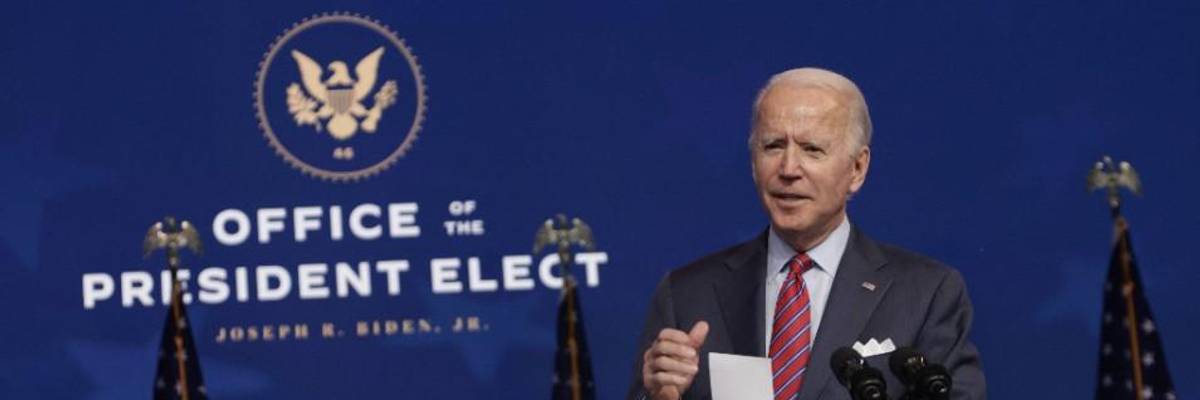
U.S. President-elect Joe Biden speaks on November job numbers at the Queen Theater December 4, 2020 Wilmington, Delaware. (Photo: Alex Wong/Getty Images)
The climate crisis isn't a single issue: It's an everything issue. To solve it, we'll have to change how we get around, how we grow food, how we heat and cool our homes, how we create electricity, and much else. We'll need an economy-wide, and society-wide, transformation that will create millions of family-sustaining jobs in clean energy, energy efficiency, and more.
To achieve that economy-wide transformation, we need every part of our government working toward it, as well as a powerful movement pushing officials to be even more ambitious and inclusive. Thankfully, many of President-elect Biden's first few cabinet picks show that he understands the necessity of a whole-government approach.
Chief among them is John Kerry, who was named to the new post of special presidential envoy for climate. Kerry is a longtime climate champion who played a key role in negotiating the Paris agreement in 2015. His cabinet-level position sits in the National Security Council, which isn't known for its focus on the climate crisis. But this foreign-policy role offers Kerry, and Antony Blinken, Biden's climate-conscious pick for Secretary of State, the opportunity to mobilize the global community toward climate action.
After years of fossil-fuel boosterism by the Trump administration, they'll have their work cut out for them. As Kerry well knows, just rejoining the Paris agreement is not enough to take U.S. off the path of planetary destruction. We'll have to go well beyond those goals, and phasing out the use of coal worldwide is a good place to start. Communities from South Korea to South Africa have documented the destructive health impacts of mining and burning dirty coal while showing how clean energy will save lives and money and create millions of jobs. One key opportunity for international climate diplomacy is to share technologies and pathways to an accelerated transition to 100% clean, renewable energy.
Our own country is in the middle of a painful recession, and Biden understands that our best way out is through a green stimulus that creates millions of family-sustaining jobs in clean energy, sustainable agriculture, and cleaning up pollution in communities of color and low-income communities. And his pick for Treasury secretary, former Federal Reserve chair Janet Yellen, will be a central part of making such a plan reality. Yellen can help ensure that we spend public money to create jobs that revitalize our communities and stave off climate catastrophe. And luckily, she's long been a proponent of using financial tools to address the risk climate change poses to this country and our economy.
Yellen's engagement on the climate can--and must--go beyond a green stimulus. After all, as Treasury Secretary, she will have profound influence over government spending, development finance, and risk management in our financial sector. Climate change is one of the greatest risks to our economy, but the largest U.S. financial institutions are accelerating the crisis by pouring more money into fossil fuels. Yellen and other financial regulators in the Biden administration have the power to carry out a managed decline of fossil fuels, and to ensure that financial institutions zero out their climate impact.
Biden still has many roles to fill in his administration, including the heads of the EPA, Department of the Interior, and the Department of Energy. And I hope that for each one, he'll nominate a leader who understands the severity of the climate crisis and the environmental injustices that burden communities of color and low-income communities. Good policy starts with good people--and good movements that push them to make the most of the power voters have granted them.
Dear Common Dreams reader, It’s been nearly 30 years since I co-founded Common Dreams with my late wife, Lina Newhouser. We had the radical notion that journalism should serve the public good, not corporate profits. It was clear to us from the outset what it would take to build such a project. No paid advertisements. No corporate sponsors. No millionaire publisher telling us what to think or do. Many people said we wouldn't last a year, but we proved those doubters wrong. Together with a tremendous team of journalists and dedicated staff, we built an independent media outlet free from the constraints of profits and corporate control. Our mission has always been simple: To inform. To inspire. To ignite change for the common good. Building Common Dreams was not easy. Our survival was never guaranteed. When you take on the most powerful forces—Wall Street greed, fossil fuel industry destruction, Big Tech lobbyists, and uber-rich oligarchs who have spent billions upon billions rigging the economy and democracy in their favor—the only bulwark you have is supporters who believe in your work. But here’s the urgent message from me today. It's never been this bad out there. And it's never been this hard to keep us going. At the very moment Common Dreams is most needed, the threats we face are intensifying. We need your support now more than ever. We don't accept corporate advertising and never will. We don't have a paywall because we don't think people should be blocked from critical news based on their ability to pay. Everything we do is funded by the donations of readers like you. When everyone does the little they can afford, we are strong. But if that support retreats or dries up, so do we. Will you donate now to make sure Common Dreams not only survives but thrives? —Craig Brown, Co-founder |
The climate crisis isn't a single issue: It's an everything issue. To solve it, we'll have to change how we get around, how we grow food, how we heat and cool our homes, how we create electricity, and much else. We'll need an economy-wide, and society-wide, transformation that will create millions of family-sustaining jobs in clean energy, energy efficiency, and more.
To achieve that economy-wide transformation, we need every part of our government working toward it, as well as a powerful movement pushing officials to be even more ambitious and inclusive. Thankfully, many of President-elect Biden's first few cabinet picks show that he understands the necessity of a whole-government approach.
Chief among them is John Kerry, who was named to the new post of special presidential envoy for climate. Kerry is a longtime climate champion who played a key role in negotiating the Paris agreement in 2015. His cabinet-level position sits in the National Security Council, which isn't known for its focus on the climate crisis. But this foreign-policy role offers Kerry, and Antony Blinken, Biden's climate-conscious pick for Secretary of State, the opportunity to mobilize the global community toward climate action.
After years of fossil-fuel boosterism by the Trump administration, they'll have their work cut out for them. As Kerry well knows, just rejoining the Paris agreement is not enough to take U.S. off the path of planetary destruction. We'll have to go well beyond those goals, and phasing out the use of coal worldwide is a good place to start. Communities from South Korea to South Africa have documented the destructive health impacts of mining and burning dirty coal while showing how clean energy will save lives and money and create millions of jobs. One key opportunity for international climate diplomacy is to share technologies and pathways to an accelerated transition to 100% clean, renewable energy.
Our own country is in the middle of a painful recession, and Biden understands that our best way out is through a green stimulus that creates millions of family-sustaining jobs in clean energy, sustainable agriculture, and cleaning up pollution in communities of color and low-income communities. And his pick for Treasury secretary, former Federal Reserve chair Janet Yellen, will be a central part of making such a plan reality. Yellen can help ensure that we spend public money to create jobs that revitalize our communities and stave off climate catastrophe. And luckily, she's long been a proponent of using financial tools to address the risk climate change poses to this country and our economy.
Yellen's engagement on the climate can--and must--go beyond a green stimulus. After all, as Treasury Secretary, she will have profound influence over government spending, development finance, and risk management in our financial sector. Climate change is one of the greatest risks to our economy, but the largest U.S. financial institutions are accelerating the crisis by pouring more money into fossil fuels. Yellen and other financial regulators in the Biden administration have the power to carry out a managed decline of fossil fuels, and to ensure that financial institutions zero out their climate impact.
Biden still has many roles to fill in his administration, including the heads of the EPA, Department of the Interior, and the Department of Energy. And I hope that for each one, he'll nominate a leader who understands the severity of the climate crisis and the environmental injustices that burden communities of color and low-income communities. Good policy starts with good people--and good movements that push them to make the most of the power voters have granted them.
The climate crisis isn't a single issue: It's an everything issue. To solve it, we'll have to change how we get around, how we grow food, how we heat and cool our homes, how we create electricity, and much else. We'll need an economy-wide, and society-wide, transformation that will create millions of family-sustaining jobs in clean energy, energy efficiency, and more.
To achieve that economy-wide transformation, we need every part of our government working toward it, as well as a powerful movement pushing officials to be even more ambitious and inclusive. Thankfully, many of President-elect Biden's first few cabinet picks show that he understands the necessity of a whole-government approach.
Chief among them is John Kerry, who was named to the new post of special presidential envoy for climate. Kerry is a longtime climate champion who played a key role in negotiating the Paris agreement in 2015. His cabinet-level position sits in the National Security Council, which isn't known for its focus on the climate crisis. But this foreign-policy role offers Kerry, and Antony Blinken, Biden's climate-conscious pick for Secretary of State, the opportunity to mobilize the global community toward climate action.
After years of fossil-fuel boosterism by the Trump administration, they'll have their work cut out for them. As Kerry well knows, just rejoining the Paris agreement is not enough to take U.S. off the path of planetary destruction. We'll have to go well beyond those goals, and phasing out the use of coal worldwide is a good place to start. Communities from South Korea to South Africa have documented the destructive health impacts of mining and burning dirty coal while showing how clean energy will save lives and money and create millions of jobs. One key opportunity for international climate diplomacy is to share technologies and pathways to an accelerated transition to 100% clean, renewable energy.
Our own country is in the middle of a painful recession, and Biden understands that our best way out is through a green stimulus that creates millions of family-sustaining jobs in clean energy, sustainable agriculture, and cleaning up pollution in communities of color and low-income communities. And his pick for Treasury secretary, former Federal Reserve chair Janet Yellen, will be a central part of making such a plan reality. Yellen can help ensure that we spend public money to create jobs that revitalize our communities and stave off climate catastrophe. And luckily, she's long been a proponent of using financial tools to address the risk climate change poses to this country and our economy.
Yellen's engagement on the climate can--and must--go beyond a green stimulus. After all, as Treasury Secretary, she will have profound influence over government spending, development finance, and risk management in our financial sector. Climate change is one of the greatest risks to our economy, but the largest U.S. financial institutions are accelerating the crisis by pouring more money into fossil fuels. Yellen and other financial regulators in the Biden administration have the power to carry out a managed decline of fossil fuels, and to ensure that financial institutions zero out their climate impact.
Biden still has many roles to fill in his administration, including the heads of the EPA, Department of the Interior, and the Department of Energy. And I hope that for each one, he'll nominate a leader who understands the severity of the climate crisis and the environmental injustices that burden communities of color and low-income communities. Good policy starts with good people--and good movements that push them to make the most of the power voters have granted them.