SUBSCRIBE TO OUR FREE NEWSLETTER
Daily news & progressive opinion—funded by the people, not the corporations—delivered straight to your inbox.
5
#000000
#FFFFFF
To donate by check, phone, or other method, see our More Ways to Give page.
Daily news & progressive opinion—funded by the people, not the corporations—delivered straight to your inbox.
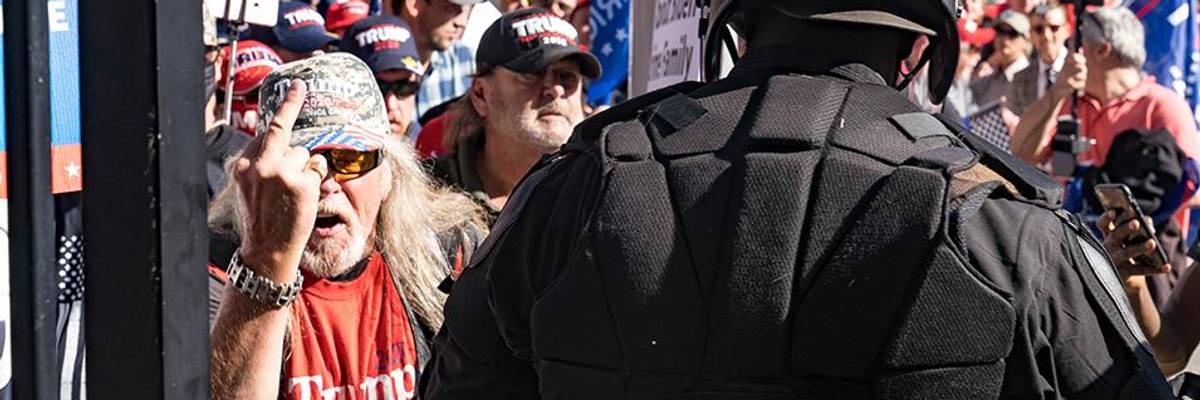
Police officers stand between protesters and counter-protesters after blocking off an intersection as supporters of Donald Trump host a 'Stop the Steal' protest outside of the Georgia State Capital building on November 21, 2020 in Atlanta, Georgia. Georgia finished the hand recount of ballots which confirmed President-elect Joe Biden's win in the state. (Photo by Megan Varner/Getty Images)
There are moments in the history of any democracy when political forces converge to weaken democratic institutions and inflict deep wounds on the acceptance of democratic norms. We are living through such a period now.
As a participant and observer of the American democratic experiment, I know I am among many who have experienced the lead up and aftermath of the election as unnerving. Trump's pre-election attacks on mail voting, his repeated refusal to say he would leave even if the election went against him, and his remark that the racist and violent Proud Boys should "stand by" led me to join tens of thousands of people who organized against what appeared as a potential coup attempt. Coalitions such as Protect the Results and Choose Democracy were formed along with local mobilizations across the country, including Washington State. Never could I have imagined becoming involved in such an endeavor.
The alarm was warranted. For sixteen days following Biden's electoral victory, Trump and his allies used every means possible to overturn the election results. Now that their efforts have apparently failed, I turn toward the long-term consequences.
Fantastical claims of victory, fraud and conspiracy have raced through social media and right-wing news sites. The myth of a stolen election quickly took hold resulting in 77 % of Trump backers saying Biden's win was fraudulent. "Stop the Steal" demonstrations proliferated. Trump continues to refuse to concede.
We should have expected no less from Trump. But what about Republican Party leaders who with few exceptions and even now have been actively or passively complicit in Trump's desperate maneuvers and his ongoing refusal to admit defeat?
A careful reading of history demonstrates that democratic institutions cannot survive without a vibrant democratic culture. The legitimacy of elections is one of the foundations of such a culture. If people are led to believe an election was stolen, the newly elected president is gravely weakened. I surmise this is the Republican game plan. If so, it is a dangerous game that throws democracy's foundational institution into crisis.
We should be extremely concerned about the damage the refusal to concede inflicts on democratic culture. Without electoral legitimacy, opponents are turned into enemies and the civility needed for debate informed by a common commitment to facts evaporates. I fear that Trump's base, feeling victimized and resentful, will likely become more involved in conspiracy theories like QAnon. Racist and xenophobic narratives of demographic replacement and subordination will become even more persuasive. Phantasms of Antifa invasions and black-on-white violence, and leftist takeover become more prominent. Not least, people who feel victimized by stolen elections are more likely to support or adopt undemocratic means for advancing their political agendas. Far-right groups prone to a punitive mindset, armed display, and violence have already demonstrated their strength.
Democracy is a work in progress. Throughout American history, social movements opposed to injustice and for inclusion and equality have been democratic struggles. They have always encountered fierce resistance. Elections are an essential site for such struggles and therefore must be protected against any attempt to suppress the vote or undermine electoral legitimacy.
On November 7th, when the Biden-Harris victory became certain, an enormous democratic energy was released. The nation's most authoritarian leader had been defeated by democratic means. The upsurge in democratic spirit is heartening and will contribute to a renewal of collective will to confront the Covid pandemic and its economic consequences. It will also galvanize support for racial justice and electoral reforms.
One lesson I have learned from a lifetime of teaching and study, strongly reinforced by our recent experience, is that nothing about democracy is guaranteed. If Republican leadership continues to fail in its obligation to protect democracy, the judgment of history will fall on its shoulders.
Dear Common Dreams reader, It’s been nearly 30 years since I co-founded Common Dreams with my late wife, Lina Newhouser. We had the radical notion that journalism should serve the public good, not corporate profits. It was clear to us from the outset what it would take to build such a project. No paid advertisements. No corporate sponsors. No millionaire publisher telling us what to think or do. Many people said we wouldn't last a year, but we proved those doubters wrong. Together with a tremendous team of journalists and dedicated staff, we built an independent media outlet free from the constraints of profits and corporate control. Our mission has always been simple: To inform. To inspire. To ignite change for the common good. Building Common Dreams was not easy. Our survival was never guaranteed. When you take on the most powerful forces—Wall Street greed, fossil fuel industry destruction, Big Tech lobbyists, and uber-rich oligarchs who have spent billions upon billions rigging the economy and democracy in their favor—the only bulwark you have is supporters who believe in your work. But here’s the urgent message from me today. It's never been this bad out there. And it's never been this hard to keep us going. At the very moment Common Dreams is most needed, the threats we face are intensifying. We need your support now more than ever. We don't accept corporate advertising and never will. We don't have a paywall because we don't think people should be blocked from critical news based on their ability to pay. Everything we do is funded by the donations of readers like you. When everyone does the little they can afford, we are strong. But if that support retreats or dries up, so do we. Will you donate now to make sure Common Dreams not only survives but thrives? —Craig Brown, Co-founder |
There are moments in the history of any democracy when political forces converge to weaken democratic institutions and inflict deep wounds on the acceptance of democratic norms. We are living through such a period now.
As a participant and observer of the American democratic experiment, I know I am among many who have experienced the lead up and aftermath of the election as unnerving. Trump's pre-election attacks on mail voting, his repeated refusal to say he would leave even if the election went against him, and his remark that the racist and violent Proud Boys should "stand by" led me to join tens of thousands of people who organized against what appeared as a potential coup attempt. Coalitions such as Protect the Results and Choose Democracy were formed along with local mobilizations across the country, including Washington State. Never could I have imagined becoming involved in such an endeavor.
The alarm was warranted. For sixteen days following Biden's electoral victory, Trump and his allies used every means possible to overturn the election results. Now that their efforts have apparently failed, I turn toward the long-term consequences.
Fantastical claims of victory, fraud and conspiracy have raced through social media and right-wing news sites. The myth of a stolen election quickly took hold resulting in 77 % of Trump backers saying Biden's win was fraudulent. "Stop the Steal" demonstrations proliferated. Trump continues to refuse to concede.
We should have expected no less from Trump. But what about Republican Party leaders who with few exceptions and even now have been actively or passively complicit in Trump's desperate maneuvers and his ongoing refusal to admit defeat?
A careful reading of history demonstrates that democratic institutions cannot survive without a vibrant democratic culture. The legitimacy of elections is one of the foundations of such a culture. If people are led to believe an election was stolen, the newly elected president is gravely weakened. I surmise this is the Republican game plan. If so, it is a dangerous game that throws democracy's foundational institution into crisis.
We should be extremely concerned about the damage the refusal to concede inflicts on democratic culture. Without electoral legitimacy, opponents are turned into enemies and the civility needed for debate informed by a common commitment to facts evaporates. I fear that Trump's base, feeling victimized and resentful, will likely become more involved in conspiracy theories like QAnon. Racist and xenophobic narratives of demographic replacement and subordination will become even more persuasive. Phantasms of Antifa invasions and black-on-white violence, and leftist takeover become more prominent. Not least, people who feel victimized by stolen elections are more likely to support or adopt undemocratic means for advancing their political agendas. Far-right groups prone to a punitive mindset, armed display, and violence have already demonstrated their strength.
Democracy is a work in progress. Throughout American history, social movements opposed to injustice and for inclusion and equality have been democratic struggles. They have always encountered fierce resistance. Elections are an essential site for such struggles and therefore must be protected against any attempt to suppress the vote or undermine electoral legitimacy.
On November 7th, when the Biden-Harris victory became certain, an enormous democratic energy was released. The nation's most authoritarian leader had been defeated by democratic means. The upsurge in democratic spirit is heartening and will contribute to a renewal of collective will to confront the Covid pandemic and its economic consequences. It will also galvanize support for racial justice and electoral reforms.
One lesson I have learned from a lifetime of teaching and study, strongly reinforced by our recent experience, is that nothing about democracy is guaranteed. If Republican leadership continues to fail in its obligation to protect democracy, the judgment of history will fall on its shoulders.
There are moments in the history of any democracy when political forces converge to weaken democratic institutions and inflict deep wounds on the acceptance of democratic norms. We are living through such a period now.
As a participant and observer of the American democratic experiment, I know I am among many who have experienced the lead up and aftermath of the election as unnerving. Trump's pre-election attacks on mail voting, his repeated refusal to say he would leave even if the election went against him, and his remark that the racist and violent Proud Boys should "stand by" led me to join tens of thousands of people who organized against what appeared as a potential coup attempt. Coalitions such as Protect the Results and Choose Democracy were formed along with local mobilizations across the country, including Washington State. Never could I have imagined becoming involved in such an endeavor.
The alarm was warranted. For sixteen days following Biden's electoral victory, Trump and his allies used every means possible to overturn the election results. Now that their efforts have apparently failed, I turn toward the long-term consequences.
Fantastical claims of victory, fraud and conspiracy have raced through social media and right-wing news sites. The myth of a stolen election quickly took hold resulting in 77 % of Trump backers saying Biden's win was fraudulent. "Stop the Steal" demonstrations proliferated. Trump continues to refuse to concede.
We should have expected no less from Trump. But what about Republican Party leaders who with few exceptions and even now have been actively or passively complicit in Trump's desperate maneuvers and his ongoing refusal to admit defeat?
A careful reading of history demonstrates that democratic institutions cannot survive without a vibrant democratic culture. The legitimacy of elections is one of the foundations of such a culture. If people are led to believe an election was stolen, the newly elected president is gravely weakened. I surmise this is the Republican game plan. If so, it is a dangerous game that throws democracy's foundational institution into crisis.
We should be extremely concerned about the damage the refusal to concede inflicts on democratic culture. Without electoral legitimacy, opponents are turned into enemies and the civility needed for debate informed by a common commitment to facts evaporates. I fear that Trump's base, feeling victimized and resentful, will likely become more involved in conspiracy theories like QAnon. Racist and xenophobic narratives of demographic replacement and subordination will become even more persuasive. Phantasms of Antifa invasions and black-on-white violence, and leftist takeover become more prominent. Not least, people who feel victimized by stolen elections are more likely to support or adopt undemocratic means for advancing their political agendas. Far-right groups prone to a punitive mindset, armed display, and violence have already demonstrated their strength.
Democracy is a work in progress. Throughout American history, social movements opposed to injustice and for inclusion and equality have been democratic struggles. They have always encountered fierce resistance. Elections are an essential site for such struggles and therefore must be protected against any attempt to suppress the vote or undermine electoral legitimacy.
On November 7th, when the Biden-Harris victory became certain, an enormous democratic energy was released. The nation's most authoritarian leader had been defeated by democratic means. The upsurge in democratic spirit is heartening and will contribute to a renewal of collective will to confront the Covid pandemic and its economic consequences. It will also galvanize support for racial justice and electoral reforms.
One lesson I have learned from a lifetime of teaching and study, strongly reinforced by our recent experience, is that nothing about democracy is guaranteed. If Republican leadership continues to fail in its obligation to protect democracy, the judgment of history will fall on its shoulders.