

SUBSCRIBE TO OUR FREE NEWSLETTER
Daily news & progressive opinion—funded by the people, not the corporations—delivered straight to your inbox.
5
#000000
#FFFFFF
To donate by check, phone, or other method, see our More Ways to Give page.
Daily news & progressive opinion—funded by the people, not the corporations—delivered straight to your inbox.
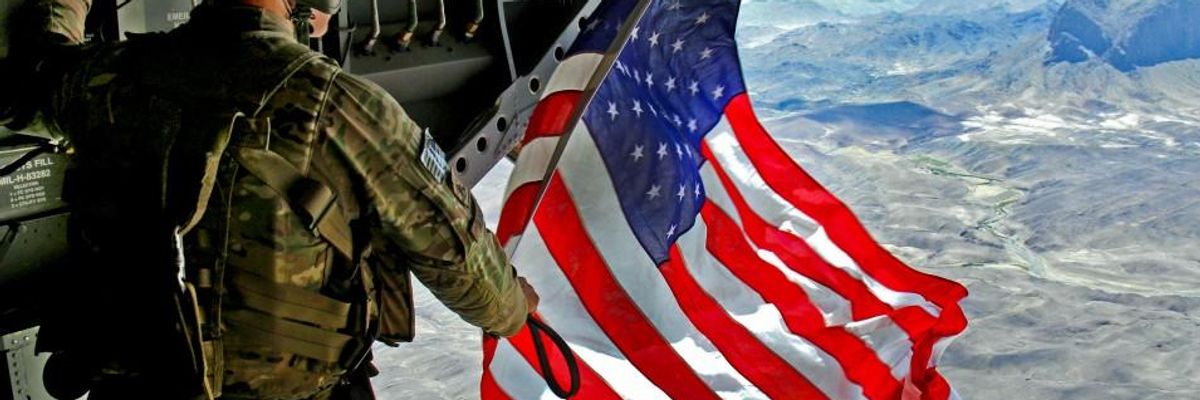
Beware of such ending-the-war promises during election season--unfortunately they are somewhat of an election staple, as history shows. (Photo: Program Executive Office Soldier/Flickr/cc)
In a recent tweet, President Trump claimed that all troops in Afghanistan would be home by Christmas. And Senator Rand Paul (R-Ky.), a staunch supporter of ending endless wars, quickly rushed to support the president, saying he "just spoke with at [sic] @realDonaldTrump. He sounds great and wants libertarians and everyone across the country to know he is ending the war in Afghanistan!"
Beware of such ending-the-war promises during election season -- unfortunately they are somewhat of an election staple, as history shows.
In 1916, Woodrow Wilson was re-elected on the slogan that "he kept us out of war," only to enter World War I a year later. While running for an unprecedented third term in October 1940, Franklin Delano Roosevelt promised, "your boys are not going to be sent into any foreign wars," thought he could not have anticipated the attack on Pearl Harbor, which made entering the war a fight for national defense.
A month before the 1964 election in which he beat Sen. Barry Goldwater in a landslide, President Lyndon B. Johnson pulled at the heartstrings of the American people by stating, "We are not about to send American boys 9 or 10 thousand miles away from home to do what Asian boys ought to be doing for themselves." In reality, Johnson not only sent combat troops to Vietnam, but he also escalated the war on multiple occasions, which contributed to the reason he did not seek re-election in 1968.
Trump is not unlike his predecessors, making claims he most likely knows he cannot keep.
Of course hindsight is 20/20, but perhaps the most egregious example is when George W. Bush said a month before his victory against Vice President Al Gore in 2000, "if we don't stop extending our troops all around the world in nation-building missions, then we're going to have a serious problem coming down the road. And I'm going to prevent that." While there was broad popular consensus that the United States needed a powerful response in the wake of 9/11, the mission to root out and destroy those responsible -- i.e. al-Qaida -- did indeed turn into more intervention and nation building in both Afghanistan and Iraq and is still ongoing nearly 19 years later.
All of these promises were made during election seasons when tensions were high, as they are now. Promises were made in the flush of victory too. During the 2008 presidential campaign, then-SenatorBarack Obama pledged to fight and end the war in Afghanistan for good, but he only increased the number of troops there in his first term. After winning his second term, in January 2013 he declared that "by the end of next year, America's war in Afghanistan will be over." Again, he increased troop numbers by 2016, and the war is ongoing.
In a way, Trump is not unlike his predecessors, making claims he most likely knows he cannot keep. But giving credit where credit is due, Trump has been fairly consistent, though not perfect, in his messaging on wanting to end the endless war.
During his first round on the campaign trail, he promised to remove U.S. forces from Afghanistan, though he increased the U.S. troop presence in 2017. The reasoning for that setback was that Trump feared creating a "vacuum that terrorists, including ISIS and al Qaeda, would instantly fill, just as happened before September 11th." However, he can be credited with pursuing previously doomed peace talks with the Taliban and even reaching an agreement in February 2020. And in July 2020, U.S. troop levels in the country fell to 8,600 from an estimated 12,000 earlier in the year.
It is clear that Trump does not want troops on the ground in Afghanistan any longer regardless of what his military advisers think is best for the region. But will he fall into the same trap Obama did, and never actually deliver? And do we have what it takes to hold his feet to the fire?
Back in 2015, Dominic Tierney, professor of political science at Swarthmore College, wrote "it seems as if Americans have signed onto a pact of forgetting: a collective effort to expunge all memory of the war in Afghanistan." And that was five years ago.
Tierney continued, "Amnesia can be an effective coping strategy. Nietzsche said it was useful 'to close the doors and windows of consciousness for a time.'" People are no longer waiting with bated breath for all the troops to come home. And that is the ultimate danger of false promises. After consistently facing disappointment, the public no longer rallies behind something they have all but accepted will never come to fruition.
A side effect of being fed too many wishes like the "troops will be home by Christmas" or "we are ending the war in Afghanistan NOW" is trust erosion. The public sees right through the facade of large lofty claims. And the only way to regain its confidence is to deliver real results. President Trump seems like he wants to be the hero of this forever story. But only time will tell when promises prove to be hollow.
Dear Common Dreams reader, It’s been nearly 30 years since I co-founded Common Dreams with my late wife, Lina Newhouser. We had the radical notion that journalism should serve the public good, not corporate profits. It was clear to us from the outset what it would take to build such a project. No paid advertisements. No corporate sponsors. No millionaire publisher telling us what to think or do. Many people said we wouldn't last a year, but we proved those doubters wrong. Together with a tremendous team of journalists and dedicated staff, we built an independent media outlet free from the constraints of profits and corporate control. Our mission has always been simple: To inform. To inspire. To ignite change for the common good. Building Common Dreams was not easy. Our survival was never guaranteed. When you take on the most powerful forces—Wall Street greed, fossil fuel industry destruction, Big Tech lobbyists, and uber-rich oligarchs who have spent billions upon billions rigging the economy and democracy in their favor—the only bulwark you have is supporters who believe in your work. But here’s the urgent message from me today. It's never been this bad out there. And it's never been this hard to keep us going. At the very moment Common Dreams is most needed, the threats we face are intensifying. We need your support now more than ever. We don't accept corporate advertising and never will. We don't have a paywall because we don't think people should be blocked from critical news based on their ability to pay. Everything we do is funded by the donations of readers like you. When everyone does the little they can afford, we are strong. But if that support retreats or dries up, so do we. Will you donate now to make sure Common Dreams not only survives but thrives? —Craig Brown, Co-founder |
In a recent tweet, President Trump claimed that all troops in Afghanistan would be home by Christmas. And Senator Rand Paul (R-Ky.), a staunch supporter of ending endless wars, quickly rushed to support the president, saying he "just spoke with at [sic] @realDonaldTrump. He sounds great and wants libertarians and everyone across the country to know he is ending the war in Afghanistan!"
Beware of such ending-the-war promises during election season -- unfortunately they are somewhat of an election staple, as history shows.
In 1916, Woodrow Wilson was re-elected on the slogan that "he kept us out of war," only to enter World War I a year later. While running for an unprecedented third term in October 1940, Franklin Delano Roosevelt promised, "your boys are not going to be sent into any foreign wars," thought he could not have anticipated the attack on Pearl Harbor, which made entering the war a fight for national defense.
A month before the 1964 election in which he beat Sen. Barry Goldwater in a landslide, President Lyndon B. Johnson pulled at the heartstrings of the American people by stating, "We are not about to send American boys 9 or 10 thousand miles away from home to do what Asian boys ought to be doing for themselves." In reality, Johnson not only sent combat troops to Vietnam, but he also escalated the war on multiple occasions, which contributed to the reason he did not seek re-election in 1968.
Trump is not unlike his predecessors, making claims he most likely knows he cannot keep.
Of course hindsight is 20/20, but perhaps the most egregious example is when George W. Bush said a month before his victory against Vice President Al Gore in 2000, "if we don't stop extending our troops all around the world in nation-building missions, then we're going to have a serious problem coming down the road. And I'm going to prevent that." While there was broad popular consensus that the United States needed a powerful response in the wake of 9/11, the mission to root out and destroy those responsible -- i.e. al-Qaida -- did indeed turn into more intervention and nation building in both Afghanistan and Iraq and is still ongoing nearly 19 years later.
All of these promises were made during election seasons when tensions were high, as they are now. Promises were made in the flush of victory too. During the 2008 presidential campaign, then-SenatorBarack Obama pledged to fight and end the war in Afghanistan for good, but he only increased the number of troops there in his first term. After winning his second term, in January 2013 he declared that "by the end of next year, America's war in Afghanistan will be over." Again, he increased troop numbers by 2016, and the war is ongoing.
In a way, Trump is not unlike his predecessors, making claims he most likely knows he cannot keep. But giving credit where credit is due, Trump has been fairly consistent, though not perfect, in his messaging on wanting to end the endless war.
During his first round on the campaign trail, he promised to remove U.S. forces from Afghanistan, though he increased the U.S. troop presence in 2017. The reasoning for that setback was that Trump feared creating a "vacuum that terrorists, including ISIS and al Qaeda, would instantly fill, just as happened before September 11th." However, he can be credited with pursuing previously doomed peace talks with the Taliban and even reaching an agreement in February 2020. And in July 2020, U.S. troop levels in the country fell to 8,600 from an estimated 12,000 earlier in the year.
It is clear that Trump does not want troops on the ground in Afghanistan any longer regardless of what his military advisers think is best for the region. But will he fall into the same trap Obama did, and never actually deliver? And do we have what it takes to hold his feet to the fire?
Back in 2015, Dominic Tierney, professor of political science at Swarthmore College, wrote "it seems as if Americans have signed onto a pact of forgetting: a collective effort to expunge all memory of the war in Afghanistan." And that was five years ago.
Tierney continued, "Amnesia can be an effective coping strategy. Nietzsche said it was useful 'to close the doors and windows of consciousness for a time.'" People are no longer waiting with bated breath for all the troops to come home. And that is the ultimate danger of false promises. After consistently facing disappointment, the public no longer rallies behind something they have all but accepted will never come to fruition.
A side effect of being fed too many wishes like the "troops will be home by Christmas" or "we are ending the war in Afghanistan NOW" is trust erosion. The public sees right through the facade of large lofty claims. And the only way to regain its confidence is to deliver real results. President Trump seems like he wants to be the hero of this forever story. But only time will tell when promises prove to be hollow.
In a recent tweet, President Trump claimed that all troops in Afghanistan would be home by Christmas. And Senator Rand Paul (R-Ky.), a staunch supporter of ending endless wars, quickly rushed to support the president, saying he "just spoke with at [sic] @realDonaldTrump. He sounds great and wants libertarians and everyone across the country to know he is ending the war in Afghanistan!"
Beware of such ending-the-war promises during election season -- unfortunately they are somewhat of an election staple, as history shows.
In 1916, Woodrow Wilson was re-elected on the slogan that "he kept us out of war," only to enter World War I a year later. While running for an unprecedented third term in October 1940, Franklin Delano Roosevelt promised, "your boys are not going to be sent into any foreign wars," thought he could not have anticipated the attack on Pearl Harbor, which made entering the war a fight for national defense.
A month before the 1964 election in which he beat Sen. Barry Goldwater in a landslide, President Lyndon B. Johnson pulled at the heartstrings of the American people by stating, "We are not about to send American boys 9 or 10 thousand miles away from home to do what Asian boys ought to be doing for themselves." In reality, Johnson not only sent combat troops to Vietnam, but he also escalated the war on multiple occasions, which contributed to the reason he did not seek re-election in 1968.
Trump is not unlike his predecessors, making claims he most likely knows he cannot keep.
Of course hindsight is 20/20, but perhaps the most egregious example is when George W. Bush said a month before his victory against Vice President Al Gore in 2000, "if we don't stop extending our troops all around the world in nation-building missions, then we're going to have a serious problem coming down the road. And I'm going to prevent that." While there was broad popular consensus that the United States needed a powerful response in the wake of 9/11, the mission to root out and destroy those responsible -- i.e. al-Qaida -- did indeed turn into more intervention and nation building in both Afghanistan and Iraq and is still ongoing nearly 19 years later.
All of these promises were made during election seasons when tensions were high, as they are now. Promises were made in the flush of victory too. During the 2008 presidential campaign, then-SenatorBarack Obama pledged to fight and end the war in Afghanistan for good, but he only increased the number of troops there in his first term. After winning his second term, in January 2013 he declared that "by the end of next year, America's war in Afghanistan will be over." Again, he increased troop numbers by 2016, and the war is ongoing.
In a way, Trump is not unlike his predecessors, making claims he most likely knows he cannot keep. But giving credit where credit is due, Trump has been fairly consistent, though not perfect, in his messaging on wanting to end the endless war.
During his first round on the campaign trail, he promised to remove U.S. forces from Afghanistan, though he increased the U.S. troop presence in 2017. The reasoning for that setback was that Trump feared creating a "vacuum that terrorists, including ISIS and al Qaeda, would instantly fill, just as happened before September 11th." However, he can be credited with pursuing previously doomed peace talks with the Taliban and even reaching an agreement in February 2020. And in July 2020, U.S. troop levels in the country fell to 8,600 from an estimated 12,000 earlier in the year.
It is clear that Trump does not want troops on the ground in Afghanistan any longer regardless of what his military advisers think is best for the region. But will he fall into the same trap Obama did, and never actually deliver? And do we have what it takes to hold his feet to the fire?
Back in 2015, Dominic Tierney, professor of political science at Swarthmore College, wrote "it seems as if Americans have signed onto a pact of forgetting: a collective effort to expunge all memory of the war in Afghanistan." And that was five years ago.
Tierney continued, "Amnesia can be an effective coping strategy. Nietzsche said it was useful 'to close the doors and windows of consciousness for a time.'" People are no longer waiting with bated breath for all the troops to come home. And that is the ultimate danger of false promises. After consistently facing disappointment, the public no longer rallies behind something they have all but accepted will never come to fruition.
A side effect of being fed too many wishes like the "troops will be home by Christmas" or "we are ending the war in Afghanistan NOW" is trust erosion. The public sees right through the facade of large lofty claims. And the only way to regain its confidence is to deliver real results. President Trump seems like he wants to be the hero of this forever story. But only time will tell when promises prove to be hollow.

