SUBSCRIBE TO OUR FREE NEWSLETTER
Daily news & progressive opinion—funded by the people, not the corporations—delivered straight to your inbox.
5
#000000
#FFFFFF
To donate by check, phone, or other method, see our More Ways to Give page.
Daily news & progressive opinion—funded by the people, not the corporations—delivered straight to your inbox.
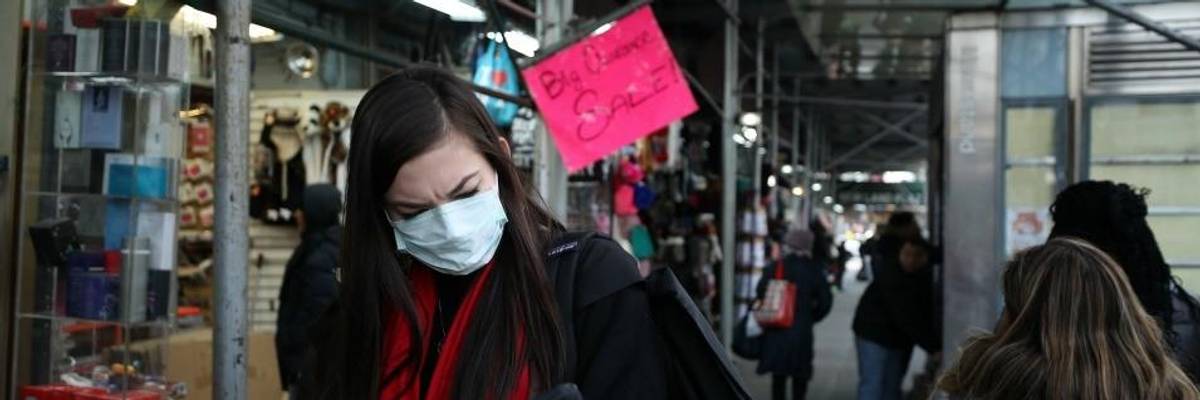
We really need to start thinking of a much richer set of economic tools that can solve society's problems in coming years. (Photo: Tayfun Coskun/Anadolu Agency via Getty Images)
The direct cost that Covid-19 inflicts on human health is obviously its most important effect on society. But this direct cost can be worsened by flawed economic and policy structures. And the indirect damage the disease causes through economic ripple effects could be large, so policymakers should do everything they can to minimize them.
Past decisions that have weakened our economic policy infrastructure will hamper our response to Covid-19; this is already baked in the cake. But there are some short-run ameliorative actions we take that might help, and, there are long-run policy changes that will aid our response to future epidemics.
In technical economic terms, Covid-19 combines potential supply shocks with sector-specific demand shocks. Basically, supply shocks hamper our ability to produce goods and services, and demand shocks are sharp cutbacks in spending from households, businesses or governments. I provide a list for policy makers of what could/should be considered to deal with some of these below.
The supply shocks come from disrupted global value chains, as, for example, Chinese production of inputs used by U.S. manufacturing and construction firms are not delivered on time because Chinese factories have temporarily closed. In countries where schools are shut down for long periods of time, a shock to labor supply can occur as working parents have to stay home to care for kids.
The potential sector-specific demand shock is to businesses where consumption is largely social--done with other people around. Think bars, restaurants, grocery stores, and malls. As people avoid social contact to minimize disease transmission, this leads to less activity in these sectors.
These effects mean it will be hard indeed for policymakers to spare the economy any pain from this.
There's very little that can be done about the supply-side shocks--particularly in the short-run. Demand-side shocks are generally easier to address with policy (in theory--policymakers still often fumble the ball in this regard), but the specific nature of the demand shocks associated with Covid-19 make them slightly harder to address. Simply giving households more money won't boost consumption much in the sectors likely to be affected--the pullback in consumption is not driven by income constraints, but due to concerns over catching the illness.
This means that while traditional stimulus can be useful in keeping this sector-specific demand shock from spilling over to the economy more widely, it likely will not be able to completely neutralize the effects of this sector-specific shock.
What are the types of things policymakers should be thinking about as they wrestle with the economic effects of Covid-19 and (hopefully) think about the next epidemic? In the long-run, the list is obvious.
But all of these options will take a long time to phase in and will likely miss the current Covid-19 epidemic. Is there anything in the short-run we could do to blunt the potential economic pain of Covid-19?
Perhaps notably absent from this list is anything about the Federal Reserve, even as the Fed's response--culminating in today's decision to cut interest rates by half a percent--occupied much of the economic commentary surrounding the response to Covid-19. The Federal Reserve is a hugely important economic institution, and their decisions matter a lot for many reasons--but they're largely a sideshow in the response to Covid-19. For one thing, their main instrument to boost demand (cutting interest rates) operates with a lag that is long enough to likely miss much of the epidemic's duration. Further, unlike fiscal policy responses, the Fed's tool really cannot be tailored or targeted in any way to alleviate particular distress. If a knock-on effect of the economic damage done by Covid-19 includes distress in the financial sector, then the Fed can usefully provide liquidity and other support to banks (in exchange for banks' forbearance in collecting debts from affected businesses). But, in the first round of response it seems like focusing on what the Fed will do is a bit of a distraction. Economic policy commentary has become far too Fed-centric over the past decade. We really need to start thinking of a much richer set of economic tools that can solve society's problems in coming years.
Dear Common Dreams reader, It’s been nearly 30 years since I co-founded Common Dreams with my late wife, Lina Newhouser. We had the radical notion that journalism should serve the public good, not corporate profits. It was clear to us from the outset what it would take to build such a project. No paid advertisements. No corporate sponsors. No millionaire publisher telling us what to think or do. Many people said we wouldn't last a year, but we proved those doubters wrong. Together with a tremendous team of journalists and dedicated staff, we built an independent media outlet free from the constraints of profits and corporate control. Our mission has always been simple: To inform. To inspire. To ignite change for the common good. Building Common Dreams was not easy. Our survival was never guaranteed. When you take on the most powerful forces—Wall Street greed, fossil fuel industry destruction, Big Tech lobbyists, and uber-rich oligarchs who have spent billions upon billions rigging the economy and democracy in their favor—the only bulwark you have is supporters who believe in your work. But here’s the urgent message from me today. It's never been this bad out there. And it's never been this hard to keep us going. At the very moment Common Dreams is most needed, the threats we face are intensifying. We need your support now more than ever. We don't accept corporate advertising and never will. We don't have a paywall because we don't think people should be blocked from critical news based on their ability to pay. Everything we do is funded by the donations of readers like you. When everyone does the little they can afford, we are strong. But if that support retreats or dries up, so do we. Will you donate now to make sure Common Dreams not only survives but thrives? —Craig Brown, Co-founder |
The direct cost that Covid-19 inflicts on human health is obviously its most important effect on society. But this direct cost can be worsened by flawed economic and policy structures. And the indirect damage the disease causes through economic ripple effects could be large, so policymakers should do everything they can to minimize them.
Past decisions that have weakened our economic policy infrastructure will hamper our response to Covid-19; this is already baked in the cake. But there are some short-run ameliorative actions we take that might help, and, there are long-run policy changes that will aid our response to future epidemics.
In technical economic terms, Covid-19 combines potential supply shocks with sector-specific demand shocks. Basically, supply shocks hamper our ability to produce goods and services, and demand shocks are sharp cutbacks in spending from households, businesses or governments. I provide a list for policy makers of what could/should be considered to deal with some of these below.
The supply shocks come from disrupted global value chains, as, for example, Chinese production of inputs used by U.S. manufacturing and construction firms are not delivered on time because Chinese factories have temporarily closed. In countries where schools are shut down for long periods of time, a shock to labor supply can occur as working parents have to stay home to care for kids.
The potential sector-specific demand shock is to businesses where consumption is largely social--done with other people around. Think bars, restaurants, grocery stores, and malls. As people avoid social contact to minimize disease transmission, this leads to less activity in these sectors.
These effects mean it will be hard indeed for policymakers to spare the economy any pain from this.
There's very little that can be done about the supply-side shocks--particularly in the short-run. Demand-side shocks are generally easier to address with policy (in theory--policymakers still often fumble the ball in this regard), but the specific nature of the demand shocks associated with Covid-19 make them slightly harder to address. Simply giving households more money won't boost consumption much in the sectors likely to be affected--the pullback in consumption is not driven by income constraints, but due to concerns over catching the illness.
This means that while traditional stimulus can be useful in keeping this sector-specific demand shock from spilling over to the economy more widely, it likely will not be able to completely neutralize the effects of this sector-specific shock.
What are the types of things policymakers should be thinking about as they wrestle with the economic effects of Covid-19 and (hopefully) think about the next epidemic? In the long-run, the list is obvious.
But all of these options will take a long time to phase in and will likely miss the current Covid-19 epidemic. Is there anything in the short-run we could do to blunt the potential economic pain of Covid-19?
Perhaps notably absent from this list is anything about the Federal Reserve, even as the Fed's response--culminating in today's decision to cut interest rates by half a percent--occupied much of the economic commentary surrounding the response to Covid-19. The Federal Reserve is a hugely important economic institution, and their decisions matter a lot for many reasons--but they're largely a sideshow in the response to Covid-19. For one thing, their main instrument to boost demand (cutting interest rates) operates with a lag that is long enough to likely miss much of the epidemic's duration. Further, unlike fiscal policy responses, the Fed's tool really cannot be tailored or targeted in any way to alleviate particular distress. If a knock-on effect of the economic damage done by Covid-19 includes distress in the financial sector, then the Fed can usefully provide liquidity and other support to banks (in exchange for banks' forbearance in collecting debts from affected businesses). But, in the first round of response it seems like focusing on what the Fed will do is a bit of a distraction. Economic policy commentary has become far too Fed-centric over the past decade. We really need to start thinking of a much richer set of economic tools that can solve society's problems in coming years.
The direct cost that Covid-19 inflicts on human health is obviously its most important effect on society. But this direct cost can be worsened by flawed economic and policy structures. And the indirect damage the disease causes through economic ripple effects could be large, so policymakers should do everything they can to minimize them.
Past decisions that have weakened our economic policy infrastructure will hamper our response to Covid-19; this is already baked in the cake. But there are some short-run ameliorative actions we take that might help, and, there are long-run policy changes that will aid our response to future epidemics.
In technical economic terms, Covid-19 combines potential supply shocks with sector-specific demand shocks. Basically, supply shocks hamper our ability to produce goods and services, and demand shocks are sharp cutbacks in spending from households, businesses or governments. I provide a list for policy makers of what could/should be considered to deal with some of these below.
The supply shocks come from disrupted global value chains, as, for example, Chinese production of inputs used by U.S. manufacturing and construction firms are not delivered on time because Chinese factories have temporarily closed. In countries where schools are shut down for long periods of time, a shock to labor supply can occur as working parents have to stay home to care for kids.
The potential sector-specific demand shock is to businesses where consumption is largely social--done with other people around. Think bars, restaurants, grocery stores, and malls. As people avoid social contact to minimize disease transmission, this leads to less activity in these sectors.
These effects mean it will be hard indeed for policymakers to spare the economy any pain from this.
There's very little that can be done about the supply-side shocks--particularly in the short-run. Demand-side shocks are generally easier to address with policy (in theory--policymakers still often fumble the ball in this regard), but the specific nature of the demand shocks associated with Covid-19 make them slightly harder to address. Simply giving households more money won't boost consumption much in the sectors likely to be affected--the pullback in consumption is not driven by income constraints, but due to concerns over catching the illness.
This means that while traditional stimulus can be useful in keeping this sector-specific demand shock from spilling over to the economy more widely, it likely will not be able to completely neutralize the effects of this sector-specific shock.
What are the types of things policymakers should be thinking about as they wrestle with the economic effects of Covid-19 and (hopefully) think about the next epidemic? In the long-run, the list is obvious.
But all of these options will take a long time to phase in and will likely miss the current Covid-19 epidemic. Is there anything in the short-run we could do to blunt the potential economic pain of Covid-19?
Perhaps notably absent from this list is anything about the Federal Reserve, even as the Fed's response--culminating in today's decision to cut interest rates by half a percent--occupied much of the economic commentary surrounding the response to Covid-19. The Federal Reserve is a hugely important economic institution, and their decisions matter a lot for many reasons--but they're largely a sideshow in the response to Covid-19. For one thing, their main instrument to boost demand (cutting interest rates) operates with a lag that is long enough to likely miss much of the epidemic's duration. Further, unlike fiscal policy responses, the Fed's tool really cannot be tailored or targeted in any way to alleviate particular distress. If a knock-on effect of the economic damage done by Covid-19 includes distress in the financial sector, then the Fed can usefully provide liquidity and other support to banks (in exchange for banks' forbearance in collecting debts from affected businesses). But, in the first round of response it seems like focusing on what the Fed will do is a bit of a distraction. Economic policy commentary has become far too Fed-centric over the past decade. We really need to start thinking of a much richer set of economic tools that can solve society's problems in coming years.