SUBSCRIBE TO OUR FREE NEWSLETTER
Daily news & progressive opinion—funded by the people, not the corporations—delivered straight to your inbox.
5
#000000
#FFFFFF
To donate by check, phone, or other method, see our More Ways to Give page.
Daily news & progressive opinion—funded by the people, not the corporations—delivered straight to your inbox.
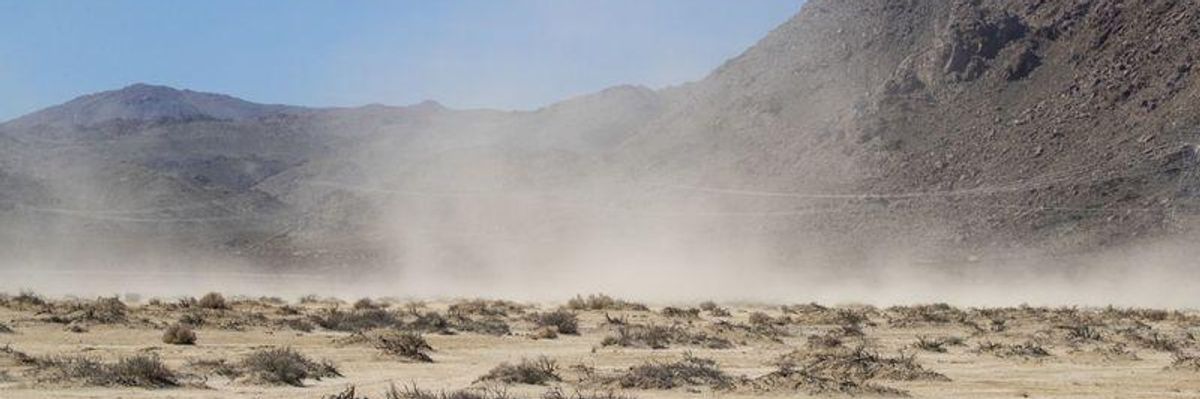
A dust storm moves across Lucerne Valley, Calif., on Feb. 25. (Photo: Los Angeles Times)
The extreme weather of the last year has been so terrifying, and so very extreme, that it is tempting to look at the string of disasters around the world and think: Climate change is here. Certainly that's what Jerry Brown meant when he described the wildfires ravaging California in the fall as "the new abnormal."
It will only get more so. We have already exited the environmental conditions that allowed the human animal to evolve in the first place, in an unplanned bet on just what we can endure. By the end of the century, if warming continues unabated, wildfires could burn 64 times as much land in California as they did last year, which was more than a million acres.
But climate change isn't binary, and this is one of the five major misapprehensions even engaged liberals have about warming. It's not a question of whether it will happen or not, or whether it will be like the 2018 wildfire season or 64 times worse. Climate change is a function that will get worse over time as long as we continue to emit greenhouse gas.
No matter how bad it gets, it will always be the case that the following decade could bring more suffering -- or less. And believe it or not, the amount will always be up to us. Climate change may seem intimidatingly large, but the responsibility is entirely ours.
If warming continues unabated, by the end of even this century, no life will remain untouched.
But these are just the direct repercussions, and the fifth major misapprehension is that science is even capable of containing and describing the sum total of the assaults. In fact, the indirect effects may be even more profound: on our psychology, our culture, our sense of place in nature and history, our relationship to technology and to capitalism. Not to mention our geopolitics.
The arrival of roughly 2 million Syrians in Europe unleashed a global wave of populism; some experts believe warming will produce a hundred times as many refugees. What will a migration crisis of that scale do to global affairs?
Meanwhile, what will it mean for the way we eat to see "carbon-free" food advertised in the supermarket, or the way we travel and do business to see carbon budgets made central to any new trade deal? As real life becomes more and more apocalyptic, what will become of science fiction?
We have reshaped the world's climate. The question is: How will climate change reshape us?
Dear Common Dreams reader, It’s been nearly 30 years since I co-founded Common Dreams with my late wife, Lina Newhouser. We had the radical notion that journalism should serve the public good, not corporate profits. It was clear to us from the outset what it would take to build such a project. No paid advertisements. No corporate sponsors. No millionaire publisher telling us what to think or do. Many people said we wouldn't last a year, but we proved those doubters wrong. Together with a tremendous team of journalists and dedicated staff, we built an independent media outlet free from the constraints of profits and corporate control. Our mission has always been simple: To inform. To inspire. To ignite change for the common good. Building Common Dreams was not easy. Our survival was never guaranteed. When you take on the most powerful forces—Wall Street greed, fossil fuel industry destruction, Big Tech lobbyists, and uber-rich oligarchs who have spent billions upon billions rigging the economy and democracy in their favor—the only bulwark you have is supporters who believe in your work. But here’s the urgent message from me today. It's never been this bad out there. And it's never been this hard to keep us going. At the very moment Common Dreams is most needed, the threats we face are intensifying. We need your support now more than ever. We don't accept corporate advertising and never will. We don't have a paywall because we don't think people should be blocked from critical news based on their ability to pay. Everything we do is funded by the donations of readers like you. When everyone does the little they can afford, we are strong. But if that support retreats or dries up, so do we. Will you donate now to make sure Common Dreams not only survives but thrives? —Craig Brown, Co-founder |
The extreme weather of the last year has been so terrifying, and so very extreme, that it is tempting to look at the string of disasters around the world and think: Climate change is here. Certainly that's what Jerry Brown meant when he described the wildfires ravaging California in the fall as "the new abnormal."
It will only get more so. We have already exited the environmental conditions that allowed the human animal to evolve in the first place, in an unplanned bet on just what we can endure. By the end of the century, if warming continues unabated, wildfires could burn 64 times as much land in California as they did last year, which was more than a million acres.
But climate change isn't binary, and this is one of the five major misapprehensions even engaged liberals have about warming. It's not a question of whether it will happen or not, or whether it will be like the 2018 wildfire season or 64 times worse. Climate change is a function that will get worse over time as long as we continue to emit greenhouse gas.
No matter how bad it gets, it will always be the case that the following decade could bring more suffering -- or less. And believe it or not, the amount will always be up to us. Climate change may seem intimidatingly large, but the responsibility is entirely ours.
If warming continues unabated, by the end of even this century, no life will remain untouched.
But these are just the direct repercussions, and the fifth major misapprehension is that science is even capable of containing and describing the sum total of the assaults. In fact, the indirect effects may be even more profound: on our psychology, our culture, our sense of place in nature and history, our relationship to technology and to capitalism. Not to mention our geopolitics.
The arrival of roughly 2 million Syrians in Europe unleashed a global wave of populism; some experts believe warming will produce a hundred times as many refugees. What will a migration crisis of that scale do to global affairs?
Meanwhile, what will it mean for the way we eat to see "carbon-free" food advertised in the supermarket, or the way we travel and do business to see carbon budgets made central to any new trade deal? As real life becomes more and more apocalyptic, what will become of science fiction?
We have reshaped the world's climate. The question is: How will climate change reshape us?
The extreme weather of the last year has been so terrifying, and so very extreme, that it is tempting to look at the string of disasters around the world and think: Climate change is here. Certainly that's what Jerry Brown meant when he described the wildfires ravaging California in the fall as "the new abnormal."
It will only get more so. We have already exited the environmental conditions that allowed the human animal to evolve in the first place, in an unplanned bet on just what we can endure. By the end of the century, if warming continues unabated, wildfires could burn 64 times as much land in California as they did last year, which was more than a million acres.
But climate change isn't binary, and this is one of the five major misapprehensions even engaged liberals have about warming. It's not a question of whether it will happen or not, or whether it will be like the 2018 wildfire season or 64 times worse. Climate change is a function that will get worse over time as long as we continue to emit greenhouse gas.
No matter how bad it gets, it will always be the case that the following decade could bring more suffering -- or less. And believe it or not, the amount will always be up to us. Climate change may seem intimidatingly large, but the responsibility is entirely ours.
If warming continues unabated, by the end of even this century, no life will remain untouched.
But these are just the direct repercussions, and the fifth major misapprehension is that science is even capable of containing and describing the sum total of the assaults. In fact, the indirect effects may be even more profound: on our psychology, our culture, our sense of place in nature and history, our relationship to technology and to capitalism. Not to mention our geopolitics.
The arrival of roughly 2 million Syrians in Europe unleashed a global wave of populism; some experts believe warming will produce a hundred times as many refugees. What will a migration crisis of that scale do to global affairs?
Meanwhile, what will it mean for the way we eat to see "carbon-free" food advertised in the supermarket, or the way we travel and do business to see carbon budgets made central to any new trade deal? As real life becomes more and more apocalyptic, what will become of science fiction?
We have reshaped the world's climate. The question is: How will climate change reshape us?