

SUBSCRIBE TO OUR FREE NEWSLETTER
Daily news & progressive opinion—funded by the people, not the corporations—delivered straight to your inbox.
5
#000000
#FFFFFF
To donate by check, phone, or other method, see our More Ways to Give page.
Daily news & progressive opinion—funded by the people, not the corporations—delivered straight to your inbox.
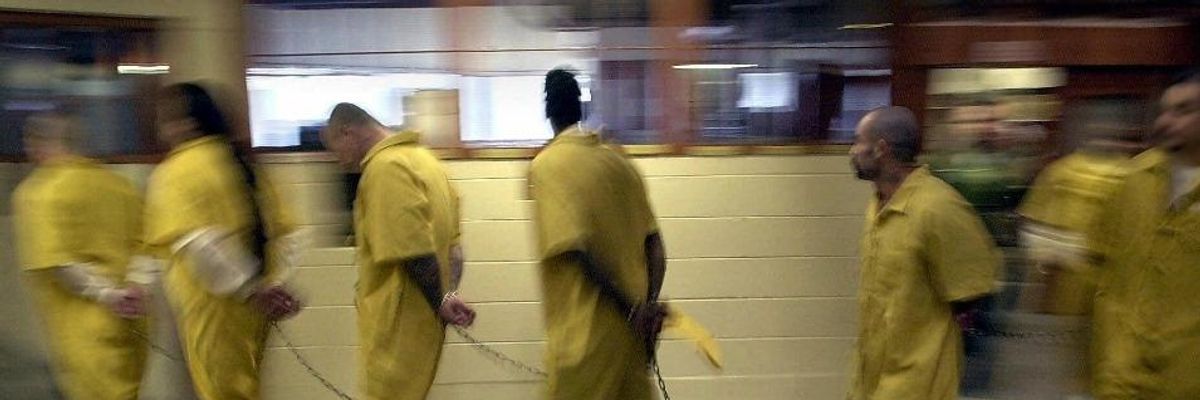
How can people subjected to conditions like these hold jobs, avoid falling into crime, and become productive members of our community?(Photo: AP)
As 2018 drew to a close, Congress passed, and President Trump signed, a historic bill called the First Step Act to begin reforming our broken criminal justice system, reducing sentences for some nonviolent drug offenders and enhancing rehabilitation programs in federal prisons. Some media have described the new legislation, which was enacted with the support of Democrats and many Republicans, as a "sweeping overhaul." Senator Kamala Harris (D-CA) more soberly dubbed it "a compromise of a compromise," adding that there's a great deal more to do. The U.S. has by far the highest incarceration rate of any country in the world, and the vast majority of people in lockup are not in federal prisons. What's more, the law will help only a fraction of the 180,000 people in federal custody, while doing nothing for the nearly two million people in state, county and local penitentiaries.
By pandering to public fears, spreading misinformation, and posturing with macho slogans, "tough-on-crime" politicians have long opposed reforms and blocked efforts to rehabilitate people in prison, making it more likely that they will return to crime after their release.
I should know. I spent much of the past two summers volunteering with the Prison Watch program of American Friends Service Committee in Newark, responding to letters from prisoners across the country, providing them with resources to help end abuses and inhumane conditions.
"Officers locked me in solitary confinement for 10 days handcuffed and shackled to a metal bed. During that time they would extinguish their cigarette butts on my body and flip hot ashes in my face and eyes and place meal trays just out of reach...Another officer told me to shut up or he would kill me and used his boot to kick me in the head..."
Letter after letter described the horrors unfolding in many of our nation's prison cells and isolation units. The Eighth Amendment of our Constitution guarantees that no one shall be subjected to "cruel and unusual punishments." Hundreds of testimonies that I encountered from prisoners suggest that this remains a promise unkept.
The well documented psychological damage wrought by solitary is lifelong and undermines a person's chances of reintegrating back into society.
Numerous studies have shown that prolonged solitary confinement increases the likelihood that people will commit crimes again. The well documented psychological damage wrought by solitary is lifelong and undermines a person's chances of reintegrating back into society.
Prisoners are often thrown into isolation for minor infractions for months and years, for 22 - 24 hours a day. According to a federal report, some 20% of prisoners spend time in solitary confinement. The United Nations and several American medical associations have defined prolonged isolation as torture.
"I've been in the hole for three years and am now so paranoid that i can't be around people. I've tried every treatment, medication possible, no help...," confessed one man.
Another testified: "This term in solitary I have been in a little over four years straight, but overall most of the past 15 years...After doing a substantial amount of time alone, then being released is shocking...It gets really uncomfortable around everyone and everything so much that it usually takes drugs or alcohol to 'feel' comfortable."
How can people subjected to conditions like these hold jobs, avoid falling into crime, and become productive members of our community?
By changing our approach to prisons from punishment to rehabilitation, our crime rate will drop and our neighborhoods will be safer.By changing our approach to prisons from punishment to rehabilitation, our crime rate will drop and our neighborhoods will be safer.
Other countries have found a better way. In Norway, some prisons are places where guards and prisoners are friends, every prisoner has a kitchen, wide green fields, and open space. Built like college dorms, they are places where the worst of the worst stay. Yet only 16 percent return to crime after completing their sentences.
In the US, by contrast, "within five years of release, about three quarters (76.6 percent) of released prisoners were rearrested. Of those prisoners who were rearrested, more than half (56.7 percent) were arrested by the end of the first year," according to the National Institute of Justice.
Opponents of criminal justice reform, including President Trump's newly nominated Attorney General, William P. Barr, claim that longer and harsher sentencing is the best way to combat crime. Most experts have concluded that it isn't. Criminologists from the Vera Institute of Justice issued a report this year called "The Prison Paradox: More Incarceration Will Not Make Us Safer," which concluded that "Increased incarceration has no effect on violent crime and may actually lead to higher crime rates..." Over the last 15 years, "19 states reduced both imprisonment and crime rates..."
The First Step Act would do nothing to stop the widespread misuse of prolonged isolation in our overcrowded federal, state and county prisons. But it could indirectly begin to curb its abuse in federal penitentiaries by shortening long mandatory-minimum sentences for nonviolent drug offenses, enabling more prisoners to benefit from programs that rehabilitate them and make their re-entry into society as law-abiding citizens more successful.
Over 80,000 people are locked up in isolation cells every day in America. Some states, like Maine, Mississippi, Colorado, and Michigan, have taken steps to curb the use of solitary. In my own state of New Jersey, an unprecedented bill that would sharply limit the use of prolonged isolation has been introduced in both houses of the legislature, and will be undergoing hearings in the coming months. Passed two years ago and vetoed by Republican governor Chris Christie, it is likely to become law this year under Democratic governor Phil Murphy.
Only grassroots pressure on our legislators in every state in the nation can bring about real change in our criminal injustice system.
Dear Common Dreams reader, It’s been nearly 30 years since I co-founded Common Dreams with my late wife, Lina Newhouser. We had the radical notion that journalism should serve the public good, not corporate profits. It was clear to us from the outset what it would take to build such a project. No paid advertisements. No corporate sponsors. No millionaire publisher telling us what to think or do. Many people said we wouldn't last a year, but we proved those doubters wrong. Together with a tremendous team of journalists and dedicated staff, we built an independent media outlet free from the constraints of profits and corporate control. Our mission has always been simple: To inform. To inspire. To ignite change for the common good. Building Common Dreams was not easy. Our survival was never guaranteed. When you take on the most powerful forces—Wall Street greed, fossil fuel industry destruction, Big Tech lobbyists, and uber-rich oligarchs who have spent billions upon billions rigging the economy and democracy in their favor—the only bulwark you have is supporters who believe in your work. But here’s the urgent message from me today. It's never been this bad out there. And it's never been this hard to keep us going. At the very moment Common Dreams is most needed, the threats we face are intensifying. We need your support now more than ever. We don't accept corporate advertising and never will. We don't have a paywall because we don't think people should be blocked from critical news based on their ability to pay. Everything we do is funded by the donations of readers like you. When everyone does the little they can afford, we are strong. But if that support retreats or dries up, so do we. Will you donate now to make sure Common Dreams not only survives but thrives? —Craig Brown, Co-founder |
As 2018 drew to a close, Congress passed, and President Trump signed, a historic bill called the First Step Act to begin reforming our broken criminal justice system, reducing sentences for some nonviolent drug offenders and enhancing rehabilitation programs in federal prisons. Some media have described the new legislation, which was enacted with the support of Democrats and many Republicans, as a "sweeping overhaul." Senator Kamala Harris (D-CA) more soberly dubbed it "a compromise of a compromise," adding that there's a great deal more to do. The U.S. has by far the highest incarceration rate of any country in the world, and the vast majority of people in lockup are not in federal prisons. What's more, the law will help only a fraction of the 180,000 people in federal custody, while doing nothing for the nearly two million people in state, county and local penitentiaries.
By pandering to public fears, spreading misinformation, and posturing with macho slogans, "tough-on-crime" politicians have long opposed reforms and blocked efforts to rehabilitate people in prison, making it more likely that they will return to crime after their release.
I should know. I spent much of the past two summers volunteering with the Prison Watch program of American Friends Service Committee in Newark, responding to letters from prisoners across the country, providing them with resources to help end abuses and inhumane conditions.
"Officers locked me in solitary confinement for 10 days handcuffed and shackled to a metal bed. During that time they would extinguish their cigarette butts on my body and flip hot ashes in my face and eyes and place meal trays just out of reach...Another officer told me to shut up or he would kill me and used his boot to kick me in the head..."
Letter after letter described the horrors unfolding in many of our nation's prison cells and isolation units. The Eighth Amendment of our Constitution guarantees that no one shall be subjected to "cruel and unusual punishments." Hundreds of testimonies that I encountered from prisoners suggest that this remains a promise unkept.
The well documented psychological damage wrought by solitary is lifelong and undermines a person's chances of reintegrating back into society.
Numerous studies have shown that prolonged solitary confinement increases the likelihood that people will commit crimes again. The well documented psychological damage wrought by solitary is lifelong and undermines a person's chances of reintegrating back into society.
Prisoners are often thrown into isolation for minor infractions for months and years, for 22 - 24 hours a day. According to a federal report, some 20% of prisoners spend time in solitary confinement. The United Nations and several American medical associations have defined prolonged isolation as torture.
"I've been in the hole for three years and am now so paranoid that i can't be around people. I've tried every treatment, medication possible, no help...," confessed one man.
Another testified: "This term in solitary I have been in a little over four years straight, but overall most of the past 15 years...After doing a substantial amount of time alone, then being released is shocking...It gets really uncomfortable around everyone and everything so much that it usually takes drugs or alcohol to 'feel' comfortable."
How can people subjected to conditions like these hold jobs, avoid falling into crime, and become productive members of our community?
By changing our approach to prisons from punishment to rehabilitation, our crime rate will drop and our neighborhoods will be safer.By changing our approach to prisons from punishment to rehabilitation, our crime rate will drop and our neighborhoods will be safer.
Other countries have found a better way. In Norway, some prisons are places where guards and prisoners are friends, every prisoner has a kitchen, wide green fields, and open space. Built like college dorms, they are places where the worst of the worst stay. Yet only 16 percent return to crime after completing their sentences.
In the US, by contrast, "within five years of release, about three quarters (76.6 percent) of released prisoners were rearrested. Of those prisoners who were rearrested, more than half (56.7 percent) were arrested by the end of the first year," according to the National Institute of Justice.
Opponents of criminal justice reform, including President Trump's newly nominated Attorney General, William P. Barr, claim that longer and harsher sentencing is the best way to combat crime. Most experts have concluded that it isn't. Criminologists from the Vera Institute of Justice issued a report this year called "The Prison Paradox: More Incarceration Will Not Make Us Safer," which concluded that "Increased incarceration has no effect on violent crime and may actually lead to higher crime rates..." Over the last 15 years, "19 states reduced both imprisonment and crime rates..."
The First Step Act would do nothing to stop the widespread misuse of prolonged isolation in our overcrowded federal, state and county prisons. But it could indirectly begin to curb its abuse in federal penitentiaries by shortening long mandatory-minimum sentences for nonviolent drug offenses, enabling more prisoners to benefit from programs that rehabilitate them and make their re-entry into society as law-abiding citizens more successful.
Over 80,000 people are locked up in isolation cells every day in America. Some states, like Maine, Mississippi, Colorado, and Michigan, have taken steps to curb the use of solitary. In my own state of New Jersey, an unprecedented bill that would sharply limit the use of prolonged isolation has been introduced in both houses of the legislature, and will be undergoing hearings in the coming months. Passed two years ago and vetoed by Republican governor Chris Christie, it is likely to become law this year under Democratic governor Phil Murphy.
Only grassroots pressure on our legislators in every state in the nation can bring about real change in our criminal injustice system.
As 2018 drew to a close, Congress passed, and President Trump signed, a historic bill called the First Step Act to begin reforming our broken criminal justice system, reducing sentences for some nonviolent drug offenders and enhancing rehabilitation programs in federal prisons. Some media have described the new legislation, which was enacted with the support of Democrats and many Republicans, as a "sweeping overhaul." Senator Kamala Harris (D-CA) more soberly dubbed it "a compromise of a compromise," adding that there's a great deal more to do. The U.S. has by far the highest incarceration rate of any country in the world, and the vast majority of people in lockup are not in federal prisons. What's more, the law will help only a fraction of the 180,000 people in federal custody, while doing nothing for the nearly two million people in state, county and local penitentiaries.
By pandering to public fears, spreading misinformation, and posturing with macho slogans, "tough-on-crime" politicians have long opposed reforms and blocked efforts to rehabilitate people in prison, making it more likely that they will return to crime after their release.
I should know. I spent much of the past two summers volunteering with the Prison Watch program of American Friends Service Committee in Newark, responding to letters from prisoners across the country, providing them with resources to help end abuses and inhumane conditions.
"Officers locked me in solitary confinement for 10 days handcuffed and shackled to a metal bed. During that time they would extinguish their cigarette butts on my body and flip hot ashes in my face and eyes and place meal trays just out of reach...Another officer told me to shut up or he would kill me and used his boot to kick me in the head..."
Letter after letter described the horrors unfolding in many of our nation's prison cells and isolation units. The Eighth Amendment of our Constitution guarantees that no one shall be subjected to "cruel and unusual punishments." Hundreds of testimonies that I encountered from prisoners suggest that this remains a promise unkept.
The well documented psychological damage wrought by solitary is lifelong and undermines a person's chances of reintegrating back into society.
Numerous studies have shown that prolonged solitary confinement increases the likelihood that people will commit crimes again. The well documented psychological damage wrought by solitary is lifelong and undermines a person's chances of reintegrating back into society.
Prisoners are often thrown into isolation for minor infractions for months and years, for 22 - 24 hours a day. According to a federal report, some 20% of prisoners spend time in solitary confinement. The United Nations and several American medical associations have defined prolonged isolation as torture.
"I've been in the hole for three years and am now so paranoid that i can't be around people. I've tried every treatment, medication possible, no help...," confessed one man.
Another testified: "This term in solitary I have been in a little over four years straight, but overall most of the past 15 years...After doing a substantial amount of time alone, then being released is shocking...It gets really uncomfortable around everyone and everything so much that it usually takes drugs or alcohol to 'feel' comfortable."
How can people subjected to conditions like these hold jobs, avoid falling into crime, and become productive members of our community?
By changing our approach to prisons from punishment to rehabilitation, our crime rate will drop and our neighborhoods will be safer.By changing our approach to prisons from punishment to rehabilitation, our crime rate will drop and our neighborhoods will be safer.
Other countries have found a better way. In Norway, some prisons are places where guards and prisoners are friends, every prisoner has a kitchen, wide green fields, and open space. Built like college dorms, they are places where the worst of the worst stay. Yet only 16 percent return to crime after completing their sentences.
In the US, by contrast, "within five years of release, about three quarters (76.6 percent) of released prisoners were rearrested. Of those prisoners who were rearrested, more than half (56.7 percent) were arrested by the end of the first year," according to the National Institute of Justice.
Opponents of criminal justice reform, including President Trump's newly nominated Attorney General, William P. Barr, claim that longer and harsher sentencing is the best way to combat crime. Most experts have concluded that it isn't. Criminologists from the Vera Institute of Justice issued a report this year called "The Prison Paradox: More Incarceration Will Not Make Us Safer," which concluded that "Increased incarceration has no effect on violent crime and may actually lead to higher crime rates..." Over the last 15 years, "19 states reduced both imprisonment and crime rates..."
The First Step Act would do nothing to stop the widespread misuse of prolonged isolation in our overcrowded federal, state and county prisons. But it could indirectly begin to curb its abuse in federal penitentiaries by shortening long mandatory-minimum sentences for nonviolent drug offenses, enabling more prisoners to benefit from programs that rehabilitate them and make their re-entry into society as law-abiding citizens more successful.
Over 80,000 people are locked up in isolation cells every day in America. Some states, like Maine, Mississippi, Colorado, and Michigan, have taken steps to curb the use of solitary. In my own state of New Jersey, an unprecedented bill that would sharply limit the use of prolonged isolation has been introduced in both houses of the legislature, and will be undergoing hearings in the coming months. Passed two years ago and vetoed by Republican governor Chris Christie, it is likely to become law this year under Democratic governor Phil Murphy.
Only grassroots pressure on our legislators in every state in the nation can bring about real change in our criminal injustice system.

