SUBSCRIBE TO OUR FREE NEWSLETTER
Daily news & progressive opinion—funded by the people, not the corporations—delivered straight to your inbox.
5
#000000
#FFFFFF
To donate by check, phone, or other method, see our More Ways to Give page.
Daily news & progressive opinion—funded by the people, not the corporations—delivered straight to your inbox.

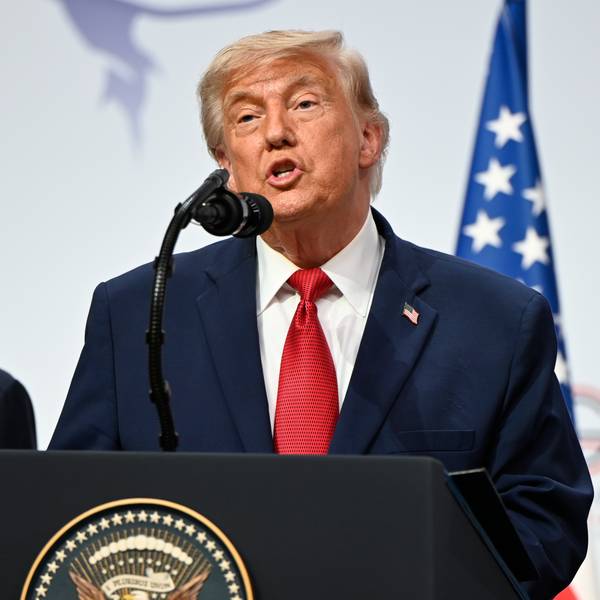
President Donald Trump speaks during a cabinet meeting at the White House on Wednesday. (Photo: Evan Vucci / AP)
"History," as Mark Twain reputedly remarked, "doesn't repeat itself, but it often rhymes." As we flip the calendar to a new year, Donald Trump would be well-advised to take careful heed of Twain's maxim.
Unless Trump suddenly discovers an untapped reservoir of self-restraint, he's going to confront an impeachment moment reminiscent of the crisis that drove Richard Nixon from office in 1974. And with his presidency on shaky ground from the outset, a Nixon-style climax appears increasingly likely.
The historical echoes and rhymes with Nixon are clearly discernible. As veteran journalist Elizabeth Drew, who covered the Watergate scandal as a Washington correspondent for The Atlantic Monthly, observed in an op-ed for the New York Times last month: "An impeachment process against President Trump now seems inescapable. Unless the president resigns, the pressure by the public on the Democratic leaders to begin an impeachment process next year will only increase."
The public is indeed becoming increasingly fed up with Trump, much as the American people turned on Nixon in the waning days of his presidency. According to a Harvard CAPS/Harris poll released on Dec. 28, nearly 60 percent of U.S. voters surveyed say Trump should either be impeached and removed from office or formally censured by Congress.
As Drew also notes, the substantive case for impeaching Trump is very strong, albeit more complex than the one mounted against Nixon.
Impeachment is a two-step process: First, the House votes to impeach, then the accused federal official is put on trial before the Senate. A two-thirds vote of the upper chamber is needed to sustain an article of impeachment, resulting in removal from office.
In July 1974, the House Judiciary Committee approved three articles of impeachment against Nixon. The first charged Nixon with nine counts of obstruction of justice for lying about his knowledge of the Watergate break-in of June 1972 and attempting to cover up the truth about the burglary. The second cited him for misusing the IRS, the FBI, the Justice Department, the CIA and members of his administration to spy on American citizens and infringe upon the constitutional rights of his assumed political enemies. The third alleged that he had, without legal justification, defied duly executed judiciary-committee subpoenas for Watergate-related documents.
Faced with near-certain approval of the articles by the entire House and subsequent conviction in the Senate, Nixon opted to resign.
Trump is vulnerable to impeachment on an even greater variety of fronts than Nixon. First and foremost, there is the final report of special counsel Robert Mueller, which may be delivered as soon as the middle of February. Even if Mueller hews to present Justice Department policy and declines to indict Trump himself for conspiring and colluding with Russian interests in the 2016 election, and obstructing justice in an effort to impede the Russia probe, he almost certainly will furnish House Democrats with powerful ammunition for impeachment.
Beyond collusion and obstruction, Trump has arguably committed impeachable offenses for misusing the presidency for personal economic gain in violation of the Constitution's foreign and domestic emoluments clauses, as well as directing his former attorney, Michael Cohen, to pay hush money to adult film star Stormy Daniels and ex-girlfriend Karen McDougal in violation of federal election laws.
An emboldened House may also return impeachment articles against Trump for his unrelenting attacks on the judiciary and the media, his threats to withhold federal funds from states that have resisted his xenophobic immigration policies, his shutting down parts of the government to secure funding for his border wall, his reckless withdrawal from international treaties like the Paris Climate Agreement, and his habitual lying to the American people about policy issues large and small.
But the reason history is merely rhyming rather than repeating is that, unlike Nixon, Trump will not resign. Some of his children and his son-in-law may be indicted, the stock market may continue its tumble, the country may slide into a recession, and the Republican establishment may desert him, but he won't follow Nixon's lead and quit.
Trump will remain until the bitter end and seek reelection, not because he is a man of courage and principle, but because he has no other safe personal option.
If Trump resigned before 2020, he would be subject to prosecution for any federal offenses he may have committed since 2015. The statute of limitations for most federal felonies is five years. Moreover, the pardon power of a newly sworn-in President Mike Pence would do nothing to limit his exposure to numerous state prosecutions.
Nixon stepped down on Aug. 9, 1974. One month later, he was preemptively pardoned of all federal offenses arising from Watergate by his former Vice President Gerald Ford, who succeeded him as the nation's 38th commander-in-chief. Nixon was able to recede from the limelight, disgraced but free.
Although it is likely Pence would do the same for Trump, it is well settled that the president's authority to grant clemency and pardons is limited to federal offenses. An offense that violates a state law is not an offense against the United States.
At present, there are at least three major investigations underway in New York that ultimately could lead to criminal charges against Trump. They include investigations opened by New York City and New York state for tax fraud, as well as probes of the recently shuttered Trump Foundation for self-dealing, money laundering and illegal coordination with the Trump presidential campaign. The president could also be implicated by the district attorney's office in Manhattan, which is looking into whether the Trump Organization falsified business records to hide his hush payments to Daniels and McDougal.
Technically, there is nothing that would prohibit New York authorities from targeting Trump right now. But apart from the somewhat comical arrest of President Ulysses S. Grant in 1872 by a District of Columbia police officer for driving his carriage through the streets of Georgetown at an excessive speed, no sitting president has ever been arrested by local authorities. (Grant was cited and fined.)
For reasons of what constitutional scholars call "comity," or reciprocity, state prosecutors probably will defer indicting the president until he leaves office, even if it means their own statutes of limitations could expire.
In any event, Trump has little to gain by departing the Oval Office early and much to lose if he does. Guided by narcissism and self-interest, and backed by his dogged white nationalist base, he'll stay put until he is either removed or defeated at the polls. Hopefully, he won't drag the last vestiges of our diminished constitutional system with him when he goes.
Dear Common Dreams reader, It’s been nearly 30 years since I co-founded Common Dreams with my late wife, Lina Newhouser. We had the radical notion that journalism should serve the public good, not corporate profits. It was clear to us from the outset what it would take to build such a project. No paid advertisements. No corporate sponsors. No millionaire publisher telling us what to think or do. Many people said we wouldn't last a year, but we proved those doubters wrong. Together with a tremendous team of journalists and dedicated staff, we built an independent media outlet free from the constraints of profits and corporate control. Our mission has always been simple: To inform. To inspire. To ignite change for the common good. Building Common Dreams was not easy. Our survival was never guaranteed. When you take on the most powerful forces—Wall Street greed, fossil fuel industry destruction, Big Tech lobbyists, and uber-rich oligarchs who have spent billions upon billions rigging the economy and democracy in their favor—the only bulwark you have is supporters who believe in your work. But here’s the urgent message from me today. It's never been this bad out there. And it's never been this hard to keep us going. At the very moment Common Dreams is most needed, the threats we face are intensifying. We need your support now more than ever. We don't accept corporate advertising and never will. We don't have a paywall because we don't think people should be blocked from critical news based on their ability to pay. Everything we do is funded by the donations of readers like you. When everyone does the little they can afford, we are strong. But if that support retreats or dries up, so do we. Will you donate now to make sure Common Dreams not only survives but thrives? —Craig Brown, Co-founder |
"History," as Mark Twain reputedly remarked, "doesn't repeat itself, but it often rhymes." As we flip the calendar to a new year, Donald Trump would be well-advised to take careful heed of Twain's maxim.
Unless Trump suddenly discovers an untapped reservoir of self-restraint, he's going to confront an impeachment moment reminiscent of the crisis that drove Richard Nixon from office in 1974. And with his presidency on shaky ground from the outset, a Nixon-style climax appears increasingly likely.
The historical echoes and rhymes with Nixon are clearly discernible. As veteran journalist Elizabeth Drew, who covered the Watergate scandal as a Washington correspondent for The Atlantic Monthly, observed in an op-ed for the New York Times last month: "An impeachment process against President Trump now seems inescapable. Unless the president resigns, the pressure by the public on the Democratic leaders to begin an impeachment process next year will only increase."
The public is indeed becoming increasingly fed up with Trump, much as the American people turned on Nixon in the waning days of his presidency. According to a Harvard CAPS/Harris poll released on Dec. 28, nearly 60 percent of U.S. voters surveyed say Trump should either be impeached and removed from office or formally censured by Congress.
As Drew also notes, the substantive case for impeaching Trump is very strong, albeit more complex than the one mounted against Nixon.
Impeachment is a two-step process: First, the House votes to impeach, then the accused federal official is put on trial before the Senate. A two-thirds vote of the upper chamber is needed to sustain an article of impeachment, resulting in removal from office.
In July 1974, the House Judiciary Committee approved three articles of impeachment against Nixon. The first charged Nixon with nine counts of obstruction of justice for lying about his knowledge of the Watergate break-in of June 1972 and attempting to cover up the truth about the burglary. The second cited him for misusing the IRS, the FBI, the Justice Department, the CIA and members of his administration to spy on American citizens and infringe upon the constitutional rights of his assumed political enemies. The third alleged that he had, without legal justification, defied duly executed judiciary-committee subpoenas for Watergate-related documents.
Faced with near-certain approval of the articles by the entire House and subsequent conviction in the Senate, Nixon opted to resign.
Trump is vulnerable to impeachment on an even greater variety of fronts than Nixon. First and foremost, there is the final report of special counsel Robert Mueller, which may be delivered as soon as the middle of February. Even if Mueller hews to present Justice Department policy and declines to indict Trump himself for conspiring and colluding with Russian interests in the 2016 election, and obstructing justice in an effort to impede the Russia probe, he almost certainly will furnish House Democrats with powerful ammunition for impeachment.
Beyond collusion and obstruction, Trump has arguably committed impeachable offenses for misusing the presidency for personal economic gain in violation of the Constitution's foreign and domestic emoluments clauses, as well as directing his former attorney, Michael Cohen, to pay hush money to adult film star Stormy Daniels and ex-girlfriend Karen McDougal in violation of federal election laws.
An emboldened House may also return impeachment articles against Trump for his unrelenting attacks on the judiciary and the media, his threats to withhold federal funds from states that have resisted his xenophobic immigration policies, his shutting down parts of the government to secure funding for his border wall, his reckless withdrawal from international treaties like the Paris Climate Agreement, and his habitual lying to the American people about policy issues large and small.
But the reason history is merely rhyming rather than repeating is that, unlike Nixon, Trump will not resign. Some of his children and his son-in-law may be indicted, the stock market may continue its tumble, the country may slide into a recession, and the Republican establishment may desert him, but he won't follow Nixon's lead and quit.
Trump will remain until the bitter end and seek reelection, not because he is a man of courage and principle, but because he has no other safe personal option.
If Trump resigned before 2020, he would be subject to prosecution for any federal offenses he may have committed since 2015. The statute of limitations for most federal felonies is five years. Moreover, the pardon power of a newly sworn-in President Mike Pence would do nothing to limit his exposure to numerous state prosecutions.
Nixon stepped down on Aug. 9, 1974. One month later, he was preemptively pardoned of all federal offenses arising from Watergate by his former Vice President Gerald Ford, who succeeded him as the nation's 38th commander-in-chief. Nixon was able to recede from the limelight, disgraced but free.
Although it is likely Pence would do the same for Trump, it is well settled that the president's authority to grant clemency and pardons is limited to federal offenses. An offense that violates a state law is not an offense against the United States.
At present, there are at least three major investigations underway in New York that ultimately could lead to criminal charges against Trump. They include investigations opened by New York City and New York state for tax fraud, as well as probes of the recently shuttered Trump Foundation for self-dealing, money laundering and illegal coordination with the Trump presidential campaign. The president could also be implicated by the district attorney's office in Manhattan, which is looking into whether the Trump Organization falsified business records to hide his hush payments to Daniels and McDougal.
Technically, there is nothing that would prohibit New York authorities from targeting Trump right now. But apart from the somewhat comical arrest of President Ulysses S. Grant in 1872 by a District of Columbia police officer for driving his carriage through the streets of Georgetown at an excessive speed, no sitting president has ever been arrested by local authorities. (Grant was cited and fined.)
For reasons of what constitutional scholars call "comity," or reciprocity, state prosecutors probably will defer indicting the president until he leaves office, even if it means their own statutes of limitations could expire.
In any event, Trump has little to gain by departing the Oval Office early and much to lose if he does. Guided by narcissism and self-interest, and backed by his dogged white nationalist base, he'll stay put until he is either removed or defeated at the polls. Hopefully, he won't drag the last vestiges of our diminished constitutional system with him when he goes.
"History," as Mark Twain reputedly remarked, "doesn't repeat itself, but it often rhymes." As we flip the calendar to a new year, Donald Trump would be well-advised to take careful heed of Twain's maxim.
Unless Trump suddenly discovers an untapped reservoir of self-restraint, he's going to confront an impeachment moment reminiscent of the crisis that drove Richard Nixon from office in 1974. And with his presidency on shaky ground from the outset, a Nixon-style climax appears increasingly likely.
The historical echoes and rhymes with Nixon are clearly discernible. As veteran journalist Elizabeth Drew, who covered the Watergate scandal as a Washington correspondent for The Atlantic Monthly, observed in an op-ed for the New York Times last month: "An impeachment process against President Trump now seems inescapable. Unless the president resigns, the pressure by the public on the Democratic leaders to begin an impeachment process next year will only increase."
The public is indeed becoming increasingly fed up with Trump, much as the American people turned on Nixon in the waning days of his presidency. According to a Harvard CAPS/Harris poll released on Dec. 28, nearly 60 percent of U.S. voters surveyed say Trump should either be impeached and removed from office or formally censured by Congress.
As Drew also notes, the substantive case for impeaching Trump is very strong, albeit more complex than the one mounted against Nixon.
Impeachment is a two-step process: First, the House votes to impeach, then the accused federal official is put on trial before the Senate. A two-thirds vote of the upper chamber is needed to sustain an article of impeachment, resulting in removal from office.
In July 1974, the House Judiciary Committee approved three articles of impeachment against Nixon. The first charged Nixon with nine counts of obstruction of justice for lying about his knowledge of the Watergate break-in of June 1972 and attempting to cover up the truth about the burglary. The second cited him for misusing the IRS, the FBI, the Justice Department, the CIA and members of his administration to spy on American citizens and infringe upon the constitutional rights of his assumed political enemies. The third alleged that he had, without legal justification, defied duly executed judiciary-committee subpoenas for Watergate-related documents.
Faced with near-certain approval of the articles by the entire House and subsequent conviction in the Senate, Nixon opted to resign.
Trump is vulnerable to impeachment on an even greater variety of fronts than Nixon. First and foremost, there is the final report of special counsel Robert Mueller, which may be delivered as soon as the middle of February. Even if Mueller hews to present Justice Department policy and declines to indict Trump himself for conspiring and colluding with Russian interests in the 2016 election, and obstructing justice in an effort to impede the Russia probe, he almost certainly will furnish House Democrats with powerful ammunition for impeachment.
Beyond collusion and obstruction, Trump has arguably committed impeachable offenses for misusing the presidency for personal economic gain in violation of the Constitution's foreign and domestic emoluments clauses, as well as directing his former attorney, Michael Cohen, to pay hush money to adult film star Stormy Daniels and ex-girlfriend Karen McDougal in violation of federal election laws.
An emboldened House may also return impeachment articles against Trump for his unrelenting attacks on the judiciary and the media, his threats to withhold federal funds from states that have resisted his xenophobic immigration policies, his shutting down parts of the government to secure funding for his border wall, his reckless withdrawal from international treaties like the Paris Climate Agreement, and his habitual lying to the American people about policy issues large and small.
But the reason history is merely rhyming rather than repeating is that, unlike Nixon, Trump will not resign. Some of his children and his son-in-law may be indicted, the stock market may continue its tumble, the country may slide into a recession, and the Republican establishment may desert him, but he won't follow Nixon's lead and quit.
Trump will remain until the bitter end and seek reelection, not because he is a man of courage and principle, but because he has no other safe personal option.
If Trump resigned before 2020, he would be subject to prosecution for any federal offenses he may have committed since 2015. The statute of limitations for most federal felonies is five years. Moreover, the pardon power of a newly sworn-in President Mike Pence would do nothing to limit his exposure to numerous state prosecutions.
Nixon stepped down on Aug. 9, 1974. One month later, he was preemptively pardoned of all federal offenses arising from Watergate by his former Vice President Gerald Ford, who succeeded him as the nation's 38th commander-in-chief. Nixon was able to recede from the limelight, disgraced but free.
Although it is likely Pence would do the same for Trump, it is well settled that the president's authority to grant clemency and pardons is limited to federal offenses. An offense that violates a state law is not an offense against the United States.
At present, there are at least three major investigations underway in New York that ultimately could lead to criminal charges against Trump. They include investigations opened by New York City and New York state for tax fraud, as well as probes of the recently shuttered Trump Foundation for self-dealing, money laundering and illegal coordination with the Trump presidential campaign. The president could also be implicated by the district attorney's office in Manhattan, which is looking into whether the Trump Organization falsified business records to hide his hush payments to Daniels and McDougal.
Technically, there is nothing that would prohibit New York authorities from targeting Trump right now. But apart from the somewhat comical arrest of President Ulysses S. Grant in 1872 by a District of Columbia police officer for driving his carriage through the streets of Georgetown at an excessive speed, no sitting president has ever been arrested by local authorities. (Grant was cited and fined.)
For reasons of what constitutional scholars call "comity," or reciprocity, state prosecutors probably will defer indicting the president until he leaves office, even if it means their own statutes of limitations could expire.
In any event, Trump has little to gain by departing the Oval Office early and much to lose if he does. Guided by narcissism and self-interest, and backed by his dogged white nationalist base, he'll stay put until he is either removed or defeated at the polls. Hopefully, he won't drag the last vestiges of our diminished constitutional system with him when he goes.