SUBSCRIBE TO OUR FREE NEWSLETTER
Daily news & progressive opinion—funded by the people, not the corporations—delivered straight to your inbox.
5
#000000
#FFFFFF
To donate by check, phone, or other method, see our More Ways to Give page.


Daily news & progressive opinion—funded by the people, not the corporations—delivered straight to your inbox.

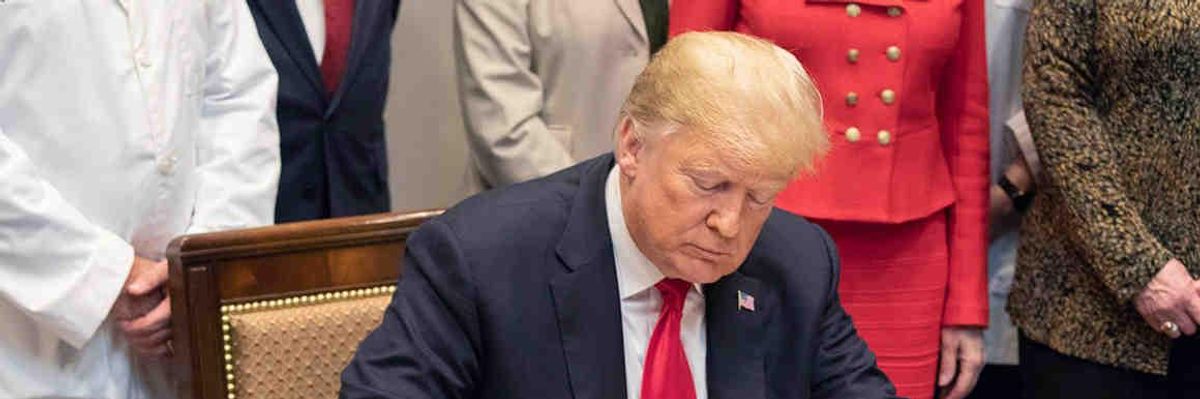
"The Supreme Court ruled, more than 100 years ago, that the citizenship guarantee applies fully to U.S.-born children whose parents have no right to citizenship." (Photo: Whitehouse/Flickr)
President Trump said this week that he is preparing an executive order to try to take away the citizenship guarantee in the 14th Amendment to the Constitution, which says that people born in the United States are United States citizens. On Tuesday, Sen. Lindsey Graham announced that he would introduce legislation with the same aim.
But the president cannot repeal part of the Constitution by executive order. And Congress cannot repeal it by simply passing a new bill. Amending the Constitution would require a two-thirds vote in both House and Senate, and also ratification by three-quarters of the states. The effort to erase the citizenship guarantee will never clear those hurdles -- for very good reasons.
Birthright citizenship is one of the bedrocks of this country. More than 150 years ago, the 14th Amendment guaranteed to all those born within the United States citizenship, without regard to parentage, skin color or ethnicity. And the Supreme Court ruled, more than 100 years ago, that the citizenship guarantee applies fully to U.S.-born children whose parents have no right to citizenship.
Before the amendment was enacted, American citizenship was controlled by the abhorrent 1857 Supreme Court decision Dred Scott v. Sandford. In that case, the justices found that Black people born in the United States were not citizens, but rather a "subordinate and inferior class of beings" with "no rights or privileges but such as those who held the power and the Government might choose to grant them." Neither slaves, nor freed slaves, nor their descendants could ever become citizens, the justices ruled.
After the Civil War, Congress overruled Dred Scott by passing the 14th Amendment. The definition of citizenship is part of its very first sentence: "All persons born or naturalized in the United States, and subject to the jurisdiction thereof, are citizens of the United States and of the state wherein they reside." In one sweep, the clause guaranteed citizenship to previously enslaved people and their children -- and ensured that the law would never again perpetuate a multigenerational, permanent underclass of individuals barred from American citizenship.
In 1898, the Supreme Court confirmed that the 14th Amendment guaranteed citizenship to all children born on U.S. soil, no matter what their parents' status. In United States v. Wong Kim Ark, the justices found that a baby born in San Francisco to parents who were citizens of China -- and subject to the Chinese Exclusion Act, which prohibited them from becoming U.S. citizens themselves -- was automatically a citizen at birth. The court specifically rejected the argument that a child in those circumstances was not "subject to the jurisdiction" of the United States, and thus excluded from the Constitution's citizenship guarantee.
Only a few categories of people are excluded: children of foreign diplomats, children of enemy soldiers present in the U.S. during an occupation, and children of Native American tribes, who have American citizenship under a separate provision of law.
At least since 1898, there has been no serious question about whether children born in the United States can be denied American citizenship because of the status of their parents. James C. Ho, who was recently appointed by President Trump to the Court of Appeals of the Fifth Circuit, has written that citizenship "is protected no less for children of undocumented persons than for descendants of Mayflower passengers." Similarly, Walter Dellinger, who was Assistant Attorney General in the Clinton administration, told Congress in 1995 that legislation to nullify birthright citizenship was "unquestionably unconstitutional."
Of course, Dellinger acknowledged, "Congress is free to propose, and the states to ratify, any amendment to the Constitution. Such naked power undeniably exists." Yet the Constitution stands for certain enduring principles, as he said in testimony before the House. "For us, for our nation, the simple, objective, bright-line fact of birth on American soil is fundamental."

Dear Common Dreams reader, It’s been nearly 30 years since I co-founded Common Dreams with my late wife, Lina Newhouser. We had the radical notion that journalism should serve the public good, not corporate profits. It was clear to us from the outset what it would take to build such a project. No paid advertisements. No corporate sponsors. No millionaire publisher telling us what to think or do. Many people said we wouldn't last a year, but we proved those doubters wrong. Together with a tremendous team of journalists and dedicated staff, we built an independent media outlet free from the constraints of profits and corporate control. Our mission has always been simple: To inform. To inspire. To ignite change for the common good. Building Common Dreams was not easy. Our survival was never guaranteed. When you take on the most powerful forces—Wall Street greed, fossil fuel industry destruction, Big Tech lobbyists, and uber-rich oligarchs who have spent billions upon billions rigging the economy and democracy in their favor—the only bulwark you have is supporters who believe in your work. But here’s the urgent message from me today. It's never been this bad out there. And it's never been this hard to keep us going. At the very moment Common Dreams is most needed, the threats we face are intensifying. We need your support now more than ever. We don't accept corporate advertising and never will. We don't have a paywall because we don't think people should be blocked from critical news based on their ability to pay. Everything we do is funded by the donations of readers like you. When everyone does the little they can afford, we are strong. But if that support retreats or dries up, so do we. Will you donate now to make sure Common Dreams not only survives but thrives? —Craig Brown, Co-founder |
President Trump said this week that he is preparing an executive order to try to take away the citizenship guarantee in the 14th Amendment to the Constitution, which says that people born in the United States are United States citizens. On Tuesday, Sen. Lindsey Graham announced that he would introduce legislation with the same aim.
But the president cannot repeal part of the Constitution by executive order. And Congress cannot repeal it by simply passing a new bill. Amending the Constitution would require a two-thirds vote in both House and Senate, and also ratification by three-quarters of the states. The effort to erase the citizenship guarantee will never clear those hurdles -- for very good reasons.
Birthright citizenship is one of the bedrocks of this country. More than 150 years ago, the 14th Amendment guaranteed to all those born within the United States citizenship, without regard to parentage, skin color or ethnicity. And the Supreme Court ruled, more than 100 years ago, that the citizenship guarantee applies fully to U.S.-born children whose parents have no right to citizenship.
Before the amendment was enacted, American citizenship was controlled by the abhorrent 1857 Supreme Court decision Dred Scott v. Sandford. In that case, the justices found that Black people born in the United States were not citizens, but rather a "subordinate and inferior class of beings" with "no rights or privileges but such as those who held the power and the Government might choose to grant them." Neither slaves, nor freed slaves, nor their descendants could ever become citizens, the justices ruled.
After the Civil War, Congress overruled Dred Scott by passing the 14th Amendment. The definition of citizenship is part of its very first sentence: "All persons born or naturalized in the United States, and subject to the jurisdiction thereof, are citizens of the United States and of the state wherein they reside." In one sweep, the clause guaranteed citizenship to previously enslaved people and their children -- and ensured that the law would never again perpetuate a multigenerational, permanent underclass of individuals barred from American citizenship.
In 1898, the Supreme Court confirmed that the 14th Amendment guaranteed citizenship to all children born on U.S. soil, no matter what their parents' status. In United States v. Wong Kim Ark, the justices found that a baby born in San Francisco to parents who were citizens of China -- and subject to the Chinese Exclusion Act, which prohibited them from becoming U.S. citizens themselves -- was automatically a citizen at birth. The court specifically rejected the argument that a child in those circumstances was not "subject to the jurisdiction" of the United States, and thus excluded from the Constitution's citizenship guarantee.
Only a few categories of people are excluded: children of foreign diplomats, children of enemy soldiers present in the U.S. during an occupation, and children of Native American tribes, who have American citizenship under a separate provision of law.
At least since 1898, there has been no serious question about whether children born in the United States can be denied American citizenship because of the status of their parents. James C. Ho, who was recently appointed by President Trump to the Court of Appeals of the Fifth Circuit, has written that citizenship "is protected no less for children of undocumented persons than for descendants of Mayflower passengers." Similarly, Walter Dellinger, who was Assistant Attorney General in the Clinton administration, told Congress in 1995 that legislation to nullify birthright citizenship was "unquestionably unconstitutional."
Of course, Dellinger acknowledged, "Congress is free to propose, and the states to ratify, any amendment to the Constitution. Such naked power undeniably exists." Yet the Constitution stands for certain enduring principles, as he said in testimony before the House. "For us, for our nation, the simple, objective, bright-line fact of birth on American soil is fundamental."
President Trump said this week that he is preparing an executive order to try to take away the citizenship guarantee in the 14th Amendment to the Constitution, which says that people born in the United States are United States citizens. On Tuesday, Sen. Lindsey Graham announced that he would introduce legislation with the same aim.
But the president cannot repeal part of the Constitution by executive order. And Congress cannot repeal it by simply passing a new bill. Amending the Constitution would require a two-thirds vote in both House and Senate, and also ratification by three-quarters of the states. The effort to erase the citizenship guarantee will never clear those hurdles -- for very good reasons.
Birthright citizenship is one of the bedrocks of this country. More than 150 years ago, the 14th Amendment guaranteed to all those born within the United States citizenship, without regard to parentage, skin color or ethnicity. And the Supreme Court ruled, more than 100 years ago, that the citizenship guarantee applies fully to U.S.-born children whose parents have no right to citizenship.
Before the amendment was enacted, American citizenship was controlled by the abhorrent 1857 Supreme Court decision Dred Scott v. Sandford. In that case, the justices found that Black people born in the United States were not citizens, but rather a "subordinate and inferior class of beings" with "no rights or privileges but such as those who held the power and the Government might choose to grant them." Neither slaves, nor freed slaves, nor their descendants could ever become citizens, the justices ruled.
After the Civil War, Congress overruled Dred Scott by passing the 14th Amendment. The definition of citizenship is part of its very first sentence: "All persons born or naturalized in the United States, and subject to the jurisdiction thereof, are citizens of the United States and of the state wherein they reside." In one sweep, the clause guaranteed citizenship to previously enslaved people and their children -- and ensured that the law would never again perpetuate a multigenerational, permanent underclass of individuals barred from American citizenship.
In 1898, the Supreme Court confirmed that the 14th Amendment guaranteed citizenship to all children born on U.S. soil, no matter what their parents' status. In United States v. Wong Kim Ark, the justices found that a baby born in San Francisco to parents who were citizens of China -- and subject to the Chinese Exclusion Act, which prohibited them from becoming U.S. citizens themselves -- was automatically a citizen at birth. The court specifically rejected the argument that a child in those circumstances was not "subject to the jurisdiction" of the United States, and thus excluded from the Constitution's citizenship guarantee.
Only a few categories of people are excluded: children of foreign diplomats, children of enemy soldiers present in the U.S. during an occupation, and children of Native American tribes, who have American citizenship under a separate provision of law.
At least since 1898, there has been no serious question about whether children born in the United States can be denied American citizenship because of the status of their parents. James C. Ho, who was recently appointed by President Trump to the Court of Appeals of the Fifth Circuit, has written that citizenship "is protected no less for children of undocumented persons than for descendants of Mayflower passengers." Similarly, Walter Dellinger, who was Assistant Attorney General in the Clinton administration, told Congress in 1995 that legislation to nullify birthright citizenship was "unquestionably unconstitutional."
Of course, Dellinger acknowledged, "Congress is free to propose, and the states to ratify, any amendment to the Constitution. Such naked power undeniably exists." Yet the Constitution stands for certain enduring principles, as he said in testimony before the House. "For us, for our nation, the simple, objective, bright-line fact of birth on American soil is fundamental."