
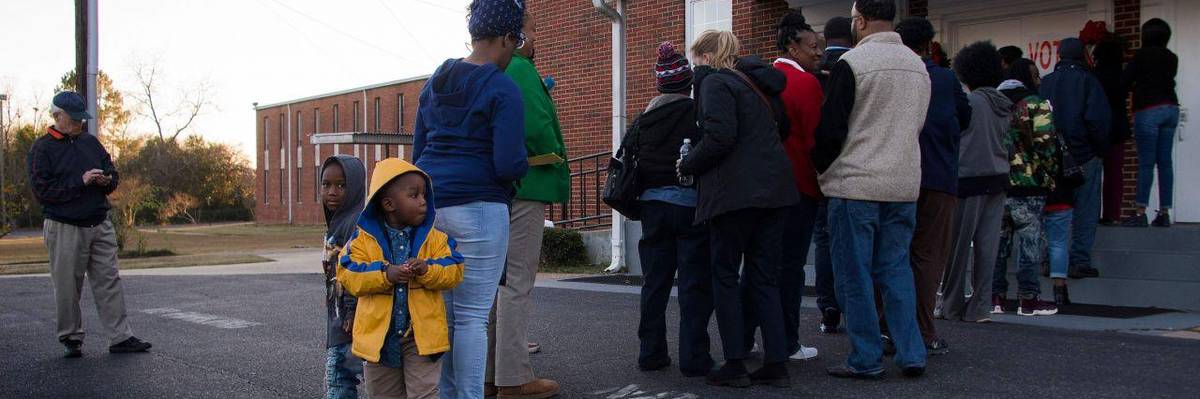
Voters stand in a long line that stretches out the door to vote at Beulah Baptist Church polling station in Montgomery, Alabama, on Dec. 12, 2017. (Photo by Jim Watson/AFP/Getty Images)
After Alabama: A Fierce, Strategic and Organized Hope Is the Only Way Forward
The Alabama special election shows that political organizing is essential if we hope to revitalize democracy through a robust electoral process.
Of late, politics has been, to borrow a phrase from my youth, a hot mess. Some hot messes are the sort that people pull up their lawn chairs and get a big bucket of hot buttered popcorn and a grape or orange soda and watch the show unfolding before them. Other hot messes, like the one in Alabama, are fraught and cause people to get out and vote for their lives and their beliefs because it will not do to stay home and hope that the blight will just go away. Doug Jones won by a slim margin. It is a potentially troubling omen that a negative polarizing record on sexual misconduct, judicial rebuke, race baiting, homophobia and all-around churlishness were side-stepped by the roughly 49 percent of voters who cast their ballots for Roy Moore.
It seems as though morality and integrity have become moving targets in our local, state and national politics; with a suspect moral compass guiding the way. When I was growing up in Durham, North Carolina in the late 1950s, 1960s and early '70s, I was taught that honest people did not tell lies, that good people did not hurt others (and if you did, you apologized and tried to make things right), that government was about focusing on the common good, and the good Lord was watching and judging us all. Of late, these things seem to carry little freight as politics (and winning at all costs) has been outmaneuvering good government. Governing requires an informed citizenship that is capable of finding its way to the base notes of a common good that benefits the majority and not a select few. It also depends on our elected officials working together, across party affiliations, to develop laws and policies that reflect the best interests of the country and not turning government into a crass points-system contest of winning and losing.
The hot mess of an election in Alabama is a vexing sign of our times. Racial lines, the rural/urban split and level of education and income were strong influences on how people voted. We have, as a nation, allowed ourselves to be duped and persuaded that immoral acts are really moral ones. We cloak lies and damned lies in hyphenated deceptions such as post-truth and post-facts. But another sign of our times may be emerging if this one election can signal a turning point. There are folks running for office who seek to reignite our sense of civic engagement, eschew partisan politics, focus on the importance of getting folks out to vote; who pay attention to issues that are shaping all of our society and not just the ones that have an immediate or personal stake or particular monetary investment.
A dear friend of mine who is a native Alabamian captures the main implication I take from the Alabama Senate race: "Just when I am ready to give up on the world, hope appears." For someone like me, who is a pragmatic optimist -- a black lesbian woman who identifies as a womanist/black feminist, a devout Christian, a political progressive who is committed to bringing together love and justice, scholarship, passion and an ornery coloredness that refuses to bend to the injustices and outrageousness of our current federal administration -- a fierce, strategic and organized hope is the only way that those of us who formed the popular vote majority in the last election can make our voices heard.
Campaigns built on bitterness and bile can be defeated with strategic and organized opposition. Good intentions and a sound message may be good starting points, but like the hornets in the black folklore story "Dey's Auganized," the return to a vibrant democracy through a robust electoral process means that candidates and their supporters must organize -- we must organize. The most patriotic thing we may do in light of this election is to remember how important it is to avoid wrapping our hopes up in lamentations of indifference and despair. These kinds of laments muzzle the hard work we must do to be an informed and engaged citizenry who remembers that life is more than a studied focus on our navels. Rather, it is looking up and out into an incredibly interesting society that is, unfortunately, listing on the boondocks of fear and anecdotes of hatred. It is refusing to accept this sad status quo. Organizing local, statewide, regional and national campaigns that are astute, that read the various moods and concerns of the electorate, that cherish people and focus on the common good, and that ultimately return to the art of governing can win.
So, I am heartened to see that candidates and campaigns do matter. It is too soon to know that we may be witnessing the first ripple of a changing tide in our electoral politics, but I hope so.
An Urgent Message From Our Co-Founder
Dear Common Dreams reader, It’s been nearly 30 years since I co-founded Common Dreams with my late wife, Lina Newhouser. We had the radical notion that journalism should serve the public good, not corporate profits. It was clear to us from the outset what it would take to build such a project. No paid advertisements. No corporate sponsors. No millionaire publisher telling us what to think or do. Many people said we wouldn't last a year, but we proved those doubters wrong. Together with a tremendous team of journalists and dedicated staff, we built an independent media outlet free from the constraints of profits and corporate control. Our mission has always been simple: To inform. To inspire. To ignite change for the common good. Building Common Dreams was not easy. Our survival was never guaranteed. When you take on the most powerful forces—Wall Street greed, fossil fuel industry destruction, Big Tech lobbyists, and uber-rich oligarchs who have spent billions upon billions rigging the economy and democracy in their favor—the only bulwark you have is supporters who believe in your work. But here’s the urgent message from me today. It's never been this bad out there. And it's never been this hard to keep us going. At the very moment Common Dreams is most needed, the threats we face are intensifying. We need your support now more than ever. We don't accept corporate advertising and never will. We don't have a paywall because we don't think people should be blocked from critical news based on their ability to pay. Everything we do is funded by the donations of readers like you. When everyone does the little they can afford, we are strong. But if that support retreats or dries up, so do we. Will you donate now to make sure Common Dreams not only survives but thrives? —Craig Brown, Co-founder |
Of late, politics has been, to borrow a phrase from my youth, a hot mess. Some hot messes are the sort that people pull up their lawn chairs and get a big bucket of hot buttered popcorn and a grape or orange soda and watch the show unfolding before them. Other hot messes, like the one in Alabama, are fraught and cause people to get out and vote for their lives and their beliefs because it will not do to stay home and hope that the blight will just go away. Doug Jones won by a slim margin. It is a potentially troubling omen that a negative polarizing record on sexual misconduct, judicial rebuke, race baiting, homophobia and all-around churlishness were side-stepped by the roughly 49 percent of voters who cast their ballots for Roy Moore.
It seems as though morality and integrity have become moving targets in our local, state and national politics; with a suspect moral compass guiding the way. When I was growing up in Durham, North Carolina in the late 1950s, 1960s and early '70s, I was taught that honest people did not tell lies, that good people did not hurt others (and if you did, you apologized and tried to make things right), that government was about focusing on the common good, and the good Lord was watching and judging us all. Of late, these things seem to carry little freight as politics (and winning at all costs) has been outmaneuvering good government. Governing requires an informed citizenship that is capable of finding its way to the base notes of a common good that benefits the majority and not a select few. It also depends on our elected officials working together, across party affiliations, to develop laws and policies that reflect the best interests of the country and not turning government into a crass points-system contest of winning and losing.
The hot mess of an election in Alabama is a vexing sign of our times. Racial lines, the rural/urban split and level of education and income were strong influences on how people voted. We have, as a nation, allowed ourselves to be duped and persuaded that immoral acts are really moral ones. We cloak lies and damned lies in hyphenated deceptions such as post-truth and post-facts. But another sign of our times may be emerging if this one election can signal a turning point. There are folks running for office who seek to reignite our sense of civic engagement, eschew partisan politics, focus on the importance of getting folks out to vote; who pay attention to issues that are shaping all of our society and not just the ones that have an immediate or personal stake or particular monetary investment.
A dear friend of mine who is a native Alabamian captures the main implication I take from the Alabama Senate race: "Just when I am ready to give up on the world, hope appears." For someone like me, who is a pragmatic optimist -- a black lesbian woman who identifies as a womanist/black feminist, a devout Christian, a political progressive who is committed to bringing together love and justice, scholarship, passion and an ornery coloredness that refuses to bend to the injustices and outrageousness of our current federal administration -- a fierce, strategic and organized hope is the only way that those of us who formed the popular vote majority in the last election can make our voices heard.
Campaigns built on bitterness and bile can be defeated with strategic and organized opposition. Good intentions and a sound message may be good starting points, but like the hornets in the black folklore story "Dey's Auganized," the return to a vibrant democracy through a robust electoral process means that candidates and their supporters must organize -- we must organize. The most patriotic thing we may do in light of this election is to remember how important it is to avoid wrapping our hopes up in lamentations of indifference and despair. These kinds of laments muzzle the hard work we must do to be an informed and engaged citizenry who remembers that life is more than a studied focus on our navels. Rather, it is looking up and out into an incredibly interesting society that is, unfortunately, listing on the boondocks of fear and anecdotes of hatred. It is refusing to accept this sad status quo. Organizing local, statewide, regional and national campaigns that are astute, that read the various moods and concerns of the electorate, that cherish people and focus on the common good, and that ultimately return to the art of governing can win.
So, I am heartened to see that candidates and campaigns do matter. It is too soon to know that we may be witnessing the first ripple of a changing tide in our electoral politics, but I hope so.
Of late, politics has been, to borrow a phrase from my youth, a hot mess. Some hot messes are the sort that people pull up their lawn chairs and get a big bucket of hot buttered popcorn and a grape or orange soda and watch the show unfolding before them. Other hot messes, like the one in Alabama, are fraught and cause people to get out and vote for their lives and their beliefs because it will not do to stay home and hope that the blight will just go away. Doug Jones won by a slim margin. It is a potentially troubling omen that a negative polarizing record on sexual misconduct, judicial rebuke, race baiting, homophobia and all-around churlishness were side-stepped by the roughly 49 percent of voters who cast their ballots for Roy Moore.
It seems as though morality and integrity have become moving targets in our local, state and national politics; with a suspect moral compass guiding the way. When I was growing up in Durham, North Carolina in the late 1950s, 1960s and early '70s, I was taught that honest people did not tell lies, that good people did not hurt others (and if you did, you apologized and tried to make things right), that government was about focusing on the common good, and the good Lord was watching and judging us all. Of late, these things seem to carry little freight as politics (and winning at all costs) has been outmaneuvering good government. Governing requires an informed citizenship that is capable of finding its way to the base notes of a common good that benefits the majority and not a select few. It also depends on our elected officials working together, across party affiliations, to develop laws and policies that reflect the best interests of the country and not turning government into a crass points-system contest of winning and losing.
The hot mess of an election in Alabama is a vexing sign of our times. Racial lines, the rural/urban split and level of education and income were strong influences on how people voted. We have, as a nation, allowed ourselves to be duped and persuaded that immoral acts are really moral ones. We cloak lies and damned lies in hyphenated deceptions such as post-truth and post-facts. But another sign of our times may be emerging if this one election can signal a turning point. There are folks running for office who seek to reignite our sense of civic engagement, eschew partisan politics, focus on the importance of getting folks out to vote; who pay attention to issues that are shaping all of our society and not just the ones that have an immediate or personal stake or particular monetary investment.
A dear friend of mine who is a native Alabamian captures the main implication I take from the Alabama Senate race: "Just when I am ready to give up on the world, hope appears." For someone like me, who is a pragmatic optimist -- a black lesbian woman who identifies as a womanist/black feminist, a devout Christian, a political progressive who is committed to bringing together love and justice, scholarship, passion and an ornery coloredness that refuses to bend to the injustices and outrageousness of our current federal administration -- a fierce, strategic and organized hope is the only way that those of us who formed the popular vote majority in the last election can make our voices heard.
Campaigns built on bitterness and bile can be defeated with strategic and organized opposition. Good intentions and a sound message may be good starting points, but like the hornets in the black folklore story "Dey's Auganized," the return to a vibrant democracy through a robust electoral process means that candidates and their supporters must organize -- we must organize. The most patriotic thing we may do in light of this election is to remember how important it is to avoid wrapping our hopes up in lamentations of indifference and despair. These kinds of laments muzzle the hard work we must do to be an informed and engaged citizenry who remembers that life is more than a studied focus on our navels. Rather, it is looking up and out into an incredibly interesting society that is, unfortunately, listing on the boondocks of fear and anecdotes of hatred. It is refusing to accept this sad status quo. Organizing local, statewide, regional and national campaigns that are astute, that read the various moods and concerns of the electorate, that cherish people and focus on the common good, and that ultimately return to the art of governing can win.
So, I am heartened to see that candidates and campaigns do matter. It is too soon to know that we may be witnessing the first ripple of a changing tide in our electoral politics, but I hope so.