SUBSCRIBE TO OUR FREE NEWSLETTER
Daily news & progressive opinion—funded by the people, not the corporations—delivered straight to your inbox.
5
#000000
#FFFFFF
To donate by check, phone, or other method, see our More Ways to Give page.
Daily news & progressive opinion—funded by the people, not the corporations—delivered straight to your inbox.
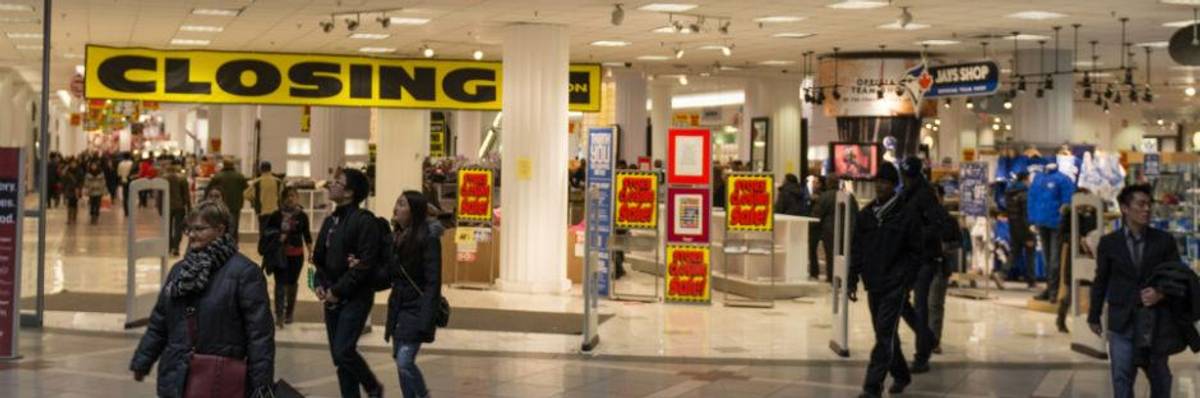
The downfall of Sears Canada seems tragic and unnecessary, and the devastating blow to its employees should not have been allowed to happen.
Suddenly jobless after two decades as a sales manager for now-defunct Sears Canada, Rose Dalessandro found herself unable to pay for dental appointments for her two children. She could blame her financial difficulties and the demise of the once-mighty Canadian retail giant on the usual suspects -- poor management, globalization, the rise of internet shopping.
But it might be more accurate to blame Eddie Lampert, the billionaire U.S. financier who is the company's largest shareholder as chairman of Chicago-based Sears Holding Corp.
The downfall of Sears Canada seems tragic and unnecessary, and the devastating blow to its employees should not have been allowed to happen.
Once the leading department store in Canada, it was innovative and successful, with an extensive distribution network based on its early years in the catalogue and home delivery business.
Of course, many big players have gone under in the dog-eat-dog retail market of recent years.
But, whatever competitive pressures Sears Canada faced along with other big retailers, its controlling shareholders almost certainly made the company's demise more likely with their decision to pay out more than $2.7 billion in dividends since 2005 to themselves and other shareholders.
Those dividends went heavily to its largest shareholder, Sears Holding, controlled by Lampert, according to Bloomberg and the Globe and Mail.
Forbes currently estimates Lampert's wealth at $1.65 billion U.S., and describes the source of his fortune as "Sears, self made."
Sears Canada might well have survived if some of the $2.7 billion paid out in dividends had been redirected into updating and redesigning its more than 130 stores to attract a new generation of shoppers.
If the company felt unable to compete, it could have, at least, set aside enough money to pay its employees severance and fully fund the company pension plan.
Instead, it left some 12,000 workers without severance and a shortfall of $270 million in its pension fund, leaving 18,000 retirees uncertain about collecting future benefits.
The media has devoted considerable attention to the story, and there's been good reporting highlighting the role of Lampert in the Sears Canada demise.
There has been less focus on solutions. Indeed, there's been a tendency to lament the plight of the Sears workers and even rail against human greed, but to resign ourselves to all this as a sad but inevitable aspect of today's capitalism.
This sense of resignation is weird. We're by no means helpless to prevent this sort of fiasco.
No, I'm not advocating the overthrow of capitalism, but rather something easier -- changing our corporate laws so that those controlling corporations can be held personally liable for money owed to their employees.
If, for instance, Eddie Lampert were personally liable for his employees' severance and pensions, he would have likely covered these costs from corporate funds before paying out $509 million in dividends in 2013.
"That's what he would have done," insists Harry Glasbeek, professor emeritus at Osgoode Hall Law School and author of Class Privilege: How Law Shelters Shareholders and Coddles Capitalists.
Holding people responsible for their actions and their debts isn't some far-fetched, ultraleft idea. On the contrary, it's a basic principle of our legal system, Glasbeek notes.
But we abandon this basic legal principle when it comes to laws governing corporations -- by limiting the legal liability of those who control corporations. "This 'limited liability' is an extraordinary privileging of one class of people," Glasbeek says.
It wasn't always this way. Wealthy capitalists used to be personally responsible for unpaid wages when their businesses went under. But capitalists fought hard in the late 19th and early 20th century to win the right to limit their liability.
At first they won only a partial limit, but over the years U.S. and Canadian courts have extended that limit.
The change was fiercely resisted on the grounds that it would leave vulnerable employees in dire situations -- like the situations faced today by thousands of Sears ex-workers.
Over the years, countless workers have found themselves similarly disempowered.
The Sears Canada tale is particularly epic, with a loyal workforce and a cartoon capitalist in Eddie Lampert -- a hedge fund manager who reportedly owns three lavish homes and 288-foot megayacht, believed to be among the world's biggest. (Who would have guessed?)
Of course, there will always be greedy capitalists. But we don't have to continue to provide special legal privileges that allow them to simply turf long-time employees, and then sail off into the sunset scot-free.
Dear Common Dreams reader, It’s been nearly 30 years since I co-founded Common Dreams with my late wife, Lina Newhouser. We had the radical notion that journalism should serve the public good, not corporate profits. It was clear to us from the outset what it would take to build such a project. No paid advertisements. No corporate sponsors. No millionaire publisher telling us what to think or do. Many people said we wouldn't last a year, but we proved those doubters wrong. Together with a tremendous team of journalists and dedicated staff, we built an independent media outlet free from the constraints of profits and corporate control. Our mission has always been simple: To inform. To inspire. To ignite change for the common good. Building Common Dreams was not easy. Our survival was never guaranteed. When you take on the most powerful forces—Wall Street greed, fossil fuel industry destruction, Big Tech lobbyists, and uber-rich oligarchs who have spent billions upon billions rigging the economy and democracy in their favor—the only bulwark you have is supporters who believe in your work. But here’s the urgent message from me today. It's never been this bad out there. And it's never been this hard to keep us going. At the very moment Common Dreams is most needed, the threats we face are intensifying. We need your support now more than ever. We don't accept corporate advertising and never will. We don't have a paywall because we don't think people should be blocked from critical news based on their ability to pay. Everything we do is funded by the donations of readers like you. When everyone does the little they can afford, we are strong. But if that support retreats or dries up, so do we. Will you donate now to make sure Common Dreams not only survives but thrives? —Craig Brown, Co-founder |
Suddenly jobless after two decades as a sales manager for now-defunct Sears Canada, Rose Dalessandro found herself unable to pay for dental appointments for her two children. She could blame her financial difficulties and the demise of the once-mighty Canadian retail giant on the usual suspects -- poor management, globalization, the rise of internet shopping.
But it might be more accurate to blame Eddie Lampert, the billionaire U.S. financier who is the company's largest shareholder as chairman of Chicago-based Sears Holding Corp.
The downfall of Sears Canada seems tragic and unnecessary, and the devastating blow to its employees should not have been allowed to happen.
Once the leading department store in Canada, it was innovative and successful, with an extensive distribution network based on its early years in the catalogue and home delivery business.
Of course, many big players have gone under in the dog-eat-dog retail market of recent years.
But, whatever competitive pressures Sears Canada faced along with other big retailers, its controlling shareholders almost certainly made the company's demise more likely with their decision to pay out more than $2.7 billion in dividends since 2005 to themselves and other shareholders.
Those dividends went heavily to its largest shareholder, Sears Holding, controlled by Lampert, according to Bloomberg and the Globe and Mail.
Forbes currently estimates Lampert's wealth at $1.65 billion U.S., and describes the source of his fortune as "Sears, self made."
Sears Canada might well have survived if some of the $2.7 billion paid out in dividends had been redirected into updating and redesigning its more than 130 stores to attract a new generation of shoppers.
If the company felt unable to compete, it could have, at least, set aside enough money to pay its employees severance and fully fund the company pension plan.
Instead, it left some 12,000 workers without severance and a shortfall of $270 million in its pension fund, leaving 18,000 retirees uncertain about collecting future benefits.
The media has devoted considerable attention to the story, and there's been good reporting highlighting the role of Lampert in the Sears Canada demise.
There has been less focus on solutions. Indeed, there's been a tendency to lament the plight of the Sears workers and even rail against human greed, but to resign ourselves to all this as a sad but inevitable aspect of today's capitalism.
This sense of resignation is weird. We're by no means helpless to prevent this sort of fiasco.
No, I'm not advocating the overthrow of capitalism, but rather something easier -- changing our corporate laws so that those controlling corporations can be held personally liable for money owed to their employees.
If, for instance, Eddie Lampert were personally liable for his employees' severance and pensions, he would have likely covered these costs from corporate funds before paying out $509 million in dividends in 2013.
"That's what he would have done," insists Harry Glasbeek, professor emeritus at Osgoode Hall Law School and author of Class Privilege: How Law Shelters Shareholders and Coddles Capitalists.
Holding people responsible for their actions and their debts isn't some far-fetched, ultraleft idea. On the contrary, it's a basic principle of our legal system, Glasbeek notes.
But we abandon this basic legal principle when it comes to laws governing corporations -- by limiting the legal liability of those who control corporations. "This 'limited liability' is an extraordinary privileging of one class of people," Glasbeek says.
It wasn't always this way. Wealthy capitalists used to be personally responsible for unpaid wages when their businesses went under. But capitalists fought hard in the late 19th and early 20th century to win the right to limit their liability.
At first they won only a partial limit, but over the years U.S. and Canadian courts have extended that limit.
The change was fiercely resisted on the grounds that it would leave vulnerable employees in dire situations -- like the situations faced today by thousands of Sears ex-workers.
Over the years, countless workers have found themselves similarly disempowered.
The Sears Canada tale is particularly epic, with a loyal workforce and a cartoon capitalist in Eddie Lampert -- a hedge fund manager who reportedly owns three lavish homes and 288-foot megayacht, believed to be among the world's biggest. (Who would have guessed?)
Of course, there will always be greedy capitalists. But we don't have to continue to provide special legal privileges that allow them to simply turf long-time employees, and then sail off into the sunset scot-free.
Suddenly jobless after two decades as a sales manager for now-defunct Sears Canada, Rose Dalessandro found herself unable to pay for dental appointments for her two children. She could blame her financial difficulties and the demise of the once-mighty Canadian retail giant on the usual suspects -- poor management, globalization, the rise of internet shopping.
But it might be more accurate to blame Eddie Lampert, the billionaire U.S. financier who is the company's largest shareholder as chairman of Chicago-based Sears Holding Corp.
The downfall of Sears Canada seems tragic and unnecessary, and the devastating blow to its employees should not have been allowed to happen.
Once the leading department store in Canada, it was innovative and successful, with an extensive distribution network based on its early years in the catalogue and home delivery business.
Of course, many big players have gone under in the dog-eat-dog retail market of recent years.
But, whatever competitive pressures Sears Canada faced along with other big retailers, its controlling shareholders almost certainly made the company's demise more likely with their decision to pay out more than $2.7 billion in dividends since 2005 to themselves and other shareholders.
Those dividends went heavily to its largest shareholder, Sears Holding, controlled by Lampert, according to Bloomberg and the Globe and Mail.
Forbes currently estimates Lampert's wealth at $1.65 billion U.S., and describes the source of his fortune as "Sears, self made."
Sears Canada might well have survived if some of the $2.7 billion paid out in dividends had been redirected into updating and redesigning its more than 130 stores to attract a new generation of shoppers.
If the company felt unable to compete, it could have, at least, set aside enough money to pay its employees severance and fully fund the company pension plan.
Instead, it left some 12,000 workers without severance and a shortfall of $270 million in its pension fund, leaving 18,000 retirees uncertain about collecting future benefits.
The media has devoted considerable attention to the story, and there's been good reporting highlighting the role of Lampert in the Sears Canada demise.
There has been less focus on solutions. Indeed, there's been a tendency to lament the plight of the Sears workers and even rail against human greed, but to resign ourselves to all this as a sad but inevitable aspect of today's capitalism.
This sense of resignation is weird. We're by no means helpless to prevent this sort of fiasco.
No, I'm not advocating the overthrow of capitalism, but rather something easier -- changing our corporate laws so that those controlling corporations can be held personally liable for money owed to their employees.
If, for instance, Eddie Lampert were personally liable for his employees' severance and pensions, he would have likely covered these costs from corporate funds before paying out $509 million in dividends in 2013.
"That's what he would have done," insists Harry Glasbeek, professor emeritus at Osgoode Hall Law School and author of Class Privilege: How Law Shelters Shareholders and Coddles Capitalists.
Holding people responsible for their actions and their debts isn't some far-fetched, ultraleft idea. On the contrary, it's a basic principle of our legal system, Glasbeek notes.
But we abandon this basic legal principle when it comes to laws governing corporations -- by limiting the legal liability of those who control corporations. "This 'limited liability' is an extraordinary privileging of one class of people," Glasbeek says.
It wasn't always this way. Wealthy capitalists used to be personally responsible for unpaid wages when their businesses went under. But capitalists fought hard in the late 19th and early 20th century to win the right to limit their liability.
At first they won only a partial limit, but over the years U.S. and Canadian courts have extended that limit.
The change was fiercely resisted on the grounds that it would leave vulnerable employees in dire situations -- like the situations faced today by thousands of Sears ex-workers.
Over the years, countless workers have found themselves similarly disempowered.
The Sears Canada tale is particularly epic, with a loyal workforce and a cartoon capitalist in Eddie Lampert -- a hedge fund manager who reportedly owns three lavish homes and 288-foot megayacht, believed to be among the world's biggest. (Who would have guessed?)
Of course, there will always be greedy capitalists. But we don't have to continue to provide special legal privileges that allow them to simply turf long-time employees, and then sail off into the sunset scot-free.