SUBSCRIBE TO OUR FREE NEWSLETTER
Daily news & progressive opinion—funded by the people, not the corporations—delivered straight to your inbox.
5
#000000
#FFFFFF
To donate by check, phone, or other method, see our More Ways to Give page.
Daily news & progressive opinion—funded by the people, not the corporations—delivered straight to your inbox.
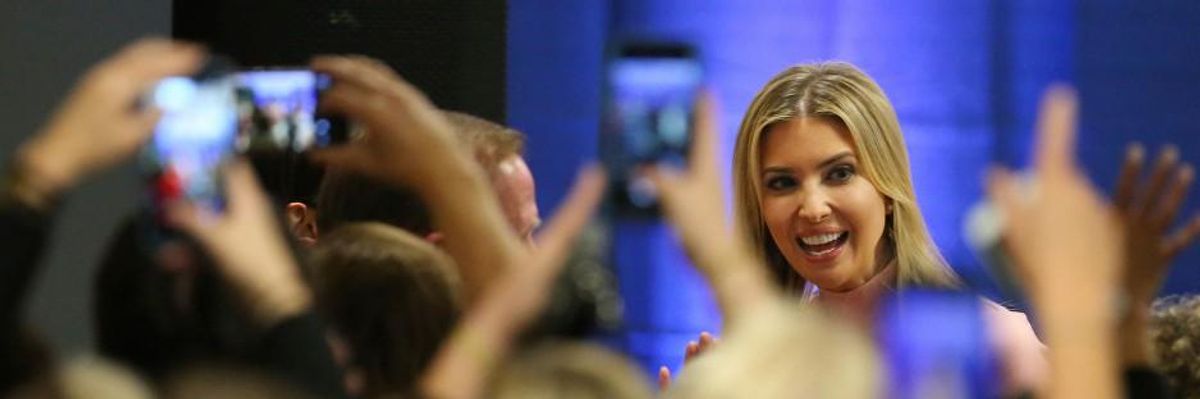
White House senior adviser Ivanka Trump during a town hall meeting on Tax Reform at the Northampton Township Senior Center in Richboro, Pa., Monday Oct. 23, 2017. (AP/Rich Schultz)
On Monday, Ivanka Trump kicked off her tour to stump for the Trump administration's tax package with a town hall in Bucks County, Pennsylvania. She pitched an increased Child Tax Credit as a way to help families struggling with high child care costs and noted that the United States invests relatively little in early childhood education compared with other countries. Given how much Ivanka Trump's reputation has suffered as she's failed to impact White House policy on issues such as climate change and gender equity, she needs to show that she can deliver on promises she made during the campaign to make child care more affordable.
The details of the Child Tax Credit are not yet public, including the amount of the expansion and whether she would make changes to help children in families with very low incomes who cannot currently receive the full credit. But one thing is very, very clear: This credit is clearly designed to help make the Trump tax plan, which is heavily skewed toward tax breaks for the wealthy, more politically palatable.
The nonpartisan Tax Policy Center found that 80 percent of the tax breaks would go to people in the top 1 percent of earners. In other words, people like Ivanka Trump.
Just repealing the estate tax--which is only one of many planned tax cuts--would amount to a $1.1 billion windfall for Ivanka Trump and her siblings. That's enough to pay for 100,000 children to go to child care for an entire year. And that's before accounting for the trillions it would cost to slash the top income tax rate, give low rates to pass-through businesses, and re-open loopholes for the wealthy.
But Trump, the dutiful soldier, is sticking to her message. That means continuing to insist that her child care plan will support most Americans, even though the plan she pitched during the campaign would have given the average family in a county that swung heavily toward Trump in the 2016 presidential election just $5.55 per year. (Residents in Ivanka Trump's former Manhattan neighborhood would stand to gain more than $7,000 in tax benefits.) A year later, the same principles apply. The Trump administration is looking to use empty rhetoric to appeal to working women to sell a major tax break for wealthy people like her.
To be clear, the Child Tax Credit can provide a vehicle for improving economic security among families with young children. The Center on Budget and Policy Priorities estimates that 16 million children in low-income working families would not receive the benefit because their families' earnings are too low. Proposals to make the credit refundable would allow lower-income families to actually benefit, and proposals to make it more generous could go a long way to defray costs associated with raising children.
If she wanted, Ivanka Trump could go even further than taxes. She could support Sen. Patty Murray (D-WA) and Rep. Bobby Scott's (D-VA) bill to guarantee child care assistance to low-income and middle-class families, or she could challenge her father's requests to cut the program that offers child care assistance to low-income working families and eliminate on-campus child care and afterschool programs.
Or, if taxes are really what speak to her, she could move on to expanding child care assistance through the Child and Dependent Care Tax Credit (CDCTC). Right now, the CDCTC primarily reaches upper-middle-class families, and the $1,050-per-child credit pales in comparison to the $10,000 annual price tag at a child care center.
If Ivanka Trump wanted to make a difference, there's no shortage of ideas. But instead, she's selling another "by Ivanka, for Ivanka" child care plan that won't work for the millions of families who struggle to pay for the child care they need.
Dear Common Dreams reader, It’s been nearly 30 years since I co-founded Common Dreams with my late wife, Lina Newhouser. We had the radical notion that journalism should serve the public good, not corporate profits. It was clear to us from the outset what it would take to build such a project. No paid advertisements. No corporate sponsors. No millionaire publisher telling us what to think or do. Many people said we wouldn't last a year, but we proved those doubters wrong. Together with a tremendous team of journalists and dedicated staff, we built an independent media outlet free from the constraints of profits and corporate control. Our mission has always been simple: To inform. To inspire. To ignite change for the common good. Building Common Dreams was not easy. Our survival was never guaranteed. When you take on the most powerful forces—Wall Street greed, fossil fuel industry destruction, Big Tech lobbyists, and uber-rich oligarchs who have spent billions upon billions rigging the economy and democracy in their favor—the only bulwark you have is supporters who believe in your work. But here’s the urgent message from me today. It's never been this bad out there. And it's never been this hard to keep us going. At the very moment Common Dreams is most needed, the threats we face are intensifying. We need your support now more than ever. We don't accept corporate advertising and never will. We don't have a paywall because we don't think people should be blocked from critical news based on their ability to pay. Everything we do is funded by the donations of readers like you. When everyone does the little they can afford, we are strong. But if that support retreats or dries up, so do we. Will you donate now to make sure Common Dreams not only survives but thrives? —Craig Brown, Co-founder |
On Monday, Ivanka Trump kicked off her tour to stump for the Trump administration's tax package with a town hall in Bucks County, Pennsylvania. She pitched an increased Child Tax Credit as a way to help families struggling with high child care costs and noted that the United States invests relatively little in early childhood education compared with other countries. Given how much Ivanka Trump's reputation has suffered as she's failed to impact White House policy on issues such as climate change and gender equity, she needs to show that she can deliver on promises she made during the campaign to make child care more affordable.
The details of the Child Tax Credit are not yet public, including the amount of the expansion and whether she would make changes to help children in families with very low incomes who cannot currently receive the full credit. But one thing is very, very clear: This credit is clearly designed to help make the Trump tax plan, which is heavily skewed toward tax breaks for the wealthy, more politically palatable.
The nonpartisan Tax Policy Center found that 80 percent of the tax breaks would go to people in the top 1 percent of earners. In other words, people like Ivanka Trump.
Just repealing the estate tax--which is only one of many planned tax cuts--would amount to a $1.1 billion windfall for Ivanka Trump and her siblings. That's enough to pay for 100,000 children to go to child care for an entire year. And that's before accounting for the trillions it would cost to slash the top income tax rate, give low rates to pass-through businesses, and re-open loopholes for the wealthy.
But Trump, the dutiful soldier, is sticking to her message. That means continuing to insist that her child care plan will support most Americans, even though the plan she pitched during the campaign would have given the average family in a county that swung heavily toward Trump in the 2016 presidential election just $5.55 per year. (Residents in Ivanka Trump's former Manhattan neighborhood would stand to gain more than $7,000 in tax benefits.) A year later, the same principles apply. The Trump administration is looking to use empty rhetoric to appeal to working women to sell a major tax break for wealthy people like her.
To be clear, the Child Tax Credit can provide a vehicle for improving economic security among families with young children. The Center on Budget and Policy Priorities estimates that 16 million children in low-income working families would not receive the benefit because their families' earnings are too low. Proposals to make the credit refundable would allow lower-income families to actually benefit, and proposals to make it more generous could go a long way to defray costs associated with raising children.
If she wanted, Ivanka Trump could go even further than taxes. She could support Sen. Patty Murray (D-WA) and Rep. Bobby Scott's (D-VA) bill to guarantee child care assistance to low-income and middle-class families, or she could challenge her father's requests to cut the program that offers child care assistance to low-income working families and eliminate on-campus child care and afterschool programs.
Or, if taxes are really what speak to her, she could move on to expanding child care assistance through the Child and Dependent Care Tax Credit (CDCTC). Right now, the CDCTC primarily reaches upper-middle-class families, and the $1,050-per-child credit pales in comparison to the $10,000 annual price tag at a child care center.
If Ivanka Trump wanted to make a difference, there's no shortage of ideas. But instead, she's selling another "by Ivanka, for Ivanka" child care plan that won't work for the millions of families who struggle to pay for the child care they need.
On Monday, Ivanka Trump kicked off her tour to stump for the Trump administration's tax package with a town hall in Bucks County, Pennsylvania. She pitched an increased Child Tax Credit as a way to help families struggling with high child care costs and noted that the United States invests relatively little in early childhood education compared with other countries. Given how much Ivanka Trump's reputation has suffered as she's failed to impact White House policy on issues such as climate change and gender equity, she needs to show that she can deliver on promises she made during the campaign to make child care more affordable.
The details of the Child Tax Credit are not yet public, including the amount of the expansion and whether she would make changes to help children in families with very low incomes who cannot currently receive the full credit. But one thing is very, very clear: This credit is clearly designed to help make the Trump tax plan, which is heavily skewed toward tax breaks for the wealthy, more politically palatable.
The nonpartisan Tax Policy Center found that 80 percent of the tax breaks would go to people in the top 1 percent of earners. In other words, people like Ivanka Trump.
Just repealing the estate tax--which is only one of many planned tax cuts--would amount to a $1.1 billion windfall for Ivanka Trump and her siblings. That's enough to pay for 100,000 children to go to child care for an entire year. And that's before accounting for the trillions it would cost to slash the top income tax rate, give low rates to pass-through businesses, and re-open loopholes for the wealthy.
But Trump, the dutiful soldier, is sticking to her message. That means continuing to insist that her child care plan will support most Americans, even though the plan she pitched during the campaign would have given the average family in a county that swung heavily toward Trump in the 2016 presidential election just $5.55 per year. (Residents in Ivanka Trump's former Manhattan neighborhood would stand to gain more than $7,000 in tax benefits.) A year later, the same principles apply. The Trump administration is looking to use empty rhetoric to appeal to working women to sell a major tax break for wealthy people like her.
To be clear, the Child Tax Credit can provide a vehicle for improving economic security among families with young children. The Center on Budget and Policy Priorities estimates that 16 million children in low-income working families would not receive the benefit because their families' earnings are too low. Proposals to make the credit refundable would allow lower-income families to actually benefit, and proposals to make it more generous could go a long way to defray costs associated with raising children.
If she wanted, Ivanka Trump could go even further than taxes. She could support Sen. Patty Murray (D-WA) and Rep. Bobby Scott's (D-VA) bill to guarantee child care assistance to low-income and middle-class families, or she could challenge her father's requests to cut the program that offers child care assistance to low-income working families and eliminate on-campus child care and afterschool programs.
Or, if taxes are really what speak to her, she could move on to expanding child care assistance through the Child and Dependent Care Tax Credit (CDCTC). Right now, the CDCTC primarily reaches upper-middle-class families, and the $1,050-per-child credit pales in comparison to the $10,000 annual price tag at a child care center.
If Ivanka Trump wanted to make a difference, there's no shortage of ideas. But instead, she's selling another "by Ivanka, for Ivanka" child care plan that won't work for the millions of families who struggle to pay for the child care they need.