SUBSCRIBE TO OUR FREE NEWSLETTER
Daily news & progressive opinion—funded by the people, not the corporations—delivered straight to your inbox.
5
#000000
#FFFFFF
To donate by check, phone, or other method, see our More Ways to Give page.
Daily news & progressive opinion—funded by the people, not the corporations—delivered straight to your inbox.
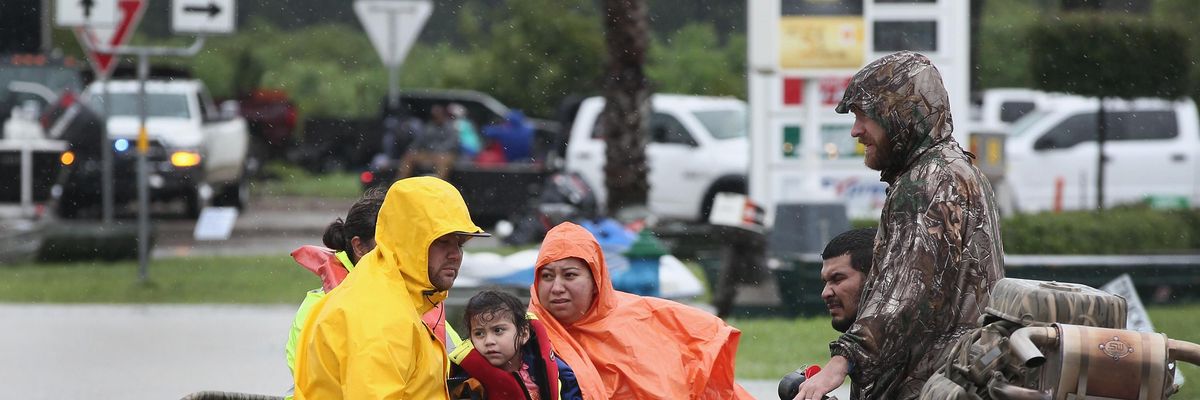
Rescue workers and volunteers help residents make their way out of a flooded neighborhood after it was inundated with rain water following Hurricane Harvey on August 29, 2017 in Houston, Texas. Harvey, which made landfall north of Corpus Christi August 25, has dumped nearly 50 inches of rain in and around areas Houston. (Photo: Scott Olson/Getty Images)
The flood waters are still rising in Texas, swallowing up homes and whole communities. Rain is predicted to continue for days. Our hearts go out to those who have lost lives, family members, homes and possessions, including the many on this list who have been affected or are still in the storm's path
The flood waters are still rising in Texas, swallowing up homes and whole communities. Rain is predicted to continue for days. Our hearts go out to those who have lost lives, family members, homes and possessions, including the many on this list who have been affected or are still in the storm's path
While Hurricane Harvey is "unprecedented" in its destructive power, it is not unexpected by those who take climate science seriously. It is not an aberration, but rather a symptom of the climate crisis. Indeed, flooding in Bangladesh, Nepal and India has killed 1,200 people this month.
The devastation and chaos of Hurricane Harvey is a preview of the future we are hurtling towards; the future we are choosing by remaining passive in the face of the existential climate threat.
It makes brutally clear the insufficiency of carbon gradualism -- the idea that we should reduce emissions slowly over time. The earth is already too hot. The only sane, moral option is to mobilize to eliminate emissions as quickly as possible and draw down excess greenhouse gases from our atmosphere.
Hurricane Harvey also reminds us what heroism looks like. Young people are rescuing their neighbors in boats; traffic is backed up because so many people are bringing their boats into the flood zone. They are there to "try to save some lives."
Rebecca Solnit writes that, in times of emergency, we remember that we are, in fact "our brother's keeper, and that purposefulness and connectedness bring joy even amid death, chaos, fear, and loss"
The Climate Mobilization's goal is to catalyze this heroic response, en masse, to solving the climate crisis itself. Will our heroism only come out in responding to the symptoms of the climate crisis? Can we model ourselves on those who dropped everything to become rescuers? Can we make sacrifices, rearrange our lives, and dedicate ourselves to bringing about emergency climate mobilization?
These seem to me the basic questions that will determine humanity's fate, and that of the natural world. At The Climate Mobilization, we are dedicated to achieving this heroic, all-hands-on-deck response to the climate emergency. Here are our open positions for volunteers, and we are always looking for people to organize their communities. We hope you join us.
Dear Common Dreams reader, It’s been nearly 30 years since I co-founded Common Dreams with my late wife, Lina Newhouser. We had the radical notion that journalism should serve the public good, not corporate profits. It was clear to us from the outset what it would take to build such a project. No paid advertisements. No corporate sponsors. No millionaire publisher telling us what to think or do. Many people said we wouldn't last a year, but we proved those doubters wrong. Together with a tremendous team of journalists and dedicated staff, we built an independent media outlet free from the constraints of profits and corporate control. Our mission has always been simple: To inform. To inspire. To ignite change for the common good. Building Common Dreams was not easy. Our survival was never guaranteed. When you take on the most powerful forces—Wall Street greed, fossil fuel industry destruction, Big Tech lobbyists, and uber-rich oligarchs who have spent billions upon billions rigging the economy and democracy in their favor—the only bulwark you have is supporters who believe in your work. But here’s the urgent message from me today. It's never been this bad out there. And it's never been this hard to keep us going. At the very moment Common Dreams is most needed, the threats we face are intensifying. We need your support now more than ever. We don't accept corporate advertising and never will. We don't have a paywall because we don't think people should be blocked from critical news based on their ability to pay. Everything we do is funded by the donations of readers like you. When everyone does the little they can afford, we are strong. But if that support retreats or dries up, so do we. Will you donate now to make sure Common Dreams not only survives but thrives? —Craig Brown, Co-founder |
Margaret Klein Salamon, PhD, is a clinical psychologist turned climate activist and thought leader. Her work helps people face the frightening, painful truths of the climate emergency and empowers all of us to transform despair into effective "emergency mode" action. Her book, Facing the Climate Emergency: How to Transform Yourself with Climate Truth (2023), is a radical self-help guide.
As the Executive Director of the Climate Emergency Fund, Margaret fundraises for and strategically deploys financial resources to high-impact disruptive protest campaigns. Her project Climate Awakening allows people to call into a video chatfrom all over the world and share their climate emotions.
The flood waters are still rising in Texas, swallowing up homes and whole communities. Rain is predicted to continue for days. Our hearts go out to those who have lost lives, family members, homes and possessions, including the many on this list who have been affected or are still in the storm's path
While Hurricane Harvey is "unprecedented" in its destructive power, it is not unexpected by those who take climate science seriously. It is not an aberration, but rather a symptom of the climate crisis. Indeed, flooding in Bangladesh, Nepal and India has killed 1,200 people this month.
The devastation and chaos of Hurricane Harvey is a preview of the future we are hurtling towards; the future we are choosing by remaining passive in the face of the existential climate threat.
It makes brutally clear the insufficiency of carbon gradualism -- the idea that we should reduce emissions slowly over time. The earth is already too hot. The only sane, moral option is to mobilize to eliminate emissions as quickly as possible and draw down excess greenhouse gases from our atmosphere.
Hurricane Harvey also reminds us what heroism looks like. Young people are rescuing their neighbors in boats; traffic is backed up because so many people are bringing their boats into the flood zone. They are there to "try to save some lives."
Rebecca Solnit writes that, in times of emergency, we remember that we are, in fact "our brother's keeper, and that purposefulness and connectedness bring joy even amid death, chaos, fear, and loss"
The Climate Mobilization's goal is to catalyze this heroic response, en masse, to solving the climate crisis itself. Will our heroism only come out in responding to the symptoms of the climate crisis? Can we model ourselves on those who dropped everything to become rescuers? Can we make sacrifices, rearrange our lives, and dedicate ourselves to bringing about emergency climate mobilization?
These seem to me the basic questions that will determine humanity's fate, and that of the natural world. At The Climate Mobilization, we are dedicated to achieving this heroic, all-hands-on-deck response to the climate emergency. Here are our open positions for volunteers, and we are always looking for people to organize their communities. We hope you join us.
Margaret Klein Salamon, PhD, is a clinical psychologist turned climate activist and thought leader. Her work helps people face the frightening, painful truths of the climate emergency and empowers all of us to transform despair into effective "emergency mode" action. Her book, Facing the Climate Emergency: How to Transform Yourself with Climate Truth (2023), is a radical self-help guide.
As the Executive Director of the Climate Emergency Fund, Margaret fundraises for and strategically deploys financial resources to high-impact disruptive protest campaigns. Her project Climate Awakening allows people to call into a video chatfrom all over the world and share their climate emotions.
The flood waters are still rising in Texas, swallowing up homes and whole communities. Rain is predicted to continue for days. Our hearts go out to those who have lost lives, family members, homes and possessions, including the many on this list who have been affected or are still in the storm's path
While Hurricane Harvey is "unprecedented" in its destructive power, it is not unexpected by those who take climate science seriously. It is not an aberration, but rather a symptom of the climate crisis. Indeed, flooding in Bangladesh, Nepal and India has killed 1,200 people this month.
The devastation and chaos of Hurricane Harvey is a preview of the future we are hurtling towards; the future we are choosing by remaining passive in the face of the existential climate threat.
It makes brutally clear the insufficiency of carbon gradualism -- the idea that we should reduce emissions slowly over time. The earth is already too hot. The only sane, moral option is to mobilize to eliminate emissions as quickly as possible and draw down excess greenhouse gases from our atmosphere.
Hurricane Harvey also reminds us what heroism looks like. Young people are rescuing their neighbors in boats; traffic is backed up because so many people are bringing their boats into the flood zone. They are there to "try to save some lives."
Rebecca Solnit writes that, in times of emergency, we remember that we are, in fact "our brother's keeper, and that purposefulness and connectedness bring joy even amid death, chaos, fear, and loss"
The Climate Mobilization's goal is to catalyze this heroic response, en masse, to solving the climate crisis itself. Will our heroism only come out in responding to the symptoms of the climate crisis? Can we model ourselves on those who dropped everything to become rescuers? Can we make sacrifices, rearrange our lives, and dedicate ourselves to bringing about emergency climate mobilization?
These seem to me the basic questions that will determine humanity's fate, and that of the natural world. At The Climate Mobilization, we are dedicated to achieving this heroic, all-hands-on-deck response to the climate emergency. Here are our open positions for volunteers, and we are always looking for people to organize their communities. We hope you join us.