SUBSCRIBE TO OUR FREE NEWSLETTER
Daily news & progressive opinion—funded by the people, not the corporations—delivered straight to your inbox.
5
#000000
#FFFFFF
To donate by check, phone, or other method, see our More Ways to Give page.
The Dow closed the week at a record high. And all those billionaires? They're barely even an exclusive club anymore, what with 442 in the U.S. in 2012 and almost a thousand more than that globally, a jump of 200 in a single year, Forbes data shows.
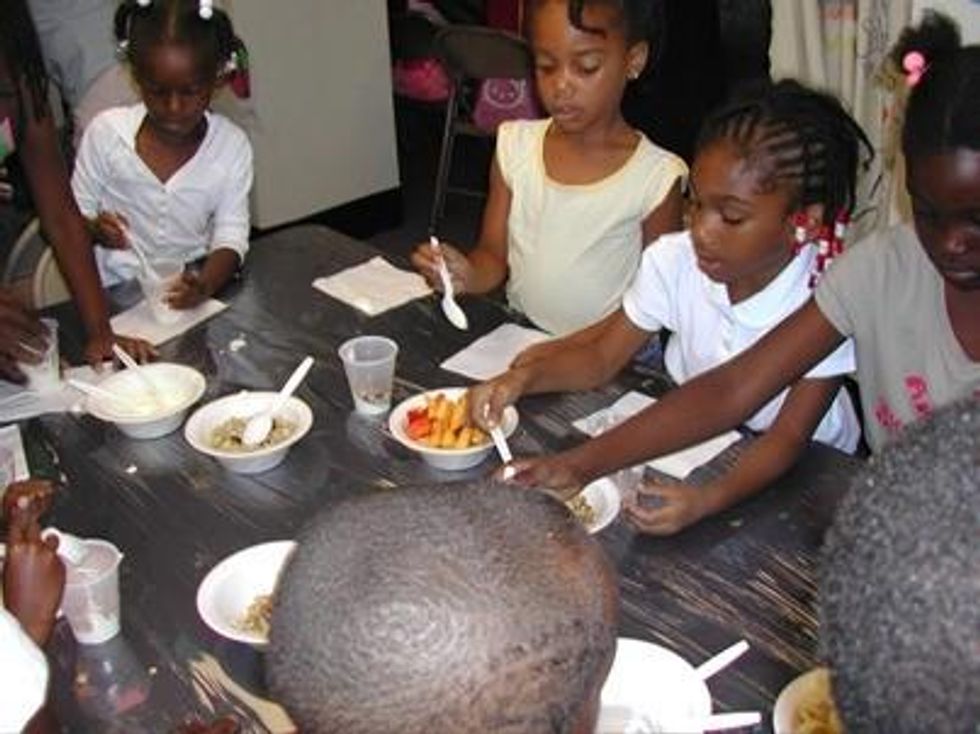
So why is it OK for working Americans to go hungry? Why in the midst such affluence for the wealthy do we, as a nation, simply turn our back on those struggling, even when they are lucky enough to land a job and work for a living?
To me, it is the shrug with which most Americans seem to greet such questions today that offers the most alarming evidence we live in a broken and declining society. Sure, each month we wait with anticipation for the job growth and unemployment data. Today public radio was abuzz with excitement at the better-than-anticipated numbers for new job creation in October.
I'm all for success; we need a whole lot more. But why do we barely notice the figures about failure -- not the failure of individuals, but the failure of a society to take care of its children, its disabled, its old people? The failure of that society -- our society -- to even acknowledge it's wrong to let people starve in the midst of affluence.
Below the fold in today's New York Times, below all the excitement about Twitter's public offering on the market, is a smallish article is titled "Cut in Food Stamps Forces Hard Choices on Poor."
It tells the story of peple like Rafaela Rivera, a home health aide who earns $10 an hour. Her husband is on disability. They support a household of four. They already supplement the money for food they get from food stamps with handouts from food kitchens. But on Nov. 1, Rafaela Rivera took a $36 cut in her food stamps. She's one of millions who saw her benefits nibbled on the same day.
"Your not dealing with big numbers," Christopher Bean, executive director of Part of the Solution, told the paper in a web video accompanying the article. "Maybe for a lot of people $36 doesn't seem like a lot. If you're a family that's relying on $300 to $400 just to go everywhere, $36 is huge."
A few weeks ago, Charles Blow wrote a column for The Times that once again noted the growing disparity between rich and everyone else. It was titled "Billionaires' Row and Welfare Lines."
He noted that while the rich are getting richer, U.S. Census data shows that the median income in the country, in real purchasing power, has declined more than 8 percent since the last recession began in 2007. And he quoted from a Pew Research Center report that noted:
During the first two years of the nation's economic recovery, the mean net worth of households in the upper 7 percent of the wealth distribution rose by an estimated 28 percent, while the mean net worth of households in the lower 93 percent dropped by 4 percent.
But the numbers don't tell the stories of the country's Rafaela Riveras, people struggling to feed their families, working people. They're at the bottom of the food chain, and there are many of them, quietly I'll bet, even in middle-class communities. They are the one in seven Americans on food stamps today, most of them living below the poverty level. Last year these Americans, many working, many others disabled, cost the government more than $78 billion. It's a record, though still much less than a fifth of the U.S. annual defense budget, the world's largest.
And soon that percentage spent on food stamps will drop further, perhaps dramatically so. The U.S. House of Representatives has passed a bill that would cut the food stamp budget in half over a decade's time. The Senate, meanwhile, has proposed cuts of "only" $4.5 billion, an amount on a par with what's rippled down in cuts of $10 and $20 and $30 a month to millions of recipients this November, causing so much hardship.
Congress, of course, deals with data -- numbers -- not people. These times are just fine for the constituents who lobby them and who pay their campaign bills. But real people, people like the Riveras, will have limited choices as Congress continues to turn the screws -- scavange for more food in kitchen pantries, go hungry or steal.
Tell me. Doesn't that bother you just a little?
The Dow closed the week at a record high. And all those billionaires? They're barely even an exclusive club anymore, what with 442 in the U.S. in 2012 and almost a thousand more than that globally, a jump of 200 in a single year, Forbes data shows.
So why is it OK for working Americans to go hungry? Why in the midst such affluence for the wealthy do we, as a nation, simply turn our back on those struggling, even when they are lucky enough to land a job and work for a living?
To me, it is the shrug with which most Americans seem to greet such questions today that offers the most alarming evidence we live in a broken and declining society. Sure, each month we wait with anticipation for the job growth and unemployment data. Today public radio was abuzz with excitement at the better-than-anticipated numbers for new job creation in October.
I'm all for success; we need a whole lot more. But why do we barely notice the figures about failure -- not the failure of individuals, but the failure of a society to take care of its children, its disabled, its old people? The failure of that society -- our society -- to even acknowledge it's wrong to let people starve in the midst of affluence.
Below the fold in today's New York Times, below all the excitement about Twitter's public offering on the market, is a smallish article is titled "Cut in Food Stamps Forces Hard Choices on Poor."
It tells the story of peple like Rafaela Rivera, a home health aide who earns $10 an hour. Her husband is on disability. They support a household of four. They already supplement the money for food they get from food stamps with handouts from food kitchens. But on Nov. 1, Rafaela Rivera took a $36 cut in her food stamps. She's one of millions who saw her benefits nibbled on the same day.
"Your not dealing with big numbers," Christopher Bean, executive director of Part of the Solution, told the paper in a web video accompanying the article. "Maybe for a lot of people $36 doesn't seem like a lot. If you're a family that's relying on $300 to $400 just to go everywhere, $36 is huge."
A few weeks ago, Charles Blow wrote a column for The Times that once again noted the growing disparity between rich and everyone else. It was titled "Billionaires' Row and Welfare Lines."
He noted that while the rich are getting richer, U.S. Census data shows that the median income in the country, in real purchasing power, has declined more than 8 percent since the last recession began in 2007. And he quoted from a Pew Research Center report that noted:
During the first two years of the nation's economic recovery, the mean net worth of households in the upper 7 percent of the wealth distribution rose by an estimated 28 percent, while the mean net worth of households in the lower 93 percent dropped by 4 percent.
But the numbers don't tell the stories of the country's Rafaela Riveras, people struggling to feed their families, working people. They're at the bottom of the food chain, and there are many of them, quietly I'll bet, even in middle-class communities. They are the one in seven Americans on food stamps today, most of them living below the poverty level. Last year these Americans, many working, many others disabled, cost the government more than $78 billion. It's a record, though still much less than a fifth of the U.S. annual defense budget, the world's largest.
And soon that percentage spent on food stamps will drop further, perhaps dramatically so. The U.S. House of Representatives has passed a bill that would cut the food stamp budget in half over a decade's time. The Senate, meanwhile, has proposed cuts of "only" $4.5 billion, an amount on a par with what's rippled down in cuts of $10 and $20 and $30 a month to millions of recipients this November, causing so much hardship.
Congress, of course, deals with data -- numbers -- not people. These times are just fine for the constituents who lobby them and who pay their campaign bills. But real people, people like the Riveras, will have limited choices as Congress continues to turn the screws -- scavange for more food in kitchen pantries, go hungry or steal.
Tell me. Doesn't that bother you just a little?
The Dow closed the week at a record high. And all those billionaires? They're barely even an exclusive club anymore, what with 442 in the U.S. in 2012 and almost a thousand more than that globally, a jump of 200 in a single year, Forbes data shows.
So why is it OK for working Americans to go hungry? Why in the midst such affluence for the wealthy do we, as a nation, simply turn our back on those struggling, even when they are lucky enough to land a job and work for a living?
To me, it is the shrug with which most Americans seem to greet such questions today that offers the most alarming evidence we live in a broken and declining society. Sure, each month we wait with anticipation for the job growth and unemployment data. Today public radio was abuzz with excitement at the better-than-anticipated numbers for new job creation in October.
I'm all for success; we need a whole lot more. But why do we barely notice the figures about failure -- not the failure of individuals, but the failure of a society to take care of its children, its disabled, its old people? The failure of that society -- our society -- to even acknowledge it's wrong to let people starve in the midst of affluence.
Below the fold in today's New York Times, below all the excitement about Twitter's public offering on the market, is a smallish article is titled "Cut in Food Stamps Forces Hard Choices on Poor."
It tells the story of peple like Rafaela Rivera, a home health aide who earns $10 an hour. Her husband is on disability. They support a household of four. They already supplement the money for food they get from food stamps with handouts from food kitchens. But on Nov. 1, Rafaela Rivera took a $36 cut in her food stamps. She's one of millions who saw her benefits nibbled on the same day.
"Your not dealing with big numbers," Christopher Bean, executive director of Part of the Solution, told the paper in a web video accompanying the article. "Maybe for a lot of people $36 doesn't seem like a lot. If you're a family that's relying on $300 to $400 just to go everywhere, $36 is huge."
A few weeks ago, Charles Blow wrote a column for The Times that once again noted the growing disparity between rich and everyone else. It was titled "Billionaires' Row and Welfare Lines."
He noted that while the rich are getting richer, U.S. Census data shows that the median income in the country, in real purchasing power, has declined more than 8 percent since the last recession began in 2007. And he quoted from a Pew Research Center report that noted:
During the first two years of the nation's economic recovery, the mean net worth of households in the upper 7 percent of the wealth distribution rose by an estimated 28 percent, while the mean net worth of households in the lower 93 percent dropped by 4 percent.
But the numbers don't tell the stories of the country's Rafaela Riveras, people struggling to feed their families, working people. They're at the bottom of the food chain, and there are many of them, quietly I'll bet, even in middle-class communities. They are the one in seven Americans on food stamps today, most of them living below the poverty level. Last year these Americans, many working, many others disabled, cost the government more than $78 billion. It's a record, though still much less than a fifth of the U.S. annual defense budget, the world's largest.
And soon that percentage spent on food stamps will drop further, perhaps dramatically so. The U.S. House of Representatives has passed a bill that would cut the food stamp budget in half over a decade's time. The Senate, meanwhile, has proposed cuts of "only" $4.5 billion, an amount on a par with what's rippled down in cuts of $10 and $20 and $30 a month to millions of recipients this November, causing so much hardship.
Congress, of course, deals with data -- numbers -- not people. These times are just fine for the constituents who lobby them and who pay their campaign bills. But real people, people like the Riveras, will have limited choices as Congress continues to turn the screws -- scavange for more food in kitchen pantries, go hungry or steal.
Tell me. Doesn't that bother you just a little?