

"[Sequestration] has not produced what the Obama administration predicted: widespread breakdowns in crucial government services," David Fahrenthold and Lisa Rein wrote in The Washington Post.
The general consensus appeared to be that since planes were still taking off from the major airports and poor people weren't starving to death in the streets, the budgets cuts simply weren't that bad.
But as the months continue to roll by, we're now beginning to see that the consequences of austerity are very real, and only getting worse.
Nationwide, states are making severe cuts to their social safety net programs.
Kansas plans to throw more than a fifth of its nearly 90,000 unemployed residents off of the food stamp rolls by reinstating federal work requirements for the program that are normally waived during times of unusually high unemployment, ThinkProgress reports.
The Department for Children and Families projected that 20,000 unemployed Kansans currently on food assistance will be affected.
Federal rules for food assistance require able-bodied recipients who do not have dependent children (a very small percentage of food stamp recipients) work at least twenty hours per week in order to receive the aid for longer than three months, but states can waive that requirement when jobs are scarce, and many states have chosen to do so during the recession.
Kansas is the fifth state to reinstitute the work requirement, and ThinkProgress reports that Oklahoma and Wisconsin are poised to follow suit.
In Kentucky, tens of thousands of low-income people have seen childcare and kinship care all but eliminated from this year's budget.
Al Jazeera America reports that, with few exceptions, no new families will receive public childcare subsidies, and current recipients will be cut from the program if they earn more than 100 percent of the federal poverty level ($19,000 per year for a three-person household, the lowest eligibility rate of any state).
Furthermore, no additional families will get kinship care, which is a monthly subsidy that encourages relatives to take custody of orphaned, abused and neglected children (and runs half the cost of a foster care placement).
Earlier in the week, families rallied in Frankfort, the state capital, to protest the cuts.
"The rhetoric about what the cuts would do--which is what all of us were talking about in the spring--that rhetoric has now become a reality for folks," said Terry Brooks, executive director of Kentucky Youth Advocates. "We're beginning to feel the effects. We're beginning to hear stories about folks who were enrolled in community college last year who aren't going to be enrolled in community college this year because of childcare issues."
"I don't think it's fair to just cop out with, 'We don't have any money,'" Brooks said. "Well, we do have money. We have money for priorities. So the question is not whether we have money or not, the question is whether childcare supports and kinship care supports are priorities."
Head Start, the federal pre-K education service for low-income families, has eliminated services for more than 57,000 children in the coming school year as a result of sequestration.
In West Virginia alone, 461 fewer children will have access to Head Start this year than they did in 2012.
Bill Johnson of South Charleston told the Hampshire Review he's frustrated that Wall Street hedge-fund traders are still getting a big tax break when therapy for his 3-year-old autistic daughter is threatened by budget cuts.
Johnson says his daughter, Marissa, is at a stage where her entire ability to communicate could be threatened if she loses the services she gets from Head Start.
"A year and a half ago this child was completely non-verbal. She's now doing sign language, even starting to speak. If that had not occurred with Head Start, she would have been two and a half years without services," Johnson said.
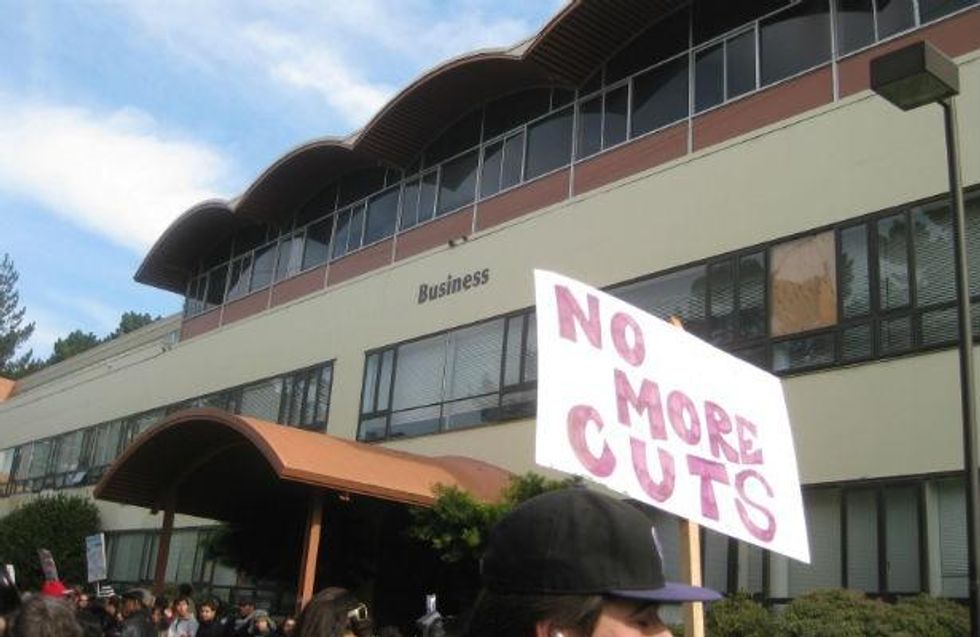
At the rally, people held signs with phrases like, "Education, not sequestration," and "Empty chairs, full jails."
Representative Nick Rahall (D-WV) said the cutbacks will "undoubtedly leave our children at a disadvantage when it comes to finding long-term academic success and a well-paying job."
In Texas, more than 4,000 kids are scheduled to lose services through Head Start.
But The Washington Post framed 57,000 kids' being cut from the program as a good thing because at least the projection wasn't as bad as the Department of Health and Human Services initial estimate, which placed the number at around 70,000 children.
One way to hide the effects of budget cuts is to implement austerity policies on marginalized or silenced minorities. Poor people and children don't have lobbying firms advocating on their behalf in Washington, so the rest of the country doesn't immediately feel the effects of starving them and cutting their services.
Then the establishment media, dominated by individuals who don't generally rely on services like Head Start and food assistance, step in to say: Gee, things don't look so bad from up here.
But the rot is still there, and it's spreading. A society cannot sustain itself by shutting down schools, cutting pre-K programs, and throwing the poor off food assistance.
"[Sequestration] has not produced what the Obama administration predicted: widespread breakdowns in crucial government services," David Fahrenthold and Lisa Rein wrote in The Washington Post.
The general consensus appeared to be that since planes were still taking off from the major airports and poor people weren't starving to death in the streets, the budgets cuts simply weren't that bad.
But as the months continue to roll by, we're now beginning to see that the consequences of austerity are very real, and only getting worse.
Nationwide, states are making severe cuts to their social safety net programs.
Kansas plans to throw more than a fifth of its nearly 90,000 unemployed residents off of the food stamp rolls by reinstating federal work requirements for the program that are normally waived during times of unusually high unemployment, ThinkProgress reports.
The Department for Children and Families projected that 20,000 unemployed Kansans currently on food assistance will be affected.
Federal rules for food assistance require able-bodied recipients who do not have dependent children (a very small percentage of food stamp recipients) work at least twenty hours per week in order to receive the aid for longer than three months, but states can waive that requirement when jobs are scarce, and many states have chosen to do so during the recession.
Kansas is the fifth state to reinstitute the work requirement, and ThinkProgress reports that Oklahoma and Wisconsin are poised to follow suit.
In Kentucky, tens of thousands of low-income people have seen childcare and kinship care all but eliminated from this year's budget.
Al Jazeera America reports that, with few exceptions, no new families will receive public childcare subsidies, and current recipients will be cut from the program if they earn more than 100 percent of the federal poverty level ($19,000 per year for a three-person household, the lowest eligibility rate of any state).
Furthermore, no additional families will get kinship care, which is a monthly subsidy that encourages relatives to take custody of orphaned, abused and neglected children (and runs half the cost of a foster care placement).
Earlier in the week, families rallied in Frankfort, the state capital, to protest the cuts.
"The rhetoric about what the cuts would do--which is what all of us were talking about in the spring--that rhetoric has now become a reality for folks," said Terry Brooks, executive director of Kentucky Youth Advocates. "We're beginning to feel the effects. We're beginning to hear stories about folks who were enrolled in community college last year who aren't going to be enrolled in community college this year because of childcare issues."
"I don't think it's fair to just cop out with, 'We don't have any money,'" Brooks said. "Well, we do have money. We have money for priorities. So the question is not whether we have money or not, the question is whether childcare supports and kinship care supports are priorities."
Head Start, the federal pre-K education service for low-income families, has eliminated services for more than 57,000 children in the coming school year as a result of sequestration.
In West Virginia alone, 461 fewer children will have access to Head Start this year than they did in 2012.
Bill Johnson of South Charleston told the Hampshire Review he's frustrated that Wall Street hedge-fund traders are still getting a big tax break when therapy for his 3-year-old autistic daughter is threatened by budget cuts.
Johnson says his daughter, Marissa, is at a stage where her entire ability to communicate could be threatened if she loses the services she gets from Head Start.
"A year and a half ago this child was completely non-verbal. She's now doing sign language, even starting to speak. If that had not occurred with Head Start, she would have been two and a half years without services," Johnson said.
At the rally, people held signs with phrases like, "Education, not sequestration," and "Empty chairs, full jails."
Representative Nick Rahall (D-WV) said the cutbacks will "undoubtedly leave our children at a disadvantage when it comes to finding long-term academic success and a well-paying job."
In Texas, more than 4,000 kids are scheduled to lose services through Head Start.
But The Washington Post framed 57,000 kids' being cut from the program as a good thing because at least the projection wasn't as bad as the Department of Health and Human Services initial estimate, which placed the number at around 70,000 children.
One way to hide the effects of budget cuts is to implement austerity policies on marginalized or silenced minorities. Poor people and children don't have lobbying firms advocating on their behalf in Washington, so the rest of the country doesn't immediately feel the effects of starving them and cutting their services.
Then the establishment media, dominated by individuals who don't generally rely on services like Head Start and food assistance, step in to say: Gee, things don't look so bad from up here.
But the rot is still there, and it's spreading. A society cannot sustain itself by shutting down schools, cutting pre-K programs, and throwing the poor off food assistance.
"[Sequestration] has not produced what the Obama administration predicted: widespread breakdowns in crucial government services," David Fahrenthold and Lisa Rein wrote in The Washington Post.
The general consensus appeared to be that since planes were still taking off from the major airports and poor people weren't starving to death in the streets, the budgets cuts simply weren't that bad.
But as the months continue to roll by, we're now beginning to see that the consequences of austerity are very real, and only getting worse.
Nationwide, states are making severe cuts to their social safety net programs.
Kansas plans to throw more than a fifth of its nearly 90,000 unemployed residents off of the food stamp rolls by reinstating federal work requirements for the program that are normally waived during times of unusually high unemployment, ThinkProgress reports.
The Department for Children and Families projected that 20,000 unemployed Kansans currently on food assistance will be affected.
Federal rules for food assistance require able-bodied recipients who do not have dependent children (a very small percentage of food stamp recipients) work at least twenty hours per week in order to receive the aid for longer than three months, but states can waive that requirement when jobs are scarce, and many states have chosen to do so during the recession.
Kansas is the fifth state to reinstitute the work requirement, and ThinkProgress reports that Oklahoma and Wisconsin are poised to follow suit.
In Kentucky, tens of thousands of low-income people have seen childcare and kinship care all but eliminated from this year's budget.
Al Jazeera America reports that, with few exceptions, no new families will receive public childcare subsidies, and current recipients will be cut from the program if they earn more than 100 percent of the federal poverty level ($19,000 per year for a three-person household, the lowest eligibility rate of any state).
Furthermore, no additional families will get kinship care, which is a monthly subsidy that encourages relatives to take custody of orphaned, abused and neglected children (and runs half the cost of a foster care placement).
Earlier in the week, families rallied in Frankfort, the state capital, to protest the cuts.
"The rhetoric about what the cuts would do--which is what all of us were talking about in the spring--that rhetoric has now become a reality for folks," said Terry Brooks, executive director of Kentucky Youth Advocates. "We're beginning to feel the effects. We're beginning to hear stories about folks who were enrolled in community college last year who aren't going to be enrolled in community college this year because of childcare issues."
"I don't think it's fair to just cop out with, 'We don't have any money,'" Brooks said. "Well, we do have money. We have money for priorities. So the question is not whether we have money or not, the question is whether childcare supports and kinship care supports are priorities."
Head Start, the federal pre-K education service for low-income families, has eliminated services for more than 57,000 children in the coming school year as a result of sequestration.
In West Virginia alone, 461 fewer children will have access to Head Start this year than they did in 2012.
Bill Johnson of South Charleston told the Hampshire Review he's frustrated that Wall Street hedge-fund traders are still getting a big tax break when therapy for his 3-year-old autistic daughter is threatened by budget cuts.
Johnson says his daughter, Marissa, is at a stage where her entire ability to communicate could be threatened if she loses the services she gets from Head Start.
"A year and a half ago this child was completely non-verbal. She's now doing sign language, even starting to speak. If that had not occurred with Head Start, she would have been two and a half years without services," Johnson said.
At the rally, people held signs with phrases like, "Education, not sequestration," and "Empty chairs, full jails."
Representative Nick Rahall (D-WV) said the cutbacks will "undoubtedly leave our children at a disadvantage when it comes to finding long-term academic success and a well-paying job."
In Texas, more than 4,000 kids are scheduled to lose services through Head Start.
But The Washington Post framed 57,000 kids' being cut from the program as a good thing because at least the projection wasn't as bad as the Department of Health and Human Services initial estimate, which placed the number at around 70,000 children.
One way to hide the effects of budget cuts is to implement austerity policies on marginalized or silenced minorities. Poor people and children don't have lobbying firms advocating on their behalf in Washington, so the rest of the country doesn't immediately feel the effects of starving them and cutting their services.
Then the establishment media, dominated by individuals who don't generally rely on services like Head Start and food assistance, step in to say: Gee, things don't look so bad from up here.
But the rot is still there, and it's spreading. A society cannot sustain itself by shutting down schools, cutting pre-K programs, and throwing the poor off food assistance.