
The State Department's "don't worry" environmental impact statement for the proposed Keystone XL tarsands pipeline, released late Friday afternoon, was written not by government officials but by a private company in the pay of the pipeline's owner. The "sustainability consultancy" Environmental Resources Management (ERM) was paid an undisclosed amount under contract to TransCanada to write the statement, which is now an official government document. The statement estimates, and then dismisses, the pipeline's massive carbon footprint and other environmental impacts, because, it asserts, the mining and burning of the tar sands is unstoppable.
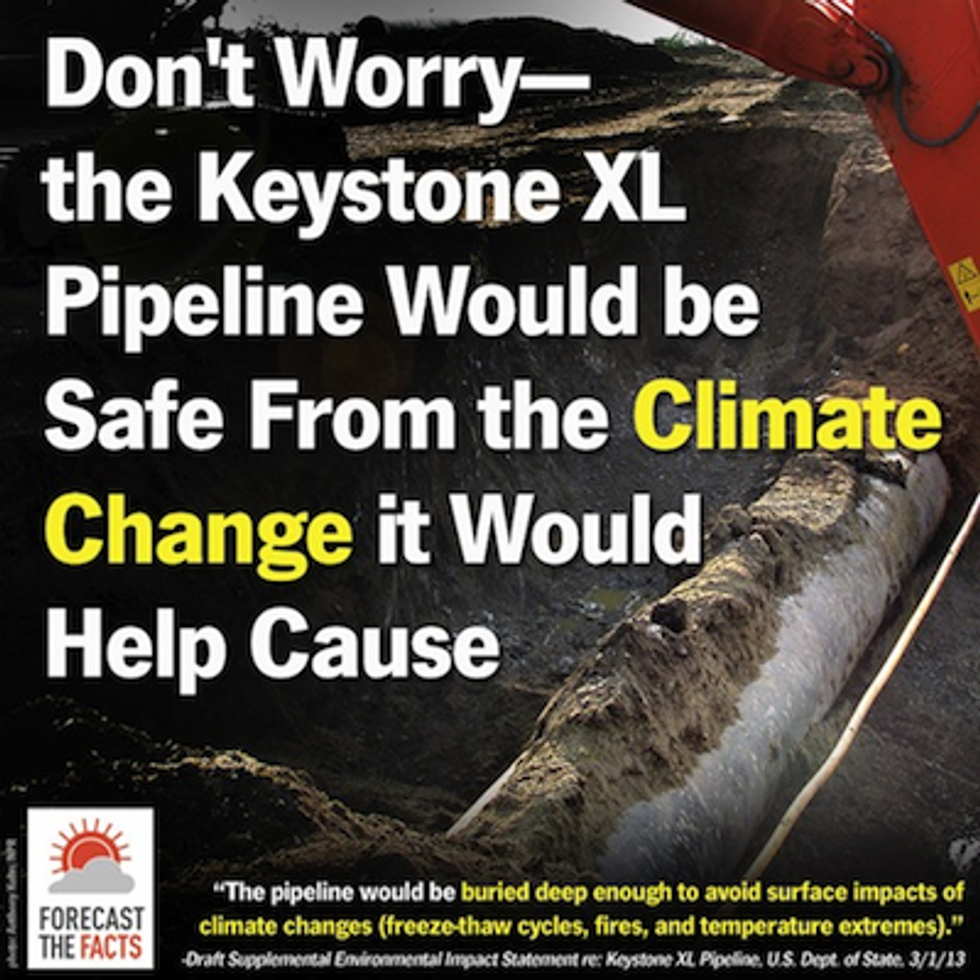
The department's contractor-written Draft Supplemental Environmental Impact Statement even says the pipeline will be safe from the climate impacts to which it will contribute.
The documents from the ERM-TransCanada agreement are on the State Department's website, but payment amounts and other clients and past work of ERM are redacted. In the contract documents, ERM partner Steven J. Koster certifies that his company has no conflicts of interest. He also certifies that ERM has no business relationship with TransCanada or "any business entity that could be affected in any way by the proposed work" (notwithstanding the impact statement contract itself). In a cover letter, Koster promises State Department NEPA Coordinator Genevieve Walker that ERM understands "the need for an efficient and expedited process to meet the demands of the desired project schedule."
An investigation by Inside Climate News finds that ERM's report draws from work done by other oil industry contractors, Ensys Energy and ICF International.
Because the impact statement was written by a TransCanada contractor, not by State Department officials, it should come as no surprise that it presents a worldview of a global economy inevitably dependent on dirty fossil fuels that is entirely at odds with the expressed views of Secretary of State John Kerry.
As Secretary of State John Kerry said six years ago, "we're on an urgent clock" to confront fossil-fueled climate change, which he compared to the threat of nuclear weaponry as a "man-made" and "uncontrolled" weapon with "the ability to change life as we know it on this Earth." Kerry's recognition of the scientific necessity to keep global concentrations of carbon dioxide below 450 ppm should preclude the possibility of building a pipeline designed to pump 7 gigatons of carbon dioxide worth of tar sands crude over decades.
According to TransCanada's paid report, "production of WCSB and Bakken crude oil will proceed with or without the proposed Project."
As Kerry said last month, "We need to find the courage to leave a far different legacy."
The State Department's "don't worry" environmental impact statement for the proposed Keystone XL tarsands pipeline, released late Friday afternoon, was written not by government officials but by a private company in the pay of the pipeline's owner. The "sustainability consultancy" Environmental Resources Management (ERM) was paid an undisclosed amount under contract to TransCanada to write the statement, which is now an official government document. The statement estimates, and then dismisses, the pipeline's massive carbon footprint and other environmental impacts, because, it asserts, the mining and burning of the tar sands is unstoppable.
The department's contractor-written Draft Supplemental Environmental Impact Statement even says the pipeline will be safe from the climate impacts to which it will contribute.
The documents from the ERM-TransCanada agreement are on the State Department's website, but payment amounts and other clients and past work of ERM are redacted. In the contract documents, ERM partner Steven J. Koster certifies that his company has no conflicts of interest. He also certifies that ERM has no business relationship with TransCanada or "any business entity that could be affected in any way by the proposed work" (notwithstanding the impact statement contract itself). In a cover letter, Koster promises State Department NEPA Coordinator Genevieve Walker that ERM understands "the need for an efficient and expedited process to meet the demands of the desired project schedule."
An investigation by Inside Climate News finds that ERM's report draws from work done by other oil industry contractors, Ensys Energy and ICF International.
Because the impact statement was written by a TransCanada contractor, not by State Department officials, it should come as no surprise that it presents a worldview of a global economy inevitably dependent on dirty fossil fuels that is entirely at odds with the expressed views of Secretary of State John Kerry.
As Secretary of State John Kerry said six years ago, "we're on an urgent clock" to confront fossil-fueled climate change, which he compared to the threat of nuclear weaponry as a "man-made" and "uncontrolled" weapon with "the ability to change life as we know it on this Earth." Kerry's recognition of the scientific necessity to keep global concentrations of carbon dioxide below 450 ppm should preclude the possibility of building a pipeline designed to pump 7 gigatons of carbon dioxide worth of tar sands crude over decades.
According to TransCanada's paid report, "production of WCSB and Bakken crude oil will proceed with or without the proposed Project."
As Kerry said last month, "We need to find the courage to leave a far different legacy."
The State Department's "don't worry" environmental impact statement for the proposed Keystone XL tarsands pipeline, released late Friday afternoon, was written not by government officials but by a private company in the pay of the pipeline's owner. The "sustainability consultancy" Environmental Resources Management (ERM) was paid an undisclosed amount under contract to TransCanada to write the statement, which is now an official government document. The statement estimates, and then dismisses, the pipeline's massive carbon footprint and other environmental impacts, because, it asserts, the mining and burning of the tar sands is unstoppable.
The department's contractor-written Draft Supplemental Environmental Impact Statement even says the pipeline will be safe from the climate impacts to which it will contribute.
The documents from the ERM-TransCanada agreement are on the State Department's website, but payment amounts and other clients and past work of ERM are redacted. In the contract documents, ERM partner Steven J. Koster certifies that his company has no conflicts of interest. He also certifies that ERM has no business relationship with TransCanada or "any business entity that could be affected in any way by the proposed work" (notwithstanding the impact statement contract itself). In a cover letter, Koster promises State Department NEPA Coordinator Genevieve Walker that ERM understands "the need for an efficient and expedited process to meet the demands of the desired project schedule."
An investigation by Inside Climate News finds that ERM's report draws from work done by other oil industry contractors, Ensys Energy and ICF International.
Because the impact statement was written by a TransCanada contractor, not by State Department officials, it should come as no surprise that it presents a worldview of a global economy inevitably dependent on dirty fossil fuels that is entirely at odds with the expressed views of Secretary of State John Kerry.
As Secretary of State John Kerry said six years ago, "we're on an urgent clock" to confront fossil-fueled climate change, which he compared to the threat of nuclear weaponry as a "man-made" and "uncontrolled" weapon with "the ability to change life as we know it on this Earth." Kerry's recognition of the scientific necessity to keep global concentrations of carbon dioxide below 450 ppm should preclude the possibility of building a pipeline designed to pump 7 gigatons of carbon dioxide worth of tar sands crude over decades.
According to TransCanada's paid report, "production of WCSB and Bakken crude oil will proceed with or without the proposed Project."
As Kerry said last month, "We need to find the courage to leave a far different legacy."